1

Engineering Winter Internship Jobs (NOW HIRING)

... world engineering. You will use our massive datasets of real driving logs to train models and ... date between Winter 2026 and Spring 2027. * Machine Learning / Math Foundation: Strong ...

... world engineering. You will use our massive datasets of real driving logs to train models and ... date between Winter 2026 and Spring 2027. * Machine Learning / Math Foundation: Strong ...

next page

Showing results 1-20

Engineering Winter Internship information

See salary details

$11

$19

$29

How much do engineering winter internship jobs pay per hour?

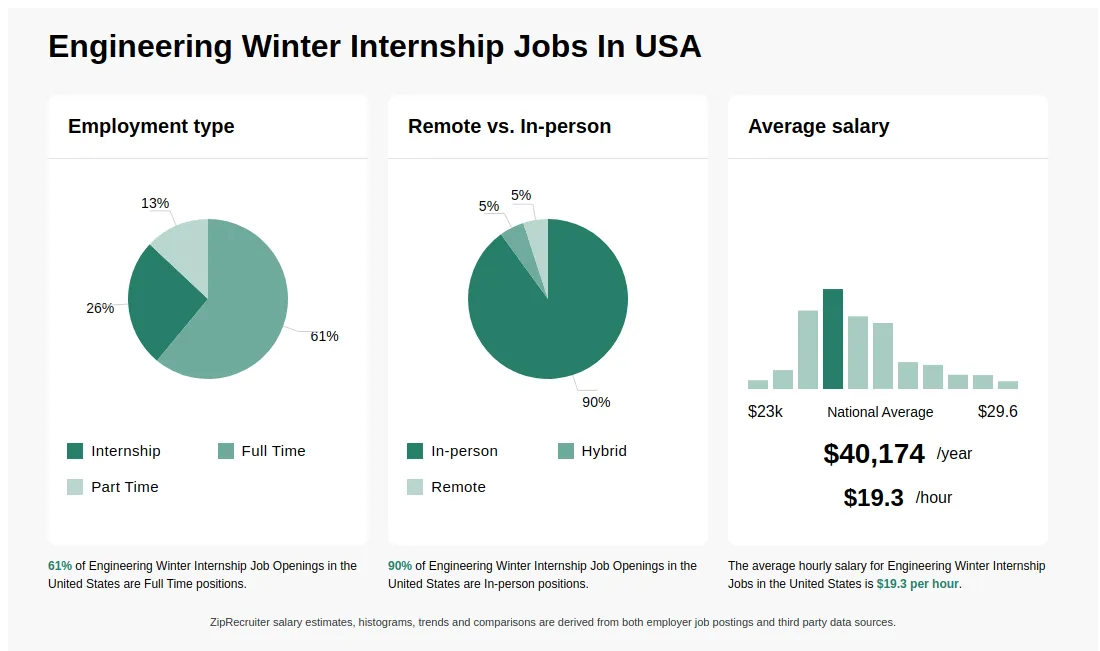
As of Jun 8, 2026, the average hourly pay for engineering winter internship in the United States is $19.31, according to ZipRecruiter salary data. Most workers in this role earn between $16.11 and $20.91 per hour, depending on experience, location, and employer.

What is the difference between Engineering Winter Internship vs Engineering Co-op?

AspectEngineering Winter InternshipEngineering Co-op
DurationTypically 4-12 weeks during winter breakUsually 3-12 months, alternating semesters
Work EnvironmentShort-term, project-based, often part-timeLong-term, integrated with academic schedule
CredentialsEnrolled in an engineering program, some may require specific courseworkEnrolled in an engineering program, often more advanced students
PurposeGain initial industry experience, explore career optionsApply academic knowledge, gain in-depth industry experience

While both Engineering Winter Internships and Engineering Co-ops provide valuable industry experience, internships are shorter, often during winter break, and focus on introductory exposure. Co-ops are longer, integrated with academic schedules, and offer more comprehensive hands-on experience, making them suitable for students seeking in-depth industry involvement.

What is an Engineering Winter Internship?

An Engineering Winter Internship is a short-term work experience, typically lasting a few weeks during the winter break, designed for students pursuing engineering degrees. These internships allow students to gain practical, hands-on experience in their chosen field, work on real-world projects, and develop professional skills. They can also help students build their professional network, explore different engineering disciplines, and enhance their resumes for future job opportunities.

What kinds of projects can I expect to work on during an Engineering Winter Internship, and how are interns typically supported throughout the program?

During an Engineering Winter Internship, you can expect to work on real-world projects such as assisting in product design, conducting experiments, performing data analysis, or supporting ongoing engineering initiatives. Interns are usually paired with mentors or supervisors who provide guidance, regular feedback, and technical support. You'll likely collaborate with other interns and engineering team members through team meetings, project reviews, and hands-on training sessions. This collaborative environment helps interns develop practical skills and gain insight into the day-to-day operations of professional engineers.

What are the key skills and qualifications needed to thrive as an Engineering Winter Intern, and why are they important?

To thrive as an Engineering Winter Intern, you generally need foundational knowledge in engineering principles, relevant coursework, and progress toward a related degree. Familiarity with CAD software, programming languages, and industry-specific tools or lab equipment is often expected. Strong problem-solving abilities, teamwork, and effective communication help you stand out in collaborative and fast-paced environments. These skills and qualities are important because they enable you to contribute meaningfully to projects, learn quickly, and adapt to the professional engineering workplace.
What cities are hiring for Engineering Winter Internship jobs? Cities with the most Engineering Winter Internship job openings:
Infographic showing various Engineering Winter Internship job openings in the United States as of May 2026, with employment types broken down into 100% Full Time. Highlights an 100% In-person job distribution, with an average salary of $40,174 per year, or $19.3 per hour.
Structural Engineering Internship (Catastrophe Modeling) - 2026 (PhD / Graduate Student)

Structural Engineering Internship (Catastrophe Modeling) - 2026 (PhD / Graduate Student)

Karen Clark & Company

Boston, MA โ€ข On-site

$25/hr

Other

Posted 10 days ago


Job description

Structural Engineering Internship (Catastrophe Modeling) - 2026 (PhD / Graduate Student)
Karen Clark & Company (KCC) is seeking a qualified candidate for a 2026 internship with a term of at least 8 weeks. The selected candidate will work with the Model Development Team in-person in KCC's Boston office to support the development of advanced catastrophe reference models. In this position, you will work closely with other scientists and engineers to develop and manage the vulnerability module of KCC's catastrophe models. The internship is supervised by senior staff and provides hands-on experience working on real-world science and engineering problems in the catastrophe modeling industry.
Expected Pay: $25 per hour
About KCC
Karen Clark & Company (KCC) is the innovation and technology leader in weather, climate, and catastrophe risk modeling. KCC professionals are globally recognized experts in catastrophe modeling and risk management. From our headquarters in Boston, Massachusetts, we provide advanced models, innovative software, and comprehensive consulting services to (re)insurance company executives nationwide. These services enhance business strategies, and the financial results put our clients at a competitive advantage. KCC catastrophe models currently cover tropical cyclones, extratropical cyclones, severe convective storms, floods, earthquakes, winter storms, and wildfires in over 50 countries. For more information, please visit www.kcc.us.com.
Qualifications
  • MS or PhD candidate in Structural Engineering, Civil Engineering, or a related field with focus on natural hazards (e.g., wind, flood, wildfire, earthquake)
  • Understanding of structural behavior and damage mechanisms under natural hazards
  • Familiarity with probabilistic methods and basic risk modeling concepts
  • Experience with numerical modeling or simulation (e.g., structural analysis, fragility/vulnerability modeling)
  • Proficiency in Python or similar language for data analysis; ability to work with and process large datasets
  • Strong analytical and problem-solving skills, with attention to detail
  • Clear technical communication skills (written and verbal)