1

Engineer Jobs in Snowflake, AZ (NOW HIRING)

Clinician

Cibecue, AZ · On-site

$50K - $66K/yr

SCIENCE, TECHNOLOGY, ENGINEERING & MATH (6-18) This school-based group program encourages students to develop social and emotional learning though science, technology, engineering, and math (STEM ...

Clinician

Cibecue, AZ · On-site

$50K - $66K/yr

SCIENCE, TECHNOLOGY, ENGINEERING & MATH (6-18) This school-based group program encourages students to develop social and emotional learning though science, technology, engineering, and math (STEM ...

Clinician

Cibecue, AZ · On-site

$50K - $66K/yr

SCIENCE, TECHNOLOGY, ENGINEERING & MATH (6-18) This school-based group program encourages students to develop social and emotional learning though science, technology, engineering, and math (STEM ...

Our business reach spans satellite television service, live-streaming and on-demand programming, smart home installation services, mobile plans and products. Today, our brands include Boost Mobile ...

Showing results 41-60

Engineer information

See Snowflake, AZ salary details

$33.3K

$86.9K

$117.4K

How much do engineer jobs pay per year?

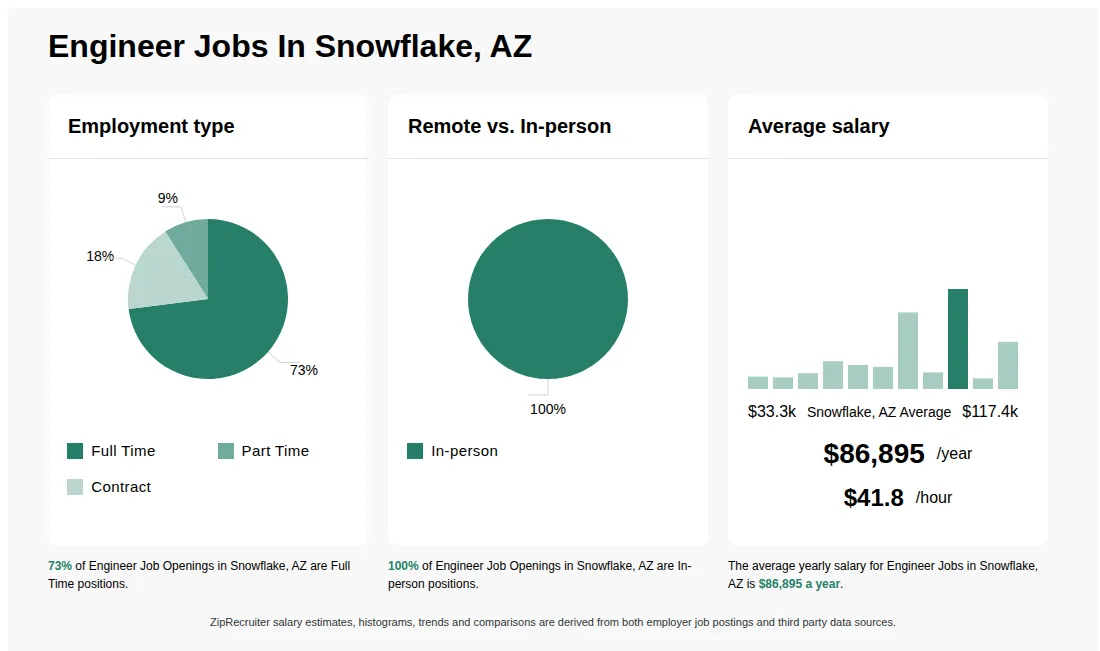
As of Sep 2, 2026, the average yearly pay for engineer in Snowflake, AZ is $86,895.00, according to ZipRecruiter salary data. Most workers in this role earn between $71,700.00 and $99,500.00 per year, depending on experience, location, and employer.

What is an engineer?

Engineers design, build, and maintain the functional aspects of a product, structure, or system for their specific engineering industry. Their specific job description relates to all of the detailed tasks, responsibilities, skills, and education requirements that a company or organization requires for their engineering specialty. For example, electrical engineers develop, monitor, and test electrical systems. Civil engineers design, construct, and maintain large infrastructure projects, such as highways, bridges, and airports. Many engineers begin their career with an internship or apprenticeship while they are still in school, and then acquire an entry-level position. As they learn more about the industry, engineers are given their own projects and more responsibility.

What are the key skills and qualifications needed to thrive as an engineer?

To thrive as an Engineer, you need a solid background in mathematics, problem-solving, and engineering principles, typically supported by a relevant bachelor’s degree. Familiarity with industry-specific software such as CAD tools, simulation platforms, and, in some fields, certifications like FE or PE is often required. Strong communication, teamwork, and critical thinking skills set exceptional engineers apart. These abilities ensure effective project delivery, innovative solutions, and smooth collaboration in technical environments.

What does an engineer do?

An engineer applies principles of science and mathematics to develop solutions for technical problems. They design, build, and test products, systems, or structures while considering efficiency, safety, and cost. Engineers can work in a variety of fields such as civil, mechanical, electrical, and software engineering, each with its own specialized focus. Their work often involves teamwork, problem-solving, and the use of advanced technology.

How do engineers typically collaborate with other departments during a project?

Engineers often work closely with professionals from various departments such as product management, design, and quality assurance to ensure project requirements are met. Collaboration usually involves regular meetings to align on goals, discuss technical constraints, and review progress. Effective communication and teamwork are key, as engineers may need to translate complex technical concepts for non-technical colleagues and incorporate feedback from different stakeholders. This cross-functional approach helps ensure that projects are delivered efficiently and meet all necessary standards.

What is the difference between Engineer vs Technician?

AspectEngineerTechnician
Required CredentialsBachelor's degree in engineering or related fieldTechnical diploma or associate degree
Work EnvironmentDesign, planning, analysis, project managementInstallation, maintenance, troubleshooting
Industry UsageDesign firms, manufacturing, constructionField service, manufacturing plants, maintenance teams
Common Search/ComparisonEngineer vs Technician

Engineers typically hold a bachelor's degree and focus on designing, analyzing, and managing projects. Technicians usually have technical diplomas and handle hands-on installation, maintenance, and troubleshooting. While engineers plan and oversee, technicians implement and support. Both roles are essential in engineering projects, but they differ in education, responsibilities, and work environment.

What are 10 engineering jobs?

Engineering encompasses a wide range of roles including civil engineer, mechanical engineer, electrical engineer, software engineer, chemical engineer, aerospace engineer, industrial engineer, environmental engineer, biomedical engineer, and petroleum engineer. These jobs often require specific technical skills, relevant certifications, and proficiency with industry tools and software. The roles vary by industry and specialization, offering diverse career paths for engineering professionals.

What are 10 types of engineers?

Engineers specialize in various fields, including civil, mechanical, electrical, chemical, software, aerospace, biomedical, environmental, industrial, and nuclear engineering. Each type focuses on different industries and uses specific skills, tools, and certifications to solve technical problems. The choice of engineering discipline depends on interests and career goals.

What kind of jobs do engineers do?

Engineers design, develop, and test systems, structures, or products across various fields such as civil, mechanical, electrical, software, and aerospace engineering. They often work in offices, labs, or construction sites, using technical skills, mathematics, and industry standards to solve problems and improve technology.

What are the most commonly searched types of Engineer jobs in Snowflake, AZ?

The most popular types of Engineer jobs in Snowflake, AZ are:

What cities near Snowflake, AZ are hiring for Engineer jobs?

Cities near Snowflake, AZ with the most Engineer job openings:

Infographic showing various Engineer job openings in Snowflake, AZ as of August 2026, with employment types broken down into 83% Full Time, and 17% Part Time. Highlights an 100% In-person job distribution, with an average salary of $86,895 per year, or $41.8 per hour.

Wildland Firefighter (Fire Dozer Operator)

Recruitment and Hiring | US Forest Service

Overgaard, AZ • On-site

$33.11/hr

Full-time

Retirement

Posted 10 days ago


Job description

These positions will be located at a USDA Forest Service Unit.
This position is established on a Forest Unit to serve primarily as an operator of heavy equipment on initial attack, fire, and fuels management activities. The incumbent also operates this equipment in support of other natural resource projects.
See ADDITIONAL INFORMATION for Regional contacts.Qualifications:In order to qualify, you must meet the eligibility and qualifications requirements as defined below by the closing date of the announcement. For more information on the qualifications for this position, visit the Office of Personnel Management's Federal Wage System Qualifications Standards.
Your application and resume must clearly show that you possess the experience requirements.
Basic Requirement:
You must possess the Basic Requirements identified below to be considered eligible for this position. Your application or resume must clearly show that you possess the appropriate experience requirements to successfully perform the duties of Engineering Equipment Operator.
Applicants will be evaluated on their ability to perform the duties of the position rather than length of experience. Eligibility will be determined by the relevance, scope and quality of all experience and training, regardless of where or how acquired. Applicants will be assessed based on their knowledge of the job elements identified in this announcement.
Screen-out Job Element: Applicants who do not meet the screen-out job elements will not be further evaluated.
  • Ability to do the work of the position without more than normal supervision.
In addition to the above requirements, applicants will be assessed based on their knowledge of the job elements identified below:
  • Ability to operate engineering and construction equipment, such as graders, tractors with bulldozer or angle-dozer blades, front-end loaders, backhoes, trench diggers, and large industrial tractors with pan or scraper attachments to push, pull, fill, pile or load gravel or earth.
  • Operation of Motor Vehicles (such as graders, tractors with bulldozer or angle dozer blades, front-end loaders, backhoes, trench diggers, and large industrial tractors with pan or scraper attachments to push, pull, fill, pile or load gravel or earth in steep, hilly, rocky, and other types of adverse terrain, close to buildings, trees, drop-offs, rocks, or other obstructions and obstacles)
  • Work Practices (includes keeping things neat, clean and in order)
  • Ability to Interpret Instructions, Specifications, etc. (related to mobile equipment operation)
  • Ability to Drive Safely (Motor Vehicles) Reliability and Dependability as an Engineering Equipment Operator (to excavate, backfill, grade, or level earth to rough specifications on all types of terrain including mountains, steep slopes, graded curves and shoulders, rocky and soft ground, and hilly forests)

Selective Placement Factors
Applicants must possess and maintain a Commercial Driver's License (CDL).
Primary firefighter positions include the following age requirements: Under age 37 -OR- less than age 37 after subtracting the months of Permanent Federal Service worked in a primary or secondary firefighter/law enforcement position -OR- a veteran preference eligible, older than age 37 and is requesting a waiver to the maximum age requirement -OR-currently occupy a permanent position with primary fire fighter retirement coverage.
For those who do not currently occupy a permanent Federal position covered under primary fire fighter retirement, you must be under age 37; less than age 37 after subtracting the months of Permanent Federal Service in a primary or secondary firefighter/law enforcement position; or a veteran preference eligible, older than age 37 and requesting a waiver to the requirement.
Experience refers to paid and unpaid experience, including volunteer work done through National Service programs (e.g., Peace Corps, AmeriCorps) and other organizations (e.g., professional; philanthropic; religious; spiritual; community, student, social). Volunteer work helps build critical competencies, knowledge, and skills and can provide valuable training and experience that translates directly to paid employment. You will receive credit for all qualifying experience, including volunteer experience.
FIREFIGHTER RETIREMENT COVERAGE: This is a primary/rigorous position covered under the special retirement provisions of 5 USC 8336(c) for the Civil Service Retirement System and of 5 USC 8412(d) for the Federal Employees Retirement System.
WORK CAPACITY TEST (WCT) for Wildland Firefighters: This position participates in wildland firefighting activities. Based on the type of work performed, TAKING and PASSING the WCT at the MODERATE level is a condition of employment.
To receive consideration for this position, you must provide updated required documents and meet all qualification requirements by the closing date of this announcement.Education:There is no substitution of education for specialized experience.Employment Type: OTHER