1

Energy Trading Jobs (NOW HIRING)

Eagle Seven is seeking an experienced Energy Trader to trade energy futures and swap markets listed ... Monitoring of trading activity and positions consistently throughout the shift * Performing ...

Eagle Seven is seeking an experienced Energy Trader to trade energy futures and swap markets listed ... Monitoring of trading activity and positions consistently throughout the shift * Performing ...

Eagle Seven is seeking an experienced Energy Trader to trade energy futures and swap markets listed ... Monitoring of trading activity and positions consistently throughout the shift * Performing ...

next page

Showing results 1-20

Energy Trading information

See salary details

$110K

$157.5K

$201.5K

How much do energy trading jobs pay per year?

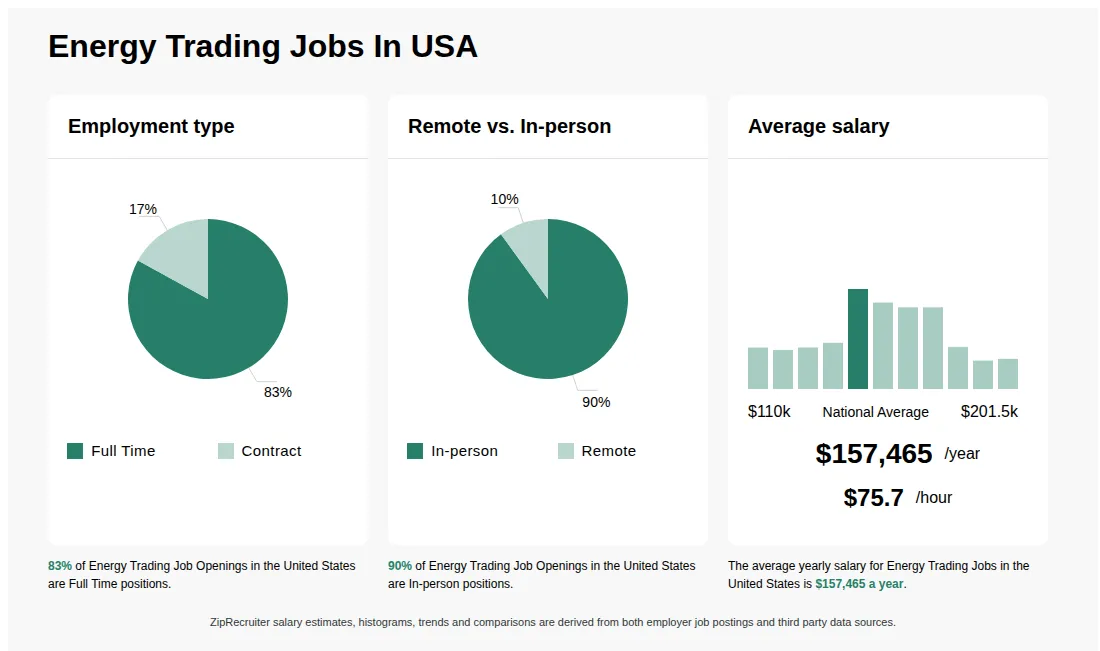
As of May 28, 2026, the average yearly pay for energy trading in the United States is $157,465.00, according to ZipRecruiter salary data. Most workers in this role earn between $142,500.00 and $173,500.00 per year, depending on experience, location, and employer.

What Are Energy Trading Jobs?

The most common energy trading job is an energy trader. This position can start at entry-level and work up to a senior role. As an energy trader, your responsibilities include purchasing energy and completing trade sales to produce a profit with limited cost. You examine technical market factors, the availability of power sources, and prices to predict the next drop or rise for shares. If you work as an energy trade analyst, you track, interpret, and report on conditions that affect energy trading. There are also energy trading directors and energy trading managers who handle high-level duties and oversee trading activities.


What are the key skills and qualifications needed to thrive as an Energy Trader, and why are they important?

To succeed as an Energy Trader, you need strong analytical abilities, a solid grasp of financial markets, and a relevant degree in finance, economics, or engineering. Familiarity with trading platforms (such as Eikon or Bloomberg), risk management tools, and energy market regulations or certifications (like Series 7 or 63) is typically required. Excellent decision-making under pressure, attention to detail, and effective communication skills help traders excel in fast-paced environments. These competencies are crucial for managing market volatility, optimizing trades, and ensuring regulatory compliance in the dynamic energy sector.

What are some common challenges faced by professionals working in energy trading?

Energy trading professionals often face challenges such as managing price volatility in the markets, staying up-to-date with regulatory changes, and making quick, data-driven decisions under pressure. They must also coordinate closely with risk management, analysts, and operations teams to ensure trades align with company strategy and compliance requirements. Adapting to new technologies and market trends is essential for success, as is maintaining strong communication skills to work effectively with both internal and external stakeholders.

What is energy trading?

Energy trading involves the buying and selling of energy commodities such as electricity, natural gas, oil, and renewable energy certificates. Professionals in this field analyze market trends, forecast supply and demand, and execute trades to optimize profits or reduce risks for utility companies, producers, or financial institutions. Energy traders may operate on physical markets, where actual delivery of energy is involved, or on financial markets, dealing with contracts and derivatives. The field is fast-paced and requires strong analytical, quantitative, and decision-making skills.

What is the difference between Energy Trading vs Energy Analyst?

AspectEnergy TradingEnergy Analyst
Required CredentialsBachelor's degree in finance, economics, or related field; certifications like CFA beneficialBachelor's or master's in economics, finance, or energy management
Work EnvironmentFast-paced trading floors, financial institutions, energy companiesResearch-focused, office settings, consulting firms, energy companies
Employer & Industry UsageFinancial firms, energy trading companies, utilitiesEnergy companies, consulting firms, government agencies
Common Search & ComparisonYesNo

Energy Trading involves buying and selling energy commodities to maximize profit, often in real-time markets. Energy Analysts focus on analyzing energy data, market trends, and providing insights to support decision-making. While both roles require understanding of energy markets, Energy Trading is more transaction-oriented, whereas Energy Analysts emphasize research and analysis.

What cities are hiring for Energy Trading jobs? Cities with the most Energy Trading job openings:
What are the most commonly searched types of Energy Trading jobs? The most popular types of Energy Trading jobs are:
What states have the most Energy Trading jobs? States with the most job openings for Energy Trading jobs include:
Infographic showing various Energy Trading job openings in the United States as of May 2026, with employment types broken down into 100% Full Time. Highlights an 100% In-person job distribution, with an average salary of $157,465 per year, or $75.7 per hour.

Front Office Application Support - Energy Trading

Talan

Houston, TX • Hybrid

Full-time

Posted 28 days ago


Job description

Company Description

Talan is an international consulting group in innovation and transformation through technology. For 20 years, Talan has been advising companies and administrations. The group supports them and implements their transformation and innovation projects internationally.

Present on five continents, the group achieved a turnover of 600 million euros in 2023 than 5,000 consultants and aims to exceed the one billion € turnover mark by 2025. The group puts innovation at the heart of its development and intervenes in areas related to the technological changes of large groups, such as Artificial Intelligence, Data Intelligence, Web3, Metaverse, Blockchain or IoT.

Job Description

Location: Houston, Texas (Hybrid – at least 3 days onsite/week)

Visa Sponsorship: Talan does not sponsor U.S. work permits or employment visas.

As part of a major Orchestrade Go-Live, the Front Office is strengthening its local support team. We are hiring a Trade Support Junior Analyst to work closely with traders, quants, and senior technical teams in a fast-paced energy trading environment (Power & Gas).

This role will complement an existing senior resource and requires a hands-on, structured, and resilient professional with strong technical fundamentals and Front Office exposure.

Key Responsibilities

  • Provide Front Office trade support for Power and Gas desks during and post-migration to Orchestrade
  • Monitor trade lifecycle, positions, and PnL consistency across systems (ETRM, market data, downstream consumers)
  • Perform daily production checks, identify discrepancies, troubleshoot issues, and escalate time-critical incidents when required
  • Support traders on trade capture, pricing, system usage, and workflows
  • Ensure smooth End-of-Day processes and intraday controls
  • Coordinate with Development, QA, and Infrastructure teams on defects, fixes, and enhancements
  • Contribute to documentation, runbooks, and knowledge transfer
  • Act as a first point of contact for Front Office operational and system issues

#LI-ASD

Qualifications

Required Skills & Experience:

  • 2–15 years of experience in Front Office Trade Support, Application Support, or Production Support within energy or financial markets
  • Strong technical foundation:
  • SQL
  • Linux / Unix
  • Shell scripting
  • Experience with an ETRM platform (Orchestrade, Endur, Allegro, RightAngle, etc.) is a strong plus
  • Exposure to US Power and/or Gas markets (even limited experience acceptable)
  • Proven ability to work under pressure in a trading floor environment
  • Strong communication skills and executive presence

Nice to Have:

  • Python
  • AKS / Kubernetes
  • AWS
  • Previous experience in an Energy Trading or Financial Front Office
  • Orchestrade experience from Europe or Finance, even with limited US market exposure