Curious - we turn knowledge into action Energy Trading markets are becoming more complex as supply and demand can quickly shift in response to geopolitical issues, regulatory changes and structural ...
Curious - we turn knowledge into action Energy Trading markets are becoming more complex as supply and demand can quickly shift in response to geopolitical issues, regulatory changes and structural ...

Your client portfolio will include key Wood Mackenzie clients in the energy trading market. This is your opportunity to truly partner with the firm's critical clients. Main Responsibilities * Develop ...
Your client portfolio will include key Wood Mackenzie clients in the energy trading market. This is your opportunity to truly partner with the firm's critical clients. Main Responsibilities * Develop ...
US Summer Internship - Energy & Resources - Commodities & Energy Trading Texas, USA Baringa is a global consulting firm that partners with leaders to drive change and create value. With deep industry ...
US Summer Internship - Energy & Resources - Commodities & Energy Trading Texas, USA Baringa is a global consulting firm that partners with leaders to drive change and create value. With deep industry ...
US Summer Internship - Energy & Resources - Commodities & Energy Trading Texas, USA Baringa is a global consulting firm that partners with leaders to drive change and create value. With deep industry ...
US Summer Internship - Energy & Resources - Commodities & Energy Trading Texas, USA Baringa is a global consulting firm that partners with leaders to drive change and create value. With deep industry ...
Curious - we turn knowledge into action Energy Trading markets are becoming more complex as supply and demand can quickly shift in response to geopolitical issues, regulatory changes and structural ...
Curious - we turn knowledge into action Energy Trading markets are becoming more complex as supply and demand can quickly shift in response to geopolitical issues, regulatory changes and structural ...
Senior Orchestrade BA - Energy Trading & ETRM
Houston, TX · On-site
$88K - $114K/yr
You will work with one of our major clients in the energy trading sector to support the enhancement and expansion of their Orchestrade ETRM platform, used across Front Office, Middle Office, Risk ...
Senior Orchestrade BA - Energy Trading & ETRM
Houston, TX · On-site
$88K - $114K/yr
You will work with one of our major clients in the energy trading sector to support the enhancement and expansion of their Orchestrade ETRM platform, used across Front Office, Middle Office, Risk ...
Curious - we turn knowledge into action Energy Trading markets are becoming more complex as supply and demand can quickly shift in response to geopolitical issues, regulatory changes and structural ...
Curious - we turn knowledge into action Energy Trading markets are becoming more complex as supply and demand can quickly shift in response to geopolitical issues, regulatory changes and structural ...

Als Consultant im Energy & Commodity Trading (m/w/d) beratst du deine Kunden zu zentralen Themen wie der Digitalisierung und Optimierung des Energie- und Rohstoffmanagements - und tragst so mageblich ...
Als Consultant im Energy & Commodity Trading (m/w/d) beratst du deine Kunden zu zentralen Themen wie der Digitalisierung und Optimierung des Energie- und Rohstoffmanagements - und tragst so mageblich ...
Curious - we turn knowledge into action Energy Trading markets are becoming more complex as supply and demand can quickly shift in response to geopolitical issues, regulatory changes and structural ...
Curious - we turn knowledge into action Energy Trading markets are becoming more complex as supply and demand can quickly shift in response to geopolitical issues, regulatory changes and structural ...
Your client portfolio will include key Wood Mackenzie clients in the energy trading market. This is your opportunity to truly partner with the firm's critical clients.**Main Responsibilities*
Your client portfolio will include key Wood Mackenzie clients in the energy trading market. This is your opportunity to truly partner with the firm's critical clients.**Main Responsibilities*
Manager, Commodity & Energy Trading - US Power Markets Texas, USA Baringa is a global consulting firm that partners with leaders to drive change and create value. With deep industry expertise, and ...
Manager, Commodity & Energy Trading - US Power Markets Texas, USA Baringa is a global consulting firm that partners with leaders to drive change and create value. With deep industry expertise, and ...

The Energy Quantitative Research team, part of the Quantitative Trading and Research organization, develops the valuation models, analytical tools, and risk infrastructure that underpins the global ...
The Energy Quantitative Research team, part of the Quantitative Trading and Research organization, develops the valuation models, analytical tools, and risk infrastructure that underpins the global ...

You will adhere to internal trading limits and execute timely submission of bids daily. You will ... Report directly to the Manager of Energy Trading on daily project fundamentals and P&L.
You will adhere to internal trading limits and execute timely submission of bids daily. You will ... Report directly to the Manager of Energy Trading on daily project fundamentals and P&L.

Coaching and performance evaluation for the Trade Reporting and Logistics team. * Review exposure ... Experience: * 5+ years of experience in the energy industry preferred. SKILLS AND PHYSICAL DEMANDS:
Coaching and performance evaluation for the Trade Reporting and Logistics team. * Review exposure ... Experience: * 5+ years of experience in the energy industry preferred. SKILLS AND PHYSICAL DEMANDS:

Knowledge of energy trading contracts for physical and financial products. * Required: Knowledge of internal control and compliance requirements related to contracts. * Required: Skill in ...
Knowledge of energy trading contracts for physical and financial products. * Required: Knowledge of internal control and compliance requirements related to contracts. * Required: Skill in ...

Chief Operating Officer / Business Manager - Fixed Income & Currencies - Energy Trading - Vice Presi
New York, NY · On-site
Drive the Energy Trading change-the-Bank program to completion in preparation for Day 1 trading. In partnership with the Energy Trading desk, formulate, enable and implement business strategy.
Chief Operating Officer / Business Manager - Fixed Income & Currencies - Energy Trading - Vice Presi
New York, NY · On-site
Drive the Energy Trading change-the-Bank program to completion in preparation for Day 1 trading. In partnership with the Energy Trading desk, formulate, enable and implement business strategy.
You will adhere to internal trading limits and execute timely submission of bids daily. You will ... Report directly to the Manager of Energy Trading on daily project fundamentals and P&L.
Quick apply
You will adhere to internal trading limits and execute timely submission of bids daily. You will ... Report directly to the Manager of Energy Trading on daily project fundamentals and P&L.
You will adhere to internal trading limits and execute timely submission of bids daily. You will ... Report directly to the Manager of Energy Trading on daily project fundamentals and P&L.
You will adhere to internal trading limits and execute timely submission of bids daily. You will ... Report directly to the Manager of Energy Trading on daily project fundamentals and P&L.

Musket Supply Chain Internship (2027)- Energy Trading
Houston, TX · On-site
$16.50 - $22/hr
Req ID: 487346 Musket Corp's highly competitive and fast-growing internship program offers students meaningful opportunities to gain hands-on experience across multiple areas of our energy trading ...
Musket Supply Chain Internship (2027)- Energy Trading
Houston, TX · On-site
$16.50 - $22/hr
Req ID: 487346 Musket Corp's highly competitive and fast-growing internship program offers students meaningful opportunities to gain hands-on experience across multiple areas of our energy trading ...
In a dynamic energy trading environment, success depends on strong risk management, continuous innovation, and embracing the opportunities of digital transformation. Delivering on this ambition ...
In a dynamic energy trading environment, success depends on strong risk management, continuous innovation, and embracing the opportunities of digital transformation. Delivering on this ambition ...
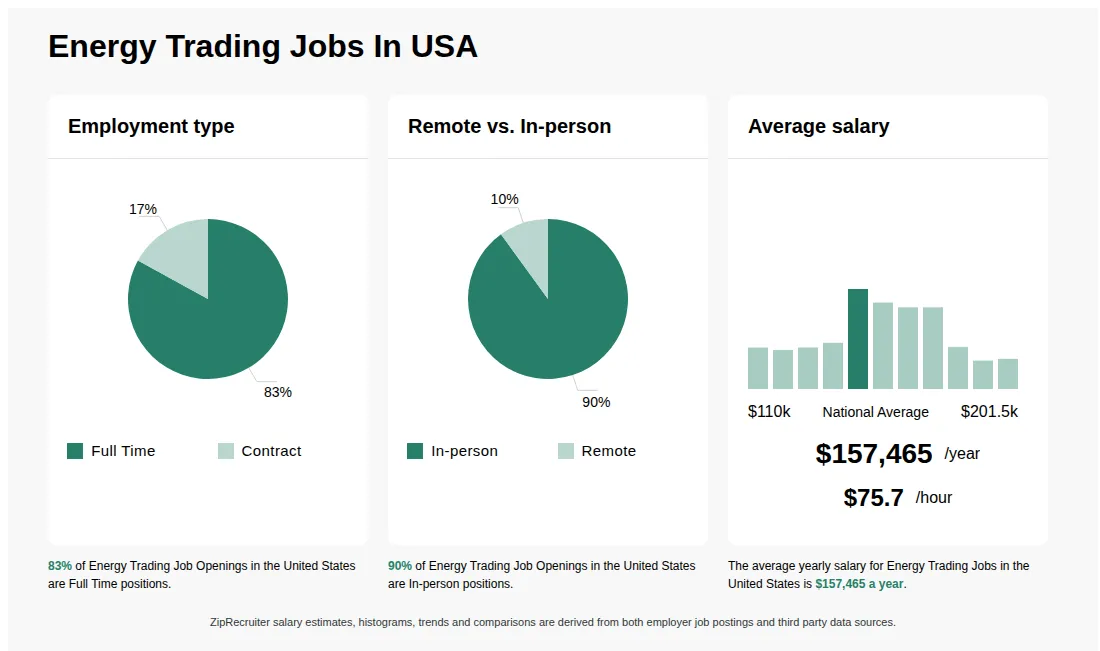
Energy Trading information
See salary details
$110K - $118.3K
6% of jobs
$118.3K - $126.6K
6% of jobs
$126.6K - $135K
6% of jobs
$141.5K is the 25th percentile. Wages below this are outliers.
$135K - $143.3K
7% of jobs
$143.3K - $151.6K
17% of jobs
The median wage is $155.4K / yr.
$151.6K - $159.9K
14% of jobs
$159.9K - $168.2K
14% of jobs
$170.5K is the 75th percentile. Wages above this are outliers.
$168.2K - $176.5K
14% of jobs
$176.5K - $184.9K
6% of jobs
$184.9K - $193.2K
4% of jobs
$193.2K - $201.5K
4% of jobs
$110K
$157.5K
$201.5K
How much do energy trading jobs pay per year?
As of Sep 14, 2026, the average yearly pay for energy trading in the United States is $157,465.00, according to ZipRecruiter salary data. Most workers in this role earn between $142,500.00 and $173,500.00 per year, depending on experience, location, and employer.
What is energy trading?
Energy trading involves the buying and selling of energy commodities such as electricity, natural gas, oil, and renewable energy certificates. Professionals in this field analyze market trends, forecast supply and demand, and execute trades to optimize profits or reduce risks for utility companies, producers, or financial institutions. Energy traders may operate on physical markets, where actual delivery of energy is involved, or on financial markets, dealing with contracts and derivatives. The field is fast-paced and requires strong analytical, quantitative, and decision-making skills.
What are energy trading jobs?
The most common energy trading job is an energy trader. This position can start at entry-level and work up to a senior role. As an energy trader, your responsibilities include purchasing energy and completing trade sales to produce a profit with limited cost. You examine technical market factors, the availability of power sources, and prices to predict the next drop or rise for shares. If you work as an energy trade analyst, you track, interpret, and report on conditions that affect energy trading. There are also energy trading directors and energy trading managers who handle high-level duties and oversee trading activities.
What are the key skills and qualifications needed to thrive as an energy trader, and why are they important?
To succeed as an Energy Trader, you need strong analytical abilities, a solid grasp of financial markets, and a relevant degree in finance, economics, or engineering. Familiarity with trading platforms (such as Eikon or Bloomberg), risk management tools, and energy market regulations or certifications (like Series 7 or 63) is typically required. Excellent decision-making under pressure, attention to detail, and effective communication skills help traders excel in fast-paced environments. These competencies are crucial for managing market volatility, optimizing trades, and ensuring regulatory compliance in the dynamic energy sector.
What are some common challenges faced by professionals working in energy trading?
Energy trading professionals often face challenges such as managing price volatility in the markets, staying up-to-date with regulatory changes, and making quick, data-driven decisions under pressure. They must also coordinate closely with risk management, analysts, and operations teams to ensure trades align with company strategy and compliance requirements. Adapting to new technologies and market trends is essential for success, as is maintaining strong communication skills to work effectively with both internal and external stakeholders.
What is the difference between Energy Trading vs Energy Analyst?
| Aspect | Energy Trading | Energy Analyst |
|---|---|---|
| Required Credentials | Bachelor's degree in finance, economics, or related field; certifications like CFA beneficial | Bachelor's or master's in economics, finance, or energy management |
| Work Environment | Fast-paced trading floors, financial institutions, energy companies | Research-focused, office settings, consulting firms, energy companies |
| Employer & Industry Usage | Financial firms, energy trading companies, utilities | Energy companies, consulting firms, government agencies |
| Common Search & Comparison | Yes | No |
Energy Trading involves buying and selling energy commodities to maximize profit, often in real-time markets. Energy Analysts focus on analyzing energy data, market trends, and providing insights to support decision-making. While both roles require understanding of energy markets, Energy Trading is more transaction-oriented, whereas Energy Analysts emphasize research and analysis.
How do I get into energy trading?
To enter energy trading, candidates typically need a bachelor's degree in finance, economics, or a related field, along with strong analytical skills and knowledge of energy markets. Gaining experience through internships or entry-level roles in trading firms, and developing proficiency with trading platforms and market analysis tools, can improve prospects. Certifications like the Energy Risk Professional (ERP) can also enhance credibility in the field.
Is energy trading a good career?
Energy trading is a competitive field that involves buying and selling energy commodities such as electricity and natural gas, often requiring strong analytical skills and knowledge of market regulations. It can offer high earning potential and opportunities for advancement, but also involves high pressure and market volatility. Success typically depends on expertise, certifications, and staying informed about industry trends.
More about Energy Trading jobs
What cities are hiring for Energy Trading jobs?
Cities with the most Energy Trading job openings:
What are the most commonly searched types of Energy Trading jobs?
The most popular types of Energy Trading jobs are:
What states have the most Energy Trading jobs?
States with the most job openings for Energy Trading jobs include:
What are popular job titles for Energy Trading?
Popular job titles for Energy Trading:
Senior Account Manager - Energy Trading
Houston, TX • On-site
Wood Mackenzie
Full-time
Re-posted 9 days ago
Job description
Wood Mackenzie is the global leader in analytics, insights and proprietary data across the entire energy and natural resources landscape.
For over 50 years our work has guided the decisions of the world's most influential energy producers, utilities companies, financial institutions and governments.
Now, with the world's energy system more complex and interconnected than ever before, sector-specific views are no longer enough. That's why we've redefined what's possible with Intelligence Connected.
By fusing our unparalleled proprietary data with the sharpest analytical minds, all supercharged by Synoptic AI, we deliver a clear, interconnected view of the entire value chain. Our trusted team of 2,700 experts across 30 countries breaks siloes and connects industries, markets and regions across the globe.
This empowers our customers to identify risk sooner, spot opportunities faster and recalibrate strategy with confidence - whether planning days, weeks, months or decades ahead.
Wood Mackenzie
Intelligence Connected
WoodMac.com
Wood Mackenzie Brand Video
Wood Mackenzie Values
Energy Trading markets are becoming more complex as supply and demand can quickly shift in response to geopolitical issues, regulatory changes and structural changes in the market. The pace and scale of change means that every decision is made under mounting pressure. Now more than ever, traders rely on the most accurate, reliable, comprehensive and up to date analytics, data and actionable insights, backed by experienced analysts and support teams.
Role Purpose
Wood Mackenzie are looking for enthusiastic and talented sales professionals to continue to further grow and embed our solutions with our energy trading clients, take responsibility for developing our strategic client relationships and delivering commercial success for the entire Wood Mackenzie business. We are looking to diversify our talent pool and bring in best practice from other industries and sectors to enable us to reach our growth targets.
The Account Manager role is a key driver for sales execution and performance across existing and new accounts. Your client portfolio will include key Wood Mackenzie clients in the energy trading market. This is your opportunity to truly partner with the firm's critical clients.
Main Responsibilities
About you and how you can excel in the role
You will:
Expectations
Equal Opportunities
We are an equal opportunities employer. This means we are committed to recruiting the best people regardless of their race, colour, religion, age, sex (including pregnancy, sexual orientation, and gender identity), national origin, disability or protected veteran status. You can find out more about your rights under the law at www.eeoc.gov
For over 50 years our work has guided the decisions of the world's most influential energy producers, utilities companies, financial institutions and governments.
Now, with the world's energy system more complex and interconnected than ever before, sector-specific views are no longer enough. That's why we've redefined what's possible with Intelligence Connected.
By fusing our unparalleled proprietary data with the sharpest analytical minds, all supercharged by Synoptic AI, we deliver a clear, interconnected view of the entire value chain. Our trusted team of 2,700 experts across 30 countries breaks siloes and connects industries, markets and regions across the globe.
This empowers our customers to identify risk sooner, spot opportunities faster and recalibrate strategy with confidence - whether planning days, weeks, months or decades ahead.
Wood Mackenzie
Intelligence Connected
WoodMac.com
Wood Mackenzie Brand Video
Wood Mackenzie Values
- Inclusive - we succeed together
- Trusting - we choose to trust each other
- Customer committed - we put customers at the heart of our decisions
- Future Focused - we accelerate change
- Curious - we turn knowledge into action
Energy Trading markets are becoming more complex as supply and demand can quickly shift in response to geopolitical issues, regulatory changes and structural changes in the market. The pace and scale of change means that every decision is made under mounting pressure. Now more than ever, traders rely on the most accurate, reliable, comprehensive and up to date analytics, data and actionable insights, backed by experienced analysts and support teams.
Role Purpose
Wood Mackenzie are looking for enthusiastic and talented sales professionals to continue to further grow and embed our solutions with our energy trading clients, take responsibility for developing our strategic client relationships and delivering commercial success for the entire Wood Mackenzie business. We are looking to diversify our talent pool and bring in best practice from other industries and sectors to enable us to reach our growth targets.
The Account Manager role is a key driver for sales execution and performance across existing and new accounts. Your client portfolio will include key Wood Mackenzie clients in the energy trading market. This is your opportunity to truly partner with the firm's critical clients.
Main Responsibilities
- Develop a deep understanding of the value our solutions provide, the sectors they operate in and the customers buying cycles.
- Successfully identify and engage with key stakeholders within your customers who present the best opportunity for growth.
- Pro-actively manage and maximize the commercial growth of the portfolio to align with regional priorities
- Understand product roadmap and look to position new solutions to customers ahead of buying cycles to maximize success.
- Partner closely with our Product Team to shape the product development roadmap as well as gathering relevant competitive intelligence.
- Represents Wood Mackenzie in the market and look to expand brand recognition and be an advocate for our market leading services and solutions.
- Effective teamwork with the broader organization to include marketing, training, client services, research and consulting.
- Effectively manage the business pipeline to ensure accurate salesforce forecasting
About you and how you can excel in the role
You will:
- Proven experience in b2b sales of either data or SaaS based solutions
- Have experience of value-based selling and developing a deep understanding of customer workflows and needs.
- Ability to develop relationships from a C-suite level down to end users and work with clients who have complex and often global organization structures
- Demonstrate competency in delivering deliver on short-term targets
- Demonstrate a developing understanding of planning and executing a long-term commercial strategy
- Have a proven track record in collaborating with different internal teams in order to achieve commercial success
- You are entrepreneurial, driven by business performance and motivated by growth - you love looking for and pursuing new business opportunities and growing existing relationships
- Demonstrate outstanding judgment in resource utilization and optimization
- Have an intellectual curiosity and aptitude towards the growing fields of data and data analytics and how these tools help clients solve business critical issues.
- Show effective organizational and planning skills with the ability to manage own workload effectively
- Extra points if you have experience in Oil & Gas, Power, or Natural resources.
Expectations
- This role is Hybrid and expected to be in the Houston office a minimum of 2 days per week
- Personal Impact; managing our personal state and our impact on others
- Acting with Integrity; behaving ethically, morally, and in line with our values
- Courage, Resilience, and Adaptability; being bold and persevering through uncertainty and change
- Growth Mindset; continuously developing ourselves to add value
- Communicating Effectively; communicating with clarity, authenticity, and purpose
- Engaging & Influencing; influencing decisions and gaining commitment from others
- Collaborating Across Boundaries; Forging impactful relationships beyond our immediate team
- Customer Collaboration; Keeping our stakeholders at the center of our decision making
- Planning and Prioritizing; Aligning our efforts to organizational goals and priorities
- Ownership & Accountability; Delivering on our commitments and owning the outcome
- Commitment to Action; Making timely decisions and taking action
- Continuous Improvement; Continuously striving for better in all we do
- Commercial; Supporting business profitability and growth
Equal Opportunities
We are an equal opportunities employer. This means we are committed to recruiting the best people regardless of their race, colour, religion, age, sex (including pregnancy, sexual orientation, and gender identity), national origin, disability or protected veteran status. You can find out more about your rights under the law at www.eeoc.gov