1

Embedded Systems Architect Jobs (NOW HIRING)

Embedded Systems Engineer

Seattle, WA · On-site

$118K - $155K/yr

... distributed embedded system that powers these machines. You'll work across firmware, real-time ... This is a hands-on engineering role for someone who wants to own core architecture, ship production ...

Space Systems is vertically integrated across the satellite architecture, thus the team designs ... About the Job Umbra is seeking an Embedded Systems Engineer with a strong firmware background to ...

Space Systems is vertically integrated across the satellite architecture, thus the team designs ... About the Job Umbra is seeking an Embedded Systems Engineer with a strong firmware background to ...

Space Systems is vertically integrated across the satellite architecture, thus the team designs ... About the Job Umbra is seeking an Embedded Systems Engineer with a strong firmware background to ...

Showing results 41-60

Embedded Systems Architect information

See salary details

$132K

$173.5K

How much do embedded systems architect jobs pay per year?

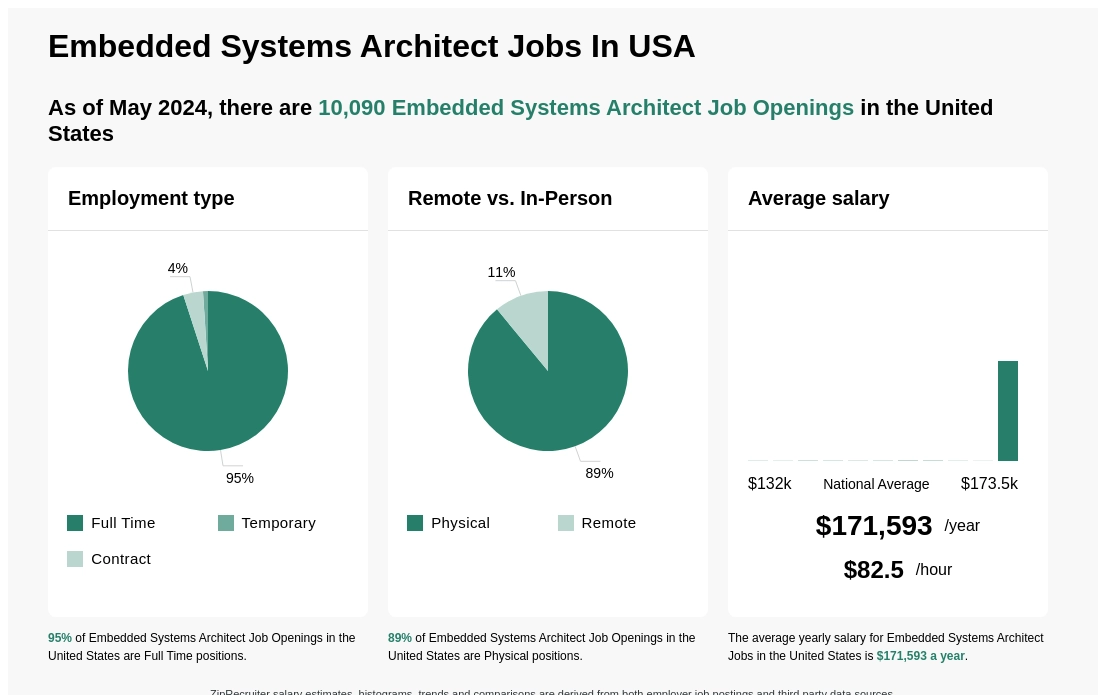
As of Aug 19, 2026, the average yearly pay for embedded systems architect in the United States is $171,593.00, according to ZipRecruiter salary data. Most workers in this role earn between $173,000.00 and $173,000.00 per year, depending on experience, location, and employer.

What is an embedded systems architect?

Embedded Systems Architects are professionals who design and oversee the development of embedded systems—specialized computing systems that are part of larger devices, such as cars, medical equipment, or household appliances. They are responsible for defining system architecture, selecting hardware and software components, and ensuring that all parts work together efficiently and securely. Their role often involves collaborating with engineers, software developers, and project managers to deliver reliable and optimized embedded solutions. Embedded Systems Architects need a deep understanding of both hardware and software, as well as strong problem-solving and communication skills.

How does an embedded systems architect typically collaborate with cross-functional teams during a project?

An Embedded Systems Architect works closely with cross-functional teams, including hardware engineers, software developers, and project managers, to ensure system integration and alignment with project goals. They often facilitate technical discussions, clarify system requirements, and resolve design trade-offs between hardware and software components. Regular collaboration involves design reviews, technical documentation, and providing guidance to ensure that deliverables meet both functional and performance standards. This collaborative environment is key to delivering robust and reliable embedded solutions.

What are the key skills and qualifications needed to thrive as an embedded systems architect, and why are they important?

To thrive as an Embedded Systems Architect, you need deep expertise in embedded software and hardware design, strong knowledge of microcontrollers, and a relevant degree in electrical engineering, computer engineering, or a related field. Familiarity with programming languages such as C/C++, real-time operating systems (RTOS), and experience with tools like MATLAB, Simulink, and various circuit design platforms are typically required. Strong problem-solving, communication, and leadership skills help you collaborate effectively and translate complex requirements into robust system architectures. These competencies are crucial to delivering efficient, reliable, and scalable embedded solutions that meet project and industry standards.

What is the difference between Embedded Systems Architect vs Embedded Software Engineer?

AspectEmbedded Systems Architect

Required CredentialsBachelor's or Master's in Electrical Engineering, Computer Engineering, or related fields; certifications like ARM or IoT certifications are common.

Work EnvironmentDesigning system architecture in R&D labs, manufacturing facilities, or product development teams.

Employer & Industry UsageUsed across industries like automotive, consumer electronics, aerospace, and industrial automation.

The Embedded Systems Architect focuses on designing and planning the overall system architecture, ensuring hardware and software integration. In contrast, the Embedded Software Engineer implements and tests the software components within that architecture. Both roles require technical expertise, but the architect has a broader strategic focus, while the engineer concentrates on coding and debugging.

More about Embedded Systems Architect jobs

What states have the most Embedded Systems Architect jobs?

States with the most job openings for Embedded Systems Architect jobs include:

Infographic showing various Embedded Systems Architect job openings in the United States as of August 2026, with employment types broken down into 1% As Needed, 85% Full Time, 9% Part Time, 4% Contract, and 1% Nights. Highlights an 88% Physical, 3% Hybrid, and 9% Remote job distribution, with an average salary of $171,593 per year, or $82.5 per hour.

Embedded Systems Engineer

Vale Concepts Inc

Seattle, WA • On-site

$118K - $155K/yr

Full-time

Medical, Dental, Vision

Re-posted 10 days ago


Job description

About the Role
Vale Concepts is building the next generation of robotic matcha machines: reliable, intelligent, serviceable systems that bring craft-quality beverage preparation into real-world retail environments.
We're looking for an embedded robotics engineer to help design and build the distributed embedded system that powers these machines. You'll work across firmware, real-time control, device orchestration, reliability, telemetry, and over-the-air software delivery. This is a hands-on engineering role for someone who wants to own core architecture, ship production hardware, and build systems that operate reliably in the field.
The ideal candidate has strong embedded systems fundamentals, experience with Rust on microcontrollers or constrained devices, and a track record of building reliable software for physical systems. Experience with CAN bus, OTA updates, robotics, telemetry, aerospace, automotive, industrial automation, or high-reliability hardware products is especially relevant.
We also expect every engineer on the team to embrace modern AI-assisted software development practices: using AI tools to accelerate implementation, improve code quality, explore designs, write tests, generate documentation, and raise the pace of engineering without compromising rigor.
What you'll do
Design and implement firmware and embedded software for a distributed robotic system spanning multiple MCUs, sensors, actuators, and control boards.
Build robust communication and orchestration layers across devices, with a strong preference for CAN bus or similar field-proven embedded networks.
Develop reliable over-the-air update systems, bootloaders, rollback mechanisms, diagnostics, and recovery flows for machines deployed in the field.
Own key parts of the runtime architecture for a robotic matcha machine, including device state management, safety handling, telemetry, fault detection, and serviceability.
Write production-quality Rust for embedded targets, with thoughtful use of C/C++ where appropriate.
Collaborate closely with mechanical, electrical, robotics, product, and operations teams to turn prototypes into dependable production systems.
Develop test infrastructure for embedded software, including hardware-in-the-loop testing, simulation, CI, fault injection, and long-duration reliability testing.
Use AI development tools as a normal part of your workflow to increase engineering leverage, improve code review, prototype faster, and maintain high standards.
Help define engineering practices for embedded reliability, release management, observability, and field debugging.
What we're looking for
Strong experience building embedded systems for real-world hardware products.
Fluency in Rust, C, or C++, with a strong preference for Rust experience on MCUs, embedded Linux, or constrained devices.
Experience designing distributed systems across multiple embedded controllers, boards, or devices.
Comfort working close to hardware: reading schematics, debugging buses, using oscilloscopes or logic analyzers, and collaborating with EE teams.
Experience with at least some of: CAN bus, embedded networking, motor control, sensor integration, robotics, industrial automation, aerospace systems, automotive systems, or telemetry-heavy products.
Practical understanding of reliability engineering for deployed hardware: watchdogs, safe states, error handling, diagnostics, logging, update safety, recovery paths, and field support.
Experience with OTA update systems, bootloaders, firmware release processes, or secure software delivery.
A bias toward ownership, clear communication, and shipping durable systems rather than demos.
Enthusiasm for AI-assisted software development and a willingness to continuously improve how engineering work gets done.
Nice to have
Experience with Embassy, RTIC, Zephyr, FreeRTOS, embedded Linux, or similar embedded runtimes.
Experience with Rust embedded crates, HALs, async embedded Rust, or no-std development.
Experience with CANopen, UAVCAN/Cyphal, J1939, or custom CAN protocols.
Experience with robotics platforms, motion systems, pumps, valves, thermal systems, food automation, or mechatronics.
Experience building telemetry, observability, and diagnostics systems for fleets of deployed machines.
Experience in aerospace, drones, automotive, industrial controls, consumer hardware, or high-volume field-deployed hardware.
Prior work on safety-critical or high-reliability systems.
How we work
We are a small, ambitious team building physical systems that have to work every day in the real world. We value engineers who can move from architecture to implementation to debugging on the bench. We care about simplicity, reliability, maintainability, and fast iteration.
We also believe AI is becoming a core engineering multiplier. We expect candidates to be curious and practical about using AI tools for coding, testing, design exploration, debugging, documentation, and review while maintaining strong technical judgment.
Why join
You'll help define the embedded architecture for a new category of robotic beverage systems.
You'll work on a tangible product where software directly controls real-world motion, sensing, preparation, and reliability.
You'll have meaningful ownership from prototype through production deployment.
You'll join early enough to shape technical direction, engineering culture, and the way we build AI-accelerated hardware products.
Location
This role is **on-site in Seattle, WA**. We believe close collaboration between software, electrical, mechanical, robotics, and operations teams is essential for building great physical products.
Compensation
$118,000 - $155,000 per year
Benefits
  • Company funded ORCA card
  • Medical, dental, and vision benefits
  • Annual bonuses
  • Joining a fun startup in Seattle