Digital Signal Processing Engineer - Audio Technology Licensing About Bose Bose Corporation is dedicated to developing breakthrough audio technologies that enrich people's lives. While Bose is well ...
Digital Signal Processing Engineer - Audio Technology Licensing About Bose Bose Corporation is dedicated to developing breakthrough audio technologies that enrich people's lives. While Bose is well ...

Software Signal Processing Engineer Program Description: Our client is prime on a program that will ... Design, develop, test, and optimize software applications supporting advanced digital signal ...
Software Signal Processing Engineer Program Description: Our client is prime on a program that will ... Design, develop, test, and optimize software applications supporting advanced digital signal ...

Digital Signal Processing (DSP) Engineer LOCATION Chantilly, VA 20151 CLEARANCE TS/SCI Full Poly (Please note this position requires full U.S. Citizenship) KEY SUMMARY We are seeking a highly skilled ...
Digital Signal Processing (DSP) Engineer LOCATION Chantilly, VA 20151 CLEARANCE TS/SCI Full Poly (Please note this position requires full U.S. Citizenship) KEY SUMMARY We are seeking a highly skilled ...

Senior Digital Signal Processing Engineer Job Category: Engineering Time Type: Full time Minimum Clearance Required to Start: Top Secret Employee Type: Regular Percentage of Travel Required: Up to ...
Senior Digital Signal Processing Engineer Job Category: Engineering Time Type: Full time Minimum Clearance Required to Start: Top Secret Employee Type: Regular Percentage of Travel Required: Up to ...
S. Citizenship)KEY SUMMARY We are seeking a highly skilled and innovative Digital Signal Processing (DSP) Engineer to join our team and develop cutting-edge solutions in signal analysis and ...
S. Citizenship)KEY SUMMARY We are seeking a highly skilled and innovative Digital Signal Processing (DSP) Engineer to join our team and develop cutting-edge solutions in signal analysis and ...
Digital Signal Processing (DSP) Engineer LOCATION Aurora, CO 80014 CLEARANCE TS/SCI Full Poly (Please note this position requires full U.S. Citizenship) KEY SUMMARY We are seeking a highly skilled ...
Digital Signal Processing (DSP) Engineer LOCATION Aurora, CO 80014 CLEARANCE TS/SCI Full Poly (Please note this position requires full U.S. Citizenship) KEY SUMMARY We are seeking a highly skilled ...
Digital Signal Processing (DSP) Engineer LOCATION Honolulu, HI 96815 CLEARANCE TS/SCI Full Poly (Please note this position requires full U.S. Citizenship) KEY SUMMARY We are seeking a highly skilled ...
Digital Signal Processing (DSP) Engineer LOCATION Honolulu, HI 96815 CLEARANCE TS/SCI Full Poly (Please note this position requires full U.S. Citizenship) KEY SUMMARY We are seeking a highly skilled ...
Digital Signal Processing (DSP) Engineer LOCATION Annapolis Junction, MD 20701 CLEARANCE TS/SCI Full Poly (Please note this position requires full U.S. Citizenship) KEY SUMMARY We are seeking a ...
Digital Signal Processing (DSP) Engineer LOCATION Annapolis Junction, MD 20701 CLEARANCE TS/SCI Full Poly (Please note this position requires full U.S. Citizenship) KEY SUMMARY We are seeking a ...
Digital Signal Processing (DSP) Engineer * Aurora, CO LOCATION Aurora, CO 80014 CLEARANCE TS/SCI Full Poly (Please note this position requires full U.S. Citizenship) KEY SUMMARY We are seeking a ...
Digital Signal Processing (DSP) Engineer * Aurora, CO LOCATION Aurora, CO 80014 CLEARANCE TS/SCI Full Poly (Please note this position requires full U.S. Citizenship) KEY SUMMARY We are seeking a ...
Digital Signal Processing (DSP) Engineer LOCATION San Antonio, TX 78208 CLEARANCE TS/SCI Full Poly (Please note this position requires full U.S. Citizenship) KEY SUMMARY We are seeking a highly ...
Digital Signal Processing (DSP) Engineer LOCATION San Antonio, TX 78208 CLEARANCE TS/SCI Full Poly (Please note this position requires full U.S. Citizenship) KEY SUMMARY We are seeking a highly ...
Digital Signal Processing (DSP) Engineer LOCATION Tysons, VA 22182 CLEARANCE TS/SCI Full Poly (Please note this position requires full U.S. Citizenship) KEY SUMMARY We are seeking a highly skilled ...
Digital Signal Processing (DSP) Engineer LOCATION Tysons, VA 22182 CLEARANCE TS/SCI Full Poly (Please note this position requires full U.S. Citizenship) KEY SUMMARY We are seeking a highly skilled ...
Digital Signal Processing (DSP) Engineer LOCATION Reston, VA 20190 CLEARANCE TS/SCI Full Poly (Please note this position requires full U.S. Citizenship) KEY SUMMARY We are seeking a highly skilled ...
Digital Signal Processing (DSP) Engineer LOCATION Reston, VA 20190 CLEARANCE TS/SCI Full Poly (Please note this position requires full U.S. Citizenship) KEY SUMMARY We are seeking a highly skilled ...

Signal Processing Engineer
Austin, TX · On-site
$121K - $230K/yr
Job Summary We are seeking a talented Signal Processing Engineer to design, develop, and optimize advanced digital signal processing (DSP) algorithms for on-chip and embedded implementation. In this ...
Signal Processing Engineer
Austin, TX · On-site
$121K - $230K/yr
Job Summary We are seeking a talented Signal Processing Engineer to design, develop, and optimize advanced digital signal processing (DSP) algorithms for on-chip and embedded implementation. In this ...

Senior Digital Signal Processing (DSP) Engineer
Berkeley Lake, GA · On-site
$150K - $220K/yr
Our client is currently seeking a Senior Digital Signal Processing (DSP) Engineer Senior Digital Signal Processing (DSP) Engineer Peachtree Corners, GA or Huntsville, AL Radar Engineering ...
Senior Digital Signal Processing (DSP) Engineer
Berkeley Lake, GA · On-site
$150K - $220K/yr
Our client is currently seeking a Senior Digital Signal Processing (DSP) Engineer Senior Digital Signal Processing (DSP) Engineer Peachtree Corners, GA or Huntsville, AL Radar Engineering ...

We are seeking a Digital Signal Processing (DSP) engineer to design, analyze and develop RF and optical systems and payloads for NASA and DoW's next generation space missions. You 'll be joining a ...
We are seeking a Digital Signal Processing (DSP) engineer to design, analyze and develop RF and optical systems and payloads for NASA and DoW's next generation space missions. You 'll be joining a ...
Signal Processing Engineer
Boston, MA · On-site
Role Summary Specter Aerospace is seeking a Signal Processing Engineer to develop and implement ... Experience developing digital signal processing, image processing, detection, or tracking ...
Signal Processing Engineer
Boston, MA · On-site
Role Summary Specter Aerospace is seeking a Signal Processing Engineer to develop and implement ... Experience developing digital signal processing, image processing, detection, or tracking ...

You will join a team of engineers developing advanced capabilities for the U.S. military and ... Have deep theoretical and practical knowledge of digital communications and signal processing, with ...
You will join a team of engineers developing advanced capabilities for the U.S. military and ... Have deep theoretical and practical knowledge of digital communications and signal processing, with ...

Digital Signal Processing Engineer - Mid Level - TS/SCI
Chantilly, VA · On-site
$103K - $181K/yr
We are currently searching for full-time Digital Signal Processing Engineers that will design, develop and maintain complex systems. We meet customer and mission needs by leveraging cutting-edge ...
Digital Signal Processing Engineer - Mid Level - TS/SCI
Chantilly, VA · On-site
$103K - $181K/yr
We are currently searching for full-time Digital Signal Processing Engineers that will design, develop and maintain complex systems. We meet customer and mission needs by leveraging cutting-edge ...
Signal Processing Engineer
Boston, MA · On-site
$114K - $162K/yr
Role Summary Specter Aerospace is seeking a Signal Processing Engineer to develop and implement ... Experience developing digital signal processing, image processing, detection, or tracking ...
Signal Processing Engineer
Boston, MA · On-site
$114K - $162K/yr
Role Summary Specter Aerospace is seeking a Signal Processing Engineer to develop and implement ... Experience developing digital signal processing, image processing, detection, or tracking ...
Signal Processing Engineer
Boston, MA · On-site
Role Summary Specter Aerospace is seeking a Signal Processing Engineer to develop and implement ... Experience developing digital signal processing, image processing, detection, or tracking ...
Quick apply
Signal Processing Engineer
Boston, MA · On-site
Role Summary Specter Aerospace is seeking a Signal Processing Engineer to develop and implement ... Experience developing digital signal processing, image processing, detection, or tracking ...
Digital Signal Processing Engineer information
See salary details
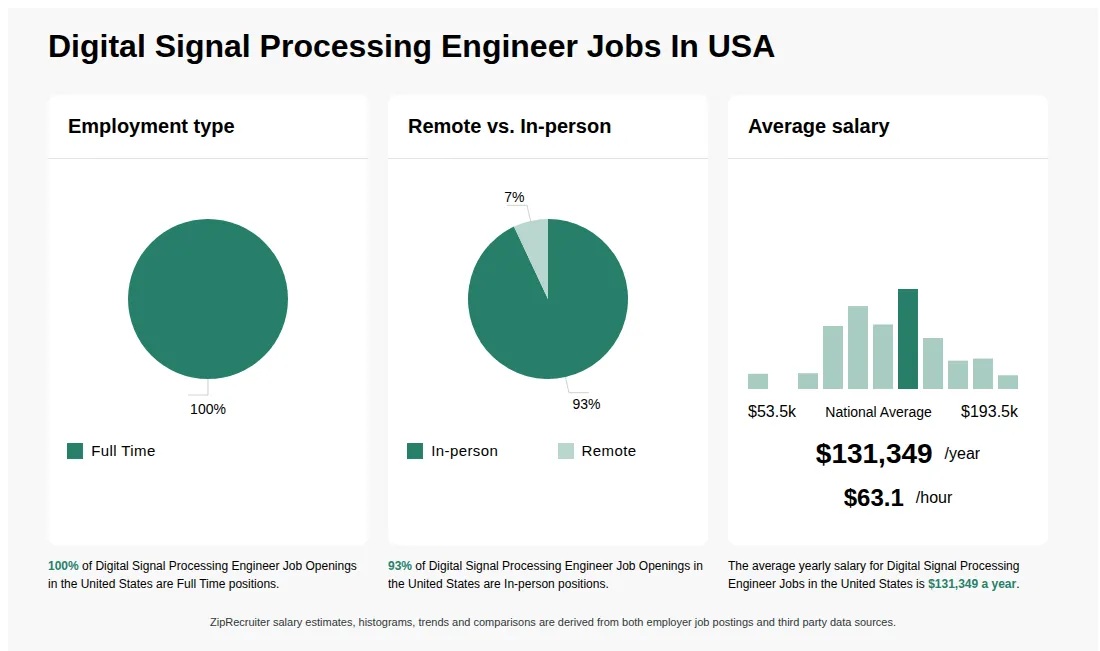
$53.5K - $66.2K
3% of jobs
$66.2K - $79K
0% of jobs
$79K - $91.7K
3% of jobs
$91.7K - $104.4K
14% of jobs
$107.8K is the 25th percentile. Wages below this are outliers.
$104.4K - $117.1K
18% of jobs
The median wage is $127.9K / yr.
$117.1K - $129.9K
14% of jobs
$129.9K - $142.6K
22% of jobs
$143.2K is the 75th percentile. Wages above this are outliers.
$142.6K - $155.3K
11% of jobs
$155.3K - $168K
6% of jobs
$168K - $180.8K
6% of jobs
$180.8K - $193.5K
2% of jobs
$53.5K
$131.3K
$193.5K
How much do digital signal processing engineer jobs pay per year?
As of Sep 13, 2026, the average yearly pay for digital signal processing engineer in the United States is $131,349.00, according to ZipRecruiter salary data. Most workers in this role earn between $108,500.00 and $147,500.00 per year, depending on experience, location, and employer.
What does a digital signal processing engineer do?
A Digital Signal Processing (DSP) Engineer designs, develops, and implements algorithms and systems that manipulate and analyze signals such as audio, video, and sensor data. They work on both hardware and software to improve signal quality, extract useful information, or compress data for efficient storage and transmission. DSP Engineers are essential in industries like telecommunications, audio engineering, medical imaging, and consumer electronics, where they help create products such as smartphones, hearing aids, and radar systems.
What are the key skills and qualifications needed to thrive as a digital signal processing engineer?
To thrive as a Digital Signal Processing (DSP) Engineer, you need a strong background in mathematics, signal processing theory, and proficiency in programming languages like MATLAB, C/C++, or Python, often supported by a degree in electrical engineering or a related field. Familiarity with DSP hardware, simulation tools, and platforms like FPGA or DSP processors is typically required, and certifications in embedded systems or signal processing are advantageous. Problem-solving ability, analytical thinking, and effective teamwork set candidates apart in this field. These skills are crucial for designing, implementing, and optimizing algorithms that process digital signals accurately and efficiently in various applications.
What are some common challenges digital signal processing engineers face when integrating new algorithms into existing systems?
Digital Signal Processing Engineers often encounter challenges such as ensuring compatibility between new algorithms and legacy hardware or software, maintaining real-time processing requirements, and optimizing for limited computational resources. Debugging and validating algorithm performance under various signal conditions can also be complex, requiring collaboration with hardware engineers and extensive testing. Effective communication with cross-functional teams is essential to address integration issues and achieve system-wide functionality.
What is the difference between Digital Signal Processing Engineer vs Electrical Engineer?
| Aspect | Digital Signal Processing Engineer | Electrical Engineer |
|---|---|---|
| Required Credentials | Bachelor's or Master's in Electrical Engineering, Signal Processing, or related fields | Bachelor's or Master's in Electrical Engineering or related fields |
| Work Environment | Research labs, tech companies, telecommunications firms | Power plants, manufacturing, electronics design |
| Industry Usage | Signal processing, communications, audio/video tech | Power systems, electronics, control systems |
| Common Search Intent | Comparing roles in signal processing and electronics | Broader electrical engineering roles |
The Digital Signal Processing Engineer specializes in designing algorithms and systems for processing digital signals, often within communications, audio, and video applications. Electrical Engineers have a broader scope, working on electrical systems, power, and electronics across various industries. While both roles require similar educational backgrounds, their focus areas and work environments differ significantly.
More about Digital Signal Processing Engineer jobs
What cities are hiring for Digital Signal Processing Engineer jobs?
Cities with the most Digital Signal Processing Engineer job openings:
What are the most commonly searched types of Digital Signal Processing Engineer jobs?
The most popular types of Digital Signal Processing Engineer jobs are:
Who are the top companies hiring for Digital Signal Processing Engineer jobs?
The top employers for Digital Signal Processing Engineer jobs are:
What states have the most Digital Signal Processing Engineer jobs?
States with the most job openings for Digital Signal Processing Engineer jobs include:
What are popular job titles related to Digital Signal Processing Engineer jobs?
For Digital Signal Processing Engineer jobs, the most frequently searched job titles are:
Digital Signal Processing Engineer - Audio Technology
Framingham, MA
Boseallaboutme
Full-time
Medical, Retirement
Re-posted 7 days ago
Key responsibilities
Design, implement, and test DSP algorithms to solve technical challenges for licensable audio technologies.
Contribute to delivering new customer and partner benefits using technologies such as active noise reduction, voice pickup, spatial audio, and speech enhancement.
Support the integration and validation of DSP algorithms on embedded, real-time systems.
Job description
At Bose Corporation, we believe sound is the most powerful force on earth - and for over 60 years, we have been a company built on innovation, excellence, and independence. Privately owned, fiercely customer-focused, and driven by our values, we continue to lead industries and transform lives through sound.
Today, Bose Corporation is entering an exciting new era. Across multiple global Business Units and Global Functions, we are shaping the future of audio technology, automotive, luxury, and premium experiences. We invite you to join us in this transformation.
Job DescriptionDigital Signal Processing Engineer - Audio Technology Licensing
About Bose
Bose Corporation is dedicated to developing breakthrough audio technologies that enrich people's lives. While Bose is well known for its first-party consumer and automotive products, an increasingly important part of our future is enabling partners around the world to deliver differentiated audio experiences through licensed Bose technologies.
The Audio Technology Licensing organization focuses on developing scalable, portable, and high-performance audio technologies that can be deployed across a wide range of partner platforms and products.
Role Overview
We are looking for a hands-on DSP engineer to join our Audio Technology Licensing engineering team. This role is well suited for a Senior and above level engineer who enjoys applying strong DSP fundamentals while learning how to design algorithms that must scale across multiple platforms, partners, and use cases.
Success for the Audio Tech DSP team emphasizes algorithm robustness, portability, and partner enablement, while still offering deep technical ownership and exposure to real-world production systems. You will work closely with senior DSP engineers, platform teams, and external partners to deliver licensable audio technologies that meet demanding quality and performance requirements.
DSP Engineer Role
DSP engineers in the Audio Technology Licensing group work in cross-disciplinary, highly collaborative teams to develop and deploy signal processing algorithms that improve audio experiences for our technology partners and their customers.
You will contribute to a broad set of technologies including audio signal processing, speech and voice processing, noise reduction, and microphone array systems, and gain experience adapting algorithms to different hardware and software environments. This role provides strong opportunities for technical growth while maintaining clear ownership of deliverables.
Key Responsibilities
- Design, implement, and test DSP algorithms to solve technical challenges for licensable audio technologies.
- Contribute to delivering new customer and partner benefits using technologies such as active noise reduction, voice pickup, spatial audio, and speech enhancement.
- Work with senior engineers to ensure algorithms are robust, portable, and scalable across multiple platforms and partner products.
- Support the integration and validation of DSP algorithms on embedded, real-time systems.
- Assist in adapting and tuning algorithms for different hardware, software, and system constraints encountered in a licensing environment.
- Participate in technical evaluations of third-party technologies and contribute to make-vs-buy analyses when appropriate.
- Collaborate with internal teams across engineering, systems, software and product management to support partner delivery and long-term platform goals.
Skills & Qualifications
The ideal candidate will have a strong subset of the following:
Technical Skills
- Solid foundation in digital signal processing, with experience in audio and/or speech processing.
- Experience developing DSP algorithms for embedded or real-time systems.
- Proficiency programming signal processing algorithms using C, Python, and Matlab; exposure to fixed-point or optimized implementations is a plus.
- Familiarity with acoustics and acoustic measurements, including microphones and audio transducers.
- Experience debugging embedded systems and working with audio lab equipment.
- Ability to evaluate and integrate third-party algorithms and libraries.
Desirable (Not Required)
- Exposure to applied machine learning techniques for audio systems, such as ML-assisted noise reduction, speech enhancement, or audio classification.
- Familiarity with Bluetooth audio systems and their constraints.
- Interest in understanding how DSP algorithms scale across different platforms and partner implementations.
Collaboration & Communication
- Effective communication skills, with the ability to discuss technical topics with engineers from different disciplines.
- A collaborative, self-directed working style suited to small, highly technical teams.
Education & Experience
- BS in Electrical Engineering, Computer Engineering, or a signal-processing-related field; MS preferred.
- 5+ years of relevant industry experience in DSP, audio, or related embedded systems development.
Our goal is to create an atmosphere where every candidate feels supported and empowered in the interviewing process. Diversity and inclusion are integral to our success, and we believe that providing reasonable accommodation is not only a legal obligation but also a fundamental aspect of our commitment to being an employer of choice. We recognize that individuals may have different needs and requirements based on their abilities, and we provide reasonable accommodations to ensure ideal conditions are met during the application process.