Operates and maintains all equipment used to store and transfer liquid cargo * Follows safety ... All crew members are considered to be filling safety-sensitive positions as well. * Ensures first ...
Operates and maintains all equipment used to store and transfer liquid cargo * Follows safety ... All crew members are considered to be filling safety-sensitive positions as well. * Ensures first ...
Alaska Native Hire Program - Tankerman (Vessel)
Valdez, AK · On-site
$42K - $53K/yr
Operates and maintains all equipment used to store and transfer liquid cargo * Follows safety ... All crew members are considered to be filling safety-sensitive positions as well. * Ensures first ...
Quick apply
Alaska Native Hire Program - Tankerman (Vessel)
Valdez, AK · On-site
$42K - $53K/yr
Operates and maintains all equipment used to store and transfer liquid cargo * Follows safety ... All crew members are considered to be filling safety-sensitive positions as well. * Ensures first ...
Alaska Native Hire Program - Tankerman (Vessel)
Valdez, AK · On-site
$42K - $53K/yr
Operates and maintains all equipment used to store and transfer liquid cargo * Follows safety ... All crew members are considered to be filling safety-sensitive positions as well. * Ensures first ...
Alaska Native Hire Program - Tankerman (Vessel)
Valdez, AK · On-site
$42K - $53K/yr
Operates and maintains all equipment used to store and transfer liquid cargo * Follows safety ... All crew members are considered to be filling safety-sensitive positions as well. * Ensures first ...

Vessel Operator I
Seattle, WA · On-site
$30.08/hr
Directs crew activities while deployed. PRINCIPLE RESPONSIBILITIES: * Deploys, tows, and anchors ... collection and transfer stations, recycling and polymer centers, treatment facilities, and ...
Vessel Operator I
Seattle, WA · On-site
$30.08/hr
Directs crew activities while deployed. PRINCIPLE RESPONSIBILITIES: * Deploys, tows, and anchors ... collection and transfer stations, recycling and polymer centers, treatment facilities, and ...
Vessel Operator I
Seattle, WA · On-site
$30.08/hr
Directs crew activities while deployed. PRINCIPLE RESPONSIBILITIES: * Deploys, tows, and anchors ... collection and transfer stations, recycling and polymer centers, treatment facilities, and ...
Vessel Operator I
Seattle, WA · On-site
$30.08/hr
Directs crew activities while deployed. PRINCIPLE RESPONSIBILITIES: * Deploys, tows, and anchors ... collection and transfer stations, recycling and polymer centers, treatment facilities, and ...
Vessel Operator I
$30.08/hr
Directs crew activities while deployed. PRINCIPLE RESPONSIBILITIES: * Deploys, tows, and anchors ... collection and transfer stations, recycling and polymer centers, treatment facilities, and ...
Vessel Operator I
$30.08/hr
Directs crew activities while deployed. PRINCIPLE RESPONSIBILITIES: * Deploys, tows, and anchors ... collection and transfer stations, recycling and polymer centers, treatment facilities, and ...

SIO Research Vessel Engine Crew - Per Diem - 136620
San Diego, CA · On-site
$25 - $84.16/hr
Variable, Variable at Sea, Variable at Sea #136620 SIO Research Vessel Engine Crew - Per Diem ... transferable skills for a job opening, we strongly encourage you to apply. DESCRIPTION Engineer ...
SIO Research Vessel Engine Crew - Per Diem - 136620
San Diego, CA · On-site
$25 - $84.16/hr
Variable, Variable at Sea, Variable at Sea #136620 SIO Research Vessel Engine Crew - Per Diem ... transferable skills for a job opening, we strongly encourage you to apply. DESCRIPTION Engineer ...
Standby Vessel Operator I - Grays Harbor
Seattle, WA · On-site
$24.45 - $33.60/hr
Directs crew activities while deployed. PRINCIPLE RESPONSIBILITIES: * Deploys, tows, and anchors ... collection and transfer stations, recycling and polymer centers, treatment facilities, and ...
Standby Vessel Operator I - Grays Harbor
Seattle, WA · On-site
$24.45 - $33.60/hr
Directs crew activities while deployed. PRINCIPLE RESPONSIBILITIES: * Deploys, tows, and anchors ... collection and transfer stations, recycling and polymer centers, treatment facilities, and ...
Standby Vessel Operator I - Grays Harbor
Seattle, WA · On-site
$24.45 - $33.60/hr
Directs crew activities while deployed. PRINCIPLE RESPONSIBILITIES: * Deploys, tows, and anchors ... collection and transfer stations, recycling and polymer centers, treatment facilities, and ...
Standby Vessel Operator I - Grays Harbor
Seattle, WA · On-site
$24.45 - $33.60/hr
Directs crew activities while deployed. PRINCIPLE RESPONSIBILITIES: * Deploys, tows, and anchors ... collection and transfer stations, recycling and polymer centers, treatment facilities, and ...
Standby Vessel Operator I - Grays Harbor
Seattle, WA · On-site
$24.45 - $33.60/hr
Directs crew activities while deployed. PRINCIPLE RESPONSIBILITIES: * Deploys, tows, and anchors ... collection and transfer stations, recycling and polymer centers, treatment facilities, and ...
Standby Vessel Operator I - Grays Harbor
Seattle, WA · On-site
$24.45 - $33.60/hr
Directs crew activities while deployed. PRINCIPLE RESPONSIBILITIES: * Deploys, tows, and anchors ... collection and transfer stations, recycling and polymer centers, treatment facilities, and ...
2nd Officer
Miami, FL · On-site
... the vessel. They stand their own watch, primarily during daytime and evening hours when senior ... Be prepared to operate tenders and establish safe, secure passenger and crew transfer procedures ...
2nd Officer
Miami, FL · On-site
... the vessel. They stand their own watch, primarily during daytime and evening hours when senior ... Be prepared to operate tenders and establish safe, secure passenger and crew transfer procedures ...

Advise vessel crew on the project specific regulatory requirements and real time mitigation actions ... S. to recruit, hire, train, promote, transfer and compensate our employees and provide all other ...
Advise vessel crew on the project specific regulatory requirements and real time mitigation actions ... S. to recruit, hire, train, promote, transfer and compensate our employees and provide all other ...
Advise vessel crew on the project specific regulatory requirements and real time mitigation actions ... S. to recruit, hire, train, promote, transfer and compensate our employees and provide all other ...
Advise vessel crew on the project specific regulatory requirements and real time mitigation actions ... S. to recruit, hire, train, promote, transfer and compensate our employees and provide all other ...
Vessel Strike Avoidance Observer - Cataumet, Ma
Cataumet, MA · On-site
$18 - $22/hr
Advise vessel crew on the project specific regulatory requirements and real time mitigation actions ... S. to recruit, hire, train, promote, transfer and compensate our employees and provide all other ...
Quick apply
Vessel Strike Avoidance Observer - Cataumet, Ma
Cataumet, MA · On-site
$18 - $22/hr
Advise vessel crew on the project specific regulatory requirements and real time mitigation actions ... S. to recruit, hire, train, promote, transfer and compensate our employees and provide all other ...
Vessel Strike Avoidance Observer - Cataumet, Ma
Cataumet, MA · On-site
$18 - $22/hr
Advise vessel crew on the project specific regulatory requirements and real time mitigation actions ... S. to recruit, hire, train, promote, transfer and compensate our employees and provide all other ...
Vessel Strike Avoidance Observer - Cataumet, Ma
Cataumet, MA · On-site
$18 - $22/hr
Advise vessel crew on the project specific regulatory requirements and real time mitigation actions ... S. to recruit, hire, train, promote, transfer and compensate our employees and provide all other ...
Advise vessel crew on the project specific regulatory requirements and real time mitigation actions ... S. to recruit, hire, train, promote, transfer and compensate our employees and provide all other ...
Advise vessel crew on the project specific regulatory requirements and real time mitigation actions ... S. to recruit, hire, train, promote, transfer and compensate our employees and provide all other ...
Advise vessel crew on the project specific regulatory requirements and real time mitigation actions ... S. to recruit, hire, train, promote, transfer and compensate our employees and provide all other ...
Advise vessel crew on the project specific regulatory requirements and real time mitigation actions ... S. to recruit, hire, train, promote, transfer and compensate our employees and provide all other ...
Vessel Strike Avoidance Observer - Point Judith, RI
Narragansett, RI · On-site
$18 - $22/hr
Advise vessel crew on the project specific regulatory requirements and real time mitigation actions ... S. to recruit, hire, train, promote, transfer and compensate our employees and provide all other ...
Quick apply
Vessel Strike Avoidance Observer - Point Judith, RI
Narragansett, RI · On-site
$18 - $22/hr
Advise vessel crew on the project specific regulatory requirements and real time mitigation actions ... S. to recruit, hire, train, promote, transfer and compensate our employees and provide all other ...
Vessel Strike Avoidance Observer - Point Judith, RI
Narragansett, RI · On-site
$18 - $22/hr
Advise vessel crew on the project specific regulatory requirements and real time mitigation actions ... S. to recruit, hire, train, promote, transfer and compensate our employees and provide all other ...
Vessel Strike Avoidance Observer - Point Judith, RI
Narragansett, RI · On-site
$18 - $22/hr
Advise vessel crew on the project specific regulatory requirements and real time mitigation actions ... S. to recruit, hire, train, promote, transfer and compensate our employees and provide all other ...
Advise vessel crew on the project specific regulatory requirements and real time mitigation actions ... S. to recruit, hire, train, promote, transfer and compensate our employees and provide all other ...
Advise vessel crew on the project specific regulatory requirements and real time mitigation actions ... S. to recruit, hire, train, promote, transfer and compensate our employees and provide all other ...
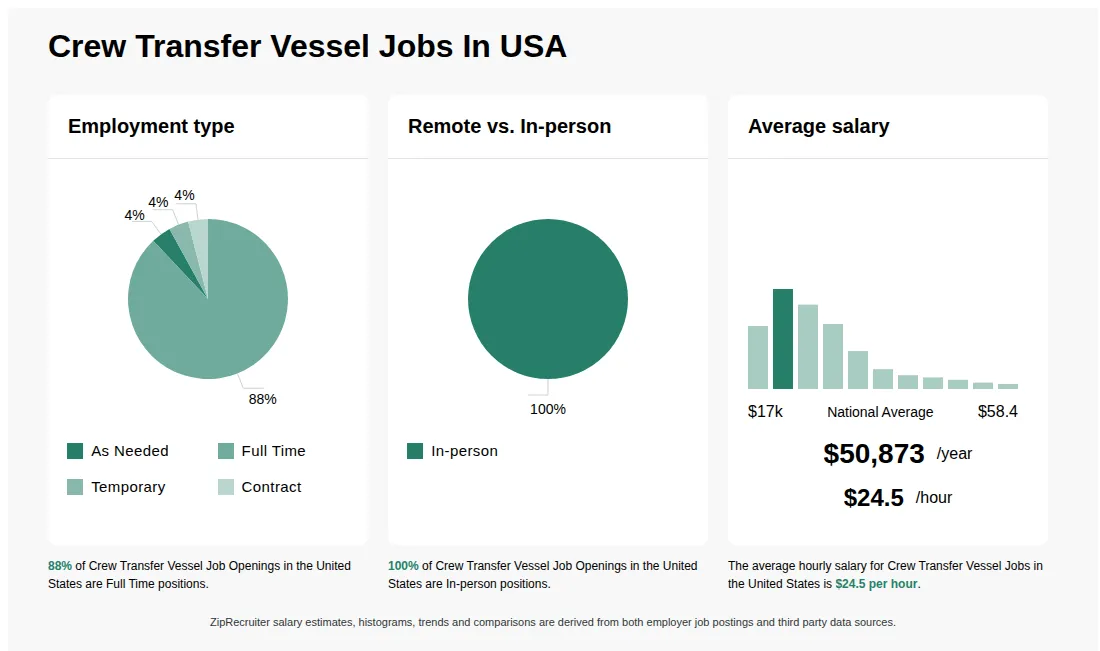
Crew Transfer Vessel information
See salary details
$8.17 - $12.74
16% of jobs
$14.45 is the 25th percentile. Wages below this are outliers.
$12.74 - $17.31
25% of jobs
The median wage is $19.36 / hr.
$17.31 - $21.88
21% of jobs
$25.83 is the 75th percentile. Wages above this are outliers.
$21.88 - $26.44
16% of jobs
$26.44 - $31.01
9% of jobs
$31.01 - $35.58
4% of jobs
$35.58 - $40.14
3% of jobs
$40.14 - $44.71
2% of jobs
$44.71 - $49.28
2% of jobs
$49.28 - $53.85
1% of jobs
$53.85 - $58.41
1% of jobs
$8
$24
$58
How much do crew transfer vessel jobs pay per hour?
As of Sep 9, 2026, the average hourly pay for crew transfer vessel in the United States is $24.46, according to ZipRecruiter salary data. Most workers in this role earn between $14.90 and $27.88 per hour, depending on experience, location, and employer.
What is a crew transfer vessel?
A Crew Transfer Vessel (CTV) job involves operating or working on a specialized boat designed to transport personnel and equipment to and from offshore wind farms or other marine installations. Crew members include captains, deckhands, and engineers who ensure safe and efficient transfers in varying sea conditions. Responsibilities may include vessel navigation, maintenance, and assisting with personnel transfers. Strong maritime experience and safety training are typically required.
What are the key skills and qualifications needed to thrive as a crew transfer vessel operator?
To thrive as a Crew Transfer Vessel (CTV) Operator, a solid background in marine navigation, seamanship, and vessel operations is essential, often supported by relevant maritime certifications such as STCW, Deck Officer licenses, and experience with dynamic positioning systems. Familiarity with on-board safety equipment, electronic chart systems, and radio communication tools is typically required. Strong situational awareness, teamwork, and effective communication skills are vital when coordinating with offshore installation teams and other crew members. These qualifications and abilities ensure safe, efficient, and reliable transport of personnel and equipment to and from offshore facilities, often under challenging weather and sea conditions.
What are the typical working conditions and schedules for crew transfer vessel operators?
Crew Transfer Vessel Operators typically work in offshore environments, spending several days to weeks at sea depending on project needs and rotation schedules. Work often follows a shift pattern, such as two weeks on and two weeks off, to allow for adequate rest and safety. Operators must be prepared for variable weather conditions, extended periods away from home, and the physical demands of working on the water. Despite these challenges, the role offers the opportunity to work closely with skilled marine professionals and can lead to advancement into senior vessel operations or shore-based management positions over time. Teamwork, adaptability, and a commitment to safety and regulatory compliance are highly valued in this dynamic field.
More about Crew Transfer Vessel jobs
What cities are hiring for Crew Transfer Vessel jobs?
Cities with the most Crew Transfer Vessel job openings:
What states have the most Crew Transfer Vessel jobs?
States with the most job openings for Crew Transfer Vessel jobs include:
What job categories do people searching Crew Transfer Vessel jobs look for?
The top searched job categories for Crew Transfer Vessel jobs are:

Alaska Native Hire Program - Tankerman (Vessel)
Valdez, AK
Edison Chouest Offshore •
Water Transportation • 1 - 5K employees1,001 - 5,000 employees
$42K - $53K/yr
Full-time
Re-posted 16 days ago
Edison Chouest Offshore rating

8.1
Based on 15 frontline employees who took The Breakroom Quiz
Job description
Responsibilities
Ensures the safety of the vessel and complies with government regulations, including confirming that all necessary documents are complete and accurate. Must be able to handle, overhaul, rig, and maintain all lines in addition to performing general maintenance of the vessel.
Marine Functions
Adheres to and complies with company policies, U.S. Coast Guard, and environmental regulation
Works a rotation of 12 hours in a 24-hour period with occasional hours not to exceed 14 consecutive hours
Operates and maintains all equipment used to store and transfer liquid cargo
Follows safety regulations related to operating machinery
Supervise the storage of liquid cargo in tanks according to standard procedures to ensure proper handling and stowage of hazardous materials
Monitor gauges and other indicators to ensure that tank levels are within safe ranges at all times
Maintain records of liquid transfers between tanks and other storage facilities
Open and close valves to start and stop liquid flow
Cleans, paints, and does general housekeeping on the vessel
Paints and chips rust on the deck or superstructure, splices and repairs cable and ropes using hand tools
May be required to assist in the maintenance of ship's gear and decks or watch duties and may also be required to ensure cleanliness of the engine room, bilges, rudder room, and void spaces, examine machinery for specified pressures and flow of lubricants, oils, and greases moving parts.
Participates in safety and rescue drills for emergency situations
Provides and/or assists with training
Holds a valid merchant mariner credential
Emergency Response Functions
Safety Sensitive Duties: Include but are not limited to; directing and mustering passengers in emergencies, passing out lifejackets, controlling and operating lifesaving equipment, controlling and operating firefighting equipment
Safety Sensitive Position: Is any position aboard a vessel that requires the person filling that position to perform one or more safety-sensitive duties on either a routine or emergency-only basis. Any person filling a safety-sensitive position is subject to U.S. Coast Guard drug & alcohol testing. All crew members are considered to be filling safety-sensitive positions as well.
Ensures first aid is provided to victims Firefighting and damage control
Assist on deck for man overboard crisis
Directed by the Master/Mate to take appropriate actions at the scene of an emergency
Security Functions
Designated Security Duties
HSE Responsibilities
Document and notify the supervisor immediately of any accidents/illnesses/vessel incidents/ near misses/ etc.
Participate and supervise the company’s safety programs (i.e. Safety Observations, Toolbox Talks, Permit to Work, Near Miss, Risk Assessments, etc.)
Utilize “Stop Work Authority” if any personal safety, environmental risk, property damage, or company reputation is at risk
Responsible for ensuring the maintenance and use of all necessary PPE
Performs all duties while wearing protective equipment including foul weather gear, PFD, gloves, boots, eye protection, hearing protection, etc. as required.
Responsible for ensuring and supervising the elimination of at-risk behaviors by reducing unsafe conditions and unsafe acts on and around the worksite
Supervisory Functions
Responsible for imparting knowledge about the specific features, characteristics, and procedures of the vessel operations to crew members and the orientation of all new personnel aboard the vessel
Provide on-the-job training
Ensures that he/she is capable of navigating through and communicating the requirements and contents of the MS to company representatives, regulatory personnel, and vessel crew-members
Work Environment
Work in locations not accessible to definitive medical care
Physical Demands
Required to be able to read and write in English, calculate, have estimation skills, possess good verbal presentation, and be able to communicate effectively
Required to be able to tolerate repetitive and prolonged postures involving standing, sitting, twisting, squatting, kneeling, stooping, bending, pushing, pulling, stretching, reaching, and reaching to full range from above the head to the floor
Required to be able to utilize good dexterity and frequently use one or two hands throughout the work period Required good balance/coordination when walking over uneven and/or slippery surfaces
Required to have sufficient cardio-respiratory fitness to perform medium-heavy physical labor involving the ability to sit and/or stand for extended time frames, walk for prolonged periods, handle various tools, climb ladders, and climb stairwells
Subject to adverse weather conditions including rough seas, cold, wet, elevated temperatures, and humid conditions
Required to be able to lift at least 50 pounds
Required to demonstrate physical demand requirements during initial pre-employment physical and any future physicals while employed
Able to repeatedly walk the length of the vessel
Other Duties
Please note this job description is not designed to cover or contain a comprehensive listing of activities, duties or responsibilities that are required of the employee for this job. Duties, responsibilities, and activities may change at any time with or without notice.
Employment Type: FULL_TIMEWhat Edison Chouest Offshore employees say
Pay
Benefits
Hours and flexibility
Workplace
Get the full story on Breakroom

About Edison Chouest Offshore
Sourced by ZipRecruiter
Industry
Water transportation
Company size
1,001 - 5,000 Employees
Headquarters location
Galliano, LA, US
Year founded
1960