Trial Courtroom Presentation Specialist - IMMEDIATE HIRE!!! Location: Washington, DC (On-Site) Work ... Bachelor's degree in multimedia, digital design, marketing, fine arts, or a related discipline.
Trial Courtroom Presentation Specialist - IMMEDIATE HIRE!!! Location: Washington, DC (On-Site) Work ... Bachelor's degree in multimedia, digital design, marketing, fine arts, or a related discipline.
Trial Courtroom Presentation Specialist # 373
Washington, DC · On-site
$35 - $42/hr
Trial Courtroom Presentation Specialist - IMMEDIATE HIRE!!! Location: Washington, DC (On-Site) Work ... Bachelor's degree in multimedia, digital design, marketing, fine arts, or a related discipline.
Trial Courtroom Presentation Specialist # 373
Washington, DC · On-site
$35 - $42/hr
Trial Courtroom Presentation Specialist - IMMEDIATE HIRE!!! Location: Washington, DC (On-Site) Work ... Bachelor's degree in multimedia, digital design, marketing, fine arts, or a related discipline.
Trial Courtroom Presentation Specialist # 373
Washington, DC · On-site
$40 - $48/hr
Trial Courtroom Presentation Specialist - IMMEDIATE HIRE!!! Location: Washington, DC (On-Site) Work ... Bachelor's degree in multimedia, digital design, marketing, fine arts, or a related discipline.
Trial Courtroom Presentation Specialist # 373
Washington, DC · On-site
$40 - $48/hr
Trial Courtroom Presentation Specialist - IMMEDIATE HIRE!!! Location: Washington, DC (On-Site) Work ... Bachelor's degree in multimedia, digital design, marketing, fine arts, or a related discipline.
Trial Courtroom Presentation Specialist # 373
Washington, DC · On-site
$32 - $38/hr
Trial Courtroom Presentation Specialist - DOJ Litigation Support Immediate Opening!!! Location ... Bachelor's degree in multimedia, digital design, marketing, fine arts, or a related discipline.
Quick apply
Trial Courtroom Presentation Specialist # 373
Washington, DC · On-site
$32 - $38/hr
Trial Courtroom Presentation Specialist - DOJ Litigation Support Immediate Opening!!! Location ... Bachelor's degree in multimedia, digital design, marketing, fine arts, or a related discipline.

Special Collections and Archival Services Librarian
Evanston, IL · On-site
$17.75 - $24/hr
The PLRC's special collections include archival collections such as the Supreme Court papers of Associate Justice Arthur Goldberg (JD '29, '30), over 3,000 sketches of Chicago courtroom artist Andy ...
Special Collections and Archival Services Librarian
Evanston, IL · On-site
$17.75 - $24/hr
The PLRC's special collections include archival collections such as the Supreme Court papers of Associate Justice Arthur Goldberg (JD '29, '30), over 3,000 sketches of Chicago courtroom artist Andy ...
Beyond the courtroom, Santa Fe provides an exceptional quality of life: a world-class arts scene, historic adobe architecture, a famous culinary culture, and an average of 283 days of sunshine per ...
Beyond the courtroom, Santa Fe provides an exceptional quality of life: a world-class arts scene, historic adobe architecture, a famous culinary culture, and an average of 283 days of sunshine per ...

Beyond the courtroom, Santa Fe provides an exceptional quality of life: a world-class arts scene, historic adobe architecture, a famous culinary culture, and an average of 283 days of sunshine per ...
Beyond the courtroom, Santa Fe provides an exceptional quality of life: a world-class arts scene, historic adobe architecture, a famous culinary culture, and an average of 283 days of sunshine per ...
Beyond the courtroom, Santa Fe provides an exceptional quality of life: a world-class arts scene, historic adobe architecture, a famous culinary culture, and an average of 283 days of sunshine per ...
Beyond the courtroom, Santa Fe provides an exceptional quality of life: a world-class arts scene, historic adobe architecture, a famous culinary culture, and an average of 283 days of sunshine per ...
Beyond the courtroom, Santa Fe provides an exceptional quality of life: a world-class arts scene, historic adobe architecture, a famous culinary culture, and an average of 283 days of sunshine per ...
Beyond the courtroom, Santa Fe provides an exceptional quality of life: a world-class arts scene, historic adobe architecture, a famous culinary culture, and an average of 283 days of sunshine per ...
Beyond the courtroom, Santa Fe provides an exceptional quality of life: a world-class arts scene, historic adobe architecture, a famous culinary culture, and an average of 283 days of sunshine per ...
Beyond the courtroom, Santa Fe provides an exceptional quality of life: a world-class arts scene, historic adobe architecture, a famous culinary culture, and an average of 283 days of sunshine per ...
Beyond the courtroom, Santa Fe provides an exceptional quality of life: a world-class arts scene, historic adobe architecture, a famous culinary culture, and an average of 283 days of sunshine per ...
Beyond the courtroom, Santa Fe provides an exceptional quality of life: a world-class arts scene, historic adobe architecture, a famous culinary culture, and an average of 283 days of sunshine per ...
Beyond the courtroom, Santa Fe provides an exceptional quality of life: a world-class arts scene, historic adobe architecture, a famous culinary culture, and an average of 283 days of sunshine per ...
Beyond the courtroom, Santa Fe provides an exceptional quality of life: a world-class arts scene, historic adobe architecture, a famous culinary culture, and an average of 283 days of sunshine per ...
Beyond the courtroom, Santa Fe provides an exceptional quality of life: a world-class arts scene, historic adobe architecture, a famous culinary culture, and an average of 283 days of sunshine per ...
Beyond the courtroom, Santa Fe provides an exceptional quality of life: a world-class arts scene, historic adobe architecture, a famous culinary culture, and an average of 283 days of sunshine per ...
Beyond the courtroom, Santa Fe provides an exceptional quality of life: a world-class arts scene, historic adobe architecture, a famous culinary culture, and an average of 283 days of sunshine per ...
Beyond the courtroom, Santa Fe provides an exceptional quality of life: a world-class arts scene, historic adobe architecture, a famous culinary culture, and an average of 283 days of sunshine per ...
Beyond the courtroom, Santa Fe provides an exceptional quality of life: a world-class arts scene, historic adobe architecture, a famous culinary culture, and an average of 283 days of sunshine per ...
Beyond the courtroom, Santa Fe provides an exceptional quality of life: a world-class arts scene, historic adobe architecture, a famous culinary culture, and an average of 283 days of sunshine per ...
Beyond the courtroom, Santa Fe provides an exceptional quality of life: a world-class arts scene, historic adobe architecture, a famous culinary culture, and an average of 283 days of sunshine per ...
Beyond the courtroom, Santa Fe provides an exceptional quality of life: a world-class arts scene, historic adobe architecture, a famous culinary culture, and an average of 283 days of sunshine per ...
Beyond the courtroom, Santa Fe provides an exceptional quality of life: a world-class arts scene, historic adobe architecture, a famous culinary culture, and an average of 283 days of sunshine per ...
Beyond the courtroom, Santa Fe provides an exceptional quality of life: a world-class arts scene, historic adobe architecture, a famous culinary culture, and an average of 283 days of sunshine per ...
Beyond the courtroom, Santa Fe provides an exceptional quality of life: a world-class arts scene, historic adobe architecture, a famous culinary culture, and an average of 283 days of sunshine per ...
Beyond the courtroom, Santa Fe provides an exceptional quality of life: a world-class arts scene, historic adobe architecture, a famous culinary culture, and an average of 283 days of sunshine per ...
Beyond the courtroom, Santa Fe provides an exceptional quality of life: a world-class arts scene, historic adobe architecture, a famous culinary culture, and an average of 283 days of sunshine per ...
Beyond the courtroom, Santa Fe provides an exceptional quality of life: a world-class arts scene, historic adobe architecture, a famous culinary culture, and an average of 283 days of sunshine per ...
Beyond the courtroom, Santa Fe provides an exceptional quality of life: a world-class arts scene, historic adobe architecture, a famous culinary culture, and an average of 283 days of sunshine per ...
Beyond the courtroom, Santa Fe provides an exceptional quality of life: a world-class arts scene, historic adobe architecture, a famous culinary culture, and an average of 283 days of sunshine per ...
Courtroom Artist information
See salary details
$9.13 - $11.98
1% of jobs
$11.98 - $14.82
6% of jobs
$17.62 is the 25th percentile. Wages below this are outliers.
$14.82 - $17.66
18% of jobs
$17.66 - $20.50
17% of jobs
The median wage is $21.92 / hr.
$20.50 - $23.34
16% of jobs
$23.34 - $26.18
16% of jobs
$26.50 is the 75th percentile. Wages above this are outliers.
$26.18 - $29.02
12% of jobs
$29.02 - $31.86
6% of jobs
$31.86 - $34.70
4% of jobs
$34.70 - $37.54
3% of jobs
$37.54 - $40.38
1% of jobs
$9
$24
$40
How much do courtroom artist jobs pay per hour?
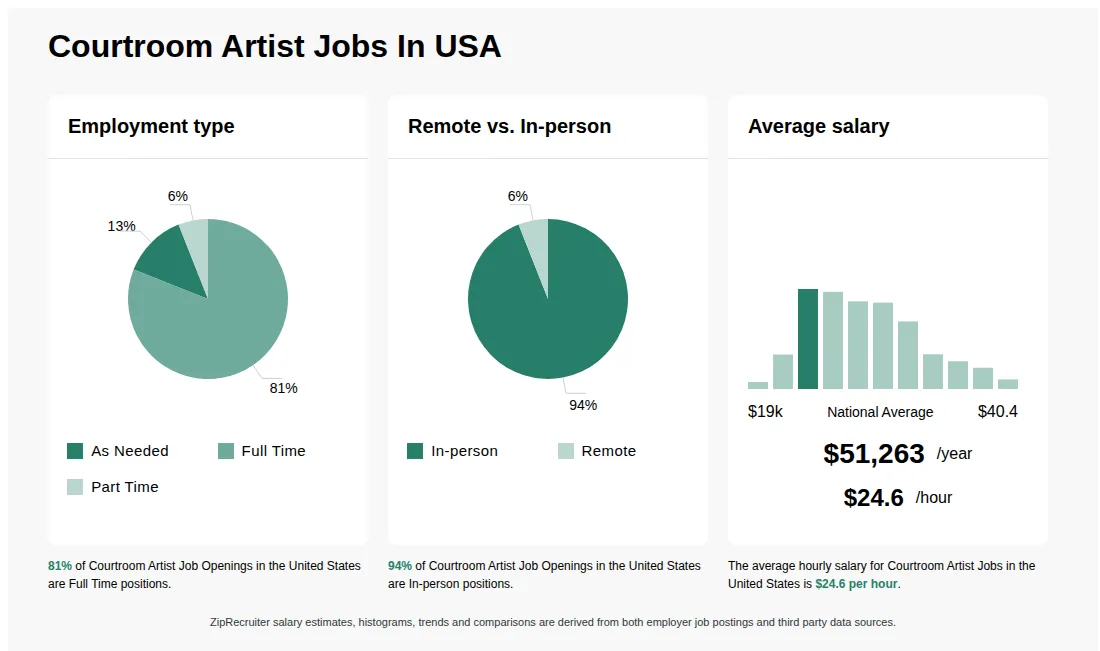
As of Sep 14, 2026, the average hourly pay for courtroom artist in the United States is $24.65, according to ZipRecruiter salary data. Most workers in this role earn between $17.55 and $27.88 per hour, depending on experience, location, and employer.
What is a courtroom artist?
A courtroom artist is a professional who creates visual illustrations of courtroom proceedings, often for media outlets when cameras are not allowed in the courtroom. They quickly sketch key moments, such as witness testimonies, defendant reactions, and judge rulings, capturing the atmosphere and expressions. These artists must work under tight deadlines and have a strong understanding of anatomy, perspective, and expression. Their work helps the public stay informed about high-profile trials through newspapers, television, and online media.
What skills and qualifications are needed to be a courtroom artist?
To thrive as a Courtroom Artist, you need proficient drawing and observational skills, a deep understanding of human anatomy, and a portfolio that demonstrates quick, accurate sketching under pressure. Traditional media such as pencils, charcoal, and pastels are primarily used, and while formal art training or certification can be beneficial, it is not always required. Attention to detail, discretion, professionalism, and the ability to work quietly in high-stakes environments are key soft skills. These abilities ensure accurate documentation of courtroom proceedings while respecting legal protocols and tight deadlines.
What are the biggest challenges a courtroom artist typically faces on the job?
Courtroom artists often face significant challenges such as limited time to capture likenesses during fast-paced proceedings, restricted space to work in crowded courtrooms, and strict rules on discretion and non-interference. They must quickly observe and sketch subjects—sometimes from memory if obstructions occur—and ensure their work does not disrupt the process or privacy of participants. Despite these challenges, many artists find the work rewarding due to its historical significance and unique access to high-profile trials. Staying adaptable and prepared helps overcome these common obstacles.
How do you become a courtroom artist?
To become a courtroom artist, individuals typically develop drawing skills through art education or self-study, and gain experience in sketching quickly and accurately. Many courtroom artists have backgrounds in fine arts or illustration and may need to familiarize themselves with courtroom procedures and legal environments. Building a portfolio and networking with media outlets or legal professionals can also help in securing opportunities in this specialized field.
More about Courtroom Artist jobs
What cities are hiring for Courtroom Artist jobs?
Cities with the most Courtroom Artist job openings:
What are the most commonly searched types of Courtroom Artist jobs?
The most popular types of Courtroom Artist jobs are:
What states have the most Courtroom Artist jobs?
States with the most job openings for Courtroom Artist jobs include:
What are popular job titles related to Courtroom Artist jobs?
For Courtroom Artist jobs, the most frequently searched job titles are:

Trial Courtroom Presentation Specialist # 373
Washington, DC
JLGOV LLC
• Network Security • 1 - 10 employees1 - 10 employees
$35 - $42/hr
Full-time
Posted 24 days ago
Job description
Trial Courtroom Presentation Specialist - IMMEDIATE HIRE!!!
Location: Washington, DC (On-Site)
Work Arrangement: Primarily onsite
Employment Type: Part-time, six-month contract-to-hire
Pay Range: $35-$42/ hour
Travel: Travel: Approximately 25% travel may be required, including extended stays for trials. Pre-approved business travel expenses will be reimbursed in accordance with company and contract requirements.
Security Requirement: Due to the nature of the work, U.S. citizenship is required and the ability to obtain a DOJ Public Trust
Position Overview - A paralegal or attorney could qualify if they also have the required technical courtroom presentation experience.
JLGOV is seeking an experiencedTrial Courtroom Presentation Specialist to support the U.S. Department of Justice Civil Rights Division. The selected candidate will work directly with attorneys, expert witnesses, and litigation teams to prepare and present evidence, develop persuasive visual materials, operate courtroom presentation systems, and provide live "hot seat" support during trials and other legal proceedings.
This is a six-month contract-to-hire opportunity.Conversion to the prime contractor may be considered after the initial assignment but is not guaranteed. Benefits provided at 6-month transition.
Key Responsibilities
- Prepare, organize, sequence, and present exhibits and multimedia evidence.
- Operate OnCue, Sanction, and courtroom presentation systems.
- Provide live courtroom "hot seat" support during trials, hearings, arbitrations, and mediations.
- Work with attorneys and expert witnesses to develop trial presentation strategies.
- Create PowerPoint presentations, demonstratives, infographics, graphics, video, and other multimedia content.
- Design courtroom and war-room display layouts.
- Oversee courtroom equipment installation, testing, and technical readiness.
- Support litigation databases, imaging tools, tablets, iPads, and other mobile devices.
- Troubleshoot presentation and audiovisual issues in high-pressure environments.
- Travel to trial locations and support extended or weekend schedules when required.
Required Qualifications
- Experience supporting and consulting on at least 10 trials.
- Hands-on proficiency with OnCue and Sanction.
- Experience with Relativity, CaseMap, or comparable litigation-support applications.
- Strong Microsoft PowerPoint and Adobe Creative Suite skills.
- Experience developing courtroom graphics, demonstratives, and multimedia presentations.
- Experience supporting mobile devices, tablets, and iPads during trials.
- Bachelor's degree in multimedia, digital design, marketing, fine arts, or a related discipline.
- Excellent communication, teamwork, judgment, and problem-solving skills.
- Ability to work effectively under tight deadlines and high-pressure trial conditions.
- Ability to travel for extended periods and work variable schedules.
- U.S. citizenship.
- Ability to obtain and maintain a DOJ Public Trust.
Preferred Qualifications
- Law degree or litigation paralegal training.
- Experience with video editing, 2D graphics, or 3D animation.
- Experience with WordPress, Webflow, Bootstrap, HTML, CSS, or Dreamweaver.
- Prior experience supporting federal litigation teams.
Schedule
Standard support is generally Monday through Friday, 8:30 a.m. to 5:00 p.m. Eastern Time. Active trials may require 10- to 12-hour days, weekend work, and travel.
Compensation
The anticipated candidate pay range is $40.00-$48.00 per hour, based on trial experience, courtroom presentation software proficiency, graphic and multimedia capabilities, and availability.
JLGOV LLC is an equal opportunity employer. Employment decisions are based on qualifications, merit, and business need.

About JLGOV
Sourced by ZipRecruiter
Industry
Network security
Company size
1 - 10 Employees
Headquarters location
Virginia Beach, VA, US
Year founded
2009