The Computer Vision & AI Integration Engineer is responsible for identifying, evaluating, and ... Evaluate and select cameras, lighting systems, sensors, AI platforms, robotics solutions, and ...
The Computer Vision & AI Integration Engineer is responsible for identifying, evaluating, and ... Evaluate and select cameras, lighting systems, sensors, AI platforms, robotics solutions, and ...

Senior Staff Software Engineer, Geometric Computer Vision, Google Beam
Seattle, WA · On-site
$139K - $183K/yr
Bachelor's degree in Computer Science, Computer Vision , Robotics, or equivalent practical experience. * 8 years of experience in software development using modern C++, multithreading, and systems ...
Senior Staff Software Engineer, Geometric Computer Vision, Google Beam
Seattle, WA · On-site
$139K - $183K/yr
Bachelor's degree in Computer Science, Computer Vision , Robotics, or equivalent practical experience. * 8 years of experience in software development using modern C++, multithreading, and systems ...

Staff Computer Vision Engineer
Chicago, IL · On-site
$120K - $151K/yr
I have years of relevant professional or applied research experience in computer vision, machine learning, machine vision, robotics, industrial automation, or related disciplines. * I have ...
Staff Computer Vision Engineer
Chicago, IL · On-site
$120K - $151K/yr
I have years of relevant professional or applied research experience in computer vision, machine learning, machine vision, robotics, industrial automation, or related disciplines. * I have ...

Computer Vision Engineer
San Diego, CA · On-site
$118K - $139K/yr
... robotics, and immersive AR/VR platforms. The group's work spans computer vision and video algorithm development, mapping these algorithms to computer vision and neural-processing accelerator ...
Computer Vision Engineer
San Diego, CA · On-site
$118K - $139K/yr
... robotics, and immersive AR/VR platforms. The group's work spans computer vision and video algorithm development, mapping these algorithms to computer vision and neural-processing accelerator ...
Computer Vision Engineer
Huntsville, AL · On-site
$106K - $125K/yr
Integrate computer vision capabilities into simulation, XR, or training software systems ... Familiarity with XR, robotics, geospatial, digital twin, or defense training applications
Computer Vision Engineer
Huntsville, AL · On-site
$106K - $125K/yr
Integrate computer vision capabilities into simulation, XR, or training software systems ... Familiarity with XR, robotics, geospatial, digital twin, or defense training applications

Computer Vision Engineer
San Diego, CA · On-site
$118K - $139K/yr
... robotics, and immersive AR/VR platforms. The group's work spans computer vision and video algorithm development, mapping these algorithms to computer vision and neural ‑ processing accelerator ...
Computer Vision Engineer
San Diego, CA · On-site
$118K - $139K/yr
... robotics, and immersive AR/VR platforms. The group's work spans computer vision and video algorithm development, mapping these algorithms to computer vision and neural ‑ processing accelerator ...
Senior Staff Software Engineer, Geometric Computer Vision, Google Beam
Mountain View, CA · On-site
$143K - $189K/yr
Bachelor's degree in Computer Science, Computer Vision , Robotics, or equivalent practical experience. * 8 years of experience in software development using modern C++, multithreading, and systems ...
Senior Staff Software Engineer, Geometric Computer Vision, Google Beam
Mountain View, CA · On-site
$143K - $189K/yr
Bachelor's degree in Computer Science, Computer Vision , Robotics, or equivalent practical experience. * 8 years of experience in software development using modern C++, multithreading, and systems ...
Robotics Vision Engineer
San Ramon, CA · On-site
Develop and evaluate state-of-the-art computer vision algorithms for real-time control of robots and other hardware devices * Port, implement, and optimize analytics and machine learning algorithms ...
Robotics Vision Engineer
San Ramon, CA · On-site
Develop and evaluate state-of-the-art computer vision algorithms for real-time control of robots and other hardware devices * Port, implement, and optimize analytics and machine learning algorithms ...
Robotics Vision Engineer
San Ramon, CA · On-site
Develop and evaluate state-of-the-art computer vision algorithms for real-time control of robots and other hardware devices * Port, implement, and optimize analytics and machine learning algorithms ...
Quick apply
Robotics Vision Engineer
San Ramon, CA · On-site
Develop and evaluate state-of-the-art computer vision algorithms for real-time control of robots and other hardware devices * Port, implement, and optimize analytics and machine learning algorithms ...
Robotics Vision Engineer
San Ramon, CA · On-site
Develop and evaluate state-of-the-art computer vision algorithms for real-time control of robots and other hardware devices * Port, implement, and optimize analytics and machine learning algorithms ...
Robotics Vision Engineer
San Ramon, CA · On-site
Develop and evaluate state-of-the-art computer vision algorithms for real-time control of robots and other hardware devices * Port, implement, and optimize analytics and machine learning algorithms ...
Computer Vision Engineer
Austin, TX · On-site
$110K - $130K/yr
Our vision systems, like ScrapEye, bring real-time computer vision into harsh industrial ... Robotics or autonomous systems engineers * Researchers who have transitioned to building and ...
Computer Vision Engineer
Austin, TX · On-site
$110K - $130K/yr
Our vision systems, like ScrapEye, bring real-time computer vision into harsh industrial ... Robotics or autonomous systems engineers * Researchers who have transitioned to building and ...
You should be comfortable working across software, computer vision, ML, data operations, and customer‑facing technical scoping. What You'll Do * Build systems for robotics and physical AI data ...
You should be comfortable working across software, computer vision, ML, data operations, and customer‑facing technical scoping. What You'll Do * Build systems for robotics and physical AI data ...

At Amazon Robotics we build high-performance, real-time robotic systems that can perceive, learn ... We hire and develop collaborative subject matter experts in AI with a focus on computer vision ...
At Amazon Robotics we build high-performance, real-time robotic systems that can perceive, learn ... We hire and develop collaborative subject matter experts in AI with a focus on computer vision ...

Computer Vision Engineer
San Jose, CA · On-site
$140K - $260K/yr
Design and implement deep-learning and classical computer vision algorithms for real-time, embedded ... Background in subscale aircraft, robotics, or vehicle perception Archer is committed to working ...
Computer Vision Engineer
San Jose, CA · On-site
$140K - $260K/yr
Design and implement deep-learning and classical computer vision algorithms for real-time, embedded ... Background in subscale aircraft, robotics, or vehicle perception Archer is committed to working ...

Extensive experience writing scientific papers, with multiple publications in top machine learning, computer vision or robotics conferences/journals, like CVPR, ICCV, ECCV, PAMI, NeurIPS, IROS, CoRL ...
Extensive experience writing scientific papers, with multiple publications in top machine learning, computer vision or robotics conferences/journals, like CVPR, ICCV, ECCV, PAMI, NeurIPS, IROS, CoRL ...
Senior Staff Software Engineer, Geometric Computer Vision, Google Beam
Seattle, WA · On-site
$139K - $183K/yr
Bachelor's degree in Computer Science, Computer Vision , Robotics, or equivalent practical experience. * 8 years of experience in software development using modern C , multithreading, and systems ...
Senior Staff Software Engineer, Geometric Computer Vision, Google Beam
Seattle, WA · On-site
$139K - $183K/yr
Bachelor's degree in Computer Science, Computer Vision , Robotics, or equivalent practical experience. * 8 years of experience in software development using modern C , multithreading, and systems ...
At Liberty Robotics, we provide 3D volumetric vision guidance systems for robot applications. Our ... Formulate, implement, and validate advanced 2D and 3D computer vision pipelines from mathematical ...
Quick apply
At Liberty Robotics, we provide 3D volumetric vision guidance systems for robot applications. Our ... Formulate, implement, and validate advanced 2D and 3D computer vision pipelines from mathematical ...
At Liberty Robotics, we provide 3D volumetric vision guidance systems for robot applications. Our ... Formulate, implement, and validate advanced 2D and 3D computer vision pipelines from mathematical ...
At Liberty Robotics, we provide 3D volumetric vision guidance systems for robot applications. Our ... Formulate, implement, and validate advanced 2D and 3D computer vision pipelines from mathematical ...
... computer vision or robotics conferences/journals, like CVPR, ICCV, ECCV, PAMI, NeurIPS, IROS, CoRL, etc. Amazon is an equal opportunity employer and does not discriminate on the basis of protected ...
... computer vision or robotics conferences/journals, like CVPR, ICCV, ECCV, PAMI, NeurIPS, IROS, CoRL, etc. Amazon is an equal opportunity employer and does not discriminate on the basis of protected ...

Computer Vision/ML Engineer
Brooklyn, NY · On-site
$117K - $138K/yr
The company Norbert is building autonomous robots that deliver healthcare. Our AI sensing platform ... What you will do: * Design, fine-tune, and deploy computer vision models (YOLO, InsightFace ...
Quick apply
Computer Vision/ML Engineer
Brooklyn, NY · On-site
$117K - $138K/yr
The company Norbert is building autonomous robots that deliver healthcare. Our AI sensing platform ... What you will do: * Design, fine-tune, and deploy computer vision models (YOLO, InsightFace ...
Computer Vision Robotics information
See salary details
$33.5K - $36.2K
1% of jobs
$38.7K is the 25th percentile. Wages below this are outliers.
$36.2K - $39K
26% of jobs
$39K - $41.7K
4% of jobs
$41.7K - $44.4K
3% of jobs
$44.4K - $47.1K
11% of jobs
The median wage is $48K / yr.
$47.1K - $49.9K
15% of jobs
$49.9K - $52.6K
11% of jobs
$54K is the 75th percentile. Wages above this are outliers.
$52.6K - $55.3K
8% of jobs
$55.3K - $58K
8% of jobs
$58K - $60.8K
12% of jobs
$60.8K - $63.5K
1% of jobs
$33.5K
$48.3K
$63.5K
How much do computer vision robotics jobs pay per year?
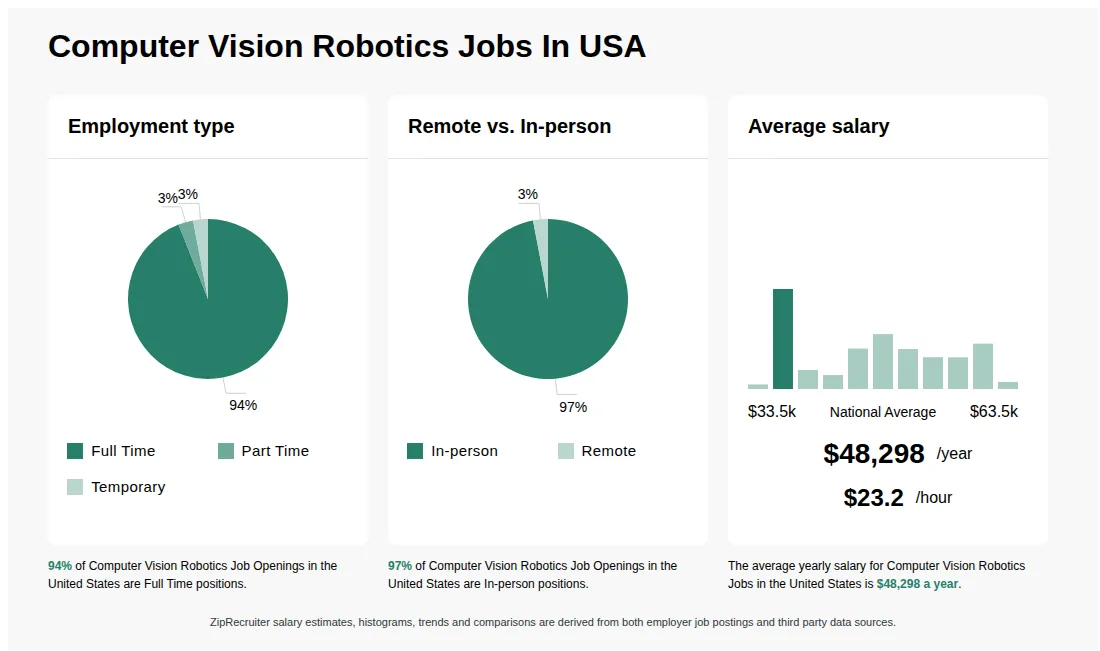
As of Sep 13, 2026, the average yearly pay for computer vision robotics in the United States is $48,298.00, according to ZipRecruiter salary data. Most workers in this role earn between $38,000.00 and $55,500.00 per year, depending on experience, location, and employer.
What is a computer vision robotics?
A Computer Vision Robotics job involves developing algorithms and systems that enable robots to interpret and understand visual data from cameras and sensors. Professionals in this role work on tasks like object recognition, navigation, real-time decision-making, and automation. They use technologies such as machine learning, deep learning, and image processing to enhance robot perception. These jobs are commonly found in industries like manufacturing, healthcare, autonomous vehicles, and agriculture. Strong programming skills in languages like Python and C++, along with experience in frameworks like OpenCV and TensorFlow, are often required.
What types of projects and challenges might I work on as a computer vision robotics professional?
As a Computer Vision Robotics professional, you can expect to work on projects like developing autonomous navigation for robots, creating real-time object detection systems, or improving industrial automation through machine vision. Daily tasks often involve coding algorithms, integrating hardware and sensors, and testing robots in various operational environments. Common challenges include optimizing vision systems for accuracy and speed, ensuring robust performance in diverse real-world conditions, and collaborating with mechanical and electrical engineers. This field is dynamic and demands ongoing learning to keep up with advances in artificial intelligence, hardware, and automation techniques.
What are the key skills and qualifications needed to thrive in the computer vision robotics position, and why are they important?
To thrive as a Computer Vision Robotics professional, you need a solid background in computer vision, robotics engineering, and proficiency with programming languages like Python or C++, often supported by a degree in computer science, engineering, or a related field. Experience with machine learning frameworks (such as TensorFlow or PyTorch), robotics middleware (like ROS), and hands-on familiarity with relevant hardware are highly valuable. Strong problem-solving abilities, creativity, and collaboration skills make candidates stand out in multidisciplinary teams. These skills are critical for designing and implementing innovative computer vision solutions that enable autonomous robotic systems to operate effectively in real-world environments.
More about Computer Vision Robotics jobs
What cities are hiring for Computer Vision Robotics jobs?
Cities with the most Computer Vision Robotics job openings:
What are the most commonly searched types of Computer Vision Robotics jobs?
The most popular types of Computer Vision Robotics jobs are:
What states have the most Computer Vision Robotics jobs?
States with the most job openings for Computer Vision Robotics jobs include:
What are popular job titles related to Computer Vision Robotics jobs?
For Computer Vision Robotics jobs, the most frequently searched job titles are:

Computer Vision & Physical AI Integration Engineer
Southfield, MI
Lear Corporation
• Transportation Equipment Manufacturing • 10K+ employees10,000+ employees
$96K - $129K/yr
Full-time
Re-posted 11 days ago
Lear Corporation rating

7.3
Based on 68 frontline employees who took The Breakroom Quiz
Job description
Lear For You
We work hard for the people who work for us. We champion our teams and foster collaboration, inclusion, respect and excellence. Because we want to be more for you.
A path to a better career. A better future.
Our teams have invented groundbreaking technologies, manufactured millions of products and earned a long list of awards. Year after year, we're named one of the World's Most Admired Companies.
They're the secret to our success-empowered, inventive and inclusive. Passionate about their craft. Driven to succeed. Because we win together.
Are you ready for a better career? A better future?
Job Description
- The Computer Vision & AI Integration Engineer is responsible for identifying, evaluating, and deploying advanced vision, sensing, and AI-enabled solutions across Lear's E-Systems manufacturing operations.
- This role focuses on improving quality, productivity, traceability, and operator effectiveness through technologies such as machine vision, intelligent inspection, edge AI, industrial sensors, robotics, and automated decision support systems.
- Working within the Digital and Automation organization, the engineer partners with manufacturing engineering, plant operations, and external technology providers to develop proof-of-concepts, validate business value, and scale successful solutions across Lear's global manufacturing network
- Join a highly visible group shaping the future of manufacturing through computer vision, AI, and advanced automation, with regular engagement across engineering, operations, and executive leadership.
- Be part of a fast-growing innovation organization with the autonomy to identify opportunities, lead new technology deployments, and help define Lear's global advanced manufacturing strategy
Responsibilities
- Identify high-value use cases for computer vision, intelligent inspection, AI-enabled automation, and advanced sensing technologies
- Define technical standards, best practices, and deployment documentation for vision and AI-enabled applications
- Collaborate with suppliers to implement vision systems for applications including defect detection, assembly verification, process monitoring, traceability, and quality control
- Evaluate and select cameras, lighting systems, sensors, AI platforms, robotics solutions, and system integration partners
- Lead proof-of-concept and pilot projects from requirements definition through technical validation and deployment
- Cooperate with automation, manufacturing engineering, IT, and digital teams to integrate solutions into existing equipment and production systems
- Support deployment and standardization of successful solutions across multiple manufacturing plants.
- Troubleshoot and optimize system performance in production environments
- Monitor emerging technologies in computer vision, industrial AI, robotics, and smart manufacturing to identify new opportunities for operational improvement
- Up to 25% travel
Education Requirements
- Bachelor's degree in Electrical Engineering, Mechatronics, Robotics, Computer Engineering, Industrial Engineering, Computer Science, or a related field
Experience Requirements
- 3+ years of experience in manufacturing automation, machine vision, robotics, industrial controls, or AI-enabled manufacturing solutions
- Experience evaluating and managing automation, vision, AI, robotics, or system integration vendors.
- Strong understanding of manufacturing automation technologies, including PLCs, HMIs, industrial networks, and production equipment integration.
- Demonstrated success leading technical pilots, prototypes, or implementation projects from concept through deployment.
- Ability to solve complex manufacturing challenges through structured problem-solving and technology application.
- Strong communication and collaboration skills across engineering, operations, IT, and external partners.
Bonus If You Have:
- Hands-on experience with computer vision, deep learning, AI-based inspection, or edge computing applications.
- Experience in wire harness manufacturing environments.
- Familiarity with MES, SCADA, industrial data platforms, and manufacturing system integration.
Certifications / Licenses
Equal Opportunity Employer
Lear Corporation is committed to fair, meritbased employment practices and equal opportunity.
We provide reasonable accommodations in accordance with applicable law. For assistance during the application process, contact your recruiter directly.
Applicants must submit their resume for consideration using our applicant tracking system. Due to the high volume of applications received, only candidates selected for interviews will be contacted. Candidates must be legally authorized to work in the country where the position is located. Unsolicited resumes from search firms, employment agencies, or similar, will not be paid a fee and will become the property of Lear Corporation.
What Lear Corporation employees say
Pay
Benefits
Hours and flexibility
Workplace
Get the full story on Breakroom

About Lear
Sourced by ZipRecruiter
Industry
Transportation equipment manufacturing
Company size
10,000+ Employees
Headquarters location
Southfield, MI, US
Year founded
1917