1

Computer Science Professor Jobs in Columbus, OH (NOW HIRING)

Computer Science Professor information

See Columbus, OH salary details

$10.3K

$118.3K

$159.8K

How much do computer science professor jobs pay per year?

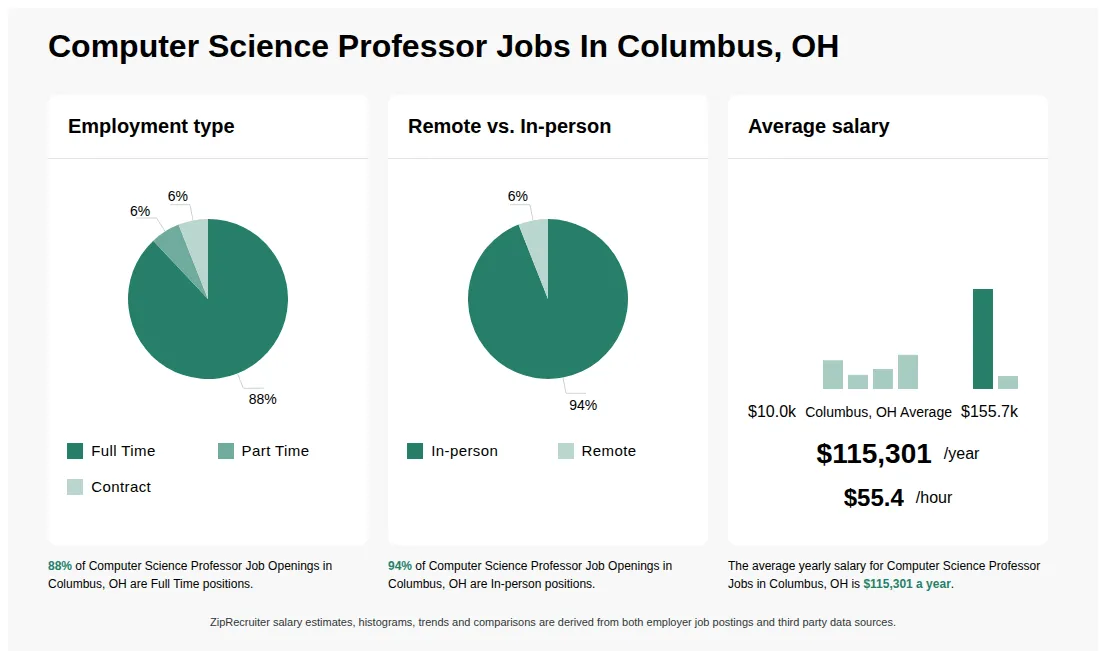
As of Sep 5, 2026, the average yearly pay for computer science professor in Columbus, OH is $118,299.00, according to ZipRecruiter salary data. Most workers in this role earn between $86,000.00 and $143,000.00 per year, depending on experience, location, and employer.

What does a computer science professor do?

A computer science professor teaches at a technical college or university. You create and teach courses in computer science (CS) or related programming or technology subjects. In this career, you prepare the syllabus for each class, deliver lectures and instructions, and use exams and quizzes to assess the performance of students. In many computer science classes, your responsibilities include allowing students to practice the subject matter in a computer lab. You facilitate this practice and offer guidance during lab sessions. In addition to your teaching duties, you sometimes give academic or career advice to students in CS degree programs.

What does a computer science professor do?

A Computer Science Professor teaches courses in computer science at the college or university level, covering topics such as programming, algorithms, data structures, artificial intelligence, and more. In addition to teaching, they often conduct research in specialized areas, publish academic papers, and supervise student projects or theses. Computer Science Professors also advise students, develop curriculum, and may participate in departmental administration or service. Their work is crucial in advancing the field of computer science and preparing the next generation of technology professionals.

What are the key skills and qualifications needed to thrive as a computer science professor?

To thrive as a Computer Science Professor, you need an advanced degree in computer science or a related field, strong research background, and expertise in core topics like algorithms, programming, and systems. Familiarity with learning management systems (LMS), programming environments, and publication platforms is typically required, along with a record of scholarly publication and potentially relevant certifications. Excellent communication, mentorship, and curriculum development skills help foster student engagement and support academic growth. These skills and qualifications are vital for delivering high-quality instruction, advancing research, and contributing to the academic community.

What are some common challenges faced by computer science professors in balancing teaching, research, and administrative responsibilities?

Computer Science Professors often juggle multiple responsibilities, including delivering lectures, guiding student projects, conducting original research, publishing papers, and participating in departmental or university committees. Balancing these can be challenging, especially during peak periods like exam seasons or major research deadlines. Effective time management and prioritization are crucial, as is seeking support from colleagues and administrative staff. Many professors also find it helpful to establish a clear schedule and set boundaries to maintain productivity and job satisfaction.

What is the difference between Computer Science Professor vs Software Developer?

AspectComputer Science ProfessorSoftware Developer
Required CredentialsTypically a Ph.D. in Computer Science or related fieldBachelor's or Master's in Computer Science or related field; certifications optional
Work EnvironmentAcademic institutions, research labs, universitiesCorporate offices, tech companies, startups
Industry UsageResearch, teaching, academic publishingSoftware development, product creation, coding
Common Search/ComparisonYesYes

While both roles involve computer science knowledge, a Computer Science Professor primarily focuses on teaching, research, and academic publishing, often requiring a Ph.D. and working in educational institutions. In contrast, a Software Developer applies programming skills to create software products in corporate or startup environments, typically with a bachelor's or master's degree. The roles differ in work environment, responsibilities, and career paths but share foundational computer science expertise.

What are popular job titles related to Computer Science Professor jobs in Columbus, OH?

For Computer Science Professor jobs in Columbus, OH, the most frequently searched job titles are:

Infographic showing various Computer Science Professor job openings in Columbus, OH as of August 2026, with employment types broken down into 100% Full Time. Highlights an 100% In-person job distribution, with an average salary of $119,188 per year, or $57.3 per hour.

Assistant/Associate Professor of Artificial Intelligence and Machine Learning in...

XPrep Learning Solutions LLC

Columbus, OH • On-site

$110 - $170/hr

Other

Posted 5 days ago


Job description

Assistant/Associate Professor of Artificial Intelligence and Machine Learning in Veterinary Population Health

The Ohio State University

Columbus, OH

The Department of Veterinary Preventive Medicine in the College of Veterinary Medicine at The Ohio State University invites applications for a full-time, tenure-track faculty appointment at the rank of Assistant or Associate Professor, specializing in Artificial Intelligence (AI) and Machine Learning (ML). We seek an AI/ML scholar whose research focuses on developing and applying innovative computational methods to address critical challenges in veterinary medicine, disease prevention and control, and population health. Ideal candidates will have a strong background in AI/ML and a demonstrated ability to translate advanced analytical approaches into meaningful discoveries and practical applications relevant to animal health and welfare. This position complements The Ohio State University’s AI Hiring Initiative to harness AI to revolutionize the translation of ideas to real-world solutions for Ohio and beyond.
The primary responsibilities of this position will be to conduct innovative, translational research at the intersection of advanced computational data science and veterinary medicine. Candidates must demonstrate significant AI/ML expertise as a core element of their scholarship through the development of novel methods or the application of existing approaches that generate new scientific knowledge, methodological advances, or practice solutions for veterinary preventive medicine and population health. The successful candidates will maintain an extramurally funded research program that prioritizes translational science discoveries using novel approaches that support animal health and/or welfare. The position is intended for faculty whose scholarly contributions are centered on AI/ML and their advancement or innovative application in veterinary and population health contexts, rather than the routine use of existing AI tools.
The successful candidate is expected to maintain a teaching program. Teaching responsibilities will include providing instruction to veterinary and graduate students on topics that may include preventive medicine, animal welfare, and/or disease diagnosis and prevention and control. The candidate may also be expected to develop and deliver content that expands AI literacy and promotes the responsible and effective use of AI tools in veterinary medicine and related disciplines.
The successful candidate is expected to serve in department, college, and university level initiatives including the OSU AI(x) Hub that aims to pioneer AI innovation for the public good. They will also have the opportunity to engage with regulatory agencies and external stakeholders to use AI to advance veterinary medicine. The specific distribution of effort will be adjusted to reflect the strengths and interests of the successful candidate but will remain predominately focused on research.

Performance Objectives
  • Conduct translational researchusing AI/MLapproachesto address challenges in veterinary medicine, disease preventionand control, and population health. Illustrative examplesinclude:
  • Traditional and syndromic disease surveillance
  • Precision livestock farming,herd health informatics, and integrated decision support
  • Predictive modelingfordisease prevention,diagnosis,treatment, and population healthand welfaremanagement
  • Populationgenomics,geneticsand epidemiological forecasting
  • Develop andmaintaina nationally and internationally recognized, extramurally funded research program focused on applied AI and machine learning in preventiveveterinarymedicine and population health.
  • Collaborate across disciplines (e.g., computer science, data analytics, public health,agriculture, medicine,and veterinary medicine) to foster cross-cutting research.
  • Deliver high-quality instruction incore and elective topics, which may include veterinary preventive medicine, epidemiology, animal welfare, and data-drivendiseaseprevention and control
  • Contribute to educational activities thatexpandAI literacyand promotetheresponsibleuse and evaluationofAIin veterinary medicine
  • Mentorgraduatestudents (MS/PhD) and postdoctoral fellows in applied data science and population health
  • Engage with profession organizations, regulatory agencies, and industry stakeholders to advance the field of veterinary medicine
  • Provide service to the department, college, and university through committee participation, academic governance, and participation inOSUAI(X) Hub.
Education and Experience Requirements

Ideal candidates willdemonstratesignificant AIexpertiseas a core element of their scholarship whether through the creation of new AI methods or novel use of AI techniques that materially advance knowledge, methods, or practice in their discipline.

  • DVM (or equivalent) or a PhD in Epidemiology, Veterinary Preventive Medicine, Biomedical Informatics, Computer Science, Data Science, or a closely related field.
  • Demonstratesatrack recordofscholarship centered onAI/ML methodologies applied to biological, medical, or population-level data.
  • Evidence of, or strong potential for, securing extramural research funding.
  • Strong communicationskills

Desired:

  • Both a DVM and a PhD in an AI relevant field
  • Board certification (or eligibility) ina relevant veterinary specialty (e.g., ACVPM, ACZM, ACVM)
  • Hands-on experience deploying AI/ML models in practical, clinical, agricultural, or wildlife settings
  • Prior experience teaching epidemiology, biostatistics, or digital health concepts to non-computational learners
Additional Information

The offer for this position will be based on internal equity and the candidate's qualifications.
Ohio State provides access to a depth and breadth of opportunities and resources. Starting your first day, Ohio State offers you a comprehensive benefits package.
The university is an equal opportunity employer, including veterans and disability.

#J-18808-Ljbffr