1

Cartography Jobs in Ohio (NOW HIRING)

Bachelor's Degree in geography, cartography, GIS or closely related field (or commensurate experience); and minimum 7 years professional experience, Windows Excel and Powerpoint, ArcGIS Pro, and must ...

Job Requirements Bachelor's Degree in geography, cartography, GIS or closely related field (or commensurate experience); and minimum 7 years professional experience, Windows Excel and Powerpoint ...

GIS Technician Associate

New Albany, OH · On-site

$22.14 - $32.49/hr

Job Summary Creating cartographic output (map making), data manipulation, data creation from digitization or field survey, basic data management, and basic map development. Interpret and enter field ...

$25 - $35.13/hr

Prepare cartographic exhibits. * Monitor, create, and manage work orders in the Cityworks system. * Maintain hardware and field equipment. * Provide support to internal and external customers.

Cartography information

See Ohio salary details

$34.7K

$72.5K

$107.9K

How much do cartography jobs pay per year?

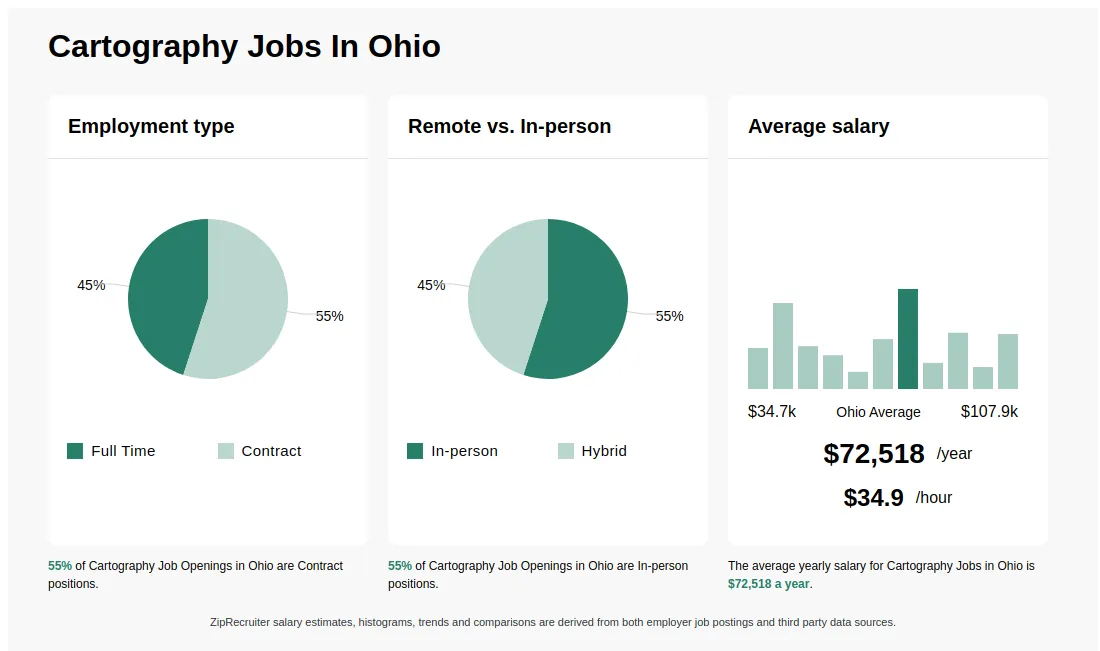
As of Aug 12, 2026, the average yearly pay for cartography in Ohio is $72,518.00, according to ZipRecruiter salary data. Most workers in this role earn between $50,400.00 and $89,800.00 per year, depending on experience, location, and employer.

What is cartography?

Cartography is the science and art of making maps. It involves the collection, analysis, interpretation, and representation of geographic information to create visual depictions of areas, regions, or features on the Earth. Cartographers use a combination of technical skills, geographic knowledge, and design principles to create maps for various purposes, including navigation, education, and research. Modern cartography often utilizes digital tools and Geographic Information Systems (GIS) to produce interactive and accurate maps.

Is cartography still a career?

Yes, cartography is still a viable career that involves creating and updating maps using GIS software, satellite imagery, and data analysis. The field has evolved with technology, requiring skills in digital mapping, spatial analysis, and geographic information systems, and offers opportunities in government, environmental management, urban planning, and technology sectors.

What are the key skills and qualifications needed to thrive as a cartographer, and why are they important?

To thrive as a Cartographer, you need a strong background in geography, spatial data analysis, and map design, usually supported by a degree in geography, cartography, or GIS. Familiarity with Geographic Information Systems (GIS), remote sensing software, and computer-aided design (CAD) tools is typically required. Attention to detail, problem-solving abilities, and effective communication skills help cartographers interpret complex data and collaborate with diverse teams. These skills ensure the creation of accurate, visually clear maps that support decision-making in fields like urban planning, navigation, and environmental management.

What is the difference between Cartography vs GIS Specialist?

AspectCartographyGIS Specialist
Required CredentialsDegree in Geography, Cartography, or related fieldDegree in Geography, GIS, or related field; GIS certifications
Work EnvironmentDesigning maps, visualizing spatial data, often in offices or labsManaging GIS databases, analyzing spatial data, often in offices or fieldwork
Industry UsageCreating maps for publications, navigation, or planningSpatial data analysis, GIS software management, and data integration

While both roles involve working with spatial data, cartographers focus on designing and producing maps, emphasizing visual representation. GIS specialists handle data analysis, database management, and spatial analysis using GIS software. Both roles often overlap but serve different primary functions within the geospatial industry.

How can I get into cartography?

To pursue a career in cartography, obtaining a bachelor's degree in geography, GIS, or a related field is common. Developing skills in GIS software like ArcGIS or QGIS, gaining experience through internships or projects, and earning certifications can improve job prospects in this field.

How do cartographers typically collaborate with other professionals during a mapping project?

Cartographers often work closely with surveyors, GIS analysts, urban planners, and environmental scientists to gather and interpret spatial data for accurate map creation. Collaboration usually involves regular meetings to discuss project requirements, data sources, and design preferences. Effective communication and teamwork are essential, as cartographers must ensure that the maps produced meet the needs of diverse stakeholders and adhere to project specifications. This interdisciplinary approach not only enhances map quality but also provides valuable insights from different fields.

Do cartographers make a lot of money?

Cartographers typically earn a median annual salary that is around the national average for technical and scientific roles, with salaries varying based on experience, education, and location. Advanced skills in GIS software and cartographic tools can lead to higher pay, especially in specialized or senior positions.

What are cartography jobs?

Cartography jobs are any jobs involving drawing maps, doing geospatial data analysis, or using geographic information systems (GIS). Some specific jobs in cartography include cartographer, GIS technician, database administrator, mapping technician, software engineer, and systems analyst, to name just a few. Many industries, including natural resource extraction and tech, employ cartographers and other GIS specialists. You can also find work with numerous government agencies, such as the National Oceanographic and Atmospheric Administration, U.S. Geological Survey, and the Bureau of Land Management.

What are the most commonly searched types of Cartography jobs in Ohio? The most popular types of Cartography jobs in Ohio are:
What cities in Ohio are hiring for Cartography jobs? Cities in Ohio with the most Cartography job openings:
Infographic showing various Cartography job openings in Ohio as of August 2026, with employment types broken down into 100% Full Time. Highlights an 100% In-person job distribution, with an average salary of $72,518 per year, or $34.9 per hour.

Full-time

Re-posted 3 days ago


EOG Resources rating

8.1

Company rating: 8.1 out of 10

Based on 16 frontline employees who took The Breakroom Quiz

27th of 86 rated oil and gas companies


Job description

Provide mapping and analysis support for the entire Land, Regulatory, Environmental, and Operations effort; able to interpret difficult land and legal descriptions and integrate data while maintaining all processes and data management standards. Duties include management of GIS raster, vector, and tabular data sets to perform GIS analysis, as well as production of GIS graphics in both report and presentation forms.  Work toward developing new ways to integrate GIS technology and implementing into daily workflows.

Bachelor's Degree in geography, cartography, GIS or closely related field (or commensurate experience); and minimum 7 years professional experience, Windows Excel and Powerpoint, ArcGIS Pro, and must have an applied understanding of geoprocessing and experience with FME and/or ModelBuilder.  Experience with Portal for ArcGIS, and Python scripting preferred but not required.   Familiar with oil and gas leasing and assignments, legal land descriptions, and map projections.  Experience in the Ohio Utica region, oil & gas operations, pipelines and facilities a plus.
 
Must be a team player and self-motivated with an ability to maintain cooperative relationships with those contacted in the course of work activities. Candidates should be detail oriented and possess an eye for efficiency and developing ways to make workflows more efficient.  
Position will be filled at a level commensurate with experience. 

EOG Resources is an Equal Opportunity Employer including Veterans and Disabled.
Education:Employment Type: FULL_TIME

What EOG Resources employees say

Pay

Benefits

Hours and flexibility

Workplace

Get the full story on Breakroom