1

C++ Quant Developer Jobs in California (NOW HIRING)

Experience in optical instrumentation, data collection, and automation using MATLAB, Python, C/C ... Strong quantitative data & image analysis skills utilizing JMP, MATLAB, or similar tools.

You need to have a working skillset in programming, preferably python, with some exposure to C/C++ or other compiled languages. On the statistics side, you will need a working knowledge of statistics ...

Software Engineer III

San Diego, CA · On-site +1

$125K - $175K/yr

... C&A) processes in compliance with DoD cybersecurity standards. Overview Location * San Diego, CA ... Agile Developer certification or Certified Scrum Developer certification * DoD 8570 IAT Level II, ...

... quant researcher). The bet: computer vision and agentic vision-language models (VLMs) grounded in ... Build backend systems on a modern startup stack, comfortable close to the metal (C/C++/Rust) * Own ...

... quantitative measurement of colorization quality, and the user interface 2. Work in WBC diff area ... and/or C/C++/C#, and/or Java, Qualifications Possesses educational qualifications and work ...

Senior Data Scientist, Apple Ads

Cupertino, CA · On-site

$147.40 - $272.10/hr

Bachelor's degree in Statistics, Economics, Mathematics, Computer Science, Engineering, Data Science, or a related quantitative discipline, or equivalent practical experience * Experience in Data ...

Showing results 41-60

C Quant Developer information

What is a C++ quant developer?

A C++ Quant Developer is a specialized software engineer who builds and maintains quantitative trading models, tools, and infrastructure for financial institutions using the C++ programming language. Their work involves implementing algorithms for pricing, trading, and risk management, often in high-frequency or low-latency environments. They collaborate closely with quantitative analysts ('quants') to translate mathematical models into efficient, reliable code. This role requires strong programming skills, a solid understanding of mathematics and finance, and the ability to optimize code for performance-critical applications.

What are the key skills and qualifications needed to thrive as a C++ quant developer, and why are they important?

To excel as a C++ Quant Developer, you typically need strong programming skills in C++, a solid foundation in mathematics or quantitative finance, and at least a bachelor's degree in a technical field such as computer science, mathematics, or engineering. Familiarity with financial libraries, low-latency trading systems, and version control tools like Git is common, and proficiency in UNIX/Linux environments is often required. Exceptional problem-solving abilities, attention to detail, and effective communication skills distinguish top performers in this role. These competencies enable developers to design robust, efficient trading algorithms and collaborate effectively with quantitative researchers and traders in high-stakes financial environments.

What are some common challenges faced by C++ quant developers when implementing trading algorithms in a live environment?

C++ Quant Developers often face challenges related to optimizing code for ultra-low latency and high reliability, as even minor inefficiencies can impact trading performance. Debugging and testing algorithms in a live environment is complex due to the need for accuracy, speed, and managing large volumes of data under real-time constraints. Collaboration with quantitative analysts, traders, and infrastructure teams is essential to ensure that models are not only mathematically sound but also robust and scalable in production. Staying updated with the latest advancements in both C++ and financial technology is also crucial for success in this role.

What does a C++ quant developer do?

The duties of a C++ quantitative developer involve financial software development using the C++ programming language. In many cases, other traders or Quant professionals write prototype code for financial institutions in a programming language such as Python or R. This prototype code is then translated into C++ by a quantitative developer. Qualifications to become a quantitative developer include a bachelor’s degree in financial engineering, computer science, or a closely related field.

What is the difference between C++ Quant Developer vs Quantitative Analyst?

AspectC++ Quant DeveloperQuantitative Analyst
Required CredentialsDegree in Computer Science, Mathematics, or related field; programming certificationsDegree in Finance, Economics, or Mathematics; often CFA or FRM certifications
Work EnvironmentFinancial firms, hedge funds, trading firms; focus on software developmentFinancial institutions, asset management; focus on data analysis and modeling
Employer & Industry UsagePrimarily in quantitative trading and algorithm developmentRisk management, investment analysis, and strategy formulation

The main difference is that C++ Quant Developers focus on building and optimizing trading systems using C++, while Quantitative Analysts analyze data and develop models to inform trading strategies. Both roles require strong quantitative skills, but their daily tasks and focus areas differ significantly.

What job categories do people searching C++ Quant Developer jobs in California look for? The top searched job categories for C++ Quant Developer jobs in California are:
What are popular job titles related to C++ Quant Developer jobs in CA? For C++ Quant Developer jobs in CA, the most frequently searched job titles are:
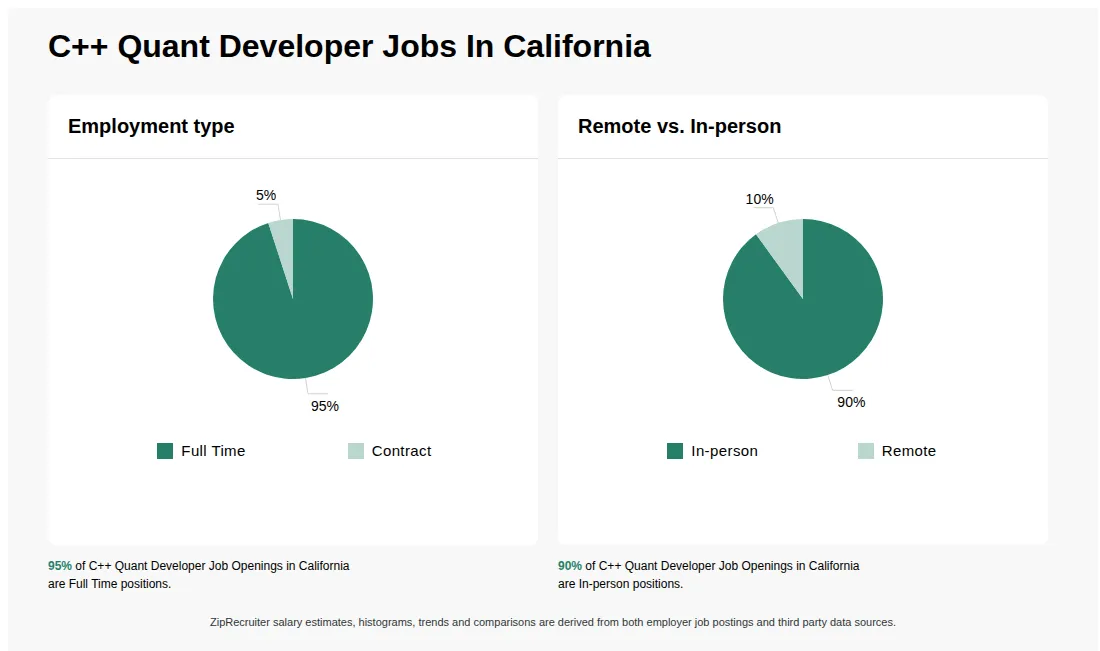
Infographic showing various C++ Quant Developer job openings in California as of August 2026, with employment types broken down into 100% Full Time. Highlights an 90% In-person, 2% Hybrid, and 8% Remote job distribution.

AI Performance Modeling Engineer

quadric, Inc

Burlingame, CA • On-site

$150K - $200K/yr

Full-time

Medical, Dental, Vision, Life, Retirement, PTO

Posted 3 days ago

New


Job description

About Quadric

Quadric is redefining edge AI with the industry's first General Purpose Neural Processing Unit (GPNPU), enabling developers to run both neural network inference and conventional C++ code on a single programmable architecture. Our technology powers intelligent edge devices across automotive, industrial, robotics, and embedded systems.

Founded by technologists from MIT and Carnegie Mellon, Quadric is a well-funded growth-stage semiconductor IP company with a growing licensing business. As we enter our next phase of growth, we're looking for our first true marketing leader to build and scale the function.

The Opportunity

Quadric has created an innovative General-Purpose Neural Processing Unit (GPNPU) architecture. Unlike standard accelerators, the Quadric GPNPU executes both neural network graph code and conventional C++ DSP/control code across edge and endpoint devices.

As an AI Performance Modeling Engineer, you will build analytical, cycle-level performance models of AI inference workloads on our next-generation architecture in Python before silicon exists. These models directly guide team decisions on hardware lane bindings, tensor placement, and architecture trade-offs. We welcome candidates across all experience levels—from early-career engineers to seasoned experts—with direct mentorship provided to help you master mapping complex workloads (like LLMs) onto our custom hardware.

What You'll DoPerformance Modeling & Architectural Analysis
  • Build analytical, cycle-level Python models of AI inference workloads executing on next-generation GPNPU hardware.
  • Derive from first principles which hardware lanes operations bind on (compute, on-chip/external memory bandwidth, interconnect) and model software pipelining overlaps.
  • Model tensor placement, tiling across processing elements, local memory residency, and data movement across memory tiers.
  • Model sharding and collective boundary communication across multi-die systems.
Workload Adaptation & Technical Writing
  • Incorporate architectural details across vision networks and Large Language Models (LLMs), including operator mix, sparsity, routing, and quantization/low-precision numeric formats.
  • Calibrate performance models against an instruction-set simulator and profiling traces to meet stated accuracy targets.
  • Write and defend technical studies presenting empirical evidence that directly informs architecture and product decisions.
  • Balance single-stream latency against scaled throughput performance.
What Success Looks Like

Within your first 6–12 months, you'll:

  • Own a full workload's model end to end, calibrated against simulation and trusted by the engineering team.
  • Build performance models that consistently predict workload behavior within 10–15% of actual measurements.
  • Publish a written study whose defended conclusions directly shape an architecture or product decision.
  • Review and extend performance models beyond your initial starting domain.
What We're Looking ForRequired
  • Python & Quantitative Modeling: Strong Python skills with experience writing, validating, and calibrating numerical or quantitative models in code.
  • Computer Architecture Fundamentals: Solid grasp of memory hierarchies, bandwidth/latency trade-offs, pipelining, and execution bottlenecks (via industry experience, coursework, or research).
  • Technical Writing: Comfort writing clear technical studies that state and defend evidence-based conclusions.
  • Core Technical Depth (One of the following):
    • Option A: Deep understanding of NN inference operators and tensor shapes (e.g., Transformers, attention mechanisms, MoE, prefill/decode split).
    • Option B: Proven performance modeling experience in another quantitative/technical domain.
  • Education: BS, MS, or Ph.D. in Computer Science, Electrical Engineering, Computer Engineering, or equivalent practical experience.
Preferred
  • Prior experience with GPUs, custom AI accelerators, CUDA, or Triton kernels.
  • Familiarity with roofline analysis, back-of-the-envelope estimation, or architecture simulators (e.g., gem5, Timeloop, MAESTRO, Accel-Sim).
  • Background in compiler internals (cost models, autotuners) or proficiency in C++.
  • Published performance studies or technical write-ups.
What We Offer

The base salary range for this position is $150,000 to $200,000. This range reflects the full span of levels and geographies at which Quadric hires for this role. The actual base salary offered will depend on a number of factors, including the specific level of the role, years and depth of relevant experience, technical skills and competencies, the criticality of the role to the business, internal equity, and work location. In addition to base salary, this role is eligible for equity and a discretionary annual performance bonus as applicable to the role and level.

In addition to a competitive salary, we offer a variety of benefits to support your needs. The benefits below reflect our US-based offerings; for roles in other locations, benefits vary and are shared during the hiring process. These include:

  • Medical, dental, and vision insurance from day one - Premiums covered at 99% for Employees
  • Company-paid life Insurance
  • Voluntary supplemental life insurance
  • STD + LTD insurance
  • Commuter support including parking or Caltrain reimbursement. Our office is conveniently located within walking distance of the Caltrain station
  • FSA + HSA
  • Equity with the business
  • Paid Parental Leave
  • 401(k) Retirement Plan
  • Flexible PTO
  • Winter holiday shutdown
  • Catered lunch each day in our office
  • Downtown Burlingame office location, close to shops, cafes, and local amenities
  • Collaborative, low-ego culture with significant ownership and impact
  • A work culture focused on innovative disruption

Founded in 2016 and based in downtown Burlingame, California, Quadric is building the world’s first supercomputer designed for the real-time needs of edge devices. Quadric aims to empower developers in every industry with superpowers to create tomorrow’s technology, today. The company was co-founded by technologists from MIT and Carnegie Mellon, who were previously the technical co-founders of the Bitcoin computing company 21.

Quadric is proud to be an equal opportunity employer. We are committed to creating an inclusive environment where people from all backgrounds can do their best work. We consider all qualified applicants without regard to race, color, religion, sex, gender identity or expression, sexual orientation, national origin, age, disability, veteran status, or any other protected characteristic under applicable law.

If this role resonates with you, we encourage you to apply even if your experience does not perfectly match every qualification. We value potential, curiosity, and a willingness to learn just as much as direct experience. Skills and growth come in many forms, and we would love to hear your story.

By submitting an application, you acknowledge that Quadric will collect and process your personal information as part of the hiring process. Please review our Privacy Policy to understand how we handle your data.


Quadric.io logo

About Quadric.io

Sourced by ZipRecruiter

Industry

Semiconductor and electronic component manufacturing

Company size

11 - 50 Employees

Headquarters location

Burlingame, CA, US

Year founded

2016

Social media