
... broadcast engineering, IT networking teams, and production staff to maintain highly reliable media infrastructure supporting executive-level studio productions. Location: New York, NY Schedule ...
... broadcast engineering, IT networking teams, and production staff to maintain highly reliable media infrastructure supporting executive-level studio productions. Location: New York, NY Schedule ...

Production/Broadcast Engineer
Stamford, CT · On-site
$36 - $52/hr
The Production/Broadcast Engineer will be responsible for providing front-line broadcast ... This position requires a combination of maintenance and project management/system engineering ...
Quick apply
Production/Broadcast Engineer
Stamford, CT · On-site
$36 - $52/hr
The Production/Broadcast Engineer will be responsible for providing front-line broadcast ... This position requires a combination of maintenance and project management/system engineering ...

Broadcast Engineer III
Austin, TX · On-site
$85K - $95K/yr
Advise operational and production staff on the technical capabilities of broadcast engineering systems and equipment to assist them to achieve particular results. * Cover technical operations crew ...
Broadcast Engineer III
Austin, TX · On-site
$85K - $95K/yr
Advise operational and production staff on the technical capabilities of broadcast engineering systems and equipment to assist them to achieve particular results. * Cover technical operations crew ...
Broadcast Engineer III
Austin, TX · On-site
$85K - $95K/yr
Advise operational and production staff on the technical capabilities of broadcast engineering systems and equipment to assist them to achieve particular results. * Cover technical operations crew ...
Broadcast Engineer III
Austin, TX · On-site
$85K - $95K/yr
Advise operational and production staff on the technical capabilities of broadcast engineering systems and equipment to assist them to achieve particular results. * Cover technical operations crew ...
... broadcast engineering, IT networking teams, and production staff to maintain highly reliable media infrastructure supporting executive-level studio productions. Location: New York, NY Schedule ...
... broadcast engineering, IT networking teams, and production staff to maintain highly reliable media infrastructure supporting executive-level studio productions. Location: New York, NY Schedule ...
... broadcast engineering, IT networking teams, and production staff to maintain highly reliable media infrastructure supporting executive-level studio productions. Location: New York, NY Schedule ...
... broadcast engineering, IT networking teams, and production staff to maintain highly reliable media infrastructure supporting executive-level studio productions. Location: New York, NY Schedule ...

We are searching for a broadcast engineering professional to work in a modern broadcast facility. The successful candidate will be able to combine solid leadership with a hands-on approach and ...
We are searching for a broadcast engineering professional to work in a modern broadcast facility. The successful candidate will be able to combine solid leadership with a hands-on approach and ...
This position requires a combination of maintenance and project management/system engineering ... Proficiency with broadcast production systems and software, including audio consoles, intercom ...
Quick apply
This position requires a combination of maintenance and project management/system engineering ... Proficiency with broadcast production systems and software, including audio consoles, intercom ...

Broadcast Engineer - WSOC TV Position Overview WSOC-TV Charlotte is seeking a Broadcast Engineer to ... Participate in the design, execution, and implementation of engineering projects under the ...
Broadcast Engineer - WSOC TV Position Overview WSOC-TV Charlotte is seeking a Broadcast Engineer to ... Participate in the design, execution, and implementation of engineering projects under the ...

BROADCAST ENGINEER
Milwaukee, WI · On-site
$60K - $70K/yr
Work with the engineering team to plan and execute technical projects and ensure they are completed ... Broadcast Systems Knowledge: Extensive knowledge of broadcast audio systems across the entire chain ...
Quick apply
BROADCAST ENGINEER
Milwaukee, WI · On-site
$60K - $70K/yr
Work with the engineering team to plan and execute technical projects and ensure they are completed ... Broadcast Systems Knowledge: Extensive knowledge of broadcast audio systems across the entire chain ...

Broadcast Engineer
Syracuse, NY · On-site
$19 - $24/hr
Communicates with members of the Engineering/I.T. team and other departments to effectively resolve ... Broadcasting is a 24/7/365 operation. Requirements and Skills: * Technical degree in Broadcasting ...
Broadcast Engineer
Syracuse, NY · On-site
$19 - $24/hr
Communicates with members of the Engineering/I.T. team and other departments to effectively resolve ... Broadcasting is a 24/7/365 operation. Requirements and Skills: * Technical degree in Broadcasting ...

Remote Broadcast Engineer
Concord, NC · On-site
Minimum of six (6) years' experience and/or training in Broadcast Engineering; or equivalent combination of education and experience. Mobile production truck experience preferred. * Proficient on ...
Remote Broadcast Engineer
Concord, NC · On-site
Minimum of six (6) years' experience and/or training in Broadcast Engineering; or equivalent combination of education and experience. Mobile production truck experience preferred. * Proficient on ...
Broadcast & Production Engineering: Lead technical execution of live and recorded productions; configure and operate cameras, switchers, audio consoles, replay, graphics, encoders; design and ...
Broadcast & Production Engineering: Lead technical execution of live and recorded productions; configure and operate cameras, switchers, audio consoles, replay, graphics, encoders; design and ...
Broadcast Engineer
East Syracuse, NY · On-site
$19 - $24/hr
Communicates with members of the Engineering/I.T. team and other departments to effectively resolve ... Broadcasting is a 24/7/365 operation. Requirements and Skills: * Technical degree in Broadcasting ...
Broadcast Engineer
East Syracuse, NY · On-site
$19 - $24/hr
Communicates with members of the Engineering/I.T. team and other departments to effectively resolve ... Broadcasting is a 24/7/365 operation. Requirements and Skills: * Technical degree in Broadcasting ...

Chief Broadcast Engineer-2014 Apply now Job no: 492468 Work type: Staff Full-time Location ... Review engineering logs, maintenance reports, and conduct equipment testing to maintain regulatory ...
Chief Broadcast Engineer-2014 Apply now Job no: 492468 Work type: Staff Full-time Location ... Review engineering logs, maintenance reports, and conduct equipment testing to maintain regulatory ...

Remote Broadcast Engineer
Concord, NC · On-site +1
Minimum of six (6) years' experience and/or training in Broadcast Engineering; or equivalent combination of education and experience. Mobile production truck experience preferred. * Proficient on ...
Remote Broadcast Engineer
Concord, NC · On-site +1
Minimum of six (6) years' experience and/or training in Broadcast Engineering; or equivalent combination of education and experience. Mobile production truck experience preferred. * Proficient on ...

This role will focus on the engineering, integration, and operation of broadcast environments, enabling large-scale corporate events, enterprise broadcasts, and live productions. This position serves ...
This role will focus on the engineering, integration, and operation of broadcast environments, enabling large-scale corporate events, enterprise broadcasts, and live productions. This position serves ...
Chief Broadcast Engineer
Washington, DC · On-site
$145K - $185K/yr
Develop engineering standards, SOPs, preventative maintenance programs, and disaster recovery ... Broadcast signal flow. * Video and audio infrastructure. * Networking and enterprise IT systems.
Chief Broadcast Engineer
Washington, DC · On-site
$145K - $185K/yr
Develop engineering standards, SOPs, preventative maintenance programs, and disaster recovery ... Broadcast signal flow. * Video and audio infrastructure. * Networking and enterprise IT systems.
Previous Broadcast Engineering experience is required * Associate degree or greater in a technical field or equivalent experience is required * SBE certification is a plus * Ability to climb ladders ...
Previous Broadcast Engineering experience is required * Associate degree or greater in a technical field or equivalent experience is required * SBE certification is a plus * Ability to climb ladders ...
Previous Broadcast Engineering experience is required * Associate degree or greater in a technical field or equivalent experience is required * SBE certification is a plus * Ability to climb ladders ...
Previous Broadcast Engineering experience is required * Associate degree or greater in a technical field or equivalent experience is required * SBE certification is a plus * Ability to climb ladders ...
Broadcast Engineering information
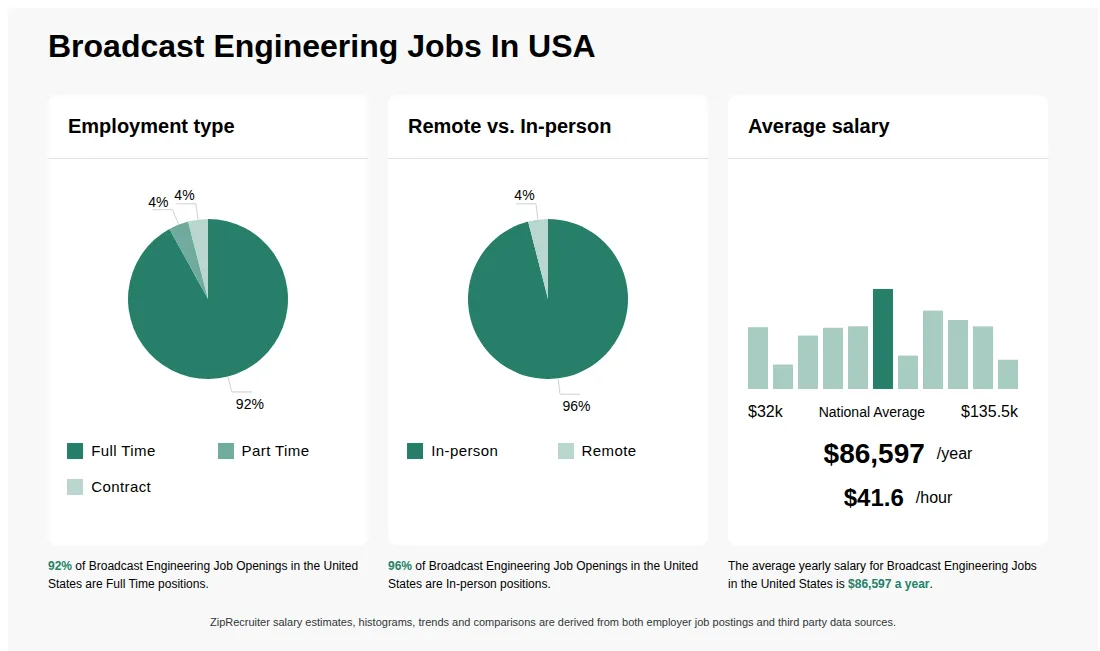
See salary details
$32K - $41.4K
10% of jobs
$41.4K - $50.8K
3% of jobs
$50.8K - $60.2K
9% of jobs
$63.6K is the 25th percentile. Wages below this are outliers.
$60.2K - $69.6K
10% of jobs
$69.6K - $79K
10% of jobs
The median wage is $84.4K / yr.
$79K - $88.5K
16% of jobs
$88.5K - $97.9K
5% of jobs
$107.1K is the 75th percentile. Wages above this are outliers.
$97.9K - $107.3K
13% of jobs
$107.3K - $116.7K
11% of jobs
$116.7K - $126.1K
10% of jobs
$126.1K - $135.5K
4% of jobs
$32K
$86.6K
$135.5K
How much do broadcast engineering jobs pay per year?
As of Jun 16, 2026, the average yearly pay for broadcast engineering in the United States is $86,597.00, according to ZipRecruiter salary data. Most workers in this role earn between $64,500.00 and $112,500.00 per year, depending on experience, location, and employer.
What are some common challenges broadcast engineers face when maintaining live broadcast operations?
Broadcast engineers often encounter challenges such as troubleshooting technical issues under tight deadlines, ensuring seamless signal transmission, and adapting quickly to equipment failures during live events. The fast-paced environment requires engineers to stay calm under pressure, work efficiently with on-air talent and production teams, and be proficient in both analog and digital broadcast systems. Proactive maintenance, clear communication, and ongoing training are essential to minimize disruptions and deliver high-quality broadcasts.
What are broadcast engineers?
Broadcast engineers are professionals who design, set up, maintain, and repair the technical equipment and systems used for radio, television, and online broadcasting. They ensure that audio and video signals are transmitted clearly and reliably from studios to audiences. Broadcast engineers work with a wide range of technology, including transmitters, mixing consoles, and computer networks, to keep broadcasts running smoothly. Their role is essential for the seamless delivery of content to viewers and listeners.
What is the difference between Broadcast Engineering vs Broadcast Technician?
| Aspect | Broadcast Engineering | Broadcast Technician |
|---|---|---|
| Required Credentials | Associate's or Bachelor's in Engineering, certifications like SBE | High school diploma, technical certifications |
| Work Environment | Studio, control rooms, field sites, technical planning | Studio, equipment setup, maintenance |
| Employer & Industry Usage | Broadcasters, production companies, network facilities | TV/radio stations, production support |
Broadcast Engineering involves designing, maintaining, and troubleshooting broadcast systems, often requiring engineering degrees and certifications. Broadcast Technicians focus on installing, operating, and repairing broadcast equipment, typically with technical certifications. Both roles are essential in the broadcast industry but differ in scope and technical depth.
What are the key skills and qualifications needed to thrive as a Broadcast Engineer, and why are they important?
To thrive as a Broadcast Engineer, you need a strong background in electronics, audio/video signal flow, and IT networking, typically supported by a degree in engineering or a related field. Familiarity with broadcast automation systems, video editing software, RF transmission equipment, and certifications like SBE (Society of Broadcast Engineers) are often required. Excellent problem-solving abilities, attention to detail, and effective communication skills set standout professionals apart in this field. These skills are crucial to ensure reliable, high-quality broadcast operations and timely resolution of technical issues.
More about Broadcast Engineering jobs
What cities are hiring for Broadcast Engineering jobs? Cities with the most Broadcast Engineering job openings:
What are the most commonly searched types of Broadcast Engineering jobs? The most popular types of Broadcast Engineering jobs are:
What states have the most Broadcast Engineering jobs? States with the most job openings for Broadcast Engineering jobs include:
Job description
Broadcast IP Infrastructure Engineer (SMPTE 2110)
Position Overview
The Broadcast IP Infrastructure Engineer is responsible for supporting and maintaining a modern SMPTE ST 2110-based broadcast infrastructure powering studio production environments.
This role focuses on maintaining the IP-based routing, timing, and signal transport systems that deliver video and audio signals across the studio ecosystem. The engineer will configure, monitor, and troubleshoot IP broadcast infrastructure while ensuring the studio remains fully operational and production-ready for live and recorded productions.
In addition to IP infrastructure responsibilities, this role supports studio production equipment and control room technologies, ensuring reliable operation of cameras, microphones, teleprompters, display systems, and other critical studio hardware.
The engineer works closely with broadcast engineering, IT networking teams, and production staff to maintain highly reliable media infrastructure supporting executive-level studio productions.
Location: New York, NY
Schedule: Full-Time | On-Site
Key Responsibilities
IP Media Architecture
Support and maintain a SMPTE ST 2110 IP media architecture used for real-time transport of video, audio, and ancillary signals across studio infrastructure.
Maintain synchronization of broadcast devices using Precision Time Protocol (PTP) and associated timing infrastructure.
Support orchestration and device discovery workflows using NMOS control frameworks.
Monitor and troubleshoot multicast media traffic and IP transport flows across broadcast networks.
Assist with maintaining high-availability broadcast networks supporting leaf-spine or similar high-bandwidth media architectures.
IP Broadcast Infrastructure
Configure, maintain, and troubleshoot Evertz Ultrix FR12 routing platforms and associated broadcast control systems.
Support hybrid broadcast environments integrating SDI and IP media workflows.
Ensure reliable media signal transport across IP broadcast infrastructure.
Assist with integration of IP routing systems with studio production technologies.
Maintain signal flow integrity across broadcast routing and monitoring platforms.
Studio Production Readiness
Prepare and validate studio technical systems to ensure the environment is fully operational prior to productions.
Perform readiness checks across cameras, routing systems, audio capture systems, display infrastructure, and monitoring systems.
Coordinate with production teams to verify system configuration and technical readiness for live or recorded productions.
Studio Equipment Support
Provide break/fix troubleshooting and maintenance across studio production equipment.
Support and maintain robotic camera systems and PTZ camera infrastructure.
Maintain and troubleshoot studio audio systems including ceiling array microphones and DSP processing systems.
Support teleprompter systems, ensuring reliable operation during studio productions.
Diagnose and resolve issues impacting studio production workflows.
Studio Display & Graphics Systems
Support large-format display infrastructure including Sony video walls and Sony CLED (Crystal LED) display systems.
Ensure proper signal routing and synchronization between broadcast routing systems and display technologies.
Assist with support and troubleshooting of Disguise (d3) media server platforms used for studio graphics and LED environments.
Network & Systems Integration
Work closely with IT networking teams to troubleshoot infrastructure issues including:
Multicast traffic
VLAN configuration
Quality of Service (QoS)
Network bandwidth allocation
Support hybrid broadcast infrastructures integrating SDI and IP transport systems.
System Monitoring & Maintenance
Perform system monitoring and health checks across broadcast infrastructure.
Maintain documentation including network topology, signal flow diagrams, and system configuration.
Test redundancy and failover systems across broadcast routing and IP network infrastructure.
Assist with lifecycle maintenance and upgrades of broadcast infrastructure systems.
Required Qualifications:
5–8+ years of experience supporting broadcast engineering or media infrastructure environments.
Hands-on experience supporting SMPTE ST 2110 broadcast environments.
Experience with Evertz routing platforms including Ultrix FR12.
Strong understanding of multicast networking, PTP timing, NMOS orchestration, and IP media transport.
Experience supporting studio production environments or broadcast control rooms.
Ability to diagnose and resolve issues affecting broadcast video, audio, and IP media systems.
Preferred Qualifications:
Experience supporting large-scale broadcast IP infrastructure environments.
Familiarity with Sony video walls or Sony CLED display systems.
Experience supporting Disguise media server platforms.
Experience supporting robotic/PTZ camera systems.
Experience supporting ceiling array microphone systems.
Knowledge of AES67 or Dante audio networking.
Experience using ticketing systems such as ServiceNow or Jira.
Additional Requirements:
Ability to lift up to 50 pounds.
Comfortable working in control rooms, studios, and equipment rack environments.
Ability to troubleshoot and respond to issues quickly in live production environments.