Director of Broadcast Engineering
About the role
WQED Multimedia seeks an experienced Director of Broadcast Engineering to lead our television and radio broadcast engineering operations.
This is a technical supervisory role. The Director must have the judgment and experience to diagnose operational issues, direct response, coordinate vendors and staff, communicate clearly with colleagues, and ensure reliable, compliant operations. The role supervises union Technicians and performs work as permitted by the collective bargaining agreement.
The Director will serve as WQED's FCC-designated Chief Operator and will have primary leadership responsibility for the production air chain. This role is mission-critical and requires 24/7 on-call availability for urgent broadcast, transmission, studio, production, or regulatory issues.
WQED operates one VHF television station with five digital channels and two radio stations with multiple audio streams. We also own a 594-foot tower and associated transmitter equipment.
Key responsibilities
Lead broadcast engineering operations
• Maintain reliable operation of WQED's production air chain, including transmitters, studio systems, automation, EAS, monitoring/logging systems, routing, master control, streaming encoders, audio chains, and remote production systems.
• Supervise preventive, routine, and emergency maintenance of broadcast and production systems.
• Diagnose technical issues, direct troubleshooting and corrective action, engage staff, vendors, contractors, or manufacturers as appropriate, and ensure follow-through to resolution.
• Ensure appropriate engineering coverage for broadcast operations, productions, events, emergencies, and planned maintenance.
Communicate clearly and prevent recurring issues
• Communicate clearly and consistently with non-technical colleagues and leadership during production issues, outages, urgent repairs, and recurring problems, including expected impact, workarounds, timelines, and resolution status.
• Lead prompt root-cause reviews after significant technical incidents, document findings and corrective actions, and focus on preventing repeat occurrences.
• Translate technical problems into plain language so production, content, operations, and leadership teams can make informed decisions.
Serve as FCC-designated Chief Operator for WQED-TV, WQED-FM, and WQEJ-FM
• Maintain required logs, records, monitoring, inspections, tests, and documentation.
• Ensure technical operations comply with FCC rules and other applicable regulatory requirements.
• Maintain EAS compliance, logging, testing, documentation, and readiness.
• Work with the Vice President of Technology and other WQED leaders on technical filings, compliance questions, inspections, and corrective actions as needed.
Supervise technical staff
• Directly supervise WQED's four union Technicians.
• Assign work, manage schedules, approve overtime, provide performance feedback, and support staff development.
• Help build a strong, accountable, safety-minded, service-oriented engineering culture.
• Provide technical guidance, coaching, and training to staff and users of broadcast/production equipment.
Maintain systems, documentation, and standards
• Maintain current equipment inventories, wiring documentation, system diagrams, preventive maintenance schedules, technical SOPs, and escalation procedures.
• Recommend equipment replacement, capital needs, maintenance priorities, and vendor support needs to the Vice President of Technology and Head of Operations.
• Coordinate with WQED's managed service provider on broadcast-adjacent networking, remote access, monitoring, and media production systems.
• Support WQED's transition to more flexible broadcast and production workflows, including cloud, IP-based, remote, and streaming-related systems.
Support transmitter and remote site operations
• Maintain oversight of WQED's transmitter and remote technical sites, including maintenance, inspection, troubleshooting response, vendor coordination, and documentation.
• Maintain valid driving privileges and the ability to respond to urgent site issues.
Qualifications
• Substantial television and radio broadcast engineering experience, with skills at least equivalent to the Society of Broadcast Engineers' CBTE and CBRE levels.
• Ability to serve as FCC-designated Chief Operator and ensure required logs, tests, inspections, monitoring, and corrective actions are completed.
• Strong knowledge of transmitters, RF systems, studio systems, automation, EAS, monitoring/logging, routing, master control, streaming encoders, audio chains, and remote production systems.
• Experience supervising technical staff, preferably in a represented labor environment.
• Ability to communicate promptly and clearly during technical incidents and provide follow-up that identifies causes, remedies, and prevention steps.
• Experience creating and maintaining technical documentation, SOPs, wiring records, equipment inventories, maintenance schedules, system diagrams, root-cause summaries, and corrective-action plans.
• Calm judgment, disciplined follow-through, and a prevention-focused approach to outages, recurring issues, and production problems.
• Valid driver's license and ability to travel to transmitter, tower, and remote technical sites as needed.
• Ability to provide 24/7 on-call leadership and work evenings, weekends, holidays, or extended hours when required.
• Ability to work safely in technical environments and around broadcast equipment, with or without reasonable accommodation.
Work environment and schedule
This is a Pittsburgh-based, on-site role. The Director of Broadcast Engineering is expected to provide 24/7 on-call leadership for urgent production air chain, transmission, studio, and regulatory issues, including assessment, escalation, staff/vendor coordination, and corrective-action oversight.
Compensation & Benefits
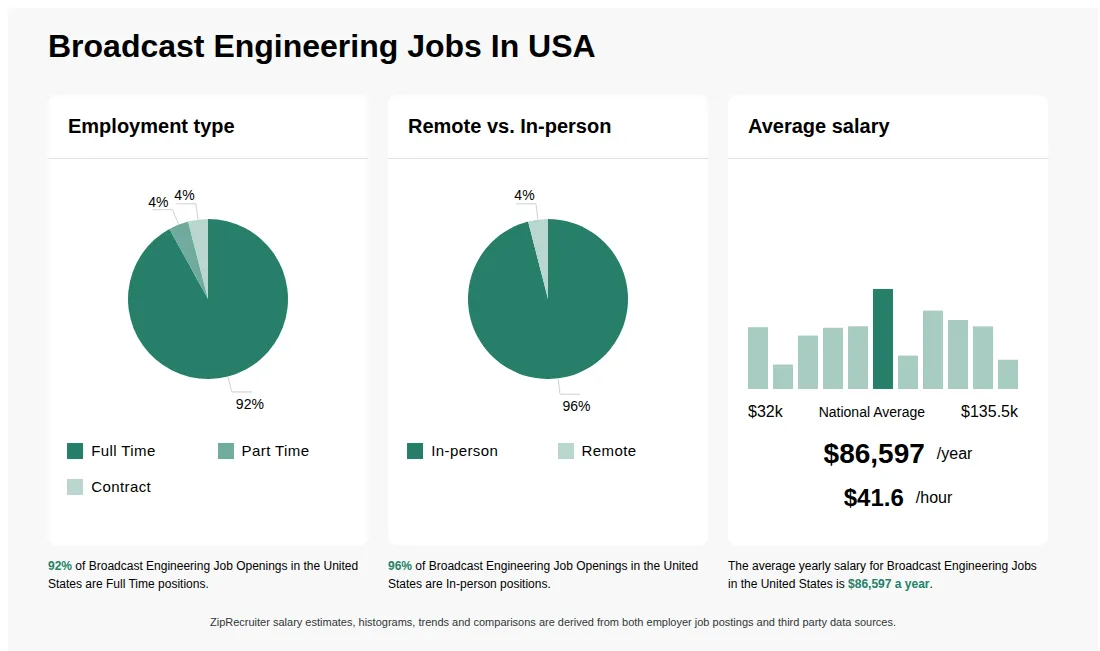
The annual compensation band for this full-time, salaried position is $100,000-$125,000, commensurate with experience. Benefits include a PPO health insurance plan; employer-paid dental, vision, disability, and life insurance; and, after 12 months, a 5% employer contribution to a 403(b) retirement plan.
Equal Employment Opportunity
WQED Multimedia is an equal opportunity employer. We celebrate the diversity of the communities we serve and are dedicated to fostering an inclusive, supportive workplace for all. Applicants with disabilities or those needing reasonable accommodation may contact careers@WQED.org.