We welcome applicants who are interested in biophysical studies aimed at mechanistic function and ... chemistry programs. #J-18808-Ljbffr
We welcome applicants who are interested in biophysical studies aimed at mechanistic function and ... chemistry programs. #J-18808-Ljbffr

Tenure-Track Assistant Professor
Baltimore, MD · On-site
$110K - $144K/yr
Jenkins Department of Biophysics ( invites applications for tenure-track appointments at the assistant professor level. We encourage applicants who seek to understand the physical chemistry ...
Tenure-Track Assistant Professor
Baltimore, MD · On-site
$110K - $144K/yr
Jenkins Department of Biophysics ( invites applications for tenure-track appointments at the assistant professor level. We encourage applicants who seek to understand the physical chemistry ...
The Department of Chemistry at Columbia University invites applications for an Associate Research Scientist with expertise in biophysical chemistry, ideally in both experimental cell biology and ...
The Department of Chemistry at Columbia University invites applications for an Associate Research Scientist with expertise in biophysical chemistry, ideally in both experimental cell biology and ...
Tenured Associate/Full Professor
Baltimore, MD · On-site
$131K - $316K/yr
Jenkins Department of Biophysics ( invites applications for tenured appointments at the associate and full professor levels. We encourage applicants who seek to understand the physical chemistry ...
Tenured Associate/Full Professor
Baltimore, MD · On-site
$131K - $316K/yr
Jenkins Department of Biophysics ( invites applications for tenured appointments at the associate and full professor levels. We encourage applicants who seek to understand the physical chemistry ...

We are looking for a highly motivated Postdoctoral Biophysical Chemist to join a cross-functional team in Indianapolis, IN to support our small molecule Early Molecule Discovery (EMD). Our team ...
We are looking for a highly motivated Postdoctoral Biophysical Chemist to join a cross-functional team in Indianapolis, IN to support our small molecule Early Molecule Discovery (EMD). Our team ...
We are looking for a highly motivated Postdoctoral Biophysical Chemist to join a cross-functional team in Indianapolis, IN to support our small molecule Early Molecule Discovery (EMD). Our team ...
We are looking for a highly motivated Postdoctoral Biophysical Chemist to join a cross-functional team in Indianapolis, IN to support our small molecule Early Molecule Discovery (EMD). Our team ...

We seek creative teacher-scholars to teach inspiring courses and develop outstanding research programs in biophysical or physical chemistry broadly defined. Qualifications Must have met the ...
We seek creative teacher-scholars to teach inspiring courses and develop outstanding research programs in biophysical or physical chemistry broadly defined. Qualifications Must have met the ...

Department of Chemistry and Biochemistry - Assistant/Associate Professor, Tenure Track
Riverside, CA · On-site
Preferred areas of expertise include biochemistry, bioanalytical chemistry, proteomics, biotechnology, pharmaceutical chemistry, and biophysical chemistry. The successful candidate will establish an ...
Department of Chemistry and Biochemistry - Assistant/Associate Professor, Tenure Track
Riverside, CA · On-site
Preferred areas of expertise include biochemistry, bioanalytical chemistry, proteomics, biotechnology, pharmaceutical chemistry, and biophysical chemistry. The successful candidate will establish an ...
Department of Chemistry and Biochemistry - Assistant/Associate Professor, Tenure Track
Riverside, CA · On-site
Preferred areas of expertise include biochemistry, bioanalytical chemistry, proteomics, biotechnology, pharmaceutical chemistry, and biophysical chemistry. The successful candidate will establish an ...
Department of Chemistry and Biochemistry - Assistant/Associate Professor, Tenure Track
Riverside, CA · On-site
Preferred areas of expertise include biochemistry, bioanalytical chemistry, proteomics, biotechnology, pharmaceutical chemistry, and biophysical chemistry. The successful candidate will establish an ...

... biophysical chemistry. The position requires a PhD in Chemistry (or an equivalent doctorate in an appropriate field) with a focus on cryogenic electron microscopy (Cryo-EM) and/or single molecule ...
... biophysical chemistry. The position requires a PhD in Chemistry (or an equivalent doctorate in an appropriate field) with a focus on cryogenic electron microscopy (Cryo-EM) and/or single molecule ...

Postdoctoral Scholar (Chemistry Department)
University Park, PA · On-site
$47K - $65K/yr
... biophysical chemistry. The position requires a PhD in Chemistry (or an equivalent doctorate in an appropriate field) with a focus on cryogenic electron microscopy (Cryo-EM) and/or single molecule ...
Postdoctoral Scholar (Chemistry Department)
University Park, PA · On-site
$47K - $65K/yr
... biophysical chemistry. The position requires a PhD in Chemistry (or an equivalent doctorate in an appropriate field) with a focus on cryogenic electron microscopy (Cryo-EM) and/or single molecule ...

... biophysical chemistry. Outstanding candidates are sought to pursue innovative experimental research that advances the molecular understanding of biological systems and enables the discovery and ...
... biophysical chemistry. Outstanding candidates are sought to pursue innovative experimental research that advances the molecular understanding of biological systems and enables the discovery and ...

Post Doctoral Scholar
Columbus, OH · On-site
$62K - $65K/yr
This Post Doctoral Scholar position requires a highly motivated and productive individual with experience in biophysical chemistry, structural biology, computational modeling, and high-field NMR ...
Post Doctoral Scholar
Columbus, OH · On-site
$62K - $65K/yr
This Post Doctoral Scholar position requires a highly motivated and productive individual with experience in biophysical chemistry, structural biology, computational modeling, and high-field NMR ...
Post Doctoral Scholar
Columbus, OH · On-site
$62K - $65K/yr
This Post Doctoral Scholar position requires a highly motivated and productive individual with experience in biophysical chemistry, structural biology, computational modeling, and high-field NMR ...
Post Doctoral Scholar
Columbus, OH · On-site
$62K - $65K/yr
This Post Doctoral Scholar position requires a highly motivated and productive individual with experience in biophysical chemistry, structural biology, computational modeling, and high-field NMR ...

Postdoctoral Associate
New Brunswick, NJ · On-site
D. in chemistry, mechanical engineering, biomedical engineering, biophysics, cell biology, or related areas is required. Certifications/Licenses N.A. Required Knowledge, Skills, and Abilities The ...
Postdoctoral Associate
New Brunswick, NJ · On-site
D. in chemistry, mechanical engineering, biomedical engineering, biophysics, cell biology, or related areas is required. Certifications/Licenses N.A. Required Knowledge, Skills, and Abilities The ...

Tenure-Track Assistant Professor
Baltimore, MD · On-site
$110K - $144K/yr
Jenkins Department of Biophysics ( invites applications for tenure-track appointments at the assistant professor level. We encourage applicants who seek to understand the physical chemistry ...
Tenure-Track Assistant Professor
Baltimore, MD · On-site
$110K - $144K/yr
Jenkins Department of Biophysics ( invites applications for tenure-track appointments at the assistant professor level. We encourage applicants who seek to understand the physical chemistry ...

Background in Protein Science, Analytical Chemistry, Biophysical Chemistry, Chemical Engineering, or related field. Proficient laboratory skills. Hands-on experience using analytical instruments and ...
Background in Protein Science, Analytical Chemistry, Biophysical Chemistry, Chemical Engineering, or related field. Proficient laboratory skills. Hands-on experience using analytical instruments and ...
Background in Protein Science, Analytical Chemistry, Biophysical Chemistry, Chemical Engineering, or related field. Proficient laboratory skills. Hands-on experience using analytical instruments and ...
Background in Protein Science, Analytical Chemistry, Biophysical Chemistry, Chemical Engineering, or related field. Proficient laboratory skills. Hands-on experience using analytical instruments and ...

... sensor chemistry, reference and control strategy, and regeneration assessment. * Assess protein ... D. in biochemistry, biophysics, molecular biology, protein engineering, or a related field; OR a ...
New
... sensor chemistry, reference and control strategy, and regeneration assessment. * Assess protein ... D. in biochemistry, biophysics, molecular biology, protein engineering, or a related field; OR a ...
New

Herbert and Florence Irving Professor of Biology or Biophysics, and Professor of Chemistry
New York, NY · On-site
$100K - $250K/yr
Herbert and Florence Irving Professor of Biology or Biophysics, and Professor of Chemistry The Barnard College Department of Chemistry seeks an innovative individual whose research contributes to ...
Herbert and Florence Irving Professor of Biology or Biophysics, and Professor of Chemistry
New York, NY · On-site
$100K - $250K/yr
Herbert and Florence Irving Professor of Biology or Biophysics, and Professor of Chemistry The Barnard College Department of Chemistry seeks an innovative individual whose research contributes to ...
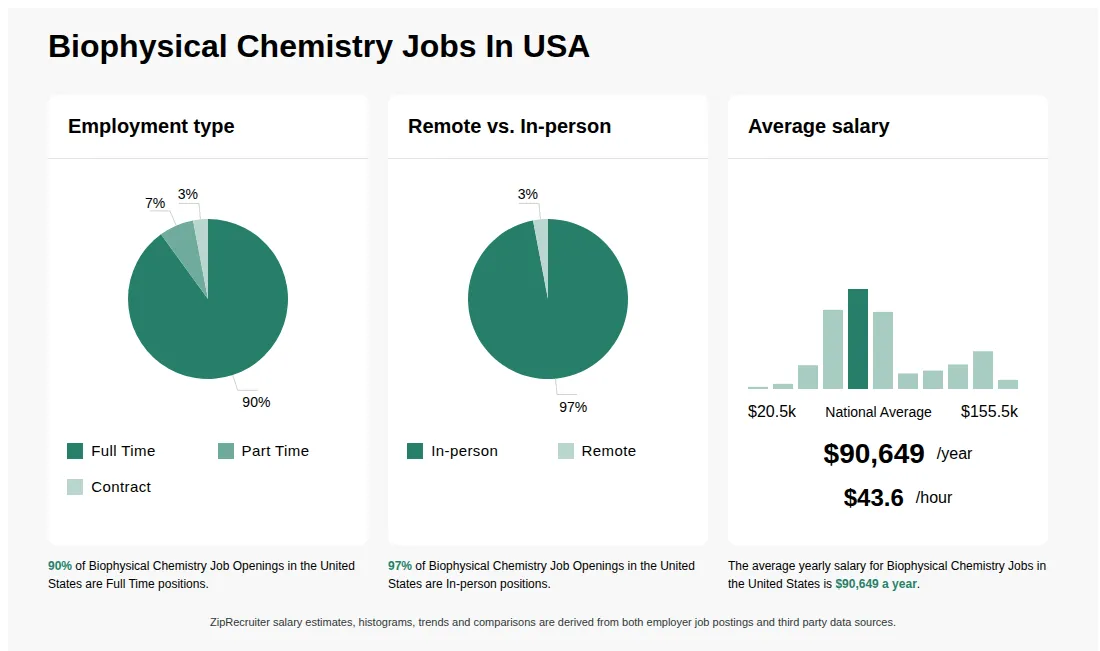
Biophysical Chemistry information
See salary details
$20.5K - $32.8K
0% of jobs
$32.8K - $45K
1% of jobs
$45K - $57.3K
6% of jobs
$67.6K is the 25th percentile. Wages below this are outliers.
$57.3K - $69.6K
21% of jobs
The median wage is $79.7K / yr.
$69.6K - $81.9K
26% of jobs
$81.9K - $94.1K
20% of jobs
$95.2K is the 75th percentile. Wages above this are outliers.
$94.1K - $106.4K
3% of jobs
$106.4K - $118.7K
4% of jobs
$118.7K - $131K
6% of jobs
$131K - $143.2K
9% of jobs
$143.2K - $155.5K
2% of jobs
$20.5K
$90.6K
$155.5K
How much do biophysical chemistry jobs pay per year?
As of Sep 14, 2026, the average yearly pay for biophysical chemistry in the United States is $90,649.00, according to ZipRecruiter salary data. Most workers in this role earn between $69,000.00 and $112,000.00 per year, depending on experience, location, and employer.
What is biophysical chemistry?
A Biophysical Chemistry job involves studying the physical principles that govern biological molecules and systems. Professionals in this field use techniques from physics and chemistry to analyze biomolecular structures, interactions, and functions. They often work in research laboratories, pharmaceutical companies, or academia to develop new drugs, study protein folding, or understand cellular processes.
What are the typical daily responsibilities of someone working in biophysical chemistry?
A professional in biophysical chemistry typically spends their day conducting experimental research, analyzing data using specialized instruments, and collaborating closely with colleagues from fields such as biology, physics, and computational science. Daily tasks include designing experiments, interpreting molecular interactions, preparing detailed reports, and presenting findings to stakeholders or at scientific meetings. You may also be involved in troubleshooting equipment and staying updated on the latest advancements in biophysical techniques. This dynamic environment offers ongoing opportunities to refine one's expertise and contribute to breakthroughs in medical, pharmaceutical, or materials science applications.
What are the key skills and qualifications needed to thrive in biophysical chemistry?
To thrive in biophysical chemistry, you typically need a strong background in chemistry, physics, and mathematics, usually supported by at least a bachelor's or master's degree in chemistry, biochemistry, or a related field. Proficiency in analytical instruments such as NMR spectroscopy, mass spectrometry, and computational modeling software is commonly required. Critical thinking, problem-solving, and effective communication are important soft skills for collaborating with multidisciplinary teams and presenting research findings. These combined skills enable biophysical chemists to investigate complex biological systems and contribute to scientific advancements.
What does a biophysical chemist do?
A biophysical chemist studies the physical principles underlying biological molecules and systems, often using techniques like spectroscopy, microscopy, and computational modeling. They analyze molecular structures, interactions, and dynamics to understand biological processes, typically working in research laboratories or academic settings.
More about Biophysical Chemistry jobs
What states have the most Biophysical Chemistry jobs?
States with the most job openings for Biophysical Chemistry jobs include:
What are popular job titles for Biophysical Chemistry?
Popular job titles for Biophysical Chemistry:

Assistant Professor of Chemistry
Winston Salem, NC • On-site
American Society for Biochemistry and Molecular Biology (ASBMB)
• Print Media Publishing • 51 - 200 employees51 - 200 employees
Other
Posted 7 days ago
Job description
WAKE FOREST UNIVERSITY. The Department of Chemistry invites applications for a tenure-track faculty position as Assistant Professor of Chemistry, effective July 1, 2027.
Position Summary: This individual will be expected to teach courses in chemistry and biochemistry at the graduate and undergraduate level that contribute to the Chemistry and Biochemistry and Molecular Biology (BMB) programs, establish and maintain an externally funded research program, engage in scholarly activities, participate in departmental, College, and University service, and contribute to the University’s community outreach efforts.
About Wake Forest University: Founded in 1834, Wake Forest University is a private, coeducational institution dedicated to academic excellence in liberal arts, graduate, and professional education. With more than 5,500 undergraduates and 3,900 graduate and professional students, Wake Forest is a collegiate university offering a vibrant, intellectual community with a rich cultural life, an impressive array of facilities, and a strong athletics program competing in the Atlantic Coast Conference (ACC). Since its founding, the University has adopted the motto Pro Humanitate, which is exemplified by a deep institutional commitment to public service and engagement with the world. For more information, visit: about.wfu.edu.
Wake Forest University is located in Winston-Salem, a beautiful, mid-sized city centrally in the Piedmont-Triad region of North Carolina. To learn more about Winston-Salem, visit: www.visitwinstonsalem.com.
About the Chemistry Department: We are a Ph.D.-granting department whose mission is to lead in undergraduate and graduate education and research ventures that extend beyond the traditional boundaries of chemistry. Our department is housed in two recently renovated, state-of-the‑art teaching and research facilities, Salem Hall and Wake Downtown. In addition to traditional chemistry degree programs, we support interdisciplinary programs in Biochemistry and Molecular Biology, Medicinal Chemistry and Drug Discovery, and Materials Chemistry. Outstanding opportunities for multi‑disciplinary collaborations exist through various WFU Research Centers and Wake Forest School of Medicine.
Equal Employment Opportunity Statement: The University is an equal opportunity employer and welcomes all qualified candidates to apply without regard to race, color, religion, national origin, sex, age, sexual orientation, gender identity and expression, genetic information, disability, and military or veteran status.
Accommodations for Applicants: If you are an individual with a disability and need an accommodation to participate in the application or interview process, please contact AskHR@wfu.edu or 336-758-4700.
Qualifications: A Ph.D. (or equivalent) in Chemistry, Biochemistry, or a related area is required for the position. Qualified applicants will demonstrate their ability to teach courses in chemistry and biochemistry, especially biophysical chemistry, develop an externally funded, nationally recognized research program involving undergraduate and graduate students, and contribute to an academic environment that fosters learning and growth for all its stakeholders. We welcome applicants who are interested in biophysical studies aimed at mechanistic function and structure of macromolecules. We seek faculty with a commitment to the teacher‑scholar model and to enhancing the breadth, depth, and diversity of our chemistry programs.

About American Society for Biochemistry and Molecular Biology
Sourced by ZipRecruiter
Industry
Print media publishing
Company size
51 - 200 Employees
Headquarters location
Rockville, MD, US
Year founded
1906