1

Banking Data Analyst Jobs (NOW HIRING)

Senior Enterprise Data Analyst

Raleigh, NC · On-site

$83K - $105K/yr

This position leads Bank initiatives that improve enterprise data quality, governance, reporting, and analytics at an advanced level of ability and technical expertise. Drives positive change across ...

Senior Enterprise Data Analyst

Raleigh, NC · On-site

$83K - $105K/yr

This position leads Bank initiatives that improve enterprise data quality, governance, reporting, and analytics at an advanced level of ability and technical expertise. Drives positive change across ...

Senior Enterprise Data Analyst

Raleigh, NC · On-site

$83K - $105K/yr

This position leads Bank initiatives that improve enterprise data quality, governance, reporting, and analytics at an advanced level of ability and technical expertise. Drives positive change across ...

Senior Enterprise Data Analyst

Phoenix, AZ · On-site

$85K - $107K/yr

This position leads Bank initiatives that improve enterprise data quality, governance, reporting, and analytics at an advanced level of ability and technical expertise. Drives positive change across ...

Senior Enterprise Data Analyst

Phoenix, AZ · On-site

$85K - $107K/yr

This position leads Bank initiatives that improve enterprise data quality, governance, reporting, and analytics at an advanced level of ability and technical expertise. Drives positive change across ...

Senior Enterprise Data Analyst

Raleigh, NC · On-site

$83K - $105K/yr

This position leads Bank initiatives that improve enterprise data quality, governance, reporting, and analytics at an advanced level of ability and technical expertise. Drives positive change across ...

Showing results 21-40

Banking Data Analyst information

See salary details

$34K

$82.6K

$136K

How much do banking data analyst jobs pay per year?

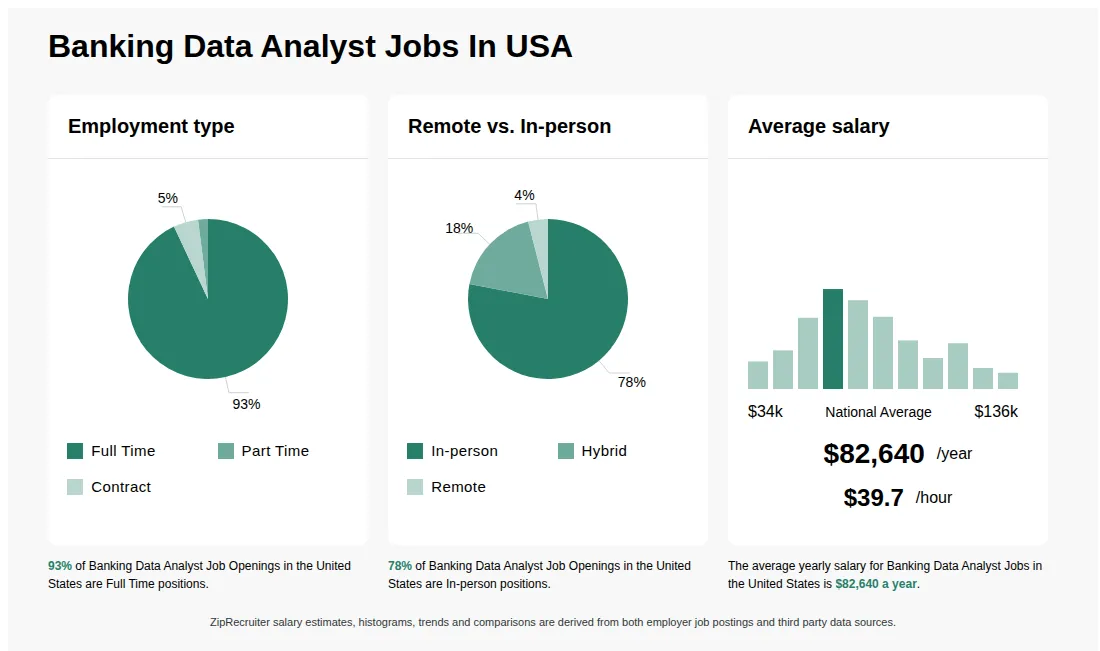
As of Aug 19, 2026, the average yearly pay for banking data analyst in the United States is $82,640.00, according to ZipRecruiter salary data. Most workers in this role earn between $62,500.00 and $97,000.00 per year, depending on experience, location, and employer.

What is a banking data analyst?

A Banking Data Analyst is responsible for collecting, processing, and analyzing financial data to help banks make informed business decisions. They use statistical models and data visualization tools to identify trends, assess risks, and improve operational efficiency. Their role involves working with large datasets, ensuring data accuracy, and providing insights that support regulatory compliance and business growth. Strong analytical skills, proficiency in data tools like SQL and Python, and an understanding of banking operations are essential for this role.

What are the key skills and qualifications needed to thrive as a banking data analyst?

A Banking Data Analyst needs strong analytical skills, proficiency in statistics, and a background in finance, business, or a related quantitative field. Experience with SQL, Excel, data visualization tools like Tableau or Power BI, and possibly certifications such as CFA or data analytics credentials, is highly valued. Attention to detail, problem-solving abilities, and effective communication are crucial soft skills for interpreting data and presenting insights to stakeholders. These skills ensure accurate financial analysis, clear reporting, and the ability to influence decision-making in a fast-paced banking environment.


What types of projects or analyses do banking data analysts typically handle in their day-to-day work?

Banking Data Analysts are often tasked with analyzing large volumes of transaction data to identify trends, forecast financial performance, and support risk management efforts. Their daily work may include preparing regular reports for management, developing dashboards to monitor key metrics, and collaborating with departments like risk, compliance, and marketing to provide actionable insights. They may also participate in projects involving fraud detection, credit scoring, customer segmentation, or regulatory reporting. These responsibilities offer exposure to a wide variety of data-driven initiatives and opportunity to make a direct impact on business strategies.

What does a banking data analyst do for a bank?

A banking data analyst collects, analyzes, and interprets financial data to help banks make informed decisions, improve operational efficiency, and manage risk. They use tools like Excel, SQL, and data visualization software to identify trends and support strategic planning. Strong analytical skills and knowledge of banking regulations are essential for this role.
More about Banking Data Analyst jobs

What cities are hiring for Banking Data Analyst jobs?

Cities with the most Banking Data Analyst job openings:

What are the most commonly searched types of Banking Data Analyst jobs?

The most popular types of Banking Data Analyst jobs are:

What states have the most Banking Data Analyst jobs?

States with the most job openings for Banking Data Analyst jobs include:

Infographic showing various Banking Data Analyst job openings in the United States as of August 2026, with employment types broken down into 1% As Needed, 85% Full Time, 11% Part Time, and 3% Contract. Highlights an 85% Physical, 4% Hybrid, and 11% Remote job distribution, with an average salary of $82,640 per year, or $39.7 per hour.

Principal Data Architect - General Bank, Commercial Bank & Digital Bank

First Citizens Bank

Raleigh, NC • On-site

Full-time

Re-posted 24 days ago


First Citizens Bank rating

7.4

Company rating: 7.4 out of 10

Based on 106 frontline employees who took The Breakroom Quiz

106th of 171 rated banks


Job description

Overview
We are seeking a highly experienced Principal Data Architect to lead the end-to-end data architecture strategy, standards, and decision-making for the bank's General Bank, Commercial Bank, and Digital Bank domains. This role will serve as the accountable Data Architecture leader within ED&A for customer, relationship, account, product, channel, transaction, lending, deposits, payments, servicing, digital engagement, and operational banking data ecosystems.
The Principal Data Architect will define target-state data architecture, integration strategies, metadata and lineage expectations, domain-aligned data product designs, and enterprise data platform adoption patterns that enable trusted, reusable, scalable, and governed data across the bank. The role requires deep banking domain experience, strong understanding of commercial and digital banking processes, and the ability to translate complex business, regulatory, risk, operational, and customer experience requirements into durable data architecture outcomes.
This leader will partner with senior business, technology, data governance, risk, compliance, product, operations, digital, and ED&A stakeholders to ensure bank data is complete, controlled, fit-for-purpose, traceable, reusable, and aligned with enterprise data strategy and modern cloud data platform capabilities.
Responsibilities
  1. General Bank, Commercial Bank, and Digital Bank Data Architecture Leadership
  • Serve as the lead Data Architect for General Bank, Commercial Bank, and Digital Bank domains, establishing the architecture vision, target-state roadmap, standards, and guardrails for domain data assets.
  • Own and govern architecture decisions impacting customer, relationship, account, product, channel, transaction, lending, deposits, payments, servicing, digital engagement, and operational banking data domains.
  • Internal | Enterprise Data & Analytics
  • Define reusable architecture patterns, canonical integration approaches, domain data product standards, metadata expectations, and consumption patterns for enterprise use.
  • Partner with business executives and domain leaders to translate growth strategies, customer experience priorities, operational needs, risk expectations, and regulatory obligations into scalable data architecture solutions.
  • Participate in portfolio planning, solution design reviews, and architecture forums to ensure domain initiatives align with ED&A architecture strategy and enterprise data platform direction.
  1. Banking Domain Data Architecture
  • Lead architecture design for banking data ecosystems supporting customer 360, relationship management, onboarding, account servicing, product analytics, deposits, lending, payments, digital journeys, and operational analytics.
  • Ensure domain data architectures support completeness, accuracy, timeliness, traceability, privacy, security, access controls, and business interpretability.
  • Define source-to-consumption lineage patterns from core banking, loan origination, deposit, CRM, digital, payments, operations, and servicing platforms through enterprise data platforms and analytics products.
  • Govern architecture patterns supporting commercial portfolio insights, banker productivity, relationship profitability, customer engagement, product performance, operational efficiency, and executive reporting.
  • Drive consistency in critical banking data elements, reference data, business rules, customer/account/product relationships, hierarchies, and domain definitions in partnership with Data Governance and business data owners.
  • Partner with Commercial Banking, Digital Banking, Operations, Risk, Compliance, and Product teams to design data capabilities that meet business utility, regulatory, privacy, and control requirements.

  1. Data Governance, Quality, Lineage, Privacy, and Controls
  • Partner with Data Governance and domain leadership to define ownership, stewardship, accountability, metadata, certification, retention, and control expectations for critical data assets.
  • Drive architectural patterns that enable data quality measurement, data observability, exception management, control monitoring, issue remediation, and governed change management.
  • Ensure architectures capture and expose business, technical, and operational lineage for high-priority customer, account, transaction, lending, payments, servicing, and digital data flows.
  • Embed privacy, security, consent, entitlement, and responsible data use considerations into architecture designs, especially for customer and digital interaction data.
  • Support regulatory, audit, risk, compliance, and internal control expectations by embedding control points and evidence generation into data architecture designs.
  1. Platform, Integration, and Data Product Architecture
  • Define patterns for integrating banking source systems into enterprise data platforms using batch, streaming, event-driven, API, CDC, and file-based patterns where appropriate.
  • Guide data product teams on architecture patterns for reusable, governed, and high-value data products serving Commercial Banking, General Banking, Digital Banking, Risk, Compliance, Operations, analytics, and reporting consumers.
  • Ensure data products include clear ownership, data contracts, metadata, quality expectations, lineage, access controls, privacy classifications, consumption patterns, and service-level expectations.
  • Align domain architecture with modern cloud data platform capabilities, including scalable storage, transformation, orchestration, curated data layers, semantic consumption, access controls, and governed self-service analytics.
  • Promote reuse of enterprise capabilities and reduce redundant data stores, inconsistent business logic, unmanaged extracts, and point-to-point data movement.

  1. Digital and Customer Experience Data Enablement
  • Define architecture patterns for digital banking data, including web/mobile events, clickstream, customer journeys, digital adoption, authentication events, servicing interactions, alerts, notifications, and digital sales funnels.
  • Internal | Enterprise Data & Analytics
  • Support trusted data capabilities for customer personalization, digital experience measurement, marketing effectiveness, next-best-action, banker/client insights, and customer engagement analytics.
  • Ensure digital, CRM, servicing, and operational data are integrated in a governed way to support omni-channel customer understanding while respecting privacy, consent, and responsible use expectations.
  • Partner with Digital, Product, Marketing, Analytics, Risk, and Compliance stakeholders to align digital data architecture with customer experience, growth, fraud, security, and regulatory priorities.

  1. Architecture Governance and Executive Influence
  • Chair or contribute to architecture review forums for General Bank, Commercial Bank, and Digital Bank initiatives.
  • Provide expert consultation to senior business, technology, and ED&A leadership on data strategy, architecture trade-offs, platform adoption, and implementation sequencing.
  • Influence roadmap decisions across programs, products, and platforms to ensure alignment with target-state architecture.
  • Communicate complex architecture concepts in business terms and create decision-ready materials for senior stakeholders.
  • Mentor data architects, engineers, analysts, product owners, and platform teams; establish playbooks and reusable patterns that raise the maturity of ED&A delivery.

Qualifications
Bachelor's Degree and 10 years of experience in Application Development, Systems Engineering, or Information Technology management OR High School Diploma or GED and 14 years of experience in Application Development, Systems Engineering, or Information Technology management
Technology Experience
Desired experience with legacy and cloud data technologies such as Netezza, DataStage, SSIS, Denodo, AWS, Snowflake, DBT, Qlik Replicate, Astronomer, APIs, event streaming, CDC patterns, Power BI, Tableau, reporting platforms, analytics platforms, data catalogs, lineage tools, data quality tools, and governed self-service data consumption capabilities.
Domain Experience Required
The successful candidate must bring meaningful banking domain experience and be able to operate as a trusted architecture partner to Commercial Banking, General Banking, Digital Banking, Product, Operations, Risk, Compliance, and Technology stakeholders. Expected domain depth includes:
Commercial Banking and Relationship Data
  • Experience with commercial customer, prospect, relationship, household/entity, exposure, portfolio, banker assignment, relationship team, pipeline, opportunity, and client profitability data.
  • Understanding of commercial banking processes including relationship management, onboarding, credit initiation, covenant tracking, portfolio management, treasury management, deposits, payments, servicing, and cross-sell analytics.

General Banking, Deposits, Lending, and Payments
  • Experience with customer, account, product, balances, transactions, fees, interest, branch, contact center, servicing, disputes, card, ACH, wire, check, loan, collateral, and payment data.
  • Ability to align architecture across core banking, deposit, loan, payments, CRM, servicing, and operational platforms to support enterprise reporting and analytics.

Digital Banking and Customer Engagement
  • Experience with digital banking channels including mobile, online banking, web, digital servicing, authentication, clickstream, journey analytics, campaign response, digital sales, and customer interaction data.
  • Understanding of the architecture implications of omni-channel experience, customer 360, personalization, customer servicing, digital adoption, fraud signals, and consent-aware analytics.

Risk, Compliance, Privacy, and Operational Controls
  • Working knowledge of data requirements supporting KYC, AML, fraud, customer complaints, fair lending, privacy, consent, access controls, operational risk, and audit requests.
  • Ability to partner across Risk, Compliance, Legal, Data Governance, and business teams to align data architecture with regulatory expectations and responsible data use.

Preferred Qualifications
  • 15+ years of experience in Data Architecture, Data Engineering, Enterprise Data Management, Data Platforms, or related disciplines.
  • 7+ years of experience supporting Commercial Banking, Retail/General Banking, Digital Banking, Payments, Lending, Deposits, Customer, Product, Operations, Risk, or Compliance domains within a large financial institution or similarly regulated environment.
  • Demonstrated experience defining enterprise-scale data architectures for banking, digital, customer, commercial, operational, analytics, reporting, or governed data platform use cases.
  • Deep expertise in data integration, metadata management, data lineage, master/reference data, data quality, data privacy, data controls, and enterprise data governance.
  • Strong understanding of banking data ecosystems, customer/account/product relationships, channel interactions, transaction flows, servicing processes, regulatory considerations, and auditability expectations.
  • Experience designing and delivering cloud-native or modern data platform architectures, including ingestion, transformation, orchestration, curated data layers, APIs, event-driven data movement, CDC, and consumption patterns.
  • Proven ability to influence senior business and technology stakeholders and drive architecture decisions across complex, multi-team delivery environments.
  • Bachelor's or Master's degree in Computer Science, Information Systems, Engineering, Finance, Data Science, or a related field; equivalent experience may be considered.
  • Experience in a large regional, national, or global banking environment.
  • Hands-on familiarity with platforms and ecosystems such as Snowflake, AWS, Databricks, Azure, cloud object storage, orchestration tools, data catalogs, lineage tools, data quality platforms, API platforms, CRM platforms, and digital analytics platforms.
  • Experience implementing governed data products, certified datasets, customer 360, relationship analytics, commercial portfolio marts, digital engagement datasets, operational reporting layers, or source-to-consumption lineage capabilities.
  • Knowledge of banking processes and regulatory considerations related to KYC, AML, fraud, privacy, consent, fair lending, complaints, operational risk, and audit readiness.
  • Experience with domain-driven design, data product operating models, enterprise data governance, metadata management, and governed self-service analytics.
  • Architecture or data management certifications such as TOGAF, CDMP, DAMA, cloud certifications, or relevant platform certifications.

#LI-XG1
Benefits are an integral part of total rewards and First Citizens Bank is committed to providing a competitive, thoughtfully designed and quality benefits program to meet the needs of our associates. More information can be found at https://jobs.firstcitizens.com/benefits.

What First Citizens Bank employees say

Pay

Benefits

Hours and flexibility

Workplace

Get the full story on Breakroom