The Quantitative Trading & Research (QTR) Algorithmic Execution group is looking for an associate with the focus on algorithmic execution across macro. The ATS group is one of the biggest execution ...
The Quantitative Trading & Research (QTR) Algorithmic Execution group is looking for an associate with the focus on algorithmic execution across macro. The ATS group is one of the biggest execution ...

Algorithmic Trader
Manhattan, NY · On-site
$210K - $240K/yr
About Wintermute Wintermute is one of the largest algorithmic trading companies in digital assets. We provide liquidity algorithmically across all major cryptocurrency exchanges and trading platforms ...
Algorithmic Trader
Manhattan, NY · On-site
$210K - $240K/yr
About Wintermute Wintermute is one of the largest algorithmic trading companies in digital assets. We provide liquidity algorithmically across all major cryptocurrency exchanges and trading platforms ...

Senior Lead eSoftware Engineer - Java, Algorithmic trading
Jersey City, NJ · On-site
$171K - $260K/yr
Design and implement algorithmic trading strategies, focusing on optimizing execution and performance in a low-touch trading environment. * Collaborate with the product team to translate trading ...
Senior Lead eSoftware Engineer - Java, Algorithmic trading
Jersey City, NJ · On-site
$171K - $260K/yr
Design and implement algorithmic trading strategies, focusing on optimizing execution and performance in a low-touch trading environment. * Collaborate with the product team to translate trading ...

AI-Driven Algorithmic Trading Strategist
Berkeley, CA · On-site
$148K - $191K/yr
You will enhance algorithmic execution, conduct research, and collaborate across teams. This role seeks candidates with over 3 years of quantitative trading experience and proficiency in Python, R ...
AI-Driven Algorithmic Trading Strategist
Berkeley, CA · On-site
$148K - $191K/yr
You will enhance algorithmic execution, conduct research, and collaborate across teams. This role seeks candidates with over 3 years of quantitative trading experience and proficiency in Python, R ...
The Quantitative Trading & Research (QTR) Algorithmic Execution group is looking for an associate with the focus on algorithmic execution across macro. The ATS group is one of the biggest execution ...
The Quantitative Trading & Research (QTR) Algorithmic Execution group is looking for an associate with the focus on algorithmic execution across macro. The ATS group is one of the biggest execution ...
Quantitative Trading & Research - Algorithmic Execution - Analyst
Manhattan, NY · On-site
$110K - $125K/yr
The Quantitative Trading & Research (QTR) Algorithmic Execution group is looking for an associate with the focus on algorithmic execution across macro. The ATS group is one of the biggest execution ...
Quantitative Trading & Research - Algorithmic Execution - Analyst
Manhattan, NY · On-site
$110K - $125K/yr
The Quantitative Trading & Research (QTR) Algorithmic Execution group is looking for an associate with the focus on algorithmic execution across macro. The ATS group is one of the biggest execution ...
The Quantitative Trading & Research (QTR) Algorithmic Execution group is looking for an associate with the focus on algorithmic execution across macro. The ATS group is one of the biggest execution ...
The Quantitative Trading & Research (QTR) Algorithmic Execution group is looking for an associate with the focus on algorithmic execution across macro. The ATS group is one of the biggest execution ...

Quantitative Analyst, Equities Algorithmic Trading, VP
New York, NY · On-site
$175/hr
Design and develop new algorithms and strategies for the next generation equity trading platform initiative at Citi. Research, design, and implement improvements for existing algorithmic trading ...
Quantitative Analyst, Equities Algorithmic Trading, VP
New York, NY · On-site
$175/hr
Design and develop new algorithms and strategies for the next generation equity trading platform initiative at Citi. Research, design, and implement improvements for existing algorithmic trading ...
Dime Line Trading develops algorithms to trade all major US sports. Dime Line was founded in 2020 by veterans of the financial trading and sports betting industries, who started their careers in the ...
Quick apply
Dime Line Trading develops algorithms to trade all major US sports. Dime Line was founded in 2020 by veterans of the financial trading and sports betting industries, who started their careers in the ...
Global Markets Business Manager for Systematic/Algorithmic Trading, Vice President
Manhattan, NY · Hybrid
$121K - $180K/yr
Provide insight into the core controls that are associated with Algorithmic trading and work with Business Control Office to put the appropriate framework in place to monitor the activity. * Prepare ...
Global Markets Business Manager for Systematic/Algorithmic Trading, Vice President
Manhattan, NY · Hybrid
$121K - $180K/yr
Provide insight into the core controls that are associated with Algorithmic trading and work with Business Control Office to put the appropriate framework in place to monitor the activity. * Prepare ...
About us Edgehog Trading is a proprietary trading firm specializing in electronic options market ... Deep understanding of computer science fundamentals (data structures, algorithms, concurrency)
About us Edgehog Trading is a proprietary trading firm specializing in electronic options market ... Deep understanding of computer science fundamentals (data structures, algorithms, concurrency)
Global Markets Business Manager for Systematic/Algorithmic Trading, Vice President
Manhattan, NY · On-site
$121K - $180K/yr
Provide insight into the core controls that are associated with Algorithmic trading and work with Business Control Office to put the appropriate framework in place to monitor the activity. * Prepare ...
Global Markets Business Manager for Systematic/Algorithmic Trading, Vice President
Manhattan, NY · On-site
$121K - $180K/yr
Provide insight into the core controls that are associated with Algorithmic trading and work with Business Control Office to put the appropriate framework in place to monitor the activity. * Prepare ...
Quantitative Analyst, Equities Algorithmic Trading, VP
New York, NY · On-site
$175/hr
Design and develop new algorithms and strategies for the next generation equity trading platform initiative at Citi. Research, design, and implement improvements for existing algorithmic trading ...
Quantitative Analyst, Equities Algorithmic Trading, VP
New York, NY · On-site
$175/hr
Design and develop new algorithms and strategies for the next generation equity trading platform initiative at Citi. Research, design, and implement improvements for existing algorithmic trading ...
Algorithmic Development & Enhancement: * Design and develop new algorithms and strategies for the next generation equity trading platform initiative at Citi. * Research, design, and implement ...
Algorithmic Development & Enhancement: * Design and develop new algorithms and strategies for the next generation equity trading platform initiative at Citi. * Research, design, and implement ...
Quantitative Analyst, Equities Algorithmic Trading, VP
Manhattan, NY · On-site
$175K - $250K/yr
Algorithmic Development & Enhancement: * Design and develop new algorithms and strategies for the next generation equity trading platform initiative at Citi. * Research, design, and implement ...
Quantitative Analyst, Equities Algorithmic Trading, VP
Manhattan, NY · On-site
$175K - $250K/yr
Algorithmic Development & Enhancement: * Design and develop new algorithms and strategies for the next generation equity trading platform initiative at Citi. * Research, design, and implement ...
Site Reliability Engineer - Algorithmic Trading
Chicago, IL · On-site
$130K - $225K/yr
The Algorithmic Trading Team is looking for a Site Reliability Engineer for our Chicago office. The SRE team is critical to the success of our trading - ensuring that our production trading systems ...
Site Reliability Engineer - Algorithmic Trading
Chicago, IL · On-site
$130K - $225K/yr
The Algorithmic Trading Team is looking for a Site Reliability Engineer for our Chicago office. The SRE team is critical to the success of our trading - ensuring that our production trading systems ...
$210K/yr
About Wintermute Wintermute is one of the largest algorithmic trading companies in digital assets. We provide liquidity algorithmically across all major cryptocurrency exchanges and trading platforms ...
$210K/yr
About Wintermute Wintermute is one of the largest algorithmic trading companies in digital assets. We provide liquidity algorithmically across all major cryptocurrency exchanges and trading platforms ...
Design, develop, and implement algorithmic trading strategies that trade ETFs across global markets. * Data Analysis & Modeling: Utilize historical and real-time market data to identify ...
Design, develop, and implement algorithmic trading strategies that trade ETFs across global markets. * Data Analysis & Modeling: Utilize historical and real-time market data to identify ...
Design, develop, and implement algorithmic trading strategies that trade ETFs across global markets. * Data Analysis & Modeling: Utilize historical and real-time market data to identify ...
Design, develop, and implement algorithmic trading strategies that trade ETFs across global markets. * Data Analysis & Modeling: Utilize historical and real-time market data to identify ...
Design, develop, and implement algorithmic trading strategies that trade ETFs across global markets. * Data Analysis & Modeling: Utilize historical and real-time market data to identify ...
Design, develop, and implement algorithmic trading strategies that trade ETFs across global markets. * Data Analysis & Modeling: Utilize historical and real-time market data to identify ...
Algorithmic Trading information
See salary details
$74.5K - $76.3K
3% of jobs
$76.3K - $78K
6% of jobs
$78K - $79.8K
11% of jobs
$80.6K is the 25th percentile. Wages below this are outliers.
$79.8K - $81.6K
11% of jobs
$81.6K - $83.4K
9% of jobs
The median wage is $85K / yr.
$83.4K - $85.1K
11% of jobs
$85.1K - $86.9K
9% of jobs
$86.9K - $88.7K
11% of jobs
$89.5K is the 75th percentile. Wages above this are outliers.
$88.7K - $90.5K
11% of jobs
$90.5K - $92.2K
9% of jobs
$92.2K - $94K
11% of jobs
$74.5K
$85.8K
$94K
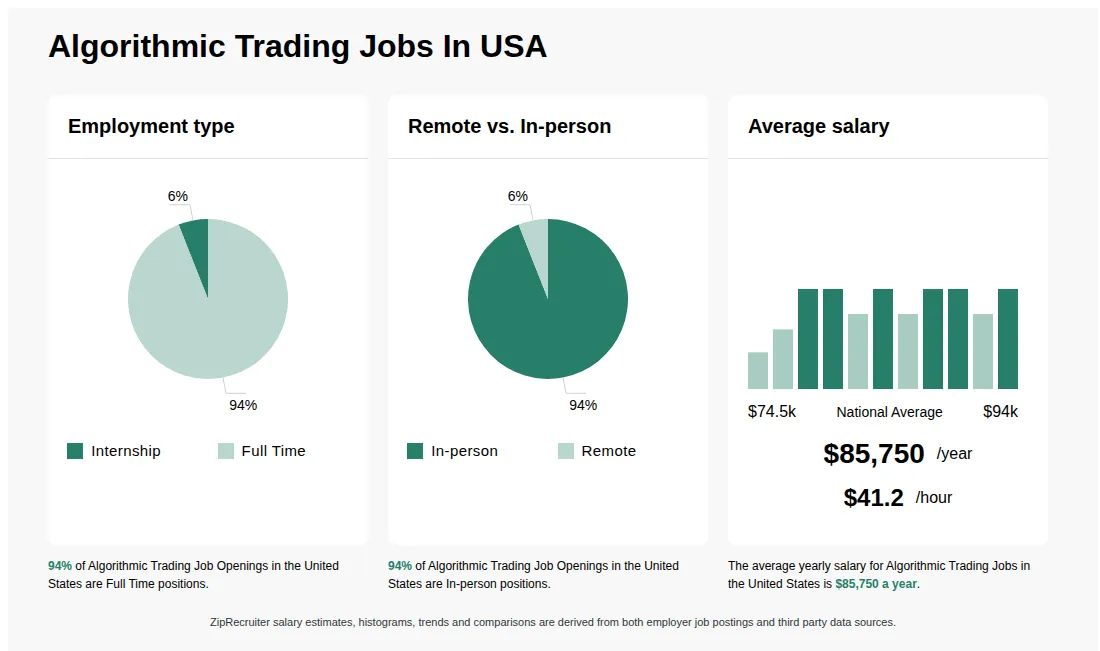
How much do algorithmic trading jobs pay per year?
As of Sep 15, 2026, the average yearly pay for algorithmic trading in the United States is $85,750.00, according to ZipRecruiter salary data. Most workers in this role earn between $81,000.00 and $91,000.00 per year, depending on experience, location, and employer.
What is algorithmic trading?
Algorithmic trading involves trading in equities, currencies, or other financial instruments using computer programs. A trading program uses an algorithm to calculate current market conditions. This trading method is automated, so the program buys or sells the financial instrument when the algorithm says that the market meets all the requirements for a profitable trade. To create an algorithm, you perform mathematical and statistical analysis, also known as quantitative analysis, on an exchange or equity. After creating an algorithm with defined trading rules, you test it using historical market data. While this is primarily a technical field, you also need an understanding of the market.
What is algorithmic trading?
Algorithmic trading refers to the use of computer programs and algorithms to automatically execute trading orders in financial markets. These algorithms follow predefined rules based on factors like price, timing, and volume to optimize trading strategies and reduce human intervention. Algorithmic trading is widely used by institutional investors, hedge funds, and individual traders to increase efficiency, minimize costs, and capitalize on market opportunities. It can range from simple rule-based systems to complex strategies involving machine learning and artificial intelligence.
What are the key skills and qualifications needed to thrive as an algorithmic trader, and why are they important?
To thrive as an Algorithmic Trader, you need a strong background in quantitative analysis, programming (often Python, C++, or Java), and a solid understanding of financial markets, typically supported by a degree in mathematics, engineering, finance, or computer science. Familiarity with statistical modeling tools, trading platforms, and backtesting systems is essential, and certifications such as CFA or FRM can be advantageous. Superior problem-solving skills, attention to detail, and the ability to work under pressure set standout professionals apart in this field. These skills are crucial to developing, implementing, and refining trading strategies that can operate profitably and reliably in fast-moving financial environments.
What are the main challenges faced by professionals in algorithmic trading, and how can they be addressed?
Professionals in algorithmic trading often encounter challenges such as developing strategies that remain effective in rapidly changing markets, minimizing latency for faster execution, and managing the risks associated with automated trading systems. To address these challenges, it's essential to stay updated with the latest market trends and technological advancements, conduct rigorous backtesting of algorithms, and implement robust risk management protocols. Collaboration with quantitative analysts, software engineers, and risk managers is also key to ensuring strategies are both innovative and resilient.
What is the difference between Algorithmic Trading vs Quantitative Analyst?
| Aspect | Algorithmic Trading | Quantitative Analyst |
|---|---|---|
| Required Credentials | Degree in finance, computer science, or related field; programming skills | Degree in mathematics, statistics, or finance; strong analytical skills |
| Work Environment | Trading firms, hedge funds, financial institutions; fast-paced | Investment banks, asset management firms; research-focused |
| Employer & Industry Usage | Used to automate trading strategies | Develops models to inform trading decisions |
While both roles involve quantitative skills and finance knowledge, Algorithmic Traders focus on implementing automated trading systems, whereas Quantitative Analysts develop models and strategies that may be used by traders or firms. The roles often overlap but differ mainly in their primary focus: execution versus modeling.
More about Algorithmic Trading jobs
What cities are hiring for Algorithmic Trading jobs?
Cities with the most Algorithmic Trading job openings:
What are the most commonly searched types of Algorithmic Trading jobs?
The most popular types of Algorithmic Trading jobs are:
What states have the most Algorithmic Trading jobs?
States with the most job openings for Algorithmic Trading jobs include:
What are popular job titles for Algorithmic Trading?
Popular job titles for Algorithmic Trading:

Quantitative Trading & Research - Algorithmic Execution - Analyst
Rochester, NY • On-site
JPMorgan Chase & Co.
• Finance and Insurance • 10K+ employees10,000+ employees
Other
Posted 27 days ago
JPMorgan Chase & Co. rating

7.9
Based on 500 frontline employees who took The Breakroom Quiz
Job description
The Quantitative Trading & Research (QTR) Algorithmic Execution group is looking for an associate with the focus on algorithmic execution across macro. The ATS group is one of the biggest execution algo providers. The objective is to research, implement and support state-of-the art algorithmic execution strategies for institutional clients
Job summary
As an Associate in our Algorithmic Execution team, you will collaborate closely with sales and technology partners to design, implement, and support cutting-edge trading strategies. Your work will directly impact the efficiency and success of institutional trading, leveraging advanced analytics and technology to deliver best-in-class solutions.
Job responsibilities
- Partner with sales to identify and design algorithmic trading solutions tailored to client needs
- Own algorithmic trading risk and resolve day-to-day execution issues
- Analyze trading data to identify patterns and revenue opportunities
- Formulate, analyze, and back test execution strategies
- Collaborate across teams to deliver innovative solutions and share insights
- Provide regular reporting and updates to senior stakeholders
- Maintain strong controls in accordance with company policies and regulatory requirements
Required qualifications, capabilities, and skills
- Degree in computer science or other quantitative field
- Strong Java coding skills and experience in algorithmic execution
- Ability to analyze large data sets and extract actionable insights
- Excellent communication skills, able to articulate complex concepts clearly
- Attention to detail, adaptable, and eager to learn
- Inclusive leadership and collaboration skills
Preferred qualifications, capabilities, and skills
- Interest in client interaction and engagement
- Interest in market microstructures and quantitative trading
- Experience in data handling using KDB
- Familiarity with modern front-end and cloud technologies
What JPMorgan Chase & Co. employees say
Pay
Benefits
Hours and flexibility
Workplace
Get the full story on Breakroom

About JPMorgan Chase & Co
Sourced by ZipRecruiter
Industry
Finance and insurance and banking and credit intermediation
Company size
10,000+ Employees
Headquarters location
New York, NY, US