1

Algorithmic Trading Jobs (NOW HIRING)

Career Description Simplex is looking for analytical and creative individuals to join our trading team. Traders at Simplex work closely with our technology team to design and optimize algorithmic ...

Algorithmic Trader

Chicago, IL · On-site

$150K - $200K/yr

People, Process, Trading Edge, and Technology. Simplex is an in-office organization, helping to ... Traders at Simplex work closely with our technology team to design and optimize algorithmic trading ...

Monitoring of trading activity and positions consistently throughout the shift * Performing research and post trade analysis using the firm's research tools on a variety of algorithmic trading ...

Monitoring of trading activity and positions consistently throughout the shift * Performing research and post trade analysis using the firm's research tools on a variety of algorithmic trading ...

Wintermute is not just a trading company, it is one the most prominent and influential players in ... What will you work on We are looking for an Algorithmic Trader with strong coding skills (Python ...

Wintermute is not just a trading company, it is one the most prominent and influential players in ... What will you work on We are looking for an Algorithmic Trader with strong coding skills (Python ...

$109K - $149K/yr

Join our innovative proprietary trading firm dedicated to developing cutting-edge algorithmic execution tools for the cryptocurrency markets. In this role, you will focus on creating ultra-low ...

next page

Showing results 1-20

Algorithmic Trading information

See salary details

$74.5K

$85.8K

$94K

How much do algorithmic trading jobs pay per year?

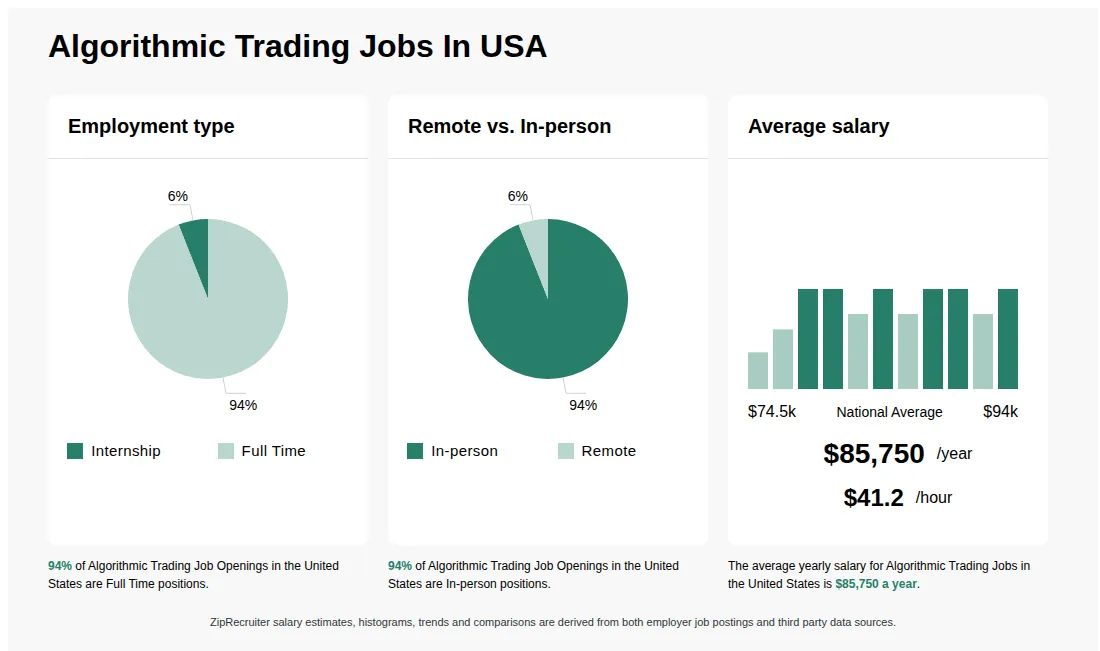
As of Jul 16, 2026, the average yearly pay for algorithmic trading in the United States is $85,750.00, according to ZipRecruiter salary data. Most workers in this role earn between $81,000.00 and $91,000.00 per year, depending on experience, location, and employer.

What Is Algorithmic Trading?

Algorithmic trading involves trading in equities, currencies, or other financial instruments using computer programs. A trading program uses an algorithm to calculate current market conditions. This trading method is automated, so the program buys or sells the financial instrument when the algorithm says that the market meets all the requirements for a profitable trade. To create an algorithm, you perform mathematical and statistical analysis, also known as quantitative analysis, on an exchange or equity. After creating an algorithm with defined trading rules, you test it using historical market data. While this is primarily a technical field, you also need an understanding of the market.

How to become an algorithmic trader?

To become an algorithmic trader, you should develop strong programming skills in languages like Python or C++, gain knowledge of financial markets and trading strategies, and learn to use trading platforms and data analysis tools. A background in mathematics, statistics, or computer science is often essential, and many traders pursue certifications such as the Chartered Market Technician (CMT) or Financial Risk Manager (FRM). Experience with backtesting and risk management is also important for success in this field.

Is algo trading a good career?

Algorithmic trading is a specialized career that involves developing and implementing automated trading strategies using programming skills, data analysis, and financial knowledge. It can be lucrative and in demand in financial firms, but it requires strong technical expertise, continuous learning, and understanding of market regulations. Success in this field depends on technical proficiency, risk management, and staying updated with market trends.

Who is the richest Algo trader in the world?

Algorithmic trading is a specialized finance role involving the use of algorithms and programming skills to execute trades. While individual net worth is often private, some of the most successful algorithmic traders and quant hedge fund managers, such as Jim Simons, have accumulated significant wealth through quantitative strategies and advanced data analysis. These professionals typically work in high-frequency trading firms or hedge funds and require strong mathematical, programming, and financial skills.

What is algorithmic trading?

Algorithmic trading refers to the use of computer programs and algorithms to automatically execute trading orders in financial markets. These algorithms follow predefined rules based on factors like price, timing, and volume to optimize trading strategies and reduce human intervention. Algorithmic trading is widely used by institutional investors, hedge funds, and individual traders to increase efficiency, minimize costs, and capitalize on market opportunities. It can range from simple rule-based systems to complex strategies involving machine learning and artificial intelligence.

What is the difference between Algorithmic Trading vs Quantitative Analyst?

AspectAlgorithmic TradingQuantitative Analyst
Required CredentialsDegree in finance, computer science, or related field; programming skillsDegree in mathematics, statistics, or finance; strong analytical skills
Work EnvironmentTrading firms, hedge funds, financial institutions; fast-pacedInvestment banks, asset management firms; research-focused
Employer & Industry UsageUsed to automate trading strategiesDevelops models to inform trading decisions

While both roles involve quantitative skills and finance knowledge, Algorithmic Traders focus on implementing automated trading systems, whereas Quantitative Analysts develop models and strategies that may be used by traders or firms. The roles often overlap but differ mainly in their primary focus: execution versus modeling.

What are the main challenges faced by professionals in algorithmic trading, and how can they be addressed?

Professionals in algorithmic trading often encounter challenges such as developing strategies that remain effective in rapidly changing markets, minimizing latency for faster execution, and managing the risks associated with automated trading systems. To address these challenges, it's essential to stay updated with the latest market trends and technological advancements, conduct rigorous backtesting of algorithms, and implement robust risk management protocols. Collaboration with quantitative analysts, software engineers, and risk managers is also key to ensuring strategies are both innovative and resilient.

Can I make money with algorithmic trading?

Algorithmic trading professionals develop and implement automated trading strategies that can generate profits if the algorithms are well-designed and market conditions are favorable. Success depends on skills in programming, data analysis, and risk management, and consistent profitability is not guaranteed. Many traders experience both gains and losses, and ongoing testing and optimization are essential for potential profitability.

What are the key skills and qualifications needed to thrive as an Algorithmic Trader, and why are they important?

To thrive as an Algorithmic Trader, you need a strong background in quantitative analysis, programming (often Python, C++, or Java), and a solid understanding of financial markets, typically supported by a degree in mathematics, engineering, finance, or computer science. Familiarity with statistical modeling tools, trading platforms, and backtesting systems is essential, and certifications such as CFA or FRM can be advantageous. Superior problem-solving skills, attention to detail, and the ability to work under pressure set standout professionals apart in this field. These skills are crucial to developing, implementing, and refining trading strategies that can operate profitably and reliably in fast-moving financial environments.
What cities are hiring for Algorithmic Trading jobs? Cities with the most Algorithmic Trading job openings:
What are the most commonly searched types of Algorithmic Trading jobs? The most popular types of Algorithmic Trading jobs are:
What states have the most Algorithmic Trading jobs? States with the most job openings for Algorithmic Trading jobs include:
Infographic showing various Algorithmic Trading job openings in the United States as of July 2026, with employment types broken down into 1% Internship, 1% As Needed, 86% Full Time, 11% Part Time, and 1% Contract. Highlights an 84% Physical, 1% Hybrid, and 15% Remote job distribution, with an average salary of $85,750 per year, or $41.2 per hour.
Algorithmic Trader

Other

Re-posted yesterday


Job description

Career Description

Simplex is looking for analytical and creative individuals to join our trading team.  Traders at Simplex work closely with our technology team to design and optimize algorithmic trading strategies based on deep knowledge of market microstructure, trading  dynamics, and data-focused understanding of pricing, risk management, and order flow.  An ideal candidate is collaborative, strongly self-motivated, and capable of detail-oriented troubleshooting, data analysis, and robust systems design.

What will you be doing?

  • Design, troubleshoot, and optimize trading strategies and supporting pricing, risk management, and order execution modules
  • Iteratively improve trading models and parameters through research and data-focused analysis
  • Investigate new opportunities and avenues for firm market share growth or product expansion

Skills and Experience:

  • At least one year professional experience in algorithmic trading, ideally equity or futures options
  • A track record of solving challenging analytical problems and implementing robust solutions
  • Firm understanding of statistics and probability, linear algebra, and calculus
  • Proficiency with Python and/or R for research, data analysis, and statistical modeling
  • Experience working with large datasets using relational databases, ideally SQL/MySQL
  • Exposure to Linux/Unix beneficial