1

Aircraft Fuel System Jobs (NOW HIRING)

Aircraft Mechanic II (Fuel System) WORKCENTER: BACK SHOP (Fuel Shop) Essential Responsibilities: * Inspect, troubleshoot, repair, overhaul and modify fuel systems. * Drain fuel from tanks and cells.

Aircraft Mechanic II (Fuel System) WORKCENTER: BACK SHOP (Fuel Shop) Essential Responsibilities: * Inspect, troubleshoot, repair, overhaul and modify fuel systems. * Drain fuel from tanks and cells.

Principal Fuel Systems Engineer (X-BAT)

Dallas, TX ยท On-site +1

$209.20K - $313.80K/yr

Demonstrated expertise with fuel system design, analysis, and certification for manned or unmanned aircraft. * Deep understanding of fluid mechanics, thermodynamics, and CFD principles. * Proficiency ...

Principal Fuel Systems Engineer (X-BAT)

Boston, MA ยท On-site +1

$209.20K - $313.80K/yr

Demonstrated expertise with fuel system design, analysis, and certification for manned or unmanned aircraft. * Deep understanding of fluid mechanics, thermodynamics, and CFD principles. * Proficiency ...

$78.18K - $91.20K/yr

DUTY 1: Receives work document(s) or oral instructions regarding problems with aircraft fuel system. Troubleshoots integral fuel tanks, using leak path analysis and other test procedures such as ...

next page

Showing results 1-20

Aircraft Fuel System information

See salary details

$11

$18

$27

How much do aircraft fuel system jobs pay per hour?

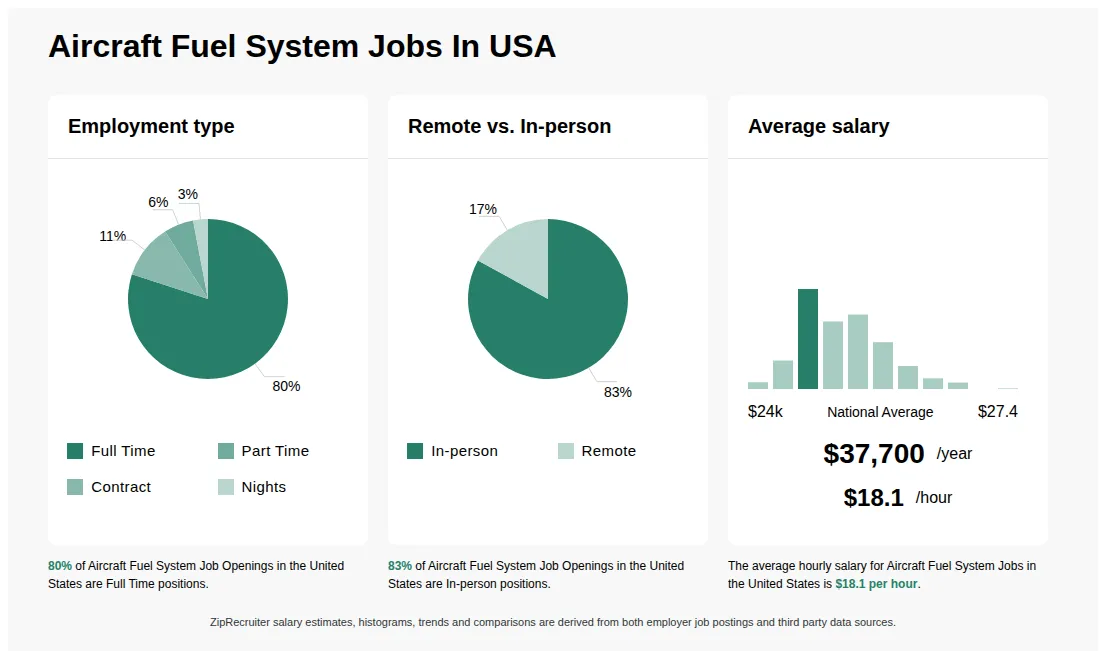
As of Jun 1, 2026, the average hourly pay for aircraft fuel system in the United States is $18.12, according to ZipRecruiter salary data. Most workers in this role earn between $15.38 and $18.75 per hour, depending on experience, location, and employer.

What is an Aircraft Fuel System job?

An Aircraft Fuel System job involves inspecting, maintaining, and repairing the fuel systems of aircraft to ensure safe and efficient operation. Technicians diagnose fuel system issues, perform leak checks, replace faulty components, and ensure compliance with safety regulations. They work with fuel pumps, tanks, valves, and lines to prevent contamination or malfunctions. This role requires technical expertise, attention to detail, and adherence to aviation maintenance protocols.

What are the key skills and qualifications needed to thrive in the Aircraft Fuel System position, and why are they important?

To excel in an Aircraft Fuel System role, a solid background in mechanical or aerospace engineering, along with experience in fuel system inspection, maintenance, and troubleshooting, is essential. Familiarity with specialized diagnostic tools, fuel system schematics, and compliance with safety standards like FAA regulations and relevant certifications (such as an A&P license) is typically required. Attention to detail, analytical thinking, and strong collaboration skills help professionals excel in both independent and team-based tasks. These capabilities are crucial to ensuring aircraft safety, efficiency, and compliance with strict industry regulations.

What are the typical daily responsibilities for someone working in Aircraft Fuel Systems?

Professionals in Aircraft Fuel Systems are responsible for inspecting, maintaining, and repairing the fuel delivery components in aircraft, including pumps, tanks, valves, and lines. On a daily basis, they may conduct system diagnostics, perform preventative maintenance checks, troubleshoot fuel leaks or pressure issues, and document their findings in accordance with regulatory requirements. Collaboration with engineers, maintenance technicians, and quality assurance teams is common to ensure all fuel system components meet stringent safety and performance standards. This role is both hands-on and technical, often involving work in hangar environments or on the tarmac, and may require adherence to tight maintenance schedules to keep aircraft operational.

What is the highest paying A&P job?

The highest paying A&P (Airframe and Powerplant) mechanic jobs are often with major airlines, military contractors, or aerospace manufacturers, especially those requiring specialized skills or certifications. Senior or lead aircraft maintenance roles, especially in large commercial operations or with government agencies, tend to offer the highest salaries in the field.
What cities are hiring for Aircraft Fuel System jobs? Cities with the most Aircraft Fuel System job openings:
What are the most commonly searched types of Aircraft Fuel System jobs? The most popular types of Aircraft Fuel System jobs are:
What states have the most Aircraft Fuel System jobs? States with the most job openings for Aircraft Fuel System jobs include:
Infographic showing various Aircraft Fuel System job openings in the United States as of May 2026, with employment types broken down into 7% As Needed, 73% Full Time, and 20% Part Time. Highlights an 92% Physical, 2% Hybrid, and 6% Remote job distribution, with an average salary of $37,700 per year, or $18.1 per hour.
Principal Engineer - Propulsion & Fuel Subsystems Design and Integration

Principal Engineer - Propulsion & Fuel Subsystems Design and Integration

SyberJet Aircraft

Chandler, AZ โ€ข On-site

Full-time

Posted 11 days ago


Job description

SyberJet is an up-and-coming aircraft manufacturer dedicated to pushing the boundaries of innovation and precision in the design and manufacturing of advanced aerospace systems and aircraft. Our team is committed to excellence, creativity, and continuous improvement in all aspects of our work.
Job Description:
SyberJet Aircraft is seeking a Senior Propulsion & Fuel Systems Engineer with strong FAA certification and systems safety experience to lead and coordinate the integration of advanced propulsion and fuel systems on our aircraft programs. This role blends technical engineering leadership, project oversight, and regulatory compliance responsibilities, and is ideally suited for a propulsion engineer who has contributed directly to FAA Part 23 or Part 25 programs and understands the full life cycle of propulsion system development, integration, and certification.
You will act as the project engineer for powerplant and fuel systems development - interfacing with vendors and guiding independent electrical and mechanical design teams to ensure the final design is safe, certifiable, and optimized for performance and manufacturability.
Key Responsibilities:
Propulsion & Fuel System Integration:
  • Lead the integration of new turbofan engines and associated fuel systems into the aircraft design.
  • Define and manage system-level requirements, interfaces, and design constraints for propulsion, fuel systems, and bleed air.
  • Guide supplier selection and coordination, ensuring design alignment and certification readiness.
  • Ensure mechanical and electrical subsystems are harmonized with engine and fuel system integration needs.
  • Coordinate the integration and application of engine bleed air for aircraft anti-ice and pneumatic systems, ensuring safe and effective performance.

FAA Certification & Safety:
  • Serve as the technical lead for propulsion and fuel systems certification efforts.
  • Coordinate with FAA ACOs and DERs (Designated Engineering Representatives) on compliance planning and issue resolution.
  • Develop and contribute to compliance documentation, including means of compliance matrices, certification plans, compliance checklists, and engineering reports.
  • Author, support, and review System Safety Assessments (SSAs), including FHA, FTA, and SSA documents per ARP4761 guidance.
  • Drive validation of certification artifacts against FAA Part 23 requirements.

Testing & Evaluation:
  • Support propulsion and fuel system ground and flight test programs.
  • Lead root-cause analysis and corrective actions for any propulsion-related anomalies or discrepancies during testing.
  • Evaluate performance data and verify compliance with safety and performance objectives.

CAD Modeling:
  • Use Siemens NX for 3D Modeling, assembly design, and drafting. Produce detailed engineering drawings and specifications.

Product Lifecycle Management:
  • Manage product data, track design changes, and ensure documentation is current and accessible using Teamcenter, Jira, and Confluence.

Problem Solving:
  • Analyze and resolve design issues, offering innovative solutions to engineering challenges.

Continuous Improvement:
  • Contribute to process improvements and best practices within the design and development team.

Qualifications:
Education:
  • Bachelor's degree in aerospace, Mechanical, or Propulsion Engineering, or a related field.

Experience:
  • Minimum of 8 years of experience in aircraft turbofan propulsion system design and integration, with at least 5 years supporting FAA certification (Part 23 or Part 25).
  • Demonstrated experience supporting or leading System Safety Assessments.
  • Solid understanding of FAA certification processes, including working with FAA DERs or as an ODA member.
  • Working knowledge of aircraft fuel system design, propulsion system controls, and engine bleed air systems (particularly for anti-icing and pneumatic integration).

Software Skills:
  • Experience with Simulink, MATLAB, or engine performance simulation tools is desired.
  • Proficiency with Siemens NX and Teamcenter is preferred.

Preferred Experience:
  • Model-based systems engineering (MBSE) tools and methodologies.
  • Agile Development using Jira Sprint Methodology.
  • Working knowledge of engine control integration, FADEC's, electrical loads, and engine nacelle design.
  • Project Management

Technical Knowledge:
  • Strong understanding of industry standards, aerospace design processes, certification methods, and the operational characteristics of aircraft turbo fan engines.

Analytical Skills:
  • Excellent problem-solving skills with the ability to analyze complex technical data and provide effective solutions.

Communication:
  • Strong verbal and written communication skills, with the ability to effectively present and document technical information to various stakeholders.

Team Player:
  • Ability to work collaboratively in a team environment, demonstrating strong interpersonal skills.

What We Offer:
  • Competitive salary and benefits package.
  • Opportunities for professional growth and development.
  • A collaborative, engineering-driven, innovative work environment.
  • The chance to work on cutting-edge aerospace projects with a talented team of professionals.