Company Description Air Pollution Control (APC) Engineer This position can be located anywhere within the United States near a Ramboll office. We invite you to join Ramboll's Air Pollution Control ...
Company Description Air Pollution Control (APC) Engineer This position can be located anywhere within the United States near a Ramboll office. We invite you to join Ramboll's Air Pollution Control ...
Company Description Air Pollution Control (APC) Engineer This position can be located anywhere within the United States near a Ramboll office. We invite you to join Ramboll's Air Pollution Control ...
Company Description Air Pollution Control (APC) Engineer This position can be located anywhere within the United States near a Ramboll office. We invite you to join Ramboll's Air Pollution Control ...
Company Description Air Pollution Control (APC) Engineer This position can be located anywhere within the United States near a Ramboll office. We invite you to join Ramboll's Air Pollution Control ...
Company Description Air Pollution Control (APC) Engineer This position can be located anywhere within the United States near a Ramboll office. We invite you to join Ramboll's Air Pollution Control ...
Company Description Air Pollution Control (APC) Engineer This position can be located anywhere within the United States near a Ramboll office. We invite you to join Ramboll's Air Pollution Control ...
Company Description Air Pollution Control (APC) Engineer This position can be located anywhere within the United States near a Ramboll office. We invite you to join Ramboll's Air Pollution Control ...
Company Description Air Pollution Control (APC) Engineer This position can be located anywhere within the United States near a Ramboll office. We invite you to join Ramboll's Air Pollution Control ...
Company Description Air Pollution Control (APC) Engineer This position can be located anywhere within the United States near a Ramboll office. We invite you to join Ramboll's Air Pollution Control ...
Company Description Air Pollution Control (APC) Engineer This position can be located anywhere within the United States near a Ramboll office. We invite you to join Ramboll's Air Pollution Control ...
Company Description Air Pollution Control (APC) Engineer This position can be located anywhere within the United States near a Ramboll office. We invite you to join Ramboll's Air Pollution Control ...
Company Description Air Pollution Control (APC) Engineer This position can be located anywhere within the United States near a Ramboll office. We invite you to join Ramboll's Air Pollution Control ...
Company Description Air Pollution Control (APC) Engineer This position can be located anywhere within the United States near a Ramboll office. We invite you to join Ramboll's Air Pollution Control ...
Company Description Air Pollution Control (APC) Engineer This position can be located anywhere within the United States near a Ramboll office. We invite you to join Ramboll's Air Pollution Control ...
Company Description Air Pollution Control (APC) Engineer This position can be located anywhere within the United States near a Ramboll office. We invite you to join Ramboll's Air Pollution Control ...
Company Description Air Pollution Control (APC) Engineer This position can be located anywhere within the United States near a Ramboll office. We invite you to join Ramboll's Air Pollution Control ...
Company Description Air Pollution Control (APC) Engineer This position can be located anywhere within the United States near a Ramboll office. We invite you to join Ramboll's Air Pollution Control ...
Company Description Air Pollution Control (APC) Engineer This position can be located anywhere within the United States near a Ramboll office. We invite you to join Ramboll's Air Pollution Control ...
Company Description Air Pollution Control (APC) Engineer This position can be located anywhere within the United States near a Ramboll office. We invite you to join Ramboll's Air Pollution Control ...
Air Pollution Control Representative
Saint Louis, MO · On-site
$23.10/hr
Public Health - Air Pollution Control Opening Date: 08/27/2026 Closing Date: 9/11/2026 11:59 PM ... Minimum Qualifications Bachelor's degree in environmental science, engineering, mathematics ...
Air Pollution Control Representative
Saint Louis, MO · On-site
$23.10/hr
Public Health - Air Pollution Control Opening Date: 08/27/2026 Closing Date: 9/11/2026 11:59 PM ... Minimum Qualifications Bachelor's degree in environmental science, engineering, mathematics ...

Air Pollution Control Representative
Saint Louis, MO · On-site
$41K - $62K/yr
... and Local air pollution control rules, regulations, standards, and ordinances This includes ... Minimum Qualifications Bachelor's degree in environmental science, engineering, mathematics ...
Air Pollution Control Representative
Saint Louis, MO · On-site
$41K - $62K/yr
... and Local air pollution control rules, regulations, standards, and ordinances This includes ... Minimum Qualifications Bachelor's degree in environmental science, engineering, mathematics ...
Air Pollution Control Monitoring Technician
El Centro, CA · On-site
$4.2K - $5.1K/mo
Air Pollution Control District Division: 1596001 Air Pollution Control District Opening Date: 09/01/2026 Closing Date: 9/11/2026 5:00 PM Pacific Basic Function and Distinguishing Characteristics ...
Air Pollution Control Monitoring Technician
El Centro, CA · On-site
$4.2K - $5.1K/mo
Air Pollution Control District Division: 1596001 Air Pollution Control District Opening Date: 09/01/2026 Closing Date: 9/11/2026 5:00 PM Pacific Basic Function and Distinguishing Characteristics ...

Air Pollution Specialist I
Alturas, CA · On-site
$47K - $74K/yr
Enforces air pollution control standards of industrial and agricultural sources under state and federal laws and regulations. * Assists in the coordination of the County agricultural burn program.
New
Quick apply
Air Pollution Specialist I
Alturas, CA · On-site
$47K - $74K/yr
Enforces air pollution control standards of industrial and agricultural sources under state and federal laws and regulations. * Assists in the coordination of the County agricultural burn program.
New
Air Pollution Specialist I
Alturas, CA · On-site
$47K - $74K/yr
Enforces air pollution control standards of industrial and agricultural sources under state and federal laws and regulations. * Assists in the coordination of the County agricultural burn program.
New
Quick apply
Air Pollution Specialist I
Alturas, CA · On-site
$47K - $74K/yr
Enforces air pollution control standards of industrial and agricultural sources under state and federal laws and regulations. * Assists in the coordination of the County agricultural burn program.
New
Air Pollution Control Monitoring Technician
El Centro, CA · On-site
$4.2K - $5.1K/mo
This is the journey level class allocated to the Air Pollution Control District. Under general supervision, installs, tests, operates, maintains, and repairs air-monitoring equipment in the shop or ...
Air Pollution Control Monitoring Technician
El Centro, CA · On-site
$4.2K - $5.1K/mo
This is the journey level class allocated to the Air Pollution Control District. Under general supervision, installs, tests, operates, maintains, and repairs air-monitoring equipment in the shop or ...
Engineer Trainee (35 Hour)
Hartford, CT · On-site
$70K/yr
... Air Pollution Control Engineer 1. Engineer Trainees receive training under the direction of a supervisor and senior staff before being promoted to Air Pollution Control Engineer 1 upon successful ...
Engineer Trainee (35 Hour)
Hartford, CT · On-site
$70K/yr
... Air Pollution Control Engineer 1. Engineer Trainees receive training under the direction of a supervisor and senior staff before being promoted to Air Pollution Control Engineer 1 upon successful ...
Office Services Specialist - Air Pollution Control
Saint Louis, MO · On-site +1
$34K - $41K/yr
Acting as the main point of contact for the Air Pollution Program, the Office Services Specialist supports the daily operations and essential functions of both the Air Pollution Control Program and ...
Office Services Specialist - Air Pollution Control
Saint Louis, MO · On-site +1
$34K - $41K/yr
Acting as the main point of contact for the Air Pollution Program, the Office Services Specialist supports the daily operations and essential functions of both the Air Pollution Control Program and ...

Air Environmental Engineer
Atlanta, GA · On-site
... pollution control systems. Key Responsibilities * Air Permitting: Prepare, submit, and manage ... Coordinate with operations, engineering, and legal teams, and interact directly with clients and ...
Air Environmental Engineer
Atlanta, GA · On-site
... pollution control systems. Key Responsibilities * Air Permitting: Prepare, submit, and manage ... Coordinate with operations, engineering, and legal teams, and interact directly with clients and ...
Air Environmental Engineer
Atlanta, GA · On-site
$90K - $135K/yr
... pollution control systems. Key Responsibilities * Air Permitting: Prepare, submit, and manage ... Coordinate with operations, engineering, and legal teams, and interact directly with clients and ...
Quick apply
Air Environmental Engineer
Atlanta, GA · On-site
$90K - $135K/yr
... pollution control systems. Key Responsibilities * Air Permitting: Prepare, submit, and manage ... Coordinate with operations, engineering, and legal teams, and interact directly with clients and ...
Air Pollution Control Engineer information
See salary details
$19.95 - $24.17
3% of jobs
$24.17 - $28.39
7% of jobs
$31.80 is the 25th percentile. Wages below this are outliers.
$28.39 - $32.60
18% of jobs
$32.60 - $36.82
21% of jobs
The median wage is $36.93 / hr.
$36.82 - $41.04
21% of jobs
$43.03 is the 75th percentile. Wages above this are outliers.
$41.04 - $45.26
9% of jobs
$45.26 - $49.48
7% of jobs
$49.48 - $53.69
5% of jobs
$53.69 - $57.91
3% of jobs
$57.91 - $62.13
2% of jobs
$62.13 - $66.35
2% of jobs
$19
$40
$66
How much do air pollution control engineer jobs pay per hour?
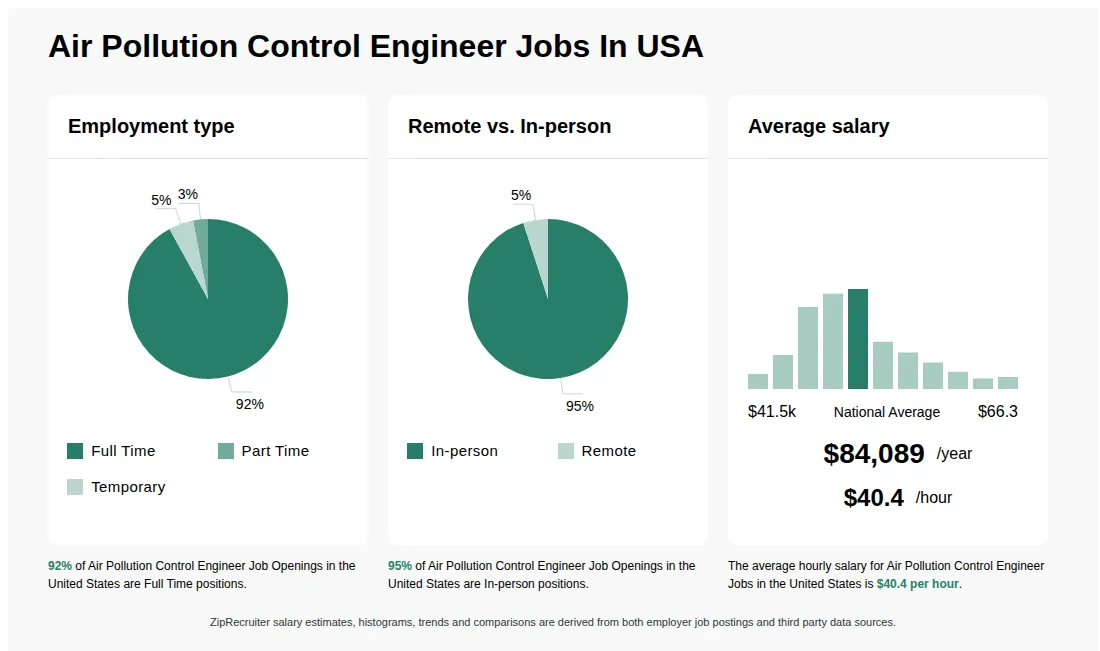
As of Sep 13, 2026, the average hourly pay for air pollution control engineer in the United States is $40.43, according to ZipRecruiter salary data. Most workers in this role earn between $32.21 and $45.67 per hour, depending on experience, location, and employer.
What does an air pollution control engineer do?
An Air Pollution Control Engineer is responsible for designing, implementing, and maintaining systems and strategies to reduce or eliminate air pollution from industrial, commercial, and municipal sources. They analyze air quality data, ensure compliance with environmental regulations, and develop solutions to minimize emissions of pollutants. Their work often involves collaborating with environmental agencies, conducting site assessments, and recommending improvements to existing pollution control technologies.
What are the key skills and qualifications needed to thrive as an air pollution control engineer?
To thrive as an Air Pollution Control Engineer, you need a solid background in environmental or chemical engineering, typically with a bachelor's degree and knowledge of air quality regulations. Familiarity with modeling software (such as AERMOD), emissions monitoring equipment, and permitting systems is often required, along with certifications like Professional Engineer (PE) licensure. Strong problem-solving, analytical thinking, and communication skills help you collaborate with stakeholders and develop effective pollution mitigation strategies. These skills and qualifications are vital for ensuring regulatory compliance, protecting public health, and designing efficient air quality solutions.
What are some common challenges air pollution control engineers face when implementing new emission reduction technologies?
Air Pollution Control Engineers often encounter challenges such as integrating advanced technologies with existing industrial systems, ensuring regulatory compliance, and balancing cost-effectiveness with environmental performance. They must work closely with multidisciplinary teams, including operations, maintenance, and regulatory affairs, to troubleshoot installation issues and optimize system performance. Additionally, staying updated on evolving environmental regulations and emerging technologies is essential to address unforeseen technical or regulatory obstacles.
What is the difference between Air Pollution Control Engineer vs Environmental Engineer?
| Aspect | Air Pollution Control Engineer | Environmental Engineer |
|---|---|---|
| Credentials | Bachelor's in environmental, chemical, or mechanical engineering; certifications like PE or APE | Bachelor's in environmental, civil, or chemical engineering; similar certifications |
| Work Environment | Designing air pollution control systems, testing emissions, working in labs or industrial sites | Broader environmental projects, including water, soil, and air quality assessments |
| Industry Usage | Industries with emission controls, manufacturing, government agencies | Consulting firms, government agencies, manufacturing, environmental organizations |
While both roles focus on environmental protection, Air Pollution Control Engineers specialize in designing and implementing systems to reduce air emissions, whereas Environmental Engineers address a wider range of environmental issues, including water and soil quality.
More about Air Pollution Control Engineer jobs
What cities are hiring for Air Pollution Control Engineer jobs?
Cities with the most Air Pollution Control Engineer job openings:
Who are the top companies hiring for Air Pollution Control Engineer jobs?
The top employers for Air Pollution Control Engineer jobs are:
What states have the most Air Pollution Control Engineer jobs?
States with the most job openings for Air Pollution Control Engineer jobs include:
What are popular job titles related to Air Pollution Control Engineer jobs?
For Air Pollution Control Engineer jobs, the most frequently searched job titles are:

Air Pollution Control (APC) Engineer
Chicago, IL • On-site
Ramboll
• Construction • 10K+ employees10,000+ employees
Full-time
Re-posted 26 days ago
Key responsibilities
Proactively sell and manage engineering and turn-key projects related to air pollution control technologies.
Serve as a technical liaison between clients and technology providers to support application of APC equipment.
Manage projects by planning, organizing, and controlling resources to meet scope, time, quality, and budget objectives.
Job description
Company Description
Air Pollution Control (APC) Engineer
This position can be located anywhere within the United States near a Ramboll office.
We invite you to join Ramboll's Air Pollution Control (APC) Group and bring your credentials within process technologies to support the delivery of excellent projects to our clients. To succeed in this role, you should have practical working experience in sales and engineering of combustion, heat recovery and air pollution control technologies. Send us your application using our online tool.
Inviting bright minds
Would you like to develop professionally in an open, collegial, international and supportive working atmosphere? Our goal is to create a sustainable future with exciting projects and to set new standards with our innovative approaches. Become part of a global company that has grown successfully since it was founded in 1945 to now 16,500 employees worldwide.
Work at the heart of sustainable change with Ramboll in the Americas
Ramboll is a global architecture, engineering, and consultancy company. As a foundation-owned people company, founded in Denmark, we believe that the purpose of sustainable change is to create a thriving world for both nature and people. So, that's where we start - and how we work. Our history is rooted in a clear vision of how a responsible company should act and being open and curious is a cornerstone of our culture. Ramboll in the Americas has thousands of experts working across more than 70 offices. Ramboll experts deliver innovative solutions across Environment & Health, Water, Energy, and Planning & Urban Design.
Job Description
Join our Energy Team
As a "change partner" for our clients, we play a key role in transforming the energy sector worldwide. We are supporting our clients by delivering cutting-edge projects with sustainability built-in. Our consulting and engineering services are key to enabling sustainable change and taking climate action. When you start with Ramboll, you'll be joining a company that strives to make a difference - for our employees, clients and society.
At Ramboll, our APC Group is an important partner for our industrial client base and is defined as an area of strategic importance for us. We have a growing need to expand these services to the Americas market.
Our team is recognized as the leading consultant in the world in this industry. The team is truly international and provides consulting engineering and design services worldwide out of offices in the Unites States, Canada, Denmark, UK, Switzerland, Singapore and Australia.
As a Senior Project Engineer in our APC Group you will be proactively selling and managing engineering and turn-key projects - and supporting the projects lead by other departments.
Your tasks and responsibilities:
Qualifications
Grow with us
At Ramboll, we support you in your personal and professional development right from the start. In order to get started with us, you should meet the following requirements:
Strong communication skills both oral and written and an ability to communicate effectively with various level of management within the company and with potential clients, suppliers, subcontractors and partners
Additional Information
Welcome to our Energy Division
Ramboll is the leading engineering, design and consultancy company and has 16,500 experts working across 35 countries applying their passion to deliver innovative solutions in markets as diverse as Buildings, Transport, Planning & Urban Design, Water, Environment & Health, Energy and Management Consulting. Our Energy from Waste & Carbon Capture division is part of Ramboll Energy. Ramboll Energy is at the forefront of addressing the green transition and offers a holistic approach to energy that supports the sector on the journey towards more sustainable solutions. We invite you to contribute to a sustainable future working in an open, collaborative and empowering culture
Ramboll in Americas
Founded in Denmark, Ramboll is a people company that has over 2,000 experts working across more than 60 offices in the Americas applying their passion to deliver innovative solutions across Buildings, Transport, Energy, Environment & Health, Water, Management Consulting, and Architecture and Landscape. As a company, we are committed to reducing our environmental impact, contributing to a cohesive society with equal rights and opportunities for all, and fostering a culture of excellence, enjoyment, and equal opportunities for all our employees. We invite you to contribute to a sustainable future working in an open, collaborative, and empowering culture.
Where People Flourish
Our mission is to create sustainable societies where people and nature flourish. This means that a culture of inclusion is embedded in everything we do. Our people bring diverse backgrounds and experiences to the company, enabling us to deliver innovative and forward-thinking solutions to our clients. We also know how important it is to achieve the right balance of where, when, and how much you work. At Ramboll, we offer flexibility as part of our positive and inclusive approach to work. We are committed to equal employment opportunity, regardless of age, disability or medical condition, gender identity, marriage and domestic partnership, pregnancy and maternity, race, ancestry, or national origin, religion or belief, sex and sexual orientation, military service and veteran status, or any other protected characteristic. Ramboll wants to ensure opportunities are accessible to candidates with disabilities. So, please let us know if there are any changes we could make to the application process to make it more comfortable for you. You can contact us at job.advert.accessibility@ramboll.com with such requests.
Salary Transparency
At Ramboll, we are committed to fair and transparent compensation practices that support our people and our purpose of creating sustainable societies. The anticipated base salary range for this position is $122,000 to $152,000 per year. This range reflects the compensation we reasonably expect to offer at the time of posting. Actual compensation will vary based on factors such as location, skills, experience, education, and internal equity. Because we operate across multiple U.S. markets, pay may differ depending on the cost of labor in specific locations. In addition to base salary, this position may be eligible for bonus, overtime or other forms of compensation and we offer a comprehensive benefits package that supports well-being, professional development, and work-life balance. Our recruiters are happy to share more about the specific salary range and total rewards package applicable to your location during the hiring process.
How to apply
Apply online. Attach your CV, cover letter and relevant documents showcasing why you are the right fit for the role, and when you are available to start. We look forward to receiving your application.
Air Pollution Control (APC) Engineer
This position can be located anywhere within the United States near a Ramboll office.
We invite you to join Ramboll's Air Pollution Control (APC) Group and bring your credentials within process technologies to support the delivery of excellent projects to our clients. To succeed in this role, you should have practical working experience in sales and engineering of combustion, heat recovery and air pollution control technologies. Send us your application using our online tool.
Inviting bright minds
Would you like to develop professionally in an open, collegial, international and supportive working atmosphere? Our goal is to create a sustainable future with exciting projects and to set new standards with our innovative approaches. Become part of a global company that has grown successfully since it was founded in 1945 to now 16,500 employees worldwide.
Work at the heart of sustainable change with Ramboll in the Americas
Ramboll is a global architecture, engineering, and consultancy company. As a foundation-owned people company, founded in Denmark, we believe that the purpose of sustainable change is to create a thriving world for both nature and people. So, that's where we start - and how we work. Our history is rooted in a clear vision of how a responsible company should act and being open and curious is a cornerstone of our culture. Ramboll in the Americas has thousands of experts working across more than 70 offices. Ramboll experts deliver innovative solutions across Environment & Health, Water, Energy, and Planning & Urban Design.
Job Description
Join our Energy Team
As a "change partner" for our clients, we play a key role in transforming the energy sector worldwide. We are supporting our clients by delivering cutting-edge projects with sustainability built-in. Our consulting and engineering services are key to enabling sustainable change and taking climate action. When you start with Ramboll, you'll be joining a company that strives to make a difference - for our employees, clients and society.
At Ramboll, our APC Group is an important partner for our industrial client base and is defined as an area of strategic importance for us. We have a growing need to expand these services to the Americas market.
Our team is recognized as the leading consultant in the world in this industry. The team is truly international and provides consulting engineering and design services worldwide out of offices in the Unites States, Canada, Denmark, UK, Switzerland, Singapore and Australia.
As a Senior Project Engineer in our APC Group you will be proactively selling and managing engineering and turn-key projects - and supporting the projects lead by other departments.
Your tasks and responsibilities:
- To be an advocate for our clients who need to apply APC equipment.
- Be a trusted technical liaison between clients and technology providers.
- To engage in and drive business development/branding work
- Solve distinctive, complex and challenging technical or business issues for clients within the air pollution control technologies sphere.
- Provide project engineering support and advance the group's position as thought leader in- and outside of Ramboll.
- Manage projects, including planning, organizing, and controlling resources/ processes to achieve project objectives within scope, time, quality and budget constraints.
- Participate in the development of intellectual property
- Work with minimum supervision
- Some travel required. Approx 30-40%
Qualifications
Grow with us
At Ramboll, we support you in your personal and professional development right from the start. In order to get started with us, you should meet the following requirements:
- A BS or MSc degree within a relevant scientific/technical/ engineering field;
- Strong technical acumen, professional experience and relevant knowledge in combustion and air pollution control technologies;
- Hands-on experience with modeling tools, with a preference for ChemCAD and Excel
- 15+ years relevant sales and work experience with a pollution control technology vendor or engineering company
- Project management experience from a similar role;
- Good at managing ambiguity, opportunities and risks;
- Customer-oriented and are characterized by a self-reliant, reliable and structured way of working;
- Intercultural competence and international experience;
Strong communication skills both oral and written and an ability to communicate effectively with various level of management within the company and with potential clients, suppliers, subcontractors and partners
Additional Information
Welcome to our Energy Division
Ramboll is the leading engineering, design and consultancy company and has 16,500 experts working across 35 countries applying their passion to deliver innovative solutions in markets as diverse as Buildings, Transport, Planning & Urban Design, Water, Environment & Health, Energy and Management Consulting. Our Energy from Waste & Carbon Capture division is part of Ramboll Energy. Ramboll Energy is at the forefront of addressing the green transition and offers a holistic approach to energy that supports the sector on the journey towards more sustainable solutions. We invite you to contribute to a sustainable future working in an open, collaborative and empowering culture
Ramboll in Americas
Founded in Denmark, Ramboll is a people company that has over 2,000 experts working across more than 60 offices in the Americas applying their passion to deliver innovative solutions across Buildings, Transport, Energy, Environment & Health, Water, Management Consulting, and Architecture and Landscape. As a company, we are committed to reducing our environmental impact, contributing to a cohesive society with equal rights and opportunities for all, and fostering a culture of excellence, enjoyment, and equal opportunities for all our employees. We invite you to contribute to a sustainable future working in an open, collaborative, and empowering culture.
Where People Flourish
Our mission is to create sustainable societies where people and nature flourish. This means that a culture of inclusion is embedded in everything we do. Our people bring diverse backgrounds and experiences to the company, enabling us to deliver innovative and forward-thinking solutions to our clients. We also know how important it is to achieve the right balance of where, when, and how much you work. At Ramboll, we offer flexibility as part of our positive and inclusive approach to work. We are committed to equal employment opportunity, regardless of age, disability or medical condition, gender identity, marriage and domestic partnership, pregnancy and maternity, race, ancestry, or national origin, religion or belief, sex and sexual orientation, military service and veteran status, or any other protected characteristic. Ramboll wants to ensure opportunities are accessible to candidates with disabilities. So, please let us know if there are any changes we could make to the application process to make it more comfortable for you. You can contact us at job.advert.accessibility@ramboll.com with such requests.
Salary Transparency
At Ramboll, we are committed to fair and transparent compensation practices that support our people and our purpose of creating sustainable societies. The anticipated base salary range for this position is $122,000 to $152,000 per year. This range reflects the compensation we reasonably expect to offer at the time of posting. Actual compensation will vary based on factors such as location, skills, experience, education, and internal equity. Because we operate across multiple U.S. markets, pay may differ depending on the cost of labor in specific locations. In addition to base salary, this position may be eligible for bonus, overtime or other forms of compensation and we offer a comprehensive benefits package that supports well-being, professional development, and work-life balance. Our recruiters are happy to share more about the specific salary range and total rewards package applicable to your location during the hiring process.
How to apply
Apply online. Attach your CV, cover letter and relevant documents showcasing why you are the right fit for the role, and when you are available to start. We look forward to receiving your application.

About Ramboll Americas
Sourced by ZipRecruiter
Industry
Construction
Company size
10,000+ Employees
Headquarters location
Arlington, VA, US