1

Aerospace Engineering Phd Jobs (NOW HIRING)

next page

Showing results 1-20

Aerospace Engineering Phd information

See salary details

$42K

$108.6K

$165K

How much do aerospace engineering phd jobs pay per year?

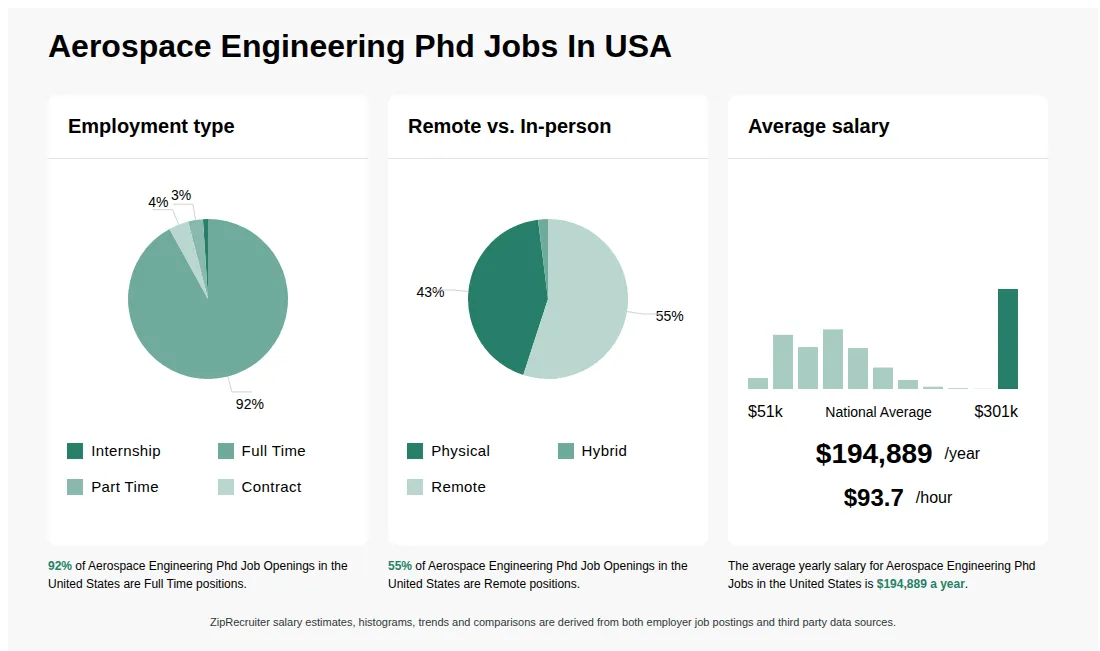
As of Jun 16, 2026, the average yearly pay for aerospace engineering phd in the United States is $108,638.00, according to ZipRecruiter salary data. Most workers in this role earn between $88,500.00 and $132,500.00 per year, depending on experience, location, and employer.

What is the difference between Aerospace Engineering Phd vs Aerospace Engineer?

AspectAerospace Engineering PhdAerospace Engineer
Required CredentialsDoctorate in Aerospace Engineering or related fieldBachelor's or Master's in Aerospace Engineering or related field
Work EnvironmentResearch labs, academia, advanced R&D projectsDesign, development, testing in industry or government agencies
Industry UsageResearch, academia, specialized R&D rolesProduct development, manufacturing, systems engineering

The main difference between an Aerospace Engineering Phd and an Aerospace Engineer lies in their education level and focus. A Phd holder typically engages in advanced research, teaching, or specialized R&D, while an Aerospace Engineer applies engineering principles to design and develop aerospace systems. Both roles are vital in the aerospace industry but serve different functions based on expertise and experience.

What is an Aerospace Engineering PhD?

An Aerospace Engineering PhD is a doctoral-level degree focused on advanced research in the design, development, testing, and production of aircraft and spacecraft. Students in this program conduct original research, often contributing new knowledge to areas like aerodynamics, propulsion, materials, or space systems. Graduates are prepared for roles in academia, research institutions, government agencies, and advanced industry positions. The program typically involves coursework, comprehensive exams, and the completion of a dissertation.

What jobs can I get with a PhD in aerospace engineering?

A PhD in aerospace engineering qualifies individuals for advanced roles such as aerospace research scientist, flight systems engineer, or university professor. Graduates often work in aircraft design, space exploration, defense, or research institutions, utilizing skills in aerodynamics, propulsion, and simulation tools. These positions typically require strong analytical abilities and familiarity with CAD software and testing environments.

Is it worth getting a PhD in aerospace engineering?

A PhD in aerospace engineering can enhance expertise, qualify individuals for research, development, and academic roles, and often lead to higher salaries. However, it requires significant time and financial investment, and job prospects depend on industry demand and specialization areas.

How much can you make with a PhD in aerospace engineering?

Aerospace engineering PhD holders typically earn between $80,000 and $150,000 annually, depending on experience, location, and industry sector such as defense, research, or manufacturing. Senior roles or positions in government agencies and private companies often offer higher salaries, especially with specialized skills in aerodynamics, propulsion, or systems design.

What engineers make $500,000?

Senior aerospace engineers with extensive experience, advanced skills in design and systems, and leadership roles can earn salaries approaching or exceeding $500,000 annually, especially in the aerospace industry or at major defense contractors. Such compensation often includes bonuses, stock options, and other incentives, typically in senior management or executive positions.

What are some common research challenges faced by Aerospace Engineering PhD candidates during their studies?

Aerospace Engineering PhD candidates often encounter challenges such as narrowing down a research topic that is both innovative and feasible within resource and time constraints. They may also face difficulties in securing funding, accessing specialized laboratory equipment, or collaborating effectively with interdisciplinary teams. Balancing coursework, teaching responsibilities, and research deadlines can be demanding, but these experiences are valuable for developing project management and problem-solving skills essential for a career in academia or industry.

What are the key skills and qualifications needed to thrive as an Aerospace Engineering PhD, and why are they important?

To thrive as an Aerospace Engineering PhD, you need advanced knowledge in aerodynamics, propulsion, structural analysis, and a doctoral degree in aerospace engineering or a related field. Expertise in simulation software like MATLAB, ANSYS, and proficiency in programming languages such as Python or C++ are commonly required, along with research experience and publications. Exceptional problem-solving abilities, critical thinking, and strong written and verbal communication skills set outstanding candidates apart. These competencies are essential for driving innovation, leading complex research projects, and effectively sharing technical findings in the highly specialized aerospace sector.

GNC Engineer III (Navigation), Eclipse

Firefly Aerospace

Cedar Park, TX

Full-time

Medical, Dental, Vision, PTO

Posted 19 days ago


Firefly Aerospace rating

8.4

Company rating: 8.4 out of 10

Based on 9 frontline employees who took The Breakroom Quiz

28th of 60 rated aerospace companies


Job description

ABOUT FIREFLY AEROSPACE

Firefly Aerospace is a space and defense technology company that enables our world to launch, land, and operate in space – anywhere, anytime. As the partner of choice for critical space missions, Firefly is the only commercial company to launch a satellite to orbit with 24-hour notice and the only company to achieve a successful Moon landing. Our launch vehicles, lunar landers, and orbital vehicles provide government and commercial customers with full mission services from low Earth orbit to the Moon and beyond. Headquartered in north Austin, Texas, Firefly is looking for passionate, hardworking innovators to join our team and help fuel our successful trajectory into space.

SUMMARY

As a Senior GNC Engineer specializing in navigation and estimation at Firefly, you will design and implement navigation systems and state estimation algorithms for operational launch vehicles. In this role, you will develop and tune navigation filters and sensor fusion algorithms, support hardware-in-the-loop testing and system integration, and provide technical leadership while collaborating with multidisciplinary teams. This position combines advanced estimation theory, real-time embedded systems development, and hands-on flight operations support while mentoring junior engineers in a fast-paced operational environment.

RESPONSIBILITIES
  • Design, analyze, and tune launch vehicle navigation software to ensure accurate state estimation from launch to orbit
  • Implement advanced filtering techniques using inertial sensor and GNSS measurements
  • Develop navigation systems robust to error sources including inertial sensor bias, GNSS signal degradation, noise, and sensor misalignments
  • Establish technical standards and validation methodologies for navigation system design, software development, and hardware-in-the-loop testing
  • Conduct covariance analysis, sensitivity studies, and performance optimization for navigation systems under nominal and off-nominal flight conditions
  • Support hardware-in-the-loop test campaigns for integrated GNC systems including navigation algorithm validation, flight software verification, and system-level performance testing
  • Drive resolution of complex GNC challenges requiring deep technical expertise and rapid problem-solving
  • Provide technical direction on system architecture and serve as subject matter expert for launch vehicle state estimation
  • Mentor junior engineers in estimation theory and flight software development
  • Author technical documentation and analysis reports that communicate GNC concepts and results to diverse audiences
  • Interface with cross-discipline teams to integrate navigation software with vehicle hardware
  • Serve as a GNC console operator for launch operations and perform post-flight analysis to improve vehicle models
  • Champion continuous improvement initiatives for GNC processes, tools, and operational efficiency
QUALIFICATIONSRequired
  • Bachelor's degree in aerospace engineering, mechanical engineering, electrical engineering, computer science, or related field
  • 5-10 years of experience in launch vehicle GNC systems with significant depth in navigation system design or flight software development
  • Advanced knowledge of state estimation techniques including Kalman filtering, sensor fusion, and covariance analysis
  • Strong understanding of inertial navigation systems, GNSS processing, and navigation sensor error modeling
  • Expertise in real-time software development using C++ for flight-critical applications
  • Experience developing high-fidelity sensor models and navigation system testbeds
  • Proficiency in hardware-in-the-loop testing and requirement verification for flight-critical systems
  • Understanding of software development best practices including version control (Git), code documentation, and testing
  • Excellent communication and presentation skills
Desired
  • Master's degree or PhD in aerospace engineering, electrical engineering, applied mathematics, or related field
  • Experience developing custom navigation or state estimation algorithms for launch vehicle applications
  • Expertise in advanced filtering techniques such as unscented Kalman filters, particle filters, or adaptive estimation methods
  • Hands-on experience with launch vehicle sensor systems including fiber optic gyros, ring laser gyros, MEMS IMUs, and GNSS receivers
  • Advanced knowledge of launch vehicle flight mechanics and high-fidelity modeling of gravity, aerodynamics, and propulsion
  • Advanced knowledge of attitude dynamics and control theory, including rotational dynamics, attitude representations, control moment generation, and stability analysis
  • Experience with modern flight software frameworks and real-time operating systems
  • Software engineering expertise with proficiency in development practices including version control, code review, testing, documentation, and CI/CD workflows
  • Proficiency in Python for scripting, data analysis, and automation
  • Working knowledge of launch vehicle systems and mission operations
  • Proven ability to develop junior engineers while managing technical responsibilities
  • Track record of thought leadership through publications, presentations, or contributions to industry state-of-the-art

Firefly offers outstanding benefits for our employees, including generous health, dental and vision plans with low plan deductibles, parental leave, educational reimbursement, short term disability, and flexible PTO options.

To conform to U.S. Government space technology export regulations, including the International Traffic in Arms Regulations (ITAR) you must be a U.S. citizen, lawful permanent resident of the U.S., protected individual as defined by 8 U.S.C. 1324b(a)(3), or eligible to obtain the required authorizations from the U.S. Department of State.

Firefly Aerospace, Inc. is an Equal Opportunity Employer; employment with Firefly is governed based on merit, competence and qualifications and will not be influenced in any manner by race, color, religion, gender, national origin/ethnicity, veteran status, disability status, age, sexual orientation, gender identity, marital status, mental or physical disability or any other legally protected status.