Minimum Qualifications • • Earned PhD in Aerospace Engineering, Engineering Mechanics, or a closely-related discipline from an accredited institution. • Demonstrated interest and record in ...
Minimum Qualifications • • Earned PhD in Aerospace Engineering, Engineering Mechanics, or a closely-related discipline from an accredited institution. • Demonstrated interest and record in ...

You hold a bachelor's or master's degree in Aerospace Engineering, PhD degree is preferred in Aerospace Engineering * You must have a minimum of 10 years of pertinent experience in the development of ...
You hold a bachelor's or master's degree in Aerospace Engineering, PhD degree is preferred in Aerospace Engineering * You must have a minimum of 10 years of pertinent experience in the development of ...
Minimum Qualifications • · Earned PhD in Aerospace Engineering, Engineering Mechanics, or a closely-related discipline from an accredited institution. · Demonstrated interest and record in ...
Quick apply
Minimum Qualifications • · Earned PhD in Aerospace Engineering, Engineering Mechanics, or a closely-related discipline from an accredited institution. · Demonstrated interest and record in ...

... in Aerospace Engineering, PhD degree is preferred in Aerospace Engineering • You must have a minimum of 10 years of pertinent experience in the development of Flight Control Laws for FBW (Fly-By ...
... in Aerospace Engineering, PhD degree is preferred in Aerospace Engineering • You must have a minimum of 10 years of pertinent experience in the development of Flight Control Laws for FBW (Fly-By ...
The AEM department currently offers three degrees: a BS in Aerospace Engineering, an MS in Aerospace Engineering and Mechanics, and a PhD in Aerospace Engineering and Mechanics. The two graduate ...
Quick apply
The AEM department currently offers three degrees: a BS in Aerospace Engineering, an MS in Aerospace Engineering and Mechanics, and a PhD in Aerospace Engineering and Mechanics. The two graduate ...
The AEM department currently offers three degrees: a BS in Aerospace Engineering, an MS in Aerospace Engineering and Mechanics, and a PhD in Aerospace Engineering and Mechanics. The two graduate ...
The AEM department currently offers three degrees: a BS in Aerospace Engineering, an MS in Aerospace Engineering and Mechanics, and a PhD in Aerospace Engineering and Mechanics. The two graduate ...
The AEM department currently offers three degrees: a BS in Aerospace Engineering, an MS in Aerospace Engineering and Mechanics, and a PhD in Aerospace Engineering and Mechanics. The two graduate ...
The AEM department currently offers three degrees: a BS in Aerospace Engineering, an MS in Aerospace Engineering and Mechanics, and a PhD in Aerospace Engineering and Mechanics. The two graduate ...

The department offers BS, MS, and PhD degrees in Mechanical Engineering and B.S. in Aerospace Engineering. Enrollment during AY 2025-2026 was 209 pre-engineering students, 231 ME undergraduates, and ...
The department offers BS, MS, and PhD degrees in Mechanical Engineering and B.S. in Aerospace Engineering. Enrollment during AY 2025-2026 was 209 pre-engineering students, 231 ME undergraduates, and ...
Minimum Qualifications • Earned PhD in Aerospace Engineering, Engineering Mechanics, or a closely-related discipline from an accredited institution. • Demonstrated interest and record in ...
Minimum Qualifications • Earned PhD in Aerospace Engineering, Engineering Mechanics, or a closely-related discipline from an accredited institution. • Demonstrated interest and record in ...
Minimum Qualifications • • Earned PhD in Aerospace Engineering, Engineering Mechanics, or a closely-related discipline from an accredited institution. • Demonstrated interest and record in ...
Minimum Qualifications • • Earned PhD in Aerospace Engineering, Engineering Mechanics, or a closely-related discipline from an accredited institution. • Demonstrated interest and record in ...
You hold a bachelor's or master's degree in Aerospace Engineering, PhD degree is preferred in Aerospace Engineering * You must have a minimum of 10 years of pertinent experience in the development of ...
Quick apply
You hold a bachelor's or master's degree in Aerospace Engineering, PhD degree is preferred in Aerospace Engineering * You must have a minimum of 10 years of pertinent experience in the development of ...
You hold a bachelor's or master's degree in Aerospace Engineering, PhD degree is preferred in Aerospace Engineering * You must have a minimum of 10 years of pertinent experience in the development of ...
Quick apply
You hold a bachelor's or master's degree in Aerospace Engineering, PhD degree is preferred in Aerospace Engineering * You must have a minimum of 10 years of pertinent experience in the development of ...
... in Aerospace Engineering, PhD degree is preferred in Aerospace Engineering • You must have a minimum of 10 years of pertinent experience in the development of Flight Control Laws for FBW (Fly-By ...
... in Aerospace Engineering, PhD degree is preferred in Aerospace Engineering • You must have a minimum of 10 years of pertinent experience in the development of Flight Control Laws for FBW (Fly-By ...
Minimum Qualifications • Earned PhD in Aerospace Engineering, Engineering Mechanics, or a closely-related discipline from an accredited institution. • Demonstrated interest and record in ...
Minimum Qualifications • Earned PhD in Aerospace Engineering, Engineering Mechanics, or a closely-related discipline from an accredited institution. • Demonstrated interest and record in ...
Earned PhD in Aerospace Engineering, Engineering Mechanics, or a closely-related discipline from an accredited institution. * Demonstrated interest and record in aerospace engineering or engineering ...
Earned PhD in Aerospace Engineering, Engineering Mechanics, or a closely-related discipline from an accredited institution. * Demonstrated interest and record in aerospace engineering or engineering ...
Minimum Qualifications Earned PhD in Aerospace Engineering, Engineering Mechanics, or a closely-related discipline from an accredited institution. Demonstrated interest and record in aerospace ...
Minimum Qualifications Earned PhD in Aerospace Engineering, Engineering Mechanics, or a closely-related discipline from an accredited institution. Demonstrated interest and record in aerospace ...
Minimum Qualifications Earned PhD in Aerospace Engineering, Engineering Mechanics, or a closely-related discipline from an accredited institution. Demonstrated interest and record in aerospace ...
Minimum Qualifications Earned PhD in Aerospace Engineering, Engineering Mechanics, or a closely-related discipline from an accredited institution. Demonstrated interest and record in aerospace ...
Minimum Qualifications • Earned PhD in Aerospace Engineering, Engineering Mechanics, or a closely-related discipline from an accredited institution. • Demonstrated interest and record in ...
Quick apply
Minimum Qualifications • Earned PhD in Aerospace Engineering, Engineering Mechanics, or a closely-related discipline from an accredited institution. • Demonstrated interest and record in ...
You hold a bachelor's or master's degree in Aerospace Engineering, PhD degree is preferred in Aerospace Engineering * You must have a minimum of 10 years of pertinent experience in the development of ...
Quick apply
You hold a bachelor's or master's degree in Aerospace Engineering, PhD degree is preferred in Aerospace Engineering * You must have a minimum of 10 years of pertinent experience in the development of ...
You hold a bachelor's or master's degree in Aerospace Engineering, PhD degree is preferred in Aerospace Engineering * You must have a minimum of 10 years of pertinent experience in the development of ...
Quick apply
You hold a bachelor's or master's degree in Aerospace Engineering, PhD degree is preferred in Aerospace Engineering * You must have a minimum of 10 years of pertinent experience in the development of ...
Aerospace Engineering Phd information
See salary details
$42K - $53.2K
5% of jobs
$53.2K - $64.4K
1% of jobs
$64.4K - $75.5K
5% of jobs
$75.5K - $86.7K
10% of jobs
$89.5K is the 25th percentile. Wages below this are outliers.
$86.7K - $97.9K
14% of jobs
The median wage is $107.3K / yr.
$97.9K - $109.1K
17% of jobs
$109.1K - $120.3K
17% of jobs
$130.9K is the 75th percentile. Wages above this are outliers.
$120.3K - $131.5K
5% of jobs
$131.5K - $142.6K
20% of jobs
$142.6K - $153.8K
1% of jobs
$153.8K - $165K
3% of jobs
$42K
$108.6K
$165K
How much do aerospace engineering phd jobs pay per year?
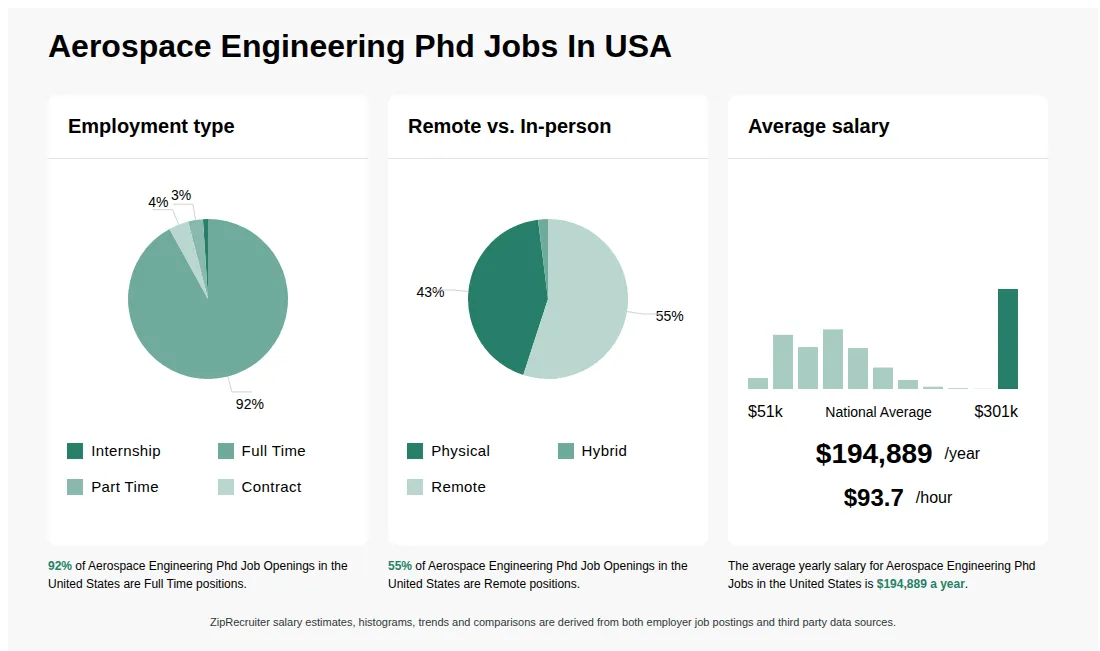
As of Sep 15, 2026, the average yearly pay for aerospace engineering phd in the United States is $108,638.00, according to ZipRecruiter salary data. Most workers in this role earn between $88,500.00 and $132,500.00 per year, depending on experience, location, and employer.
What is an aerospace engineering PhD?
An Aerospace Engineering PhD is a doctoral-level degree focused on advanced research in the design, development, testing, and production of aircraft and spacecraft. Students in this program conduct original research, often contributing new knowledge to areas like aerodynamics, propulsion, materials, or space systems. Graduates are prepared for roles in academia, research institutions, government agencies, and advanced industry positions. The program typically involves coursework, comprehensive exams, and the completion of a dissertation.
What are some common research challenges faced by aerospace engineering PhD candidates during their studies?
Aerospace Engineering PhD candidates often encounter challenges such as narrowing down a research topic that is both innovative and feasible within resource and time constraints. They may also face difficulties in securing funding, accessing specialized laboratory equipment, or collaborating effectively with interdisciplinary teams. Balancing coursework, teaching responsibilities, and research deadlines can be demanding, but these experiences are valuable for developing project management and problem-solving skills essential for a career in academia or industry.
What are the key skills and qualifications needed to thrive as an aerospace engineering PhD, and why are they important?
To thrive as an Aerospace Engineering PhD, you need advanced knowledge in aerodynamics, propulsion, structural analysis, and a doctoral degree in aerospace engineering or a related field. Expertise in simulation software like MATLAB, ANSYS, and proficiency in programming languages such as Python or C++ are commonly required, along with research experience and publications. Exceptional problem-solving abilities, critical thinking, and strong written and verbal communication skills set outstanding candidates apart. These competencies are essential for driving innovation, leading complex research projects, and effectively sharing technical findings in the highly specialized aerospace sector.
What is the difference between Aerospace Engineering Phd vs Aerospace Engineer?
| Aspect | Aerospace Engineering Phd | Aerospace Engineer |
|---|---|---|
| Required Credentials | Doctorate in Aerospace Engineering or related field | Bachelor's or Master's in Aerospace Engineering or related field |
| Work Environment | Research labs, academia, advanced R&D projects | Design, development, testing in industry or government agencies |
| Industry Usage | Research, academia, specialized R&D roles | Product development, manufacturing, systems engineering |
The main difference between an Aerospace Engineering Phd and an Aerospace Engineer lies in their education level and focus. A Phd holder typically engages in advanced research, teaching, or specialized R&D, while an Aerospace Engineer applies engineering principles to design and develop aerospace systems. Both roles are vital in the aerospace industry but serve different functions based on expertise and experience.
How much does a PhD in aerospace engineering make?
A PhD in aerospace engineering typically earns between $80,000 and $130,000 annually, depending on experience, location, and industry sector. Senior roles or positions in research and development may offer higher salaries, especially with specialized skills in aerodynamics, propulsion, or systems design.
Is a PhD worth it in aerospace engineering?
A PhD in aerospace engineering can lead to advanced research, teaching positions, and specialized roles in industry or government agencies. However, it requires significant time and effort, and the financial return varies depending on the sector and career path chosen.
What are popular job titles related to Aerospace Engineering Phd jobs?
For Aerospace Engineering Phd jobs, the most frequently searched job titles are:

Aerospace Engineering and Mechanics - Full Professor - 530190
Tuscaloosa, AL • On-site
University of Alabama
• Colleges, Universities, and Professional Schools • 1 - 5K employees1,001 - 5,000 employees
Full-time
Re-posted 9 days ago
University Of Alabama rating

7.1
Based on 60 frontline employees who took The Breakroom Quiz
Job description
Department/Organization
214211 - Aerospace and Eng Mechanics
Rank
Professor
Position Summary
The Department of Aerospace Engineering and Mechanics (AEM) and the Lee J. Styslinger Jr. College of Engineering (SCoE) at The University of Alabama (UA) invite applications at the rank of Full Professor within the department. Candidates with research interests across all domains relevant to aerospace engineering and engineering mechanics are encouraged to apply. Candidates with research emphasis and interests in the areas of (1) fatigue and fracture mechanics and (2) solid mechanics and materials are strongly encouraged to apply.
Detailed Position Information
The Department of Aerospace Engineering and Mechanics (AEM: https://aem.eng.ua.edu) and the Lee J. Styslinger Jr. College of Engineering (SCoE: https://eng.ua.edu) at The University of Alabama (UA: https://ua.edu) invite applications for a tenured faculty position at the rank of Full Professor level within the AEM department.
Candidates with research interests across all domains relevant to aerospace engineering and engineering mechanics are encouraged to apply. Candidates with research emphasis and interests in the areas of (1) fatigue and fracture mechanics and (2) solid mechanics and materials are strongly encouraged to apply.
Candidates with prestigious achievements, significant impact in their fields, and exceptional national and international reputations will be eligible for consideration for significant endowment support through appointment as an Endowed Shelby Distinguished Professor (https://provost.ua.edu/the-shelby-endowment-for-distinguished-faculty/). These Shelby Distinguished Professor positions are one of the highest honors bestowed upon faculty at The University of Alabama, and candidates who feel their record and accomplishments warrant consideration for this additional honor should indicate this in their cover letter.
Towards achieving excellence in all our efforts, the AEM department and the SCoE seek to hire faculty that can contribute to both (1) build upon existing strengths and (2) expand the scope of research within the department, college, and university as a whole during a period of record growth and success.
This is a very exciting time to join the AEM Department at The University of Alabama. The Styslinger College of Engineering has experienced tremendous growth in its faculty, facilities, student populations, and research enterprise over the past decade. The Styslinger College of Engineering currently has more than 4,800 undergraduate students and almost 800 graduate students, making it one of the largest engineering colleges in the nation. The AEM department has also seen significant growth in recent years, with undergraduate program enrollment of 570 students in the fall of 2025 and graduate enrollment of nearly 200 students. The department currently offers three degrees: a BS in Aerospace Engineering, an MS in Aerospace Engineering and Mechanics, and a PhD in Aerospace Engineering and Mechanics. The two graduate programs are offered both on-campus and through distance education. The department is currently on a multi-year effort to significantly expand its faculty size to help better serve its students and educational mission and to add both depth and breadth to the range of research activities represented across the department and its faculty.
AEM and the SCoE consider teaching, research, and service as the three critical and complementary portions of their overall mission. Candidates must demonstrate experience and the ability to successfully lead and extramurally fund a highly productive research program with significant scholarly impact in an area with long-term potential to further build upon the rapid rise and success of the AEM department and the SCoE. An ability to collaborate with existing faculty in the key focus areas both within the department and college, as well as with potential colleagues across the campus, is highly desirable. The department and college also pride themselves on the outstanding educational experience provided to their students, and thus faculty candidates must demonstrate an ability to develop and teach classes at both the undergraduate and graduate levels in the faculty member's area(s) of expertise as well as to teach courses that support the delivery and accreditation of the Department's core degree programs.
The department, college, and university are also notable for the collegial, welcoming, and supportive spirit built into the fabric of who we are and how we interact across our family of students, faculty, and staff. It is therefore expected that candidates will demonstrate an ability to support this important aspect of our community.
Appointments to the faculty of The University of Alabama are based on the personnel requirements of the University's academic programs and on the goal of achieving and maintaining excellence in its teaching, research, and service/academic citizenship activities.
Minimum Qualifications
• • Earned PhD in Aerospace Engineering, Engineering Mechanics, or a closely-related discipline from an accredited institution. • Demonstrated interest and record in aerospace engineering or engineering mechanics education and professional service. • Demonstrated record of prior research work and sustained scholarly publications in refereed journals, conference proceedings, and similarly impactful venues. • Demonstrated ability of excellent teaching at both the graduate and undergraduate levels. • Show the ability to develop and sustain a quality research program at The University of Alabama. • Demonstrate effective verbal and written communication skills. Applicants must also meet all university criteria for appointment to the rank of Full Professor.
Preferred Qualifications
• • Have 10+ years of experience as a tenure-track/tenured faculty member at a leading peer R1 institution. • Demonstrated record of high-quality and impactful research and scholarly publications that is recognized nationally and/or internationally and appropriate to the position. • Show a significant record of outstanding teaching, curriculum development, and scholarship in an engineering department with both undergraduate and graduate degree programs. • Exhibit exceptional communication, advising, mentoring, and interpersonal skills.
Instructions and Required Materials for Application
Required application documents include: (1) a cover letter that includes both the department name and rank of position for which the candidate is applying, (2) a curriculum vitae, (3) a two-to-four page statement of research interests and plans, (4) a one-to-two page statement of teaching interests and plans, and (5) the names and contact information for at least four references. Review of applications will begin immediately. Applications are preferred on or before September 30, 2026, to receive fullest consideration, but the search will continue until the positions are filled. A position start date of August 16, 2027, would be typical, but flexibility with respect to start date is possible. Questions about the position can be directed to aem-search@eng.ua.edu. The University of Alabama is an Equal Employment/Equal Educational Opportunity Institution. Candidates from under-represented groups are encouraged to apply.
About the Division/College/School
As the premier flagship university for the state of Alabama and as one of the first five universities in the nation to offer engineering instruction, The University of Alabama (UA) has more than 175 years of proud engineering history. UA's Lee J. Styslinger Jr. College of Engineering is committed to conducting cutting-edge research that advances the frontiers of science and engineering, translating such fundamental advancements through applied research and technology commercialization into impactful solutions which improve the human condition and address the challenges facing humankind, and using that immersive research environment to provide unparalleled educational experiences and opportunities for our students at both the undergraduate and graduate levels. As a College, we pride ourselves on educating and preparing the next generation of engineering and computer science scholars and professionals who will positively shape the future around us. Through our educational, research, and service activities that support our overall vision to be one of the most impactful engineering programs in the nation, our College continues to provide leadership in the many professional disciplines represented by our College and to the community, state, and nation as we advance our professions, the economy, and the lives of all those whom we serve.
The College is comprised of seven departments: Aerospace Engineering and Mechanics; Chemical and Biological Engineering; Civil, Construction, and Environmental Engineering; Computer Science; Electrical and Computer Engineering; Mechanical Engineering; and Metallurgical and Materials Engineering. These departments currently deliver 14 different undergraduate and 17 different graduate degree programs. Overall, the College enrolls approximately 6,000 students, making it one of the largest colleges out of the more than 40,000 students on UA's campus.
While the university has been on a constant mission to advance in every aspect of its operations since its inception, UA has in particular seen transformative growth in its research enterprise and impact over the past decade. Through the efforts of The University, UA Office of Research and Economic Development (ORED), the Styslinger College of Engineering and its' centers, departments, and faculty, UA's research enterprise has surged dramatically higher in the last five to ten years. This recent and continuing steep growth rate of research has positioned UA as one of the fastest growing research institutions in the nation. More specifically, the College has seen annual research awards and expenditures grow at an average of more than 25% per year for more than the last 5 years, now surpassing $100 million annually in new research awards. By more than doubling research over the past 5 to 7 years, the size of the graduate programs across the College have more than doubled as well. The continued ambitious growth of research programs amongst our existing faculty and research centers combined with the recent significant additions of a large number of new tenure-track and tenured faculty, particularly the addition of more than 80 such new highly research active faculty over the past four years, has positioned the College for maintaining this steep trajectory of research growth and impact well into the future.
The educational activities of the Styslinger College of Engineering and its constantly increasing volume of impactful research are enabled and supported by a tremendous combination of amazing faculty and staff, an outstanding array of modern new facilities that are the envy of its peers, and a world-class student body at both the undergraduate and graduate levels. The College currently has more than 185 faculty members, which includes the significant infusion of both young and experienced faculty talent over the past four years that was mentioned earlier. This year again there are plans to add yet another new cohort of tenure-track and tenured faculty to the College across all of its departments. In terms of facilities, the College has one of the largest overall footprints of any college at UA, currently occupying all or significant portions of 17 different facilities across campus. Some of the most recent additions to that space are the state-of-the-art facilities provided for many of the College's departments in the recently completed Shelby Science and Engineering Quad that was built at a cost approaching $400 million.
In addition to the traditional engineering departments and their facilities, there are also more than 10 different major research centers housed within the College that span and support a wide-ranging set of research thrust areas including artificial intelligence, cybersecurity, additive manufacturing, advanced materials, functional polymers and soft matter, water resources and water technology, advanced transportation and vehicle technology, and more. These centers bring together faculty from across the College and the University to capitalize on emerging technological opportunities and to tackle some of the most pressing challenges facing the planet both today and well into the future. In addition to these College research centers, a number of university-level research institutes and centers, including the Alabama Water Institute, the Alabama Transportation Institute, and the Alabama Mobility and Power Center, also provide support and infrastructure to an array of research thrusts and projects that engage faculty from across the College and University. This synergistic combination of outstanding people, facilities, and resources will continue to fuel the Styslinger College of Engineering's advancement and growth in education and research well into the future.
Overall, with its award-winning faculty and staff, outstanding and growing student body, tremendous array of state-of-the-art facilities, diverse offerings of nationally accredited degree programs, and the strong support of its local, state, and national partners, the College has positioned itself for continued success and rapid advancement as a leader in engineering science, education, and practice. The College is looking for new faculty who want to build or continue their career in a dynamic organization with truly unlimited potential.
It is indeed an exciting time to join The University of Alabama and the Styslinger College of Engineering. The College recently embarked on its "Top-30+ by '30" initiative which aims to have the College and all of its departments and programs achieve top-30 impact in all dimensions of our operations by 2030. Those impacts and dimensions include offering a comprehensive set of innovative degree program covering the full spectrum of engineering and computer science fields, enrolling a number of students and conferring a number of degrees at both the undergraduate and graduate levels to be one of the largest producers of engineering talent in the nation, achieving continued outstanding growth in research awards and expenditures to enable continued expansion of our graduate programs and research activities, continuing to scale scholarly research productivity to be a major force in pushing the frontiers of our disciplines, and to playing an ever more important role in shaping ou
214211 - Aerospace and Eng Mechanics
Rank
Professor
Position Summary
The Department of Aerospace Engineering and Mechanics (AEM) and the Lee J. Styslinger Jr. College of Engineering (SCoE) at The University of Alabama (UA) invite applications at the rank of Full Professor within the department. Candidates with research interests across all domains relevant to aerospace engineering and engineering mechanics are encouraged to apply. Candidates with research emphasis and interests in the areas of (1) fatigue and fracture mechanics and (2) solid mechanics and materials are strongly encouraged to apply.
Detailed Position Information
The Department of Aerospace Engineering and Mechanics (AEM: https://aem.eng.ua.edu) and the Lee J. Styslinger Jr. College of Engineering (SCoE: https://eng.ua.edu) at The University of Alabama (UA: https://ua.edu) invite applications for a tenured faculty position at the rank of Full Professor level within the AEM department.
Candidates with research interests across all domains relevant to aerospace engineering and engineering mechanics are encouraged to apply. Candidates with research emphasis and interests in the areas of (1) fatigue and fracture mechanics and (2) solid mechanics and materials are strongly encouraged to apply.
Candidates with prestigious achievements, significant impact in their fields, and exceptional national and international reputations will be eligible for consideration for significant endowment support through appointment as an Endowed Shelby Distinguished Professor (https://provost.ua.edu/the-shelby-endowment-for-distinguished-faculty/). These Shelby Distinguished Professor positions are one of the highest honors bestowed upon faculty at The University of Alabama, and candidates who feel their record and accomplishments warrant consideration for this additional honor should indicate this in their cover letter.
Towards achieving excellence in all our efforts, the AEM department and the SCoE seek to hire faculty that can contribute to both (1) build upon existing strengths and (2) expand the scope of research within the department, college, and university as a whole during a period of record growth and success.
This is a very exciting time to join the AEM Department at The University of Alabama. The Styslinger College of Engineering has experienced tremendous growth in its faculty, facilities, student populations, and research enterprise over the past decade. The Styslinger College of Engineering currently has more than 4,800 undergraduate students and almost 800 graduate students, making it one of the largest engineering colleges in the nation. The AEM department has also seen significant growth in recent years, with undergraduate program enrollment of 570 students in the fall of 2025 and graduate enrollment of nearly 200 students. The department currently offers three degrees: a BS in Aerospace Engineering, an MS in Aerospace Engineering and Mechanics, and a PhD in Aerospace Engineering and Mechanics. The two graduate programs are offered both on-campus and through distance education. The department is currently on a multi-year effort to significantly expand its faculty size to help better serve its students and educational mission and to add both depth and breadth to the range of research activities represented across the department and its faculty.
AEM and the SCoE consider teaching, research, and service as the three critical and complementary portions of their overall mission. Candidates must demonstrate experience and the ability to successfully lead and extramurally fund a highly productive research program with significant scholarly impact in an area with long-term potential to further build upon the rapid rise and success of the AEM department and the SCoE. An ability to collaborate with existing faculty in the key focus areas both within the department and college, as well as with potential colleagues across the campus, is highly desirable. The department and college also pride themselves on the outstanding educational experience provided to their students, and thus faculty candidates must demonstrate an ability to develop and teach classes at both the undergraduate and graduate levels in the faculty member's area(s) of expertise as well as to teach courses that support the delivery and accreditation of the Department's core degree programs.
The department, college, and university are also notable for the collegial, welcoming, and supportive spirit built into the fabric of who we are and how we interact across our family of students, faculty, and staff. It is therefore expected that candidates will demonstrate an ability to support this important aspect of our community.
Appointments to the faculty of The University of Alabama are based on the personnel requirements of the University's academic programs and on the goal of achieving and maintaining excellence in its teaching, research, and service/academic citizenship activities.
Minimum Qualifications
• • Earned PhD in Aerospace Engineering, Engineering Mechanics, or a closely-related discipline from an accredited institution. • Demonstrated interest and record in aerospace engineering or engineering mechanics education and professional service. • Demonstrated record of prior research work and sustained scholarly publications in refereed journals, conference proceedings, and similarly impactful venues. • Demonstrated ability of excellent teaching at both the graduate and undergraduate levels. • Show the ability to develop and sustain a quality research program at The University of Alabama. • Demonstrate effective verbal and written communication skills. Applicants must also meet all university criteria for appointment to the rank of Full Professor.
Preferred Qualifications
• • Have 10+ years of experience as a tenure-track/tenured faculty member at a leading peer R1 institution. • Demonstrated record of high-quality and impactful research and scholarly publications that is recognized nationally and/or internationally and appropriate to the position. • Show a significant record of outstanding teaching, curriculum development, and scholarship in an engineering department with both undergraduate and graduate degree programs. • Exhibit exceptional communication, advising, mentoring, and interpersonal skills.
Instructions and Required Materials for Application
Required application documents include: (1) a cover letter that includes both the department name and rank of position for which the candidate is applying, (2) a curriculum vitae, (3) a two-to-four page statement of research interests and plans, (4) a one-to-two page statement of teaching interests and plans, and (5) the names and contact information for at least four references. Review of applications will begin immediately. Applications are preferred on or before September 30, 2026, to receive fullest consideration, but the search will continue until the positions are filled. A position start date of August 16, 2027, would be typical, but flexibility with respect to start date is possible. Questions about the position can be directed to aem-search@eng.ua.edu. The University of Alabama is an Equal Employment/Equal Educational Opportunity Institution. Candidates from under-represented groups are encouraged to apply.
About the Division/College/School
As the premier flagship university for the state of Alabama and as one of the first five universities in the nation to offer engineering instruction, The University of Alabama (UA) has more than 175 years of proud engineering history. UA's Lee J. Styslinger Jr. College of Engineering is committed to conducting cutting-edge research that advances the frontiers of science and engineering, translating such fundamental advancements through applied research and technology commercialization into impactful solutions which improve the human condition and address the challenges facing humankind, and using that immersive research environment to provide unparalleled educational experiences and opportunities for our students at both the undergraduate and graduate levels. As a College, we pride ourselves on educating and preparing the next generation of engineering and computer science scholars and professionals who will positively shape the future around us. Through our educational, research, and service activities that support our overall vision to be one of the most impactful engineering programs in the nation, our College continues to provide leadership in the many professional disciplines represented by our College and to the community, state, and nation as we advance our professions, the economy, and the lives of all those whom we serve.
The College is comprised of seven departments: Aerospace Engineering and Mechanics; Chemical and Biological Engineering; Civil, Construction, and Environmental Engineering; Computer Science; Electrical and Computer Engineering; Mechanical Engineering; and Metallurgical and Materials Engineering. These departments currently deliver 14 different undergraduate and 17 different graduate degree programs. Overall, the College enrolls approximately 6,000 students, making it one of the largest colleges out of the more than 40,000 students on UA's campus.
While the university has been on a constant mission to advance in every aspect of its operations since its inception, UA has in particular seen transformative growth in its research enterprise and impact over the past decade. Through the efforts of The University, UA Office of Research and Economic Development (ORED), the Styslinger College of Engineering and its' centers, departments, and faculty, UA's research enterprise has surged dramatically higher in the last five to ten years. This recent and continuing steep growth rate of research has positioned UA as one of the fastest growing research institutions in the nation. More specifically, the College has seen annual research awards and expenditures grow at an average of more than 25% per year for more than the last 5 years, now surpassing $100 million annually in new research awards. By more than doubling research over the past 5 to 7 years, the size of the graduate programs across the College have more than doubled as well. The continued ambitious growth of research programs amongst our existing faculty and research centers combined with the recent significant additions of a large number of new tenure-track and tenured faculty, particularly the addition of more than 80 such new highly research active faculty over the past four years, has positioned the College for maintaining this steep trajectory of research growth and impact well into the future.
The educational activities of the Styslinger College of Engineering and its constantly increasing volume of impactful research are enabled and supported by a tremendous combination of amazing faculty and staff, an outstanding array of modern new facilities that are the envy of its peers, and a world-class student body at both the undergraduate and graduate levels. The College currently has more than 185 faculty members, which includes the significant infusion of both young and experienced faculty talent over the past four years that was mentioned earlier. This year again there are plans to add yet another new cohort of tenure-track and tenured faculty to the College across all of its departments. In terms of facilities, the College has one of the largest overall footprints of any college at UA, currently occupying all or significant portions of 17 different facilities across campus. Some of the most recent additions to that space are the state-of-the-art facilities provided for many of the College's departments in the recently completed Shelby Science and Engineering Quad that was built at a cost approaching $400 million.
In addition to the traditional engineering departments and their facilities, there are also more than 10 different major research centers housed within the College that span and support a wide-ranging set of research thrust areas including artificial intelligence, cybersecurity, additive manufacturing, advanced materials, functional polymers and soft matter, water resources and water technology, advanced transportation and vehicle technology, and more. These centers bring together faculty from across the College and the University to capitalize on emerging technological opportunities and to tackle some of the most pressing challenges facing the planet both today and well into the future. In addition to these College research centers, a number of university-level research institutes and centers, including the Alabama Water Institute, the Alabama Transportation Institute, and the Alabama Mobility and Power Center, also provide support and infrastructure to an array of research thrusts and projects that engage faculty from across the College and University. This synergistic combination of outstanding people, facilities, and resources will continue to fuel the Styslinger College of Engineering's advancement and growth in education and research well into the future.
Overall, with its award-winning faculty and staff, outstanding and growing student body, tremendous array of state-of-the-art facilities, diverse offerings of nationally accredited degree programs, and the strong support of its local, state, and national partners, the College has positioned itself for continued success and rapid advancement as a leader in engineering science, education, and practice. The College is looking for new faculty who want to build or continue their career in a dynamic organization with truly unlimited potential.
It is indeed an exciting time to join The University of Alabama and the Styslinger College of Engineering. The College recently embarked on its "Top-30+ by '30" initiative which aims to have the College and all of its departments and programs achieve top-30 impact in all dimensions of our operations by 2030. Those impacts and dimensions include offering a comprehensive set of innovative degree program covering the full spectrum of engineering and computer science fields, enrolling a number of students and conferring a number of degrees at both the undergraduate and graduate levels to be one of the largest producers of engineering talent in the nation, achieving continued outstanding growth in research awards and expenditures to enable continued expansion of our graduate programs and research activities, continuing to scale scholarly research productivity to be a major force in pushing the frontiers of our disciplines, and to playing an ever more important role in shaping ou
What University Of Alabama employees say
Pay
Benefits
Hours and flexibility
Workplace
Get the full story on Breakroom

About University of Alabama
Sourced by ZipRecruiter
Industry
Colleges, universities, and professional schools
Company size
1,001 - 5,000 Employees
Headquarters location
Tuscaloosa, AL, US
Year founded
1831