Earlier this year, I was in a car accident. The driver in front of me backed up suddenly, and tore up my hood with the monstrous back bumper of their SUV. I was ready to go off when we pulled over to exchange insurance, but softened when the driver exited shaking. He asked me if I was okay and apologized for his nervousness. He was on edge because he knew this meant he was about to lose his job. He had been driving for Uber.
Moreover, he had been driving for a third party that rented livery vehicles through Uber – sort of a franchise under the app’s umbrella. I felt bad for the driver, but immediately more stressed about the ordeal. Who would be accountable for the accident?
I found out I was not alone in my confusion over the issue. Uber and other companies like it have been fielding lawsuits and criticism from politicians for the last few years over the matter of who is ultimately responsible for the contractors working under the share economy. While the term ‘share economy’ may not yet be part of your lexicon, the companies that personify it most likely are.
Like ‘Xerox’ replaced photocopy and bandages are known simply as ‘Band-Aids’ by scabby kids everywhere, Uber has become metonymic with the saving grace of a safe ride home after a night of bar-hopping. TaskRabbit saves you the time and anguish of putting together yet another IKEA cabinet.
The impact of this labor movement has only recently become evident, but today’s most popular gig hosting enterprises have been building a reputation for the last decade. The collaborative consumption trend was put into motion by companies like ebay and Craigslist in the early aughts, but the advent of easy-to-use, must-have social technologies enabled businesses to capitalize on the digital sharing economy and grow at a rapid rate. The timing was perfect. In January 2007 Apple released its first iPhone, and by late 2008 companies like Airbnb and Uber were just beginning their ascent into the zeitgeist.
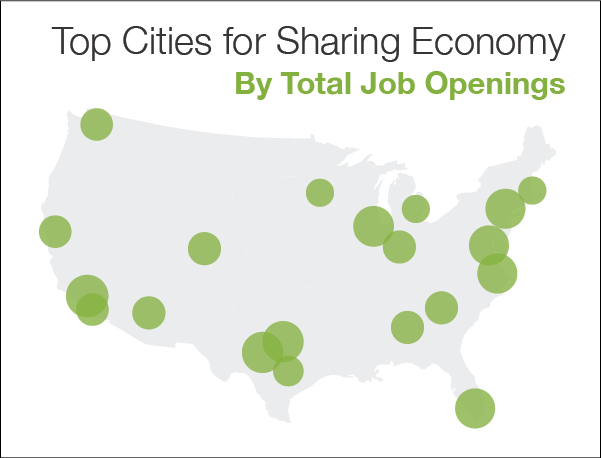
An economic recession only aided growth for these new ventures. As employees were losing their jobs and their faith in American institutions they found themselves in need of immediate income, and with few options to earn it. Gigs were the ideal alternative. They provided the opportunity to supplement income with the monetization of existing material goods and still allowed contractors time to raise their families, work part time, go back to school, or apply for their next job.
Freelance work became even more practical with the enactment of the Affordable Care Act in 2010, which gave citizens access to healthcare at their income level regardless of employment status. These developments gave entrepreneurs the opportunity to run their businesses without the normal expenses of a storefront, materials, employee training, and benefits, and allowed them to grow exponentially in a short period.
Although the economy is improving it’s still difficult to find a job, particularly for recent grads. Facing skeptical hiring managers as well as oppressive student loan debt, Millennials are finding the digital freelance option increasingly attractive. I spoke to Zoie, a recent UCLA grad, who takes extended periods away from part-time jobs to pursue creative projects. Freelancing works around her schedule, and has become a more reliable source of income during employment gaps, “When you’re young you’re constantly transitioning from school to a job to a better job, and I feel like these gigs have become a nice backup for those transitional times.”
Growing up in the anonymous-yet-collaborative age of the internet culture helps, too; “It seems so straightforward. I personally haven’t driven an Uber or worked for TaskRabbit, but it just seems like the technology has allowed us to simplify something we could’ve been doing this whole time. Now we have this system where there is an element of safety and ease because the app is responsible.” Zoie is able to use the freelance model to her advantage as a contractor, and feels protected by these gig companies a consumer.
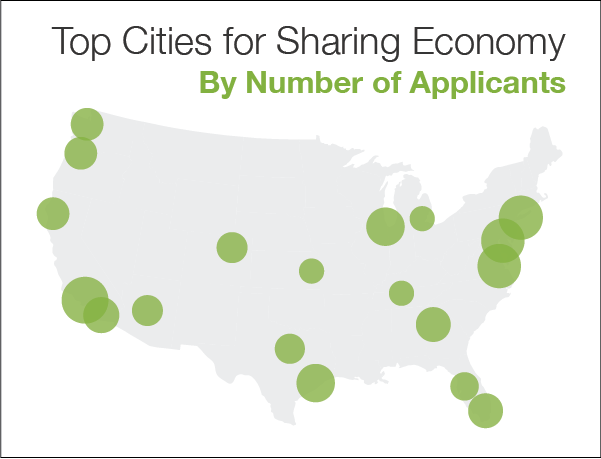
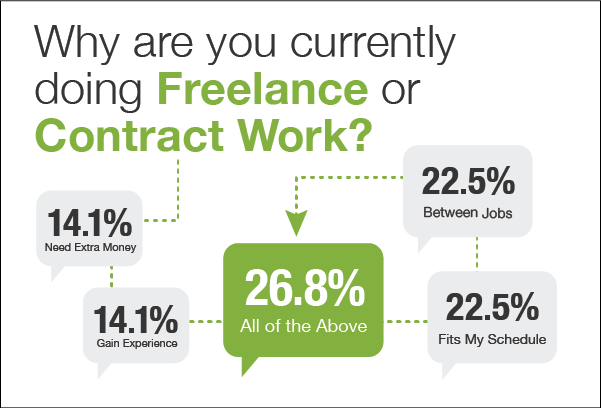
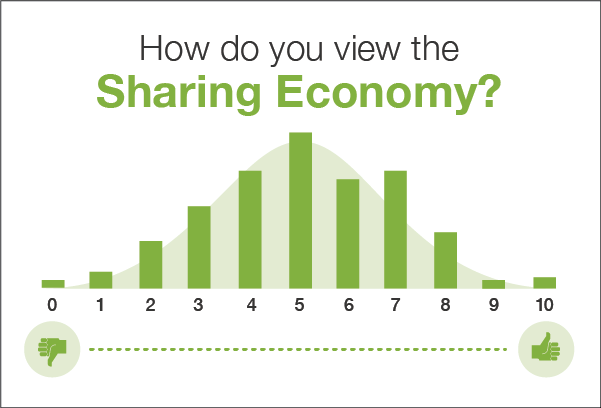
Rob, a Boston-based digital producer, has had a positive experience working in the share economy as well. He started driving for Uber after his 9 to 5 and on the weekends to offset the cost of a new car and put money towards his upcoming wedding. Most job seekers share Rob’s approval. A majority of the job seekers we surveyed said they either had a freelance job because it worked great with their schedule, or because they were in between permanent jobs. Among those that reported having a 1099 job, 66 percent rated their perception of the freelance economy at a 5 or higher.
Elijiah’s experience as an independent contractor was different from Zoie and Rob’s. He didn’t have a college degree or a permanent job to fall back on, but he did have the spirit of an entrepreneur, “I wanted to be able to make my own schedule. I was sick and tired of the nightlife – I had been a barback, I’d been a cocktail server, I’d done all this work in the food industry. And at the time I was only a high school graduate and I didn’t have much on my resume so my options were really limited. I was on Craigslist and I saw that Homejoy starts you off at 14-15 dollars an hour, and I could make my own schedule, so I decided to go for it.”
Despite an overall positive experience, Elijiah did have his criticisms of the business model, “As an independent contractor you have to buy all of your own supplies. I was the guy who’d buy a brand that was all natural, [and] I remember one time working with another cleaner that used these cheap products…Homejoy gets reviews from people whose homes are being cleaned, and the customer complained about it in our review. After that I ended up going to a lot more homes.”
By not taking responsibility as employers these companies are able to save on the cost of materials like cleaning products, but the lack of support for their laborers can actually prevent them from getting work, and ultimately reflect poorly on the company itself. Recently, Homejoy announced it was shutting down permanently after the company could no longer afford numerous lawsuits challenging it to take responsibility for their contractors as employees.
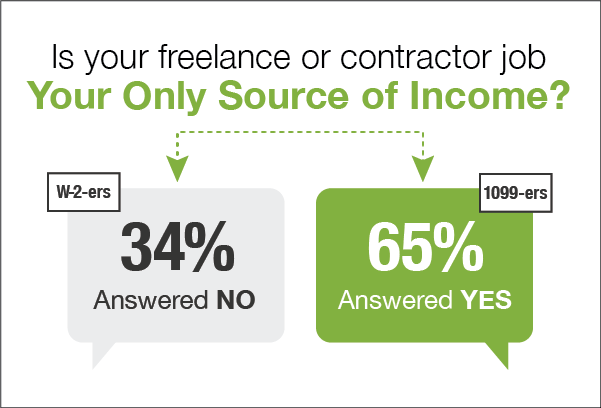
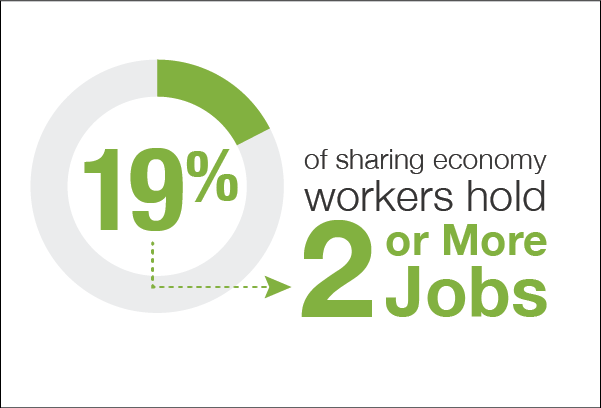
Although the perception of freelancing might be as a supplement or back up, according to our survey Elijiah’s full time work makes him the more typical freelancer. 85 percent of job seekers with a 1099 job said it was the only work they did, and 65 percent reported it as their only source of income. When asked why the chose this type of work, a majority of job seekers said it was either because it worked great with their schedule, or because they were in between permanent jobs.
Elijiah isn’t alone in his criticism of these companies. Uber has faced lawsuits regarding the employee status of their drivers, lack of regulation, unlawful rejection of disabled passengers, and street congestion, to name a few. Many Airbnb rentals were deemed illegal in Santa Monica after locals made complaints about debaucherous renters, a degradation of the community structure, and an unfair use of limited property in an area already know for its exorbitant rent prices.
The issues are so prominent that they have the attention of 2016 presidential hopefuls. The controversy was introduced as a campaign topic by Hillary Clinton, who promises to “crack down” on the inefficiencies of sharing economy companies. Her Republican opposition seized the opportunity to stand up for the free market and sway a rarely won urban base, and some have taken to supporting these businesses quite literally. The freelance system represents the entrepreneurial spirit our nation’s economic system was built upon, but allegations of companies maximizing profits at the expense of those trying to make a living wage is an indication that these ventures need regulation.
During his time at Homejoy Elijiah fondly remembers the feeling of “being [his] own boss,” but in retrospect felt the structure was unfair, “Adora Cheung, the CEO [of Homejoy], last time I checked she was worth almost $54 million or something. So I would think you could share the wealth a little bit better with your employees. Why did I have to buy all my own equipment?”
Central to all these issues is the discrepancy between the perception of these ventures as part of a revolutionary collaborative consumption movement, and the reality, which is that they are for-profit businesses very similar to the incumbent ones (taxis, hotels, etc.) that they are competing with. Airbnb claims to facilitate home-sharing and a unique community experience for travelers, but in many cases property companies are behind the cozy rentals they advertise.
When Elijiah stopped working for Homejoy, they didn’t even give him his last paycheck, “Homejoy has their own city managers that are supposed to handle the independent contractors through email correspondence, but they just ignored me…eventually I told them I was going to bring up a lawsuit, and they immediately sent the check to me.” The driver that hit my car was just as scared of losing his job as he was about the retribution of his boss, a man that would try to talk me out of making a formal claim through my insurance later that evening.
Rob noted that while he has had an overall positive experience with Uber, their encouragement of drivers to rush and take advantage of the temporarily increased fares in ‘surge pricing’ areas is often frustrating; if he’s not near that part of town all the riders are usually gone by the time he gets there, and that travel time costs him fares. Although these companies claim to merely act as digital brokers of exchanges between contractors and customers, the obligations placed on workers suggests that ‘Employer’ might be a more appropriate classification. But that would mean complying with regulations, and letting go of profit.
Understandably, profit is the end-game for all businesses. But making the impressive amounts of money these companies do while the workers that facilitate that income struggle to buy cleaning products doesn’t sound much like ‘sharing.’ While the freelancers I spoke to all found ways to make the work suit their unique needs many others are clearly less satisfied, considering the class-action lawsuits and overall backlash recounted in every-other thinkpiece I’ve read in the last few months.
For workers with few employment options, the risk run by speaking out against abuses may be too great. The Uber driver from my accident felt totally hopeless. In the solemn small talk we made while photographing car damage I learned he was a veteran; he was young, relatively unqualified in terms of work experience, and trying to use the freelance economy to his advantage. With so many unhappy laborers, how does the perception of a tech-based economic utopia persist?
Partially, because it is not entirely false. Zoie’s experience has been a wholly positive one, “I think anything geared toward our generation is probably good because … it’s better to move toward what works for that generation rather than hold on to what was working but may not work as well anymore.”
She actually felt that this shift is contributing to a better future; “People are so individualistic, which is great, but we do lose sight of the benefits of being more communal. I think the sharing economy is going to be key to a better quality of life in general.”
Rob said his biggest surprise in driving for Uber has been his riders’ willingness to talk, and their curiosity about how he enjoys the work. Aside from the extra income, the community aspect has really made the experience pleasant.
Both these contractors view the work positively, but they also have outside support. Rob’s full time job provides benefits and regular income. Zoie is still an age at which she can legally stay on her family’s health insurance (and Zoie is unlike most Millennials in that she works enough to be able to afford her own apartment and bills without outside help; most in her cohort live with with their families, making flexible part-time income ideal for the non-essential amenities their parents won’t cover).
The likely reason false impressions of ‘collaborative consumption’ remain is that few people are actually involved in it. 78 percent of the job seekers we surveyed said they did not have a freelance job, and 84 percent said they had never even considered taking one. If impressions are based solely on the consumer perspective of the 1099 economy, there is little question as to why it has such a positive reputation. These companies offer a great experience – for their customers, at least.
Even with the benefits it does offer, awareness of drawbacks to gig work is increasing. Zoie had insight into some deficiencies, “I think there should be some acknowledgment of the reality of what this app is leading to, which is not necessarily only part-time but in many cases full-time employment which should be accurately compensated for.” Rob also felt that while it has worked well for him, the 1099 work he does would not really be sustainable at the full-time level.
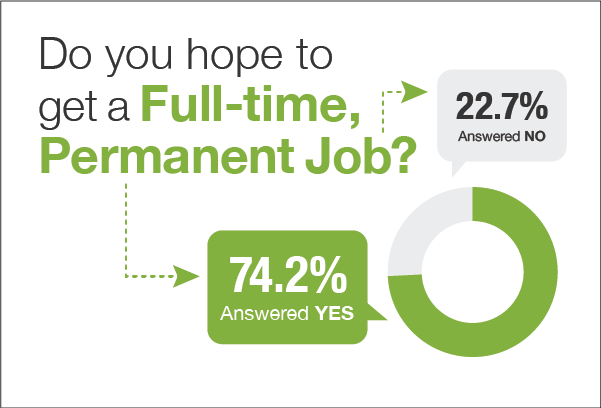
Are we headed for an economy doomed by fragmented, unregulated big-business masquerading as labor equality? Probably not, according to job seekers. 74 percent of those working in the freelance economy said they hoped to get a full-time, permanent job.
Elijiah reflected their sentiment when he described his current, full-time job, “It’s just night and day from where I am now. At this company they give us lunch, I’m getting paid a competitive hourly rate, full health coverage…they provide all these things that Homejoy just didn’t bother with. I love it.”
Improvements in the sharing economy wouldn’t have prevented an Uber driving from hitting my car, but having regulations in place could have provided clarity in the situation. The current system allows companies to act as brokers when there are problems, but employers when there is opportunity for profit. To maintain their success and position as valid enterprises, these companies will have to justify the huge profits they earn – sometimes at the expense of those who facilitate it – or agree to comply with new regulations.
This iteration of the sharing economy has the loyalty of Millennials with its tech platform and inherent on-demand nature, but as a new venture it just now being properly tested and vetted in the real world economy. Its undeniable position as a fixture in our society means that it will need to undergo the growing pains necessary to support the laborers it profits from.