The unemployment rate slipped down to 5.3% in June, as 223,000 jobs were added to the economy last month, marking the 64th month of consecutive job growth. That good news was tempered by falling labor force participation rates and sluggish wage growth. Wages have been stubbornly resistant to sustained growth throughout the recovery, and last month remained flat.
According to the our forward-looking ZipRecruiter Hiring Demand Index, which provides leading indicator data for hiring activity in key industries, these are the highlights of the 30-day hiring outlook:
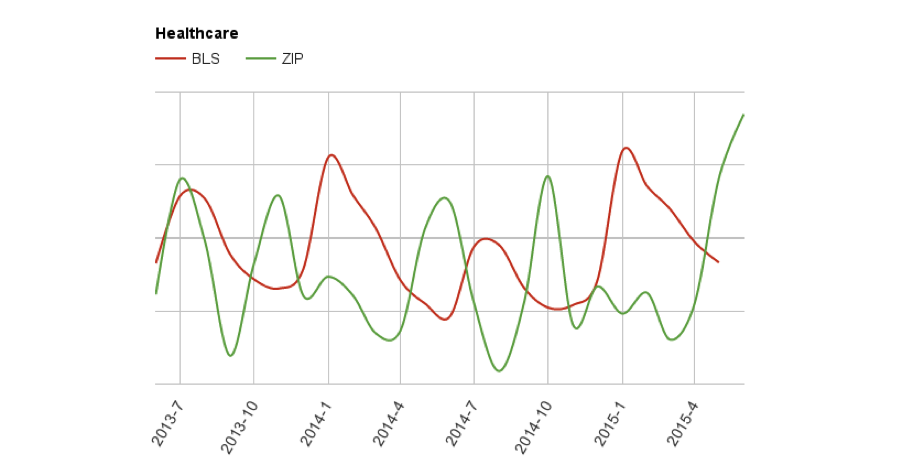
Two months after overall Healthcare employment hit 15 million jobs nationwide, hiring demand continued to grow, at a slightly slower but still healthy pace. With 22.8 million Americans joining the ranks of the insured since the implementation of the Affordable Care Act, demand for new workers to draw blood, update charts, and administer meds has spiked, a trend that seems likely to continue now that the Supreme Court ruled in favor of the Affordable Care Acts in their recent King v. Burwell decision. If that happens, an extended hiring slowdown is likely, with job losses a real possibility. For now, though, healthcare remains a key growth segment for the economy.
Predictive Analysis: Though healthcare hiring is in a cyclical mini-downturn, increased hiring demand indicates a string return to form for the sector in June and July, and beyond
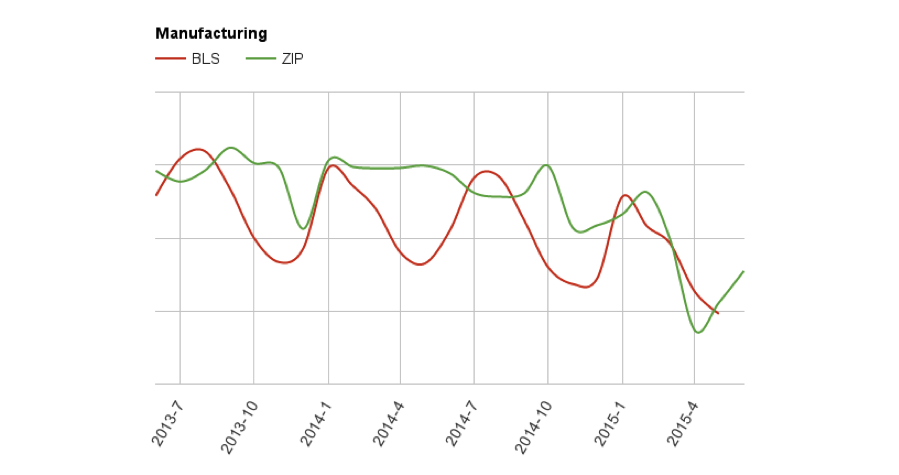
Demand for factory workers has been on the rise since April, which signals that an upswing in manufacturing activity may be on the horizon. The sector was hit hard by an absolutely brutal winter – which only added to the drag created by a rising dollar and labor woes at West Coast ports – but economists are now predicting a slow and steady recovery.
Predictive Analysis: The yearlong trough in manufacturing hiring looks set to end, as demand continues to climb after turning it around in April.
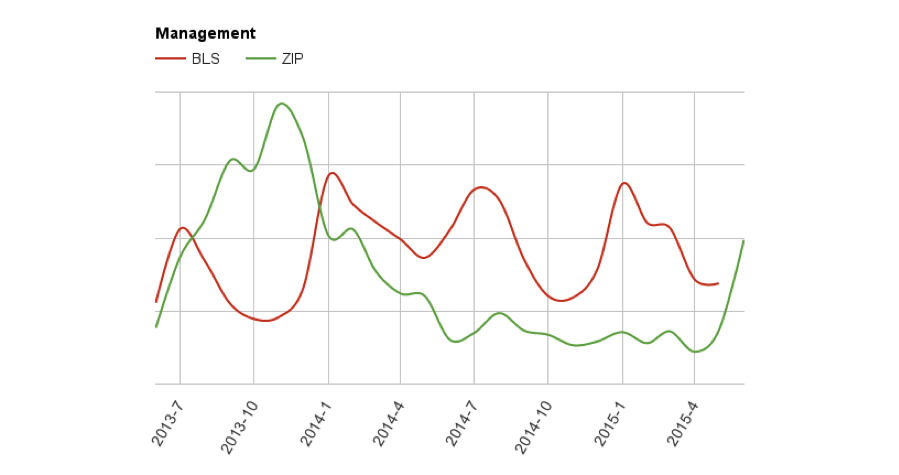
Management hiring has been on an overall downturn since January, after experiencing a year-end ramp up which left it near a two year high. Overall job creation in the sector on a normalized basis has been decent: despite the widespread media attention given to the hollowing out of the middle-class, at the managerial level, at least, the middle is a pretty good place to be.
Predictive Analysis: The June and July reports should reflect increased hiring demand with a substantial uptick in new Management hires.
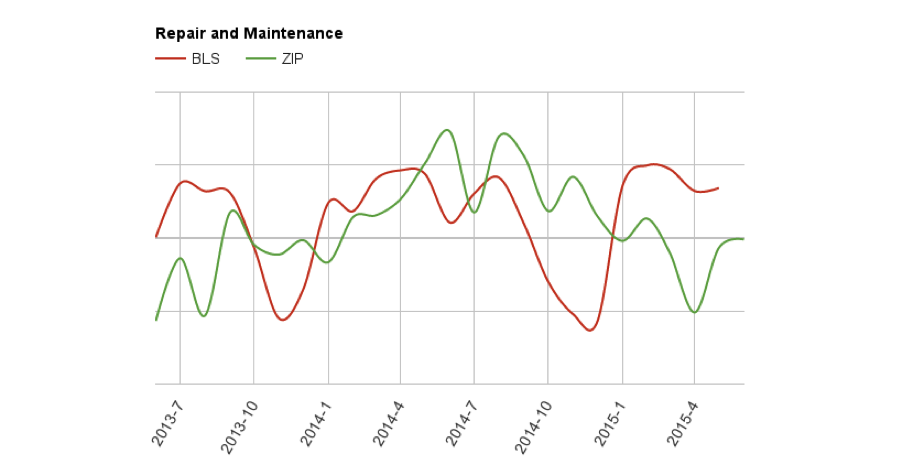
After a noticeable dip in April, the natural entropy of the world (things will break!) has created enough busted pipes, broken-down cars, and rusted gutters that this humble but incredibly important economic sector has bounced back with strong hiring demand in May continuing into July. Interestingly, the top in-demand position in this sector is Apartment Maintenance Technician, which may mean that the nasty winter weather has paid dividends by providing lots of damaged apartment buildings that need repairs.
Predictive Analysis: Despite dipping to its lowest level in a year in April’s hiring demand index, Repair and Maintenance is headed north again, and the outlook points to the industry adding jobs in June and July.
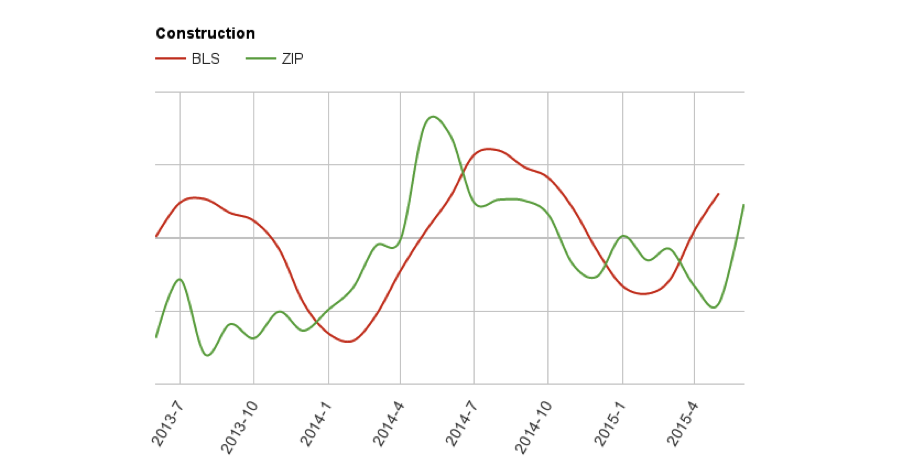
Construction blasted out of the gates in April, when it accounted for 20% of total jobs created, and has continued on a trajectory of strong growth. Surveys show that overall construction employers plan to add payroll this year, and so far they are following through.
Predictive Analysis: All signs are pointing to a strong summer for construction hiring, though it seems unlikely it will equal the peak hiring of May 2014.
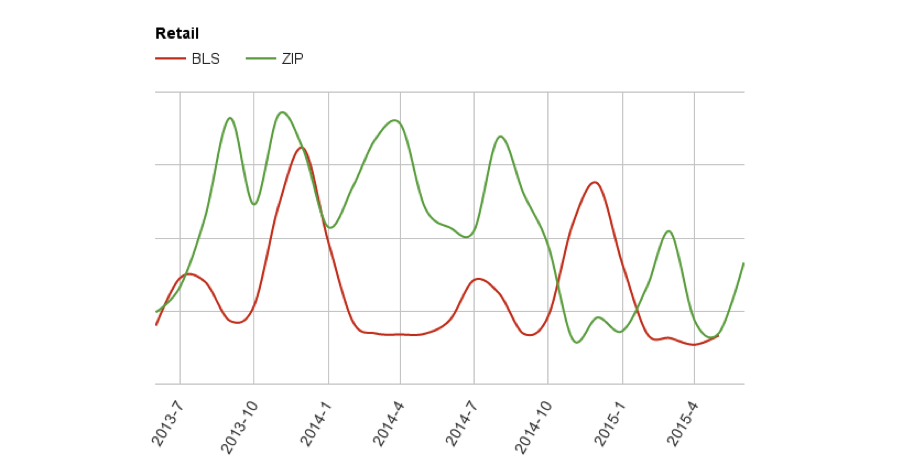
Consumer spending has finally picked up, and retail jobs are set to follow. Though Retail firing fell off considerably after a weaker than normal holiday season spike, hiring demand is turning around and moving in the right direction as Americans are opening their wallets again.
Predictive Analysis: A new hiring cycle seems set to begin in retail, but at a lower level of demand than previous peaks over the last two years.
Insurance Carriers and Related Activities
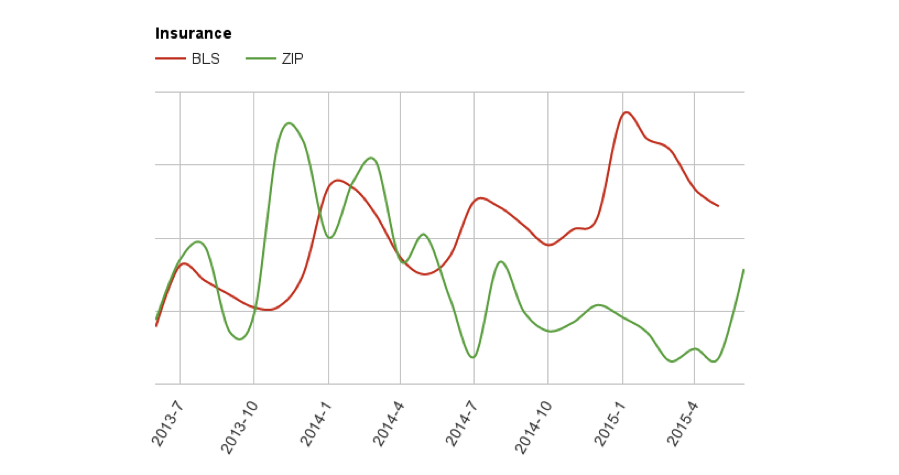
Employment in the insurance industry is on pace for a record year, but employers are reporting a shortage of qualified candidates, which may have contributed to May’s disappointing hiring demand numbers. In the long run, factors like the Affordable Care Act and an aging population point to a career in insurance as a safe bet, meaning this downtick could be a blip which will resolve itself in the next few months.
Predictive Analysis: Insurance hiring demand has picked up, with an increase in jobs added likely to follow in June and July.
The Hottest Cities for Hiring in June
Dallas is tops in hiring demand for the second month in a row, while fellow Lone Star cities Houston and San Antonio fell off the list on weakened hiring demand.
Hot Jobs in Dallas: Physician Assistant, Pharmacy Technician, Diesel Mechanic
Pittsburgh economy is not the flashiest in the nation, but it’s rock solid, chugging along at a 4% annual growth rate. Many of the jobs being created along the Allegheny are high-paying medical and tech jobs.
Hot Jobs in Pittsburgh: Registered Nurse, Senior Java Developer, Project Manager
The City of Angels moves up a spot in this month’s index, as unemployment in the city dropped to 7.6% last month, down from 8.3% in 2014.
Hot Jobs in L.A.: Nurse Practitioner, Senior Accountant, Project Manager
The Bay Area jumps to fourth place in hiring demand this month, as the San Francisco continues it hot hiring streak.
Hot Jobs in San Francisco: Nurse Practitioner, Engineer, Licensed Vocational Nurse
Despite weakness in the all important energy sector, the Capital City remains a bright spot in Louisiana’s economy. In fact, Baton Rouge recently topped 400,000 non-farm jobs, which bodes well for its long-term economic prospects.
Hot Jobs in Baton Rouge: Data Specialist, Crane Operator, Programmer
Though it’s early yet, Seattle’s minimum wage law doesn’t seem to have hurt hiring demand, as the city has climbed into our top 10 hiring demand list for the first time. On an interesting side note, Seattle is becoming a relocation target for Silicon Valley tech talent fleeing astronomical Bay Area real estate prices.
Hot Jobs in Seattle: Registered Nurse, Industrial Engineer, Senior Software Engineer
Minnesota isn’t among the leading states in growth as it was during the height of the oil boom, but the Twin Cities still boast strong hiring as seen in their microscopic unemployment rate and in this month’s hiring demand index. Basically: full unemployment, achieved.
Hot Jobs in Minneapolis: Account Executive, Manufacturing Engineer, Production Supervisor
The third of four California cities on this month’s list, San Diego saw a record 446 startups founded in the city last year, a trend reflected in this month’s hot jobs, which skew towards tech.
Hot Jobs in San Diego: Nurse Practitioner, Project Manager, Software Engineer
Yes, Bakersfield. California dominates this month’s list as Texas did for May, as the softening energy sector and a stormy spring seem to be slowling the Lone Star state’s prodigious growth.
Hot Jobs in Bakersfield: Licensed Practical Nurse, Retail Customer Service, Merchandiser
The northern anchor of the Knowledge Corridor breaks into the top ten this month on strong hiring demand growth. As is typical for the region, many of the jobs being created are high-paying healthcare and tech jobs.
Hot Jobs in Springfield: Psychiatric Nurse Practitioner, Mobile Developer, Business Analyst
The ZipRecruiter National Jobs Report measures current and leading edge demand for employees across fourteen key industries by measuring relative month over month percent changes using the following benchmarks:
-
- Current Active Jobs – Our representative sample of millions of job postings provides an overview of existing demand for new employees (as opposed to hiring numbers), which provides a snapshot of the previous month’s hiring.
- New Jobs – Our representative sample of new job postings in January provides insight into current and upcoming demand, next month’s hiring numbers, and a predictive look at the demand curve for new employees across twenty-one industries.
- Employer Demand by Metro – We have further broken down these numbers to provide insight into current and upcoming demand for new employees across metropolitan areas nationwide.
- Key Indexed Industries are: Accommodation and Food Services, Business Support Services, Construction, Educational Services, Employment Services, Financial Activities, Health Care, Insurance Carriers and Related Activities, Management of Companies and Enterprises, Manufacturing, Motor Vehicle and Parts Dealers, Repair and Maintenance, Retail Trade, Warehousing and Storage.