1

Indonesian Jobs (NOW HIRING)

Indonesian Bilingual Expert Job Type: Contractor Location: Remote Job Overview We are seeking Indonesian Bilingual Experts to support a large-scale linguistic and AI training project focused on ...

New

Indonesian Bilingual Expert Job Type: Contractor Location: Remote Job Overview We are seeking Indonesian Bilingual Experts to support a large-scale linguistic and AI training project focused on ...

New

Indonesian Bilingual Expert Job Type: Contractor Location: Remote Job Overview We are seeking Indonesian Bilingual Experts to support a large-scale linguistic and AI training project focused on ...

New

Indonesian Bilingual Expert Job Type: Contractor Location: Remote Job Overview We are seeking Indonesian Bilingual Experts to support a large-scale linguistic and AI training project focused on ...

New

Indonesian Bilingual Expert Job Type: Contractor Location: Remote Job Overview We are seeking Indonesian Bilingual Experts to support a large-scale linguistic and AI training project focused on ...

New

Linguist - (Indonesian) Location: Hybrid, travel when necessary Security Clearance: Public Trust (or ability to obtain) Schedule: This is an as-needed, part-time essential services position with work ...

next page

Showing results 1-20

indonesian information

See salary details

$5

$52

How much do indonesian jobs pay per hour?

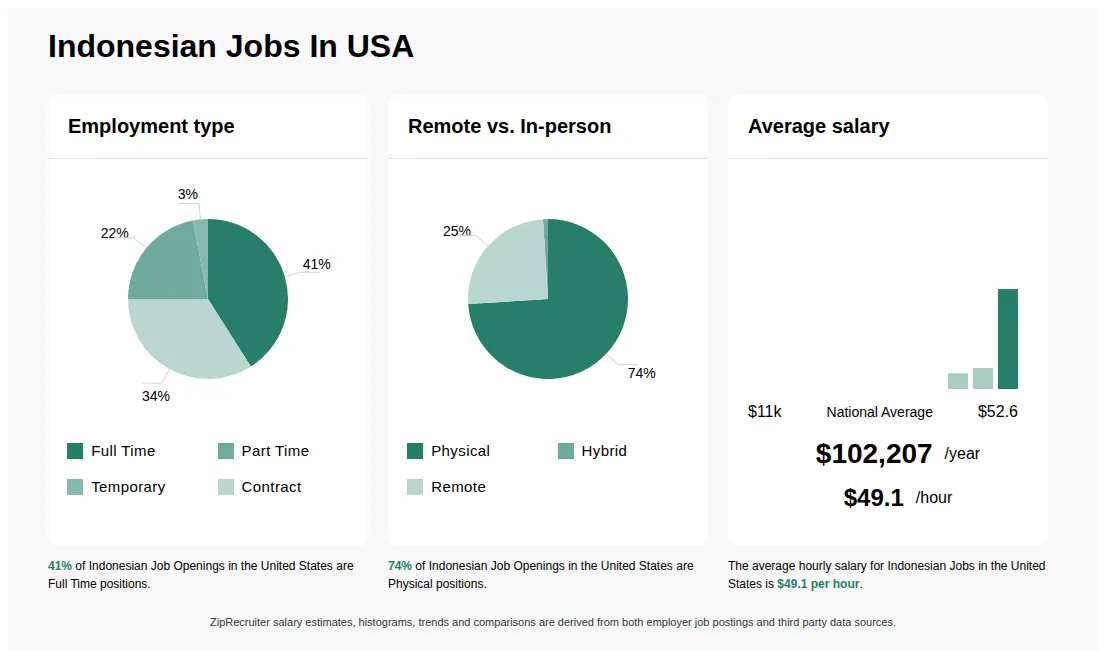
As of Aug 24, 2026, the average hourly pay for indonesian in the United States is $49.14, according to ZipRecruiter salary data. Most workers in this role earn between $48.32 and $51.44 per hour, depending on experience, location, and employer.

What is an Indonesian?

An Indonesian job typically refers to employment opportunities in Indonesia or roles related to Indonesian language, culture, or business. Jobs can range from teaching Indonesian, working in multinational companies, or roles related to tourism and trade. Many positions require fluency in Bahasa Indonesia and an understanding of local customs. Opportunities exist in various industries, including finance, technology, and manufacturing.

What are some challenges Indonesian language specialists might face when working with international teams?

Indonesian language specialists often collaborate with colleagues from diverse cultural and linguistic backgrounds. A common challenge is ensuring clear, accurate communication across different languages and adapting translations to various cultural contexts. Additionally, managing tight deadlines and balancing multiple projects can require strong organizational skills. Regular collaboration with project managers, editors, and subject-matter experts is essential to maintain quality and consistency in translations.

What are the key skills and qualifications needed to thrive as an Indonesian language teacher, and why are they important?

To thrive as an Indonesian language teacher, you need fluency in Bahasa Indonesia, a strong understanding of grammar and linguistics, and a relevant teaching qualification or certification. Familiarity with language instruction platforms, classroom technology, and curriculum development tools is typically required. Excellent communication, cultural sensitivity, and patience are crucial soft skills for engaging students and adapting to diverse learning needs. These skills ensure effective language instruction, foster student progress, and create an inclusive and motivating classroom environment.

What is the difference between Indonesian vs Filipino?

AspectIndonesianFilipino
CredentialsTypically holds Indonesian language proficiency and local certificationsUsually has Filipino language skills and relevant certifications
Work EnvironmentOften in Indonesian companies or organizations operating locally or regionallyCommon in Filipino companies, BPOs, and international firms in the Philippines
Industry UsageUsed in government, education, and local businesses in IndonesiaPrevalent in call centers, tourism, and service industries in the Philippines

The main difference between Indonesian and Filipino lies in their language, cultural background, and regional employment sectors. Indonesian typically refers to someone from Indonesia working within local or regional contexts, while Filipino pertains to individuals from the Philippines, often working in BPOs or international industries. Both roles require language skills and industry-specific knowledge, but their work environments and certifications differ based on regional standards.

More about indonesian jobs

What cities are hiring for Indonesian jobs?

Cities with the most Indonesian job openings:

What are the most commonly searched types of Indonesian jobs?

The most popular types of Indonesian jobs are:

What states have the most Indonesian jobs?

States with the most job openings for Indonesian jobs include:

Infographic showing various Indonesian job openings in the United States as of August 2026, with employment types broken down into 45% Full Time, 36% Part Time, 14% Contract, and 5% Nights. Highlights an 68% In-person, and 32% Remote job distribution, with an average salary of $102,207 per year, or $49.1 per hour.

Indonesian Bilingual Expert - Remote

YO AI Labs

Austin, TX โ€ข Remote

$30 - $65/hr

Full-time

Posted 2 days ago

New


Job description

Indonesian Bilingual Expert

Job Type: Contractor
Location: Remote

Job Overview

We are seeking Indonesian Bilingual Experts to support a large-scale linguistic and AI training project focused on improving Indonesian language understanding and generation. In this role, you will evaluate AI-generated Indonesian speech, assess linguistic and cultural accuracy, and provide detailed feedback to help improve language model performance.

No prior AI experience is required. Strong Indonesian language expertise, English communication skills, and attention to detail are the key requirements for this role.

Key Responsibilities
  • Listen to and review audio clips to evaluate the nativeness, fluency, and overall quality of AI-generated Indonesian speech.
  • Assess pronunciation, intonation, accent, rhythm, and linguistic authenticity.
  • Evaluate language accuracy and identify unnatural or inappropriate expressions.
  • Validate the cultural and contextual appropriateness of language used in audio samples.
  • Provide clear and detailed written feedback in English and verbal feedback when required.
  • Document observations accurately and provide actionable insights for model improvement.
  • Follow established guidelines, rubrics, and evaluation standards consistently.
  • Collaborate with project coordinators to discuss findings and clarify evaluation requirements.
  • Complete assigned assessments accurately and within defined project timelines.
  • Contribute linguistically informed suggestions to improve evaluation frameworks and language quality standards.
Required Qualifications
  • Native-level proficiency in Indonesian, with excellent command of spoken and written Indonesian.
  • Strong understanding of Indonesian cultural nuances and regional language variations.
  • B2+ proficiency in English, with strong written and verbal communication skills.
  • Excellent attention to detail and a methodical approach to language evaluation.
  • Ability to identify subtle differences in pronunciation, fluency, grammar, tone, and language authenticity.
  • Ability to provide clear, constructive, and actionable feedback.
  • Strong ability to follow detailed guidelines and apply evaluation criteria consistently.
  • Comfortable working independently in a remote environment.
Preferred Qualifications
  • Experience in translation, localization, linguistics, content moderation, transcription, or language quality assessment.
  • Experience evaluating audio, speech, pronunciation, or AI-generated language.
  • Familiarity with Indonesian regional dialects and cultural variations.
  • Experience working with language data, linguistic annotation, or quality assurance.
  • Interest in AI-driven language technologies and speech systems.
Core Skills
  • Indonesian Native Proficiency
  • English – B2+
  • Audio Evaluation
  • Linguistic Assessment
  • Language Quality Assurance
  • Pronunciation & Intonation
  • Cultural & Contextual Awareness
  • Attention to Detail
  • Written Communication
  • Verbal Communication
  • Critical Listening
  • Quality Assurance