Must have completed a DoD formal training program for weather observing AND forecasting or equivalent National Weather Service program. Must provide proof of completion. * Visual acuity correctable ...
Must have completed a DoD formal training program for weather observing AND forecasting or equivalent National Weather Service program. Must provide proof of completion. * Visual acuity correctable ...
Weather Forecaster/Observer-Guantanamo Bay, Cuba
Norman, OK · On-site
$31.80/hr
Must have completed a DoD formal training program for weather observing AND forecasting or equivalent National Weather Service program. Must provide proof of completion. * Visual acuity correctable ...
Weather Forecaster/Observer-Guantanamo Bay, Cuba
Norman, OK · On-site
$31.80/hr
Must have completed a DoD formal training program for weather observing AND forecasting or equivalent National Weather Service program. Must provide proof of completion. * Visual acuity correctable ...
Weather Forecaster/Observer-Guantanamo Bay, Cuba
Norman, OK · On-site
$31.80/hr
Must have completed a DoD formal training program for weather observing AND forecasting or equivalent National Weather Service program. Must provide proof of completion. * Visual acuity correctable ...
Weather Forecaster/Observer-Guantanamo Bay, Cuba
Norman, OK · On-site
$31.80/hr
Must have completed a DoD formal training program for weather observing AND forecasting or equivalent National Weather Service program. Must provide proof of completion. * Visual acuity correctable ...
Weather Forecaster/Observer-Guantanamo Bay, Cuba
Norman, OK · On-site
$31.80/hr
Must have completed a DoD formal training program for weather observing AND forecasting or equivalent National Weather Service program. Must provide proof of completion. * Visual acuity correctable ...
Weather Forecaster/Observer-Guantanamo Bay, Cuba
Norman, OK · On-site
$31.80/hr
Must have completed a DoD formal training program for weather observing AND forecasting or equivalent National Weather Service program. Must provide proof of completion. * Visual acuity correctable ...
Weather Forecaster/Observer-Guantanamo Bay, Cuba
Norman, OK · On-site
$31.80/hr
Must have completed a DoD formal training program for weather observing AND forecasting or equivalent National Weather Service program. Must provide proof of completion. * Visual acuity correctable ...
Weather Forecaster/Observer-Guantanamo Bay, Cuba
Norman, OK · On-site
$31.80/hr
Must have completed a DoD formal training program for weather observing AND forecasting or equivalent National Weather Service program. Must provide proof of completion. * Visual acuity correctable ...
Weather Forecaster/Observer-Guantanamo Bay, Cuba
$28.36 - $31.80/hr
Must have completed a DoD formal training program for weather observing AND forecasting or equivalent National Weather Service program. Must provide proof of completion. * Visual acuity correctable ...
Weather Forecaster/Observer-Guantanamo Bay, Cuba
$28.36 - $31.80/hr
Must have completed a DoD formal training program for weather observing AND forecasting or equivalent National Weather Service program. Must provide proof of completion. * Visual acuity correctable ...
Must have completed a DoD formal training program for weather observing AND forecasting or equivalent National Weather Service program. Must provide proof of completion. * Visual acuity correctable ...
Must have completed a DoD formal training program for weather observing AND forecasting or equivalent National Weather Service program. Must provide proof of completion. * Visual acuity correctable ...
Weather Forecaster/Observer-Guantanamo Bay, Cuba
Norman, OK · On-site
$31.80/hr
Must have completed a DoD formal training program for weather observing AND forecasting or equivalent National Weather Service program. Must provide proof of completion. * Visual acuity correctable ...
Weather Forecaster/Observer-Guantanamo Bay, Cuba
Norman, OK · On-site
$31.80/hr
Must have completed a DoD formal training program for weather observing AND forecasting or equivalent National Weather Service program. Must provide proof of completion. * Visual acuity correctable ...

Reporter MMJ/Weather Anchor
San Diego, CA · On-site
$35/hr
Knowledge of WSI, Baron or similar weather forecasting system * Must be able to accept constructive direction and feedback * Compensation starting at $35/hour commensurate with experience and skill ...
Reporter MMJ/Weather Anchor
San Diego, CA · On-site
$35/hr
Knowledge of WSI, Baron or similar weather forecasting system * Must be able to accept constructive direction and feedback * Compensation starting at $35/hour commensurate with experience and skill ...

Postdoctoral Associate
Cambridge, MA · On-site +1
Sherrie Wang to develop deep learning methods for hyper-local weather forecasting with uncertainty quantification. The position is supported by a NASA-funded project focused on probabilistic ...
Postdoctoral Associate
Cambridge, MA · On-site +1
Sherrie Wang to develop deep learning methods for hyper-local weather forecasting with uncertainty quantification. The position is supported by a NASA-funded project focused on probabilistic ...
Meteorologist / Forecaster
Bend, OR · On-site
However, candidates with a degree in communications and/or journalism who have a strong interest in weather forecasting will also be considered. The successful candidate will be responsible for ...
New
Meteorologist / Forecaster
Bend, OR · On-site
However, candidates with a degree in communications and/or journalism who have a strong interest in weather forecasting will also be considered. The successful candidate will be responsible for ...
New

MMJ / Weekend Weather
Las Vegas, NV · On-site
Knowledge of IBM/WSI or similar weather forecasting system * Must be able to accept constructive direction and feedback EDUCATION AND EXPERIENCE: * B.A. or B.S. Degree preferably in journalism ...
MMJ / Weekend Weather
Las Vegas, NV · On-site
Knowledge of IBM/WSI or similar weather forecasting system * Must be able to accept constructive direction and feedback EDUCATION AND EXPERIENCE: * B.A. or B.S. Degree preferably in journalism ...
MMJ / Weekend Weather
Las Vegas, NV · On-site
Knowledge of IBM/WSI or similar weather forecasting system * Must be able to accept constructive direction and feedback EDUCATION AND EXPERIENCE: * B.A. or B.S. Degree preferably injournalism ...
MMJ / Weekend Weather
Las Vegas, NV · On-site
Knowledge of IBM/WSI or similar weather forecasting system * Must be able to accept constructive direction and feedback EDUCATION AND EXPERIENCE: * B.A. or B.S. Degree preferably injournalism ...
Reporter MMJ/Weather Anchor
San Diego, CA · On-site
$35/hr
Knowledge of WSI, Baron or similar weather forecasting system * Must be able to accept constructive direction and feedback * Compensation starting at $35/hour commensurate with experience and skill ...
Reporter MMJ/Weather Anchor
San Diego, CA · On-site
$35/hr
Knowledge of WSI, Baron or similar weather forecasting system * Must be able to accept constructive direction and feedback * Compensation starting at $35/hour commensurate with experience and skill ...

Experience translating weather data, forecast products, and atmospheric conditions into operational decisions is highly valued and directly applicable to this role. * Deep experience in managing ...
Experience translating weather data, forecast products, and atmospheric conditions into operational decisions is highly valued and directly applicable to this role. * Deep experience in managing ...

Meteorologist / Forecaster
Bend, OR · On-site
However, candidates with a degree in communications and/or journalism who have a strong interest in weather forecasting will also be considered. The successful candidate will be responsible for ...
New
Meteorologist / Forecaster
Bend, OR · On-site
However, candidates with a degree in communications and/or journalism who have a strong interest in weather forecasting will also be considered. The successful candidate will be responsible for ...
New
Weather Forecaster/Observer-Guantanamo Bay, Cuba (Norman)
Norman, OK · On-site
$31.80/hr
Must have completed a DoD formal training program for weather observing AND forecasting or equivalent National Weather Service program. Must provide proof of completion. * Visual acuity correctable ...
Weather Forecaster/Observer-Guantanamo Bay, Cuba (Norman)
Norman, OK · On-site
$31.80/hr
Must have completed a DoD formal training program for weather observing AND forecasting or equivalent National Weather Service program. Must provide proof of completion. * Visual acuity correctable ...

Knowledge of IBM/WSI or similar weather forecasting system * Must be able to accept constructive direction and feedback EDUCATION AND EXPERIENCE: * B.A. or B.S. Degree preferably injournalism ...
Knowledge of IBM/WSI or similar weather forecasting system * Must be able to accept constructive direction and feedback EDUCATION AND EXPERIENCE: * B.A. or B.S. Degree preferably injournalism ...
Knowledge of WSI, Baron or similar weather forecasting system * Must be able to accept constructive direction and feedback * Compensation starting at $35/hour commensurate with experience and skill ...
Knowledge of WSI, Baron or similar weather forecasting system * Must be able to accept constructive direction and feedback * Compensation starting at $35/hour commensurate with experience and skill ...

Morning Meteorologist/ Weather Forecaster, KERO
Bakersfield, CA · On-site
$68K - $72K/yr
## Morning Meteorologist/ Weather Forecaster, KEROApplylocations: Bakersfield, CA - KEROtime type: Full timeposted on: Posted Yesterdayjob requisition id: JR036517Are you ready to be the trusted voice ...
Morning Meteorologist/ Weather Forecaster, KERO
Bakersfield, CA · On-site
$68K - $72K/yr
## Morning Meteorologist/ Weather Forecaster, KEROApplylocations: Bakersfield, CA - KEROtime type: Full timeposted on: Posted Yesterdayjob requisition id: JR036517Are you ready to be the trusted voice ...
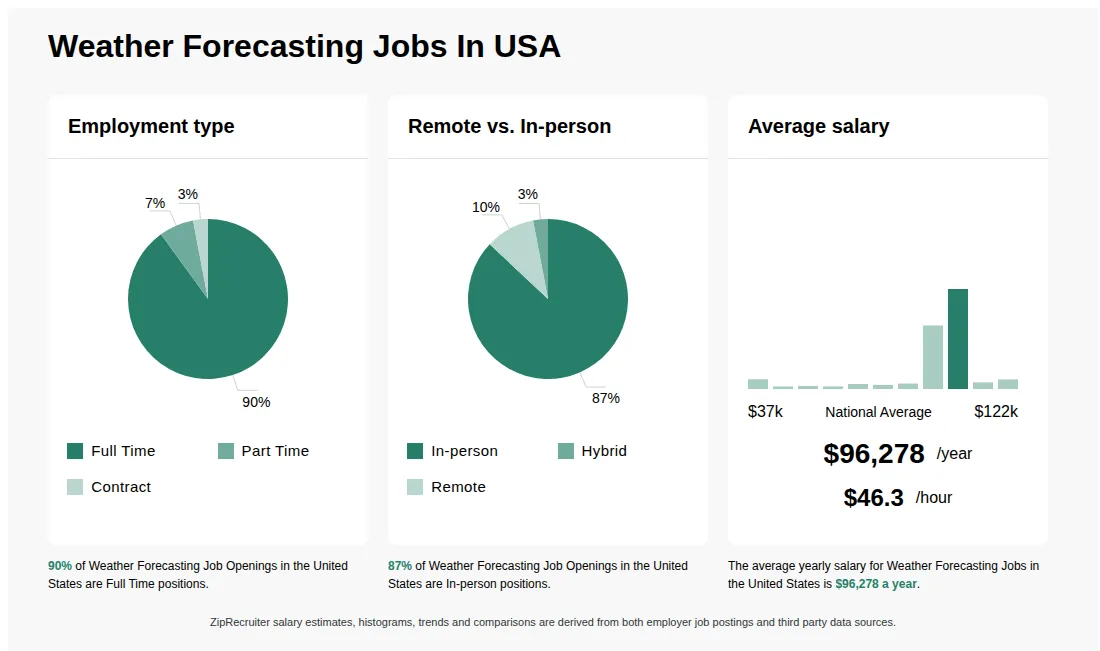
Weather Forecasting information
See salary details
$37K - $44.7K
4% of jobs
$44.7K - $52.5K
1% of jobs
$52.5K - $60.2K
1% of jobs
$60.2K - $67.9K
1% of jobs
$67.9K - $75.6K
2% of jobs
$75.6K - $83.4K
1% of jobs
$83.4K - $91.1K
2% of jobs
$94.2K is the 25th percentile. Wages below this are outliers.
$91.1K - $98.8K
31% of jobs
The median wage is $99.9K / yr.
$98.8K - $106.5K
49% of jobs
$106.5K - $114.3K
3% of jobs
$114.3K - $122K
4% of jobs
$37K
$96.3K
$122K
How much do weather forecasting jobs pay per year?
As of Sep 9, 2026, the average yearly pay for weather forecasting in the United States is $96,278.00, according to ZipRecruiter salary data. Most workers in this role earn between $98,500.00 and $98,500.00 per year, depending on experience, location, and employer.
What is weather forecasting?
Weather forecasting is the science and process of predicting the state of the atmosphere at a specific location and time in the future. Meteorologists use data from satellites, weather stations, radars, and computer models to analyze atmospheric conditions and make predictions about temperature, precipitation, wind, and other weather elements. Accurate forecasts help people prepare for daily activities, severe weather events, and make decisions in sectors like agriculture, aviation, and emergency management.
How does a weather forecaster typically collaborate with other team members during severe weather events?
During severe weather events, weather forecasters work closely with meteorologists, emergency management teams, and broadcast staff to ensure timely and accurate dissemination of information. This involves frequent briefings, real-time data analysis, and clear communication to translate complex meteorological data into actionable public advisories. Collaboration is essential to maintain consistency in messaging and to respond quickly to rapidly changing conditions. The ability to work well under pressure and coordinate with various departments is a key part of the role.
What are the key skills and qualifications needed to thrive as a weather forecaster, and why are they important?
To thrive as a Weather Forecaster, you need a strong background in meteorology, atmospheric science, and data analysis, typically supported by a relevant degree. Proficiency in using weather models, radar systems, satellite data, and specialized forecasting software like AWIPS or WRF is essential. Strong communication, critical thinking, and attention to detail help translate complex data into accurate, understandable forecasts. These skills are crucial for providing timely and reliable weather information that supports public safety and informed decision-making.
What is the difference between Weather Forecasting vs Meteorology?
| Aspect | Weather Forecasting | Meteorology |
|---|---|---|
| Required Credentials | Degree in meteorology, atmospheric science, or related field | Degree in meteorology, atmospheric science, or related field |
| Work Environment | Weather stations, forecasting centers, online platforms | Research labs, universities, forecasting agencies |
| Employer & Industry Usage | Weather services, media, government agencies | Research institutions, government agencies, academia |
| Common Search & Comparison | Focuses on short-term weather predictions | Encompasses broader atmospheric studies and research |
Weather forecasting primarily involves predicting short-term weather conditions using data analysis, while meteorology covers the broader scientific study of atmospheric phenomena, including research and long-term climate analysis. Both roles require similar educational backgrounds but differ in focus and application.
Do weather forecasters make good money?
Weather forecasters typically earn a median annual salary that varies by experience, location, and employer, with many earning between $50,000 and $100,000. Advanced skills in meteorology, certifications, and experience can lead to higher salaries, especially in broadcast or specialized roles.
How do you become a weather forecaster?
To become a weather forecaster, you typically need a bachelor's degree in meteorology, atmospheric science, or a related field. Gaining experience through internships, developing skills in weather modeling and data analysis, and obtaining certifications such as the Certified Broadcast Meteorologist credential can enhance job prospects. Proficiency with forecasting tools and strong communication skills are also important for this role.
What careers are there in weather forecasting?
Careers in weather forecasting include meteorologists, atmospheric scientists, and weather analysts who analyze weather data, develop forecasts, and communicate weather information. These roles often require knowledge of meteorological tools, computer modeling, and relevant certifications or degrees in atmospheric sciences or related fields.
More about Weather Forecasting jobs
What cities are hiring for Weather Forecasting jobs?
Cities with the most Weather Forecasting job openings:
What are the most commonly searched types of Weather Forecasting jobs?
The most popular types of Weather Forecasting jobs are:
What states have the most Weather Forecasting jobs?
States with the most job openings for Weather Forecasting jobs include:
What are popular job titles for Weather Forecasting?
Popular job titles for Weather Forecasting:
Weather Forecaster/Observer-Guantanamo Bay, Cuba
Norman, OK
RedTown Technical Services, LLC
$31.80/hr
Full-time
Re-posted 4 days ago
Job description
Description
**HUBZONE**
Qualified candidates living in a Hubzone will receive preferential consideration in hiring.
Not sure you live in a Hubzone? Go here and enter your address:
https://maps.certify.sba.gov/hubzone/map#center
The Weather Forecaster/Observer performs meteorological weather watch consisting of taking, evaluating, recording, and disseminating surface weather observations (METAR/SPECI); issuing Terminal Aerodrome Forecasts; writing DD-175-1s, issuing and disseminating weather watches, warnings, and advisories; and responding to PMSV; and dissemination of PIREPs.
Hourly pay begins $31.80 Forecaster rate and $28.36 per hour Observer rate plus $4.75 per hour for up to 40 hours per week Health & Welfare. The candidate will be paid at the observer rate during the certification process and when working observer-only shifts. Night differential is compounded to base pay. The candidate can expect to work roughly 56 hours per week, but please note there is no overtime pay to hours over 40 per week. Housing and most utilities are paid for by the employer as well as initial and final travel expenses to/from the US to Guantanamo Bay. There may be tax advantages associated with this position and candidates should consult with a tax accountant if necessary.
Role and Responsibilities
- Performs Meteorological Weather Watch, taking, evaluating, recording, encoding, and disseminating surface weather observations
- Operates the Pilot to Metro Service
- Monitors radar and satellite imagery
- Receives and disseminates PIREPs
- Issues weather warnings, watches, and advisories
- Provides DD-175-1, canned route, and over-the-counter briefings
- Writes and disseminates Terminal Aerodrome Forecasts
Qualifications/Education Requirements
- Must be a U.S. Citizen
- Obtain and maintain eligibility for a DoD CAC
- Must have current US Passport
- Resumes must reflect the minimum qualifications of 2 years of aviation forecast experience with a DoD or other government agency that included flight weather briefings and unmanned systems familiarity within the past 10 years.
- Prior observation certification with the Department of Defense (DoD), Federal Aviation Administration, or National Weather Service, including two years of experience in observing, taking, recording, and disseminating surface weather observations using Meteorological Aviation Routine Weather Report (METAR) code
- Prior forecaster certification with the Department of Defense (DoD) or National Weather Service, including two years of experience in aviation forecasting.
- Must have completed a DoD formal training program for weather observing AND forecasting or equivalent National Weather Service program. Must provide proof of completion.
- Visual acuity correctable to 20/20 with glasses or contacts
- Demonstrate sufficient ability to operate all meteorological and communications equipment required for certification
- Speak, read, and understand English, and communicate well
Preferred Qualifications
- Experience with the Navy's Flight Weather Briefer 2.0 program
- Persons currently holding an active Navy CAC or having an active security clearance within the past 2-years
- Experience operating the Automated Service Operating System (ASOS)
Physical and Mental Requirements
The selected candidate may work solo in an office type atmosphere. Meals are taken in conjunction with the shift and candidates will have access to a refrigerator, microwave, and limited vending machines. The workload will vary and may be stressful at times when bad weather is present. Due to the nature of the position, the candidate can expect to be exposed to the weather elements on a regular basis and may be required to climb stairs. May be required to work nights, weekends and occasional holidays.
Additional Notes
RedTown Technical Services, LLC is an Equal Opportunity Employer and does not discriminate against employees or applicants on the basis of race, religion, color, sex, gender identity, national origin, age, United States military veteran's status, ancestry, sexual orientation, marital status, family structure, or mental or physical disability provided the essential functions of the job can be performed with or without reasonable accommodation.
Reasonable Accommodations
The ADA defines "reasonable accommodation" as a change or adjustment to a job or work environment that allows a qualified individual with a disability to satisfactorily perform the essential functions of a particular job and does not cause undue hardship for the employer. Examples of reasonable accommodations may include: Additional modifying equipment or devices; Modified work schedules; Providing an interpreter; or Making the work environment readily accessible to individuals with disabilities.
- This Organization Participates in E-Verify- https://www.e-verify.gov/sites/default/files/everify/posters/EVerifyParticipationPoster.pdf
- "Right to Work" - https://www.e-verify.gov/sites/default/files/everify/posters/IER_RighttoWorkPoster.pdf
- "Pay Transparency Nondiscrimination" Provision - https://www.dol.gov/sites/dolgov/files/OFCCP/pdf/pay-transp_%20English_formattedESQA508c.pdf