1

Unlicensed Counselor Jobs in Atlanta, GA (NOW HIRING)

Perform performance evaluation, counsel, and utilize the disciplinary process and document as ... Supervise RN, LPN, and unlicensed personnel. * Work collaboratively with endoscopy manager ...

Unlicensed Counselor information

See Atlanta, GA salary details

$27.4K

$55.1K

$72.1K

How much do unlicensed counselor jobs pay per year?

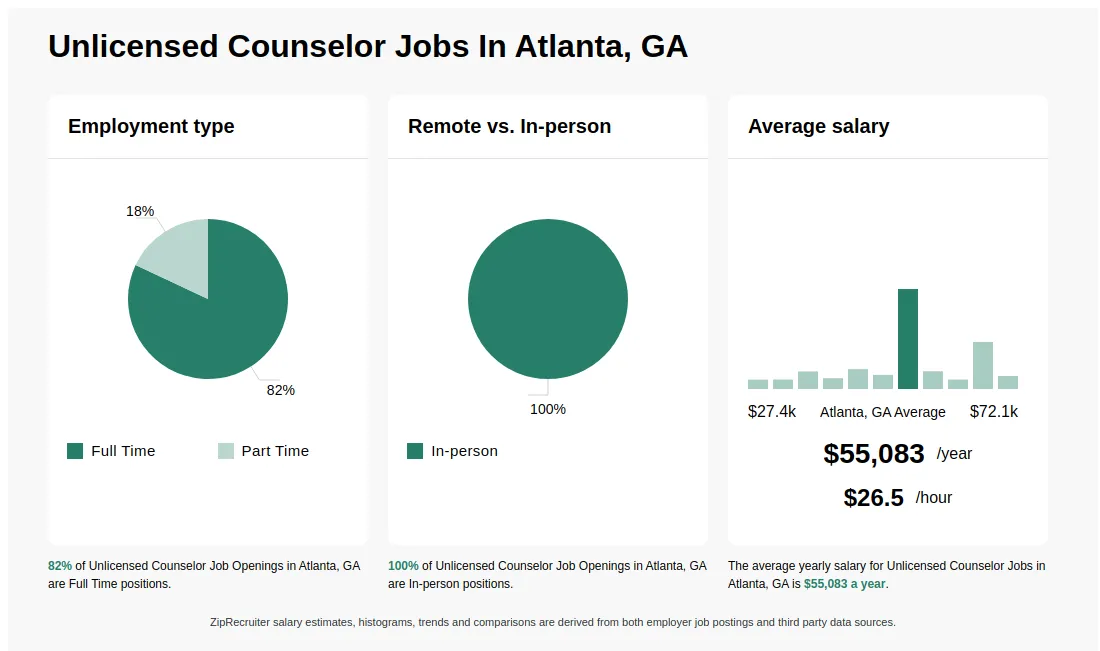
As of Sep 2, 2026, the average yearly pay for unlicensed counselor in Atlanta, GA is $55,083.00, according to ZipRecruiter salary data. Most workers in this role earn between $49,000.00 and $66,400.00 per year, depending on experience, location, and employer.

What is an unlicensed counselor?

Unlicensed counselors are individuals who provide counseling services but do not hold a state-issued license to practice as a professional counselor or therapist. They may have relevant education or training and often work under supervision or in non-clinical settings such as community programs, schools, or support groups. While they can offer support and guidance, unlicensed counselors are typically limited in the types of services they can provide and are not authorized to diagnose or treat mental health conditions. It's important to verify the qualifications and legal scope of practice for anyone offering counseling services.

What does an unlicensed counselor do?

The job duties of an unlicensed counselor include providing counseling services or mental health treatment for a client. As an unlicensed counselor, you must have some training to provide mental health therapy, but you do not have a license. In this career, you may offer counseling services in a specific area, such as cognitive behavioral therapy (CBT) or family and relationship therapy. Some unlicensed counselors use religious themes and practices in their counseling. Depending on your area of specialization, you may work with other mental health professionals in an office or clinic to provide treatment for an individual.


What are the key skills and qualifications needed to thrive as an unlicensed counselor?

To thrive as an Unlicensed Counselor, you typically need a background in psychology or a related field, strong active listening skills, and foundational knowledge of counseling principles. Familiarity with case management software, basic assessment tools, and documentation systems is often expected. Exceptional empathy, nonjudgmental communication, and the ability to build trust are crucial soft skills in this role. These competencies are essential to providing effective support, maintaining client confidentiality, and fostering positive outcomes for clients within the boundaries of the role.

How do unlicensed counselors typically collaborate with licensed professionals within a mental health setting?

Unlicensed counselors often work under the supervision of licensed mental health professionals, such as psychologists or clinical social workers. They may assist with intake interviews, facilitate group sessions, and offer support to clients while ensuring compliance with ethical guidelines set by their supervising clinician. Regular team meetings and supervision sessions are common, allowing unlicensed counselors to discuss cases, receive feedback, and further develop their skills. This collaborative environment not only ensures quality care for clients but also provides valuable learning opportunities for unlicensed counselors as they progress toward licensure.

What is the difference between Unlicensed Counselor vs Licensed Counselor?

AspectUnlicensed CounselorLicensed Counselor
CredentialsTypically no state-issued license; may have a degree in counseling or related fieldMust hold a valid state license (e.g., LPC, LMHC) with required education and supervised experience
Work EnvironmentOften works under supervision, in community agencies, schools, or clinicsWorks independently or with supervision, in similar settings but with legal authority to provide counseling
Employer & Industry UsageCommon in non-clinical roles, internships, or transitional positionsStandard in clinical practice, private practice, and healthcare settings

In summary, Unlicensed Counselors typically have relevant education but lack licensure, limiting their scope of practice. Licensed Counselors have met state requirements, allowing them to provide independent clinical services. The key difference lies in licensure status, affecting their responsibilities and legal authority.

What are the most commonly searched types of Unlicensed Counselor jobs in Atlanta, GA?

The most popular types of Unlicensed Counselor jobs in Atlanta, GA are:

What are popular job titles related to Unlicensed Counselor jobs in Atlanta, GA?

For Unlicensed Counselor jobs in Atlanta, GA, the most frequently searched job titles are:

What job categories do people searching Unlicensed Counselor jobs in Atlanta, GA look for?

The top searched job categories for Unlicensed Counselor jobs in Atlanta, GA are:

Infographic showing various Unlicensed Counselor job openings in Atlanta, GA as of August 2026, with employment types broken down into 80% Full Time, and 20% Part Time. Highlights an 100% In-person job distribution, with an average salary of $55,083 per year, or $26.5 per hour.

Licensed Professional Mental Health Counselor (Readjustment Counselor)

SD Department of Veterans Affairs

College Park, GA • On-site

$61K/yr

Full-time

This job post has expired today. Applications are no longer accepted.


Job description

This position is eligible for the Education Debt Reduction Program (EDRP), a student loan payment reimbursement program. You must meet specific eligibility requirements per VHA policy and submit your EDRP application within four months of appointment. Program Approval, award amount (up to $200,000) & eligibility period (one to five years) are determined by the VHA Education Loan Repayment Services program office after review of the EDRP application. Former EDRP participants ineligible to apply.Qualifications:Applicants pending the completion of educational or certification/licensure requirements may be referred and tentatively selected but may not be hired until all requirements are met.
BASIC REQUIREMENTS: The basic requirements for employment as a Licensed Professional Mental Health Counselor (LPMHC) are prescribed by statute in 38 U.S.C. 7402(b)(11). To qualify for appointment as an LPMHC in VHA, all applicants must meet the following:
  • Citizenship: Be a citizen of the United States. (Non-citizens may be appointed when it is not possible to recruit qualified citizens in accordance with chapter 3, section A, paragraph 3g.)
  • Education: Hold a master's or doctoral degree in: Clinical Mental Health Counseling; Clinical Rehabilitation Counseling; Clinical Mental Health Counseling and Clinical Rehabilitation Counseling; or a related field, from a program accredited by the Council on Accreditation of Counseling and Related Educational Programs (CACREP). CACREP defines the date when graduates are considered to have graduated from a CACREP accredited program. Additional information may be obtained from http://www.cacrep.org/directory/.
    • Examples of related mental health counseling fields include but are not limited to: Addiction Counseling; Community Counseling; Gerontology Counseling; Marital, Couple, and Family Counseling.
**NOTE: Traditional Rehabilitation counseling programs that are accredited by CACREP do not meet the LPMHC qualification standards as Traditional Rehabilitation counseling differs from Clinical Rehabilitation counseling.
  • Licensure: Persons hired or reassigned to LPMHC positions in the GS-0183 series in VHA must hold a full, current, and unrestricted license to independently practice as a Licensed Professional Mental Health Counselor, which includes diagnosis and treatment.
    • Exception: VHA may waive the licensure requirement for persons who are otherwise qualified, pending completion of state prerequisites for licensure for a period not to exceed 3 years for a LPMHC that provides care under the clinical supervision of a licensed LPMHC who is at or above the full performance level. This exception only applies at the entry level (GS-09).
  • English Language Proficiency: LPMHCs must be proficient in spoken and written English in accordance with VA Handbook 5005, Part II, Chapter 3, Section A, paragraph 3j.
  • Grandfathering Provision: All persons employed in VHA as a LPMHC on the effective date of this qualification standard are considered to have met all qualification requirements for the grade held. For employees who do not meet all the basic requirements in this standard, but who met the qualifications applicable to the position at the time they were appointed to it, the following provisions apply:
    • Such employees may be reassigned, promoted up to and including the full performance (journey) level, demoted, but may not be promoted beyond the journeyman level or placed in supervisory or managerial positions.
    • Employees who are appointed on a temporary basis prior to the effective date of the qualification standard may not have their temporary appointment extended or be reappointed, until they fully meet the basic requirements of the standard.
Grade Determinations: In addition to the basic requirements above for employment, the following criteria must be met when determining the grade level for each candidate.
LPMHC, GS-09 (Entry Level):
  • Experience, Education and Licensure: The GS-9 grade level is the entry grade level for LPMHCs with less than one year of experience (post-master's degree) or for LPMHCs at the master's or doctoral level) who are graduates not yet licensed at the independent practice level. Unlicensed LPMHCs at the GS-9 grade level have completed the required education and are working toward completion of prerequisites for licensure.
~AND~
  • Demonstrated Knowledge, Skills and Abilities (KSAs): In addition, candidates must demonstrate the KSAs below:
    • Ability to engage in intake and assessment, problem identification, diagnosis, treatment planning and implementation, continuum of care, evaluation and follow-up.
    • Knowledge of current Diagnostic and Statistical Manual (DSM) of Mental Disorders in formulation of treatment goals and application of appropriate clinical interventions using professional counseling practices.
    • Basic knowledge of professional counseling practice with emphasis on human development principles through cognitive, affective, behavioral or systemic interventions, and strategies that address high risk behaviors, wellness, personal growth, and career development across the life span.
    • Ability to use a wide variety of individual, group, or family counseling interventions; demonstrates sensitivity to diversity and possesses multicultural counseling skills.
    • Ability to serve on an interdisciplinary team with focus on the intrapersonal, interpersonal, and relational functioning of individuals, groups and families and on the counseling approaches, strategies, and techniques that will best help patients function effectively.
    • Basic skill in the use of computer software applications for drafting documents, data management, maintaining accurate, timely and thorough clinical documentation and delivery of services, such as Telehealth.
    • Ability to learn and utilize software programs in use by VHA.
    • Knowledge and understanding of existing relevant statutes, case laws, ethical codes, and regulations affecting professional practice of counseling.
    • Ability to communicate effectively, both orally and in writing, with people from varied backgrounds.
LPMHC, GS-11 (Full Performance Level):
  • Experience, Education and Licensure: In addition to the basic requirements, candidates must have at least one year of post-master's or post- doctoral degree mental health counseling experience (VA or non-VA experience) and must be licensed to practice at the independent practice level.
~AND~
  • Demonstrated Knowledge, Skills and Abilities (KSAs): In addition to the GS-11 experience, education and licensure grade requirements, candidates must demonstrate all the KSAs below:
    • Ability to make professional evaluations, decisions, and recommendation for treatment planning and implementation.
    • Advanced knowledge and mastery of the fundamentals of the counseling process which includes defining patient/family problems and maintaining an effective counseling relationship.
    • Ability to provide subject matter consultation to colleagues and trainees on the counseling process within various specialty areas, build on the foundation of competence through regular meetings and discussions to explain assignments, review progress of cases and confer about the counseling perspectives and orientation.
    • Ability to provide complex crisis intervention and stabilization to patients who are in psychological distress. Requires independent judgment and skill.
    • Ability to establish goals/treatment through a collaborative process with the patient utilizing advanced counseling skills, including evidenced- based practices, screening, and psychosocial assessment.
    • Ability to use a wide variety of individual, group, or familial counseling interventions; demonstrates sensitivity to and possesses multicultural counseling skills.
    • Ability to fully utilize the current DSM in making diagnoses and formulation of treatment goals and application of appropriate clinical intervention using professional counseling practices.
    • Ability to develop and facilitate psychotherapy and psycho- education groups that include life skills, family support, and community integration. This may include evidence-based psychotherapy.
Physical Requirements: The work does not inherently include physical requirements essential for successful job performance that could not otherwise be performed with a workplace accommodation.
References: VA Qualifications Standards - Office of the Chief Human Capital Officer (OCHCO)Education:Note: Only education or degrees recognized by the U.S. Department of Education from accredited colleges, universities, schools, or institutions may be used to qualify for Federal employment. You can verify your education here: http://ope.ed.gov/accreditation/. If you are using foreign education to meet qualification requirements, you must send a Certificate of Foreign Equivalency with your transcript in order to receive credit for that education. For further information, visit: https://sites.ed.gov/international/recognition-of-foreign-qualifications/.Employment Type: OTHER