1

Smart Contracts Developer Jobs (NOW HIRING)

We are looking for a motivated developer that can not only develop, but aptly research and deploy ... Develop solidity contracts and produce comprehensive test suites for the protocol. * Maintain ...

Smart Contract Engineer

New York, NY ยท On-site

$180K - $250K/yr

You'll implement smart contracts that are well suited to the resources and throughput enabled by the Monad client built by Category Labs * You'll identify needs in the app developer ecosystem and ...

Senior Smart Contract Engineer

New York, NY ยท On-site

$226K - $282K/yr

We are looking for an experienced smart contract engineer to help us build the next generation of ... You will be responsible for implementing and designing smart contracts for the next generation of ...

Smart Contract Engineer

Manhattan, NY ยท On-site +1

$180K - $250K/yr

You'll implement smart contracts that are well suited to the resources and throughput enabled by the Monad client built by Category Labs * You'll identify needs in the app developer ecosystem and ...

Smart Contract Engineer

New York, NY ยท On-site

$120K - $220K/yr

Designing and deploying Solidity smart contracts for staking and restaking strategies. * Building ... Strong programming & design skill in Solidity * Have strong fundamentals in software engineering ...

next page

Showing results 1-20

Smart Contracts Developer information

See salary details

$29K

$138.5K

$194K

How much do smart contracts developer jobs pay per year?

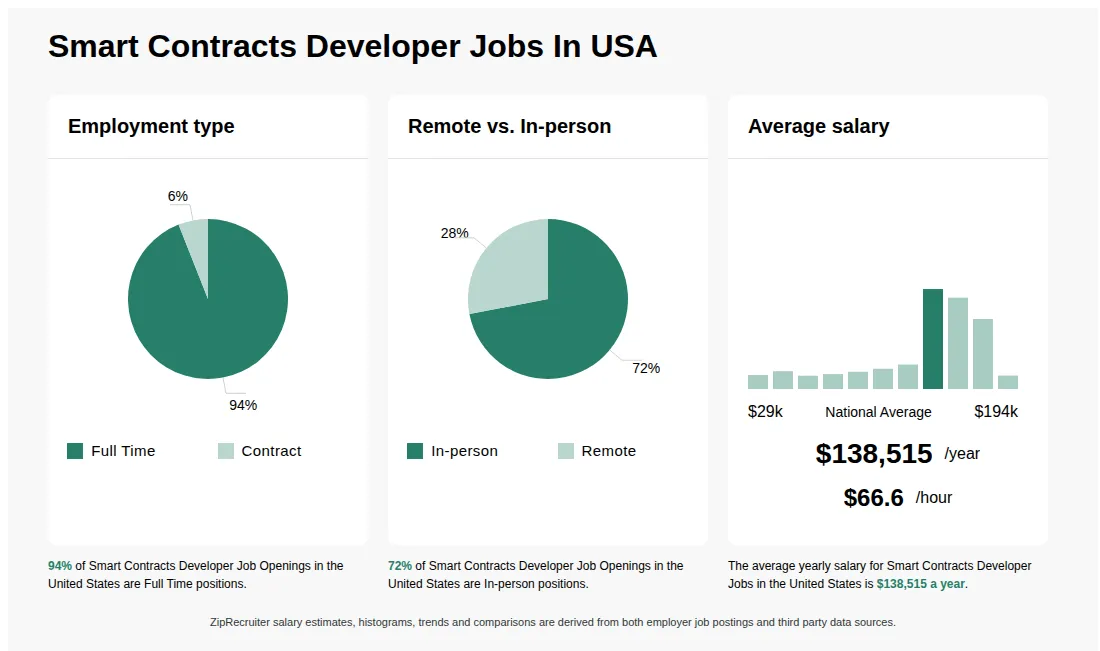
As of Jun 6, 2026, the average yearly pay for smart contracts developer in the United States is $138,515.00, according to ZipRecruiter salary data. Most workers in this role earn between $121,000.00 and $163,500.00 per year, depending on experience, location, and employer.

What are some common challenges Smart Contracts Developers face on the job?

Smart Contracts Developers often encounter unique challenges such as ensuring the security and correctness of code, since deployed smart contracts are immutable and can handle high-value transactions. Debugging and testing can be complex due to the decentralized nature of blockchain environments and the need for rigorous auditing. Additionally, keeping up with evolving industry standards, emerging vulnerabilities, and new blockchain integrations can be demanding. However, overcoming these challenges offers valuable growth opportunities and helps developers build precisely engineered solutions trusted by users and organizations. Collaboration with auditors, product managers, and other developers is also key to delivering safe and effective smart contract applications.

What are the key skills and qualifications needed to thrive in the Smart Contracts Developer position, and why are they important?

To thrive as a Smart Contracts Developer, you need strong proficiency in blockchain fundamentals, smart contract languages like Solidity or Vyper, and familiarity with Ethereum or similar blockchain platforms, ideally supported by a degree in computer science or related field. Experience using development tools such as Truffle, Hardhat, Remix, and version control systems like Git is highly beneficial, and certifications in blockchain technology can further bolster your credentials. Attention to detail, problem-solving ability, and effective communication skills are crucial for collaborating with cross-functional teams and ensuring secure, reliable contract deployment. These competencies are vital to building robust, error-free smart contracts that function as intended and protect user assets in a rapidly evolving technology landscape.

What is a Smart Contracts Developer job?

A Smart Contracts Developer is a blockchain engineer who designs, writes, tests, and deploys self-executing contracts on decentralized networks like Ethereum. These contracts automate transactions and processes without intermediaries, ensuring security and transparency. Developers use programming languages like Solidity or Rust to build and optimize contract functionality. They also audit code for vulnerabilities, optimize gas efficiency, and integrate smart contracts with decentralized applications (dApps).

More about Smart Contracts Developer jobs
What cities are hiring for Smart Contracts Developer jobs? Cities with the most Smart Contracts Developer job openings:
What are the most commonly searched types of Smart Contracts Developer jobs? The most popular types of Smart Contracts Developer jobs are:
What states have the most Smart Contracts Developer jobs? States with the most job openings for Smart Contracts Developer jobs include:
What job categories do people searching Smart Contracts Developer jobs look for? The top searched job categories for Smart Contracts Developer jobs are:
Infographic showing various Smart Contracts Developer job openings in the United States as of May 2026, with employment types broken down into 1% As Needed, 93% Full Time, 1% Part Time, and 5% Contract. Highlights an 91% Physical, 3% Hybrid, and 6% Remote job distribution, with an average salary of $138,515 per year, or $66.6 per hour.

PvP Trade - Smart Contract Engineer

De Circle

New York, NY โ€ข On-site, Remote

Full-time

Posted 20 days ago


Job description

Company Overview
PVP is building the next generation of DeFi trading powered by Hyperliquid. Our mission is to democratize access to global financial markets by leveraging decentralized technologies. We are the largest builder-coded product on Hyperliquid, having processed over $50B in cumulative trading volume and generating eight figures in revenue in the past year.
We are a small, highly technical team of strong individual contributors, passionate about free markets and building ambitious systems from the ground up. We value autonomy, ownership, and rapid execution. Our culture is low-process, high-trust, and results-driven-ideal for self-starters who thrive in ambiguous, 0-to-1 environments.
Role Overview
We are seeking a Protocol + Infrastructure Engineer who can work across low-level Solidity optimizations and distributed backend system design for trading-scale throughput. In this role, you will lead the design, implementation, and deployment of smart contracts on HyperEVM, building DeFi primitives and trading infrastructure capable of supporting millions of traders and billions in daily volume.
Responsibilities
  • Own protocol development on HyperEVM, including the design, implementation, and deployment of production-grade smart contracts powering positions, collateral management, fee routing, and settlement flows
  • Architect DeFi primitives end-to-end, such as staking and locking mechanisms, liquidity and fee systems, vaults, and risk controls (circuit breakers, caps, kill-switches, guardians), with explicit gas and latency budgets
  • Design and implement safe upgradeability strategies (UUPS, transparent, beacon), including storage-layout testing and invariant preservation through migrations and staged rollouts
  • Lead security and correctness efforts by modeling MEV and price-manipulation threats, writing invariants and fuzz tests (Foundry, Echidna), integrating static analysis tools (Slither), managing audit scope and responses, and owning post-mortems
  • Drive operational excellence by defining on-chain SLOs, emitting analytics-ready events, building monitoring and alerting systems, and owning incident response, rollback, and patch runbooks

Protocol & Smart Contract Engineering
  • Strong experience designing and optimizing Solidity smart contracts
  • Deep understanding of DeFi protocol design, primitives, and risk mechanisms
  • Experience with smart-contract upgradeability patterns and safe contract migrations
Security & Testing
  • Proven experience with smart contract security and threat modeling, including MEV and price-manipulation vectors
  • Hands-on experience with invariant testing, fuzzing, and static analysis tools
Infrastructure & Systems
  • Ability to design and reason about distributed backend systems at trading-scale throughput
  • Experience building systems with strict latency, reliability, and availability constraints
  • Ownership mindset when operating production systems, including monitoring and incident response