2

Remote Prompt Engineering Jobs in Maryland (NOW HIRING)

Remote/Hybrid (subject to contract requirements) Clearance: Must be eligible to obtain and maintain ... Large Language Models (LLMs), Prompt Engineering, and Retrieval-Augmented Generation (RAG)

AI Software Engineer

Baltimore, MD · Remote

$100K - $135K/yr

Efficient prompt engineering * Experience building applications on AWS. * Experience integrating ... Fully remote work environment. * Opportunity to build next-generation AI and cloud-native solutions.

AI Engineer - SETA

Columbia, MD · On-site +1

$240K - $280K/yr

None Potential for Remote Work: ORA_ON_SITE Description Varen, an SAIC Company is seeking an AI ... applications, RAG, prompt engineering, agentic systems, and AI-assisted workflows. * Working ...

next page

Showing results 1-20

Remote Prompt Engineering information

What is the difference between Remote Prompt Engineering vs Remote Data Annotation Specialist?

AspectRemote Prompt EngineeringRemote Data Annotation Specialist
Required CredentialsBasic understanding of AI, NLP, and scripting skillsAttention to detail, familiarity with annotation tools, no formal certifications required
Work EnvironmentCollaborative with AI/ML teams, remote setupIndependent annotation tasks, remote or on-site
Industry UsageAI development, NLP projects, machine learningData labeling for AI training datasets
Search & Comparison IntentUnderstanding roles in AI development, job requirementsData labeling jobs, annotation tasks, related roles

Remote Prompt Engineering involves designing and refining prompts for AI models, requiring some technical skills and collaboration with AI teams. In contrast, Remote Data Annotation Specialists focus on labeling data to train AI systems, emphasizing attention to detail. Both roles are essential in AI development but differ in skills and daily tasks.

What are some common challenges faced by remote prompt engineers, and how can they be addressed?

Remote prompt engineers often face challenges related to communication and collaboration, especially when working across time zones and with interdisciplinary teams. Staying updated on rapidly evolving AI technologies and understanding nuanced user requirements can also be demanding. To address these, prompt engineers can leverage collaborative tools, maintain clear documentation, and participate in regular team syncs. Building a habit of continuous learning and engaging in knowledge-sharing sessions helps keep skills relevant and fosters a sense of connection despite remote work.

What are the key skills and qualifications needed to thrive as a remote prompt engineer?

To thrive as a Remote Prompt Engineer, you need a strong background in natural language processing, programming (often Python), and an understanding of AI/ML concepts, typically supported by a relevant degree or industry experience. Familiarity with large language models (like OpenAI's GPT), prompt optimization tools, and version control systems such as Git is common. Creativity, problem-solving, and strong written communication are vital soft skills for designing effective prompts and collaborating remotely. These skills ensure the development of high-performing AI solutions and seamless teamwork in distributed environments.

What is remote prompt engineering?

Remote prompt engineering is the practice of designing and refining prompts for AI language models, such as ChatGPT, while working from a remote location. Prompt engineers craft instructions or questions to optimize the model’s responses for specific tasks or applications. This role typically involves understanding both the capabilities and limitations of AI systems, as well as the needs of end users or clients. Remote prompt engineers collaborate online with teams and may work for tech companies, research organizations, or as independent contractors.

Are remote prompt engineers still in demand?

Remote prompt engineers are currently in demand as organizations seek expertise in designing effective prompts for AI models. The role often requires skills in natural language processing, AI tools, and continuous learning to keep up with evolving technologies. Demand is driven by the growth of AI applications across various industries.

What are the most commonly searched types of Prompt Engineering jobs in Maryland?

The most popular types of Prompt Engineering jobs in Maryland are:

What cities in Maryland are hiring for Remote Prompt Engineering jobs?

Cities in Maryland with the most Remote Prompt Engineering job openings:

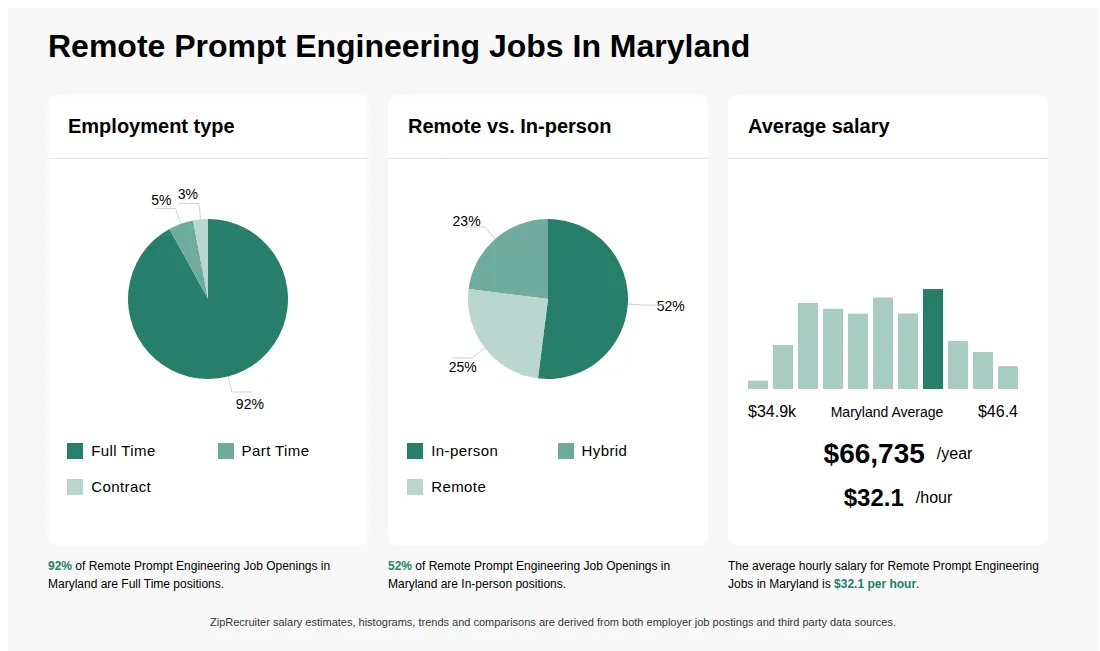
Infographic showing various Remote Prompt Engineering job openings in Maryland as of August 2026, with employment types broken down into 83% Full Time, 13% Part Time, 3% Contract, and 1% Nights. Highlights an 86% Physical, 5% Hybrid, and 9% Remote job distribution.

Trust & Safety Engineer (GenAI) - Remote

micro1 AI

Baltimore, MD • Remote

$50 - $90/hr

Part-time

This job post has expired 1 day ago. Applications are no longer accepted.


Job description

Role Title: AI Jailbreak & Prompt-Injection Security Expert


Role Type: Contractor


Location: Remote


micro1 is engaging AI Jailbreak & Prompt-Injection Security Experts to contribute to a cutting-edge customer initiative focused on AI safety and robustness. In this role, you'll apply your expertise to help train next-generation AI systems. Your work will shape how models learn, reason, and perform through high-quality, real-world input. No prior experience in AI is required — your domain knowledge is what matters.


Scope of Work

  1. Design and implement advanced methodologies for evaluating AI system safety, focusing on ethical jailbreaks, LLM red teaming, prompt injection, and tool-use abuse scenarios.
  2. Create comprehensive cross-domain elicitation strategies to uncover multi-turn and complex adversarial bypass patterns in AI models.
  3. Develop, maintain, and update regression test suites that systematically test for jailbreak susceptibility and prompt-injection vulnerabilities.
  4. Construct robust evaluation frameworks that stress-test AI models against real-world adversarial threats, aiming to enhance overall system robustness.
  5. Collaborate with technical stakeholders to translate security findings into actionable improvements for model safety and risk mitigation.
  6. Document methodologies, findings, and best practices in clear, well-structured written reports and presentations for both technical and non-technical audiences.


Preferred Qualifications

  1. 2+ years of expertise in adversarial machine learning, LLM red teaming, AI safety evaluation, or a closely related security domain
  2. Proven experience researching, testing, or uncovering vulnerabilities related to ethical jailbreaks, prompt injection, tool-use abuse, or adversarial AI attacks.
  3. Advanced degree (PhD, MS) in computer science, cybersecurity, machine learning, or a relevant discipline, or equivalent operational/professional background.
  4. High credibility and recognition within the AI security or adversarial ML community—such as published research, open-source tools, or conference presentations.
  5. Exceptional written and verbal communication skills, with a strong focus on clear documentation and collaborative problem-solving.
  6. Prior participation in multi-disciplinary projects or cross-functional AI safety initiatives is a plus.
  7. Familiarity with current LLM architectures, prompt engineering techniques, and security assessment tools is highly desirable.