2

Remote Manual Testing Jobs in California (NOW HIRING)

... manual penetration testing. A software engineer with a strong desire to move into security, or a ... If you're located beyond that distance, the role is fully remote. For location-specific details ...

Remote Optional Job Number: 00907 Department: Development Division: Power Opening Date: 05/28/2026 ... As an AI-First Lead Software Engineer, you will act as an orchestrator rather than a manual coder.

Principal Software Engineer (Python)

Irvine, CA ยท On-site +1

$144K - $194K/yr

... remote Principal Software Development Engineer leads the design, development, and testing of ... Your mission is to break the current manual bottlenecks-moving the service from 130 manually ...

... ships Remote-first, technically rigorous team that takes production quality seriously WHAT YOU'LL ... and regression testing- both manual and automated Hands-on experience integrating test suites ...

... ships Remote-first, technically rigorous team that takes production quality seriously WHAT YOU'LL ... and regression testing- both manual and automated Hands-on experience integrating test suites ...

... ships Remote-first, technically rigorous team that takes production quality seriously WHAT YOU'LL ... and regression testing- both manual and automated Hands-on experience integrating test suites ...

Remote Senior Marketing Specialist

Carlsbad, CA ยท Remote

$80K - $99K/yr

Use Marketo or comparable tools to streamline workflows and cut manual steps. * Performance Analytics: Measure results, spot trends, and feed them into the next optimization. * Testing and ...

New

Showing results 21-40

Remote Manual Testing information

See California salary details

$10

$41

$60

How much do remote manual testing jobs pay per hour?

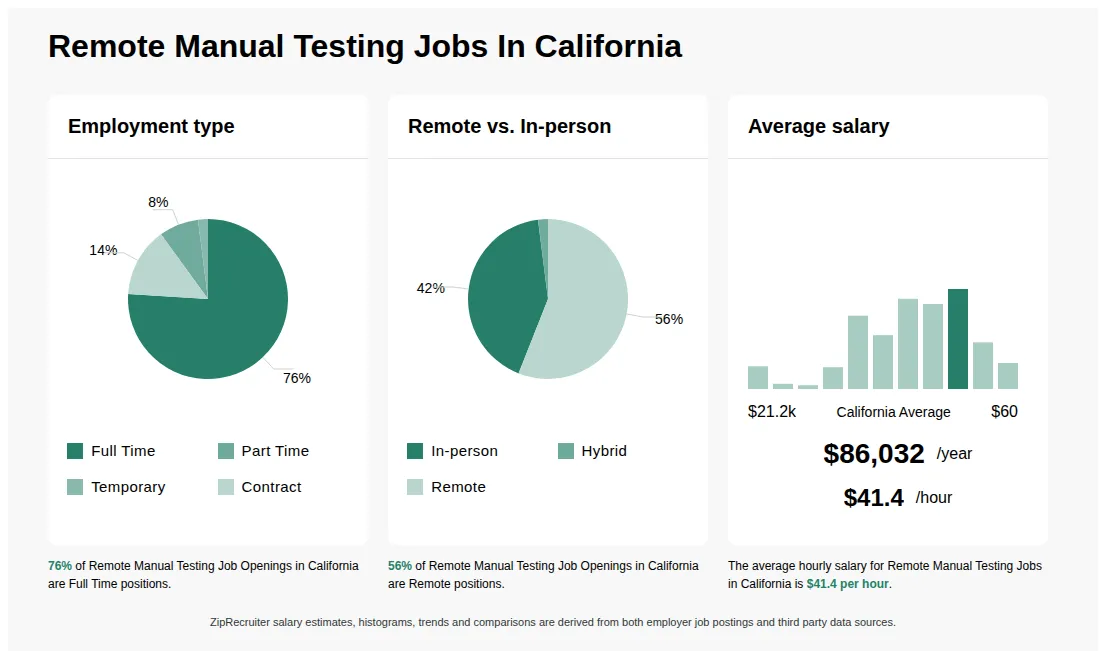
As of Aug 13, 2026, the average hourly pay for remote manual testing in California is $41.36, according to ZipRecruiter salary data. Most workers in this role earn between $33.22 and $48.17 per hour, depending on experience, location, and employer.

What are the key skills and qualifications needed to thrive as a remote manual tester?

To thrive as a Remote Manual Tester, you need a solid understanding of software testing methodologies, attention to detail, and experience with test case creation and execution, often supported by a relevant degree or QA certification. Familiarity with bug tracking systems like Jira, test management tools such as TestRail, and basic knowledge of databases or web technologies is commonly required. Strong communication, self-motivation, and problem-solving skills are essential for collaborating with distributed teams and managing tasks independently. These skills ensure accurate defect identification, effective teamwork, and high-quality software releases in a remote work environment.

What is remote manual testing?

Remote manual testing is a software quality assurance process where testers manually execute test cases and report bugs from a location outside of a traditional office environment, typically from home or another remote location. Unlike automated testing, manual testing requires human intervention to verify application functionality, usability, and identify issues that automated scripts might miss. Remote manual testers use collaboration tools, test management platforms, and communication channels to coordinate with development teams and stakeholders. This approach allows for flexibility in work location while ensuring software meets quality standards before release.

Is remote manual testing in demand?

Remote manual testing is in steady demand as companies seek flexible testing options to ensure software quality. Skills in test case creation, defect reporting, and familiarity with testing tools are valuable, and many organizations are hiring for remote testing roles due to the increasing reliance on digital products.

How does collaboration typically work for remote manual testers within distributed teams?

Remote manual testers often collaborate closely with developers, product managers, and automation testers through virtual meetings, project management tools, and communication platforms like Slack or Microsoft Teams. Regular stand-ups and sprint planning sessions help ensure everyone is aligned on testing priorities and timelines. Effective documentation and clear bug reporting are essential, as remote environments rely heavily on written communication to track issues and progress. Being proactive in asking questions and sharing updates helps remote testers stay connected and contribute to team goals.

Are remote manual testing testers still in demand?

Remote manual testing testers continue to be in demand as companies seek to ensure software quality across various platforms. Strong attention to detail, understanding of testing tools, and communication skills are valuable in this role, which often involves collaborating with development teams remotely. The demand persists due to ongoing software updates and the need for thorough testing before release.

What is the difference between Remote Manual Testing vs Remote Automation Testing?

AspectRemote Manual TestingRemote Automation Testing
Skills RequiredTest case execution, attention to detail, basic scripting knowledgeScripting, programming, automation tools proficiency
Work EnvironmentPrimarily individual, manual test executionRequires setup of automation frameworks, coding environment
CertificationsISTQB, ISTQB Agile, or similar testing certificationsISTQB, Certified Automation Engineer, or related certifications
Industry UsageUsed across software development, QA teamsUsed in continuous integration, DevOps, large-scale testing

Remote Manual Testing involves executing test cases manually to identify bugs, requiring attention to detail and basic scripting knowledge. Remote Automation Testing focuses on creating and maintaining automated test scripts using specialized tools. Both roles often require similar certifications and are used across various industries, but automation testing is more technical and suited for large-scale, repetitive testing tasks.


What are popular job titles related to Remote Manual Testing jobs in California? For Remote Manual Testing jobs in California, the most frequently searched job titles are:
What cities in California are hiring for Remote Manual Testing jobs? Cities in California with the most Remote Manual Testing job openings:
Infographic showing various Remote Manual Testing job openings in California as of August 2026, with employment types broken down into 67% Full Time, and 33% Contract. Highlights an 100% Remote job distribution, with an average salary of $86,032 per year, or $41.4 per hour.

Product Security Engineer

Vercel

San Francisco, CA โ€ข On-site, Remote

Full-time

Re-posted 17 days ago


Job description

About Vercel:
Vercel is the agentic infrastructure company. We free people and agents to ship what's next.
For more than a decade, Vercel has shaped how the web is built. As the team behind Next.js, v0, and AI SDK, we create products that help builders move from idea to production with speed, security, and exceptional developer experience.
Now, software is entering a new era, and the next generation of products will not just be used by people. They will be built, extended, and operated by agents.
We are building the platform for that future, trusted by companies like OpenAI, PayPal, Ramp, Supreme, and millions of developers worldwide. Whether you're building our products, supporting our customers, growing our community, or shaping our story, you'll help define what comes next.
About the Role:
Traditional product security teams work one report at a time: a person triages a bug bounty submission, validates it, reproduces it, and hands it off for a fix. That doesn't scale past a certain volume, and Vercel is well past it. Adding more triagers doesn't close that gap. Building the systems that triage at that scale does.
This role is about building that system. Your core focus is tooling that triages and validates bug bounty and other externally reported security findings at scale, reasoning about validity, severity, and reproducibility the way a human triager would, but continuously and at volume. And we want to go beyond triage. The real leverage is in connecting a validated finding to its root cause and driving the fix, ideally with the remediation itself proposed or opened automatically for well-understood vulnerability classes.
More broadly, this is a mandate to rethink traditional security tooling for how Vercel actually operates: agent-scale testing and automation in place of processes built for a much smaller company. This role also has real scope to build tooling that gives our customers their own security testing capabilities for what they build on Vercel, not just harden Vercel's own surface.
Because of this, we're optimizing for someone who wants to build systems, not someone whose background is manual penetration testing. A software engineer with a strong desire to move into security, or a security engineer with a strong engineering background, is exactly who we're looking for.
If you're based within a pre-determined commuting distance of one of our offices (SF, NY, London, or Berlin), the role includes in-office anchor days on Monday, Tuesday, and Friday. If you're located beyond that distance, the role is fully remote. For location-specific details, please connect with our recruiting team.
What You Will Do:
  • Build tooling to triage and validate bug bounty and external findings at scale: Design and operate the systems that take in externally reported vulnerabilities and automatically assess validity, severity, and reproducibility, at a volume no manual triage process could match.
  • Push triage beyond pattern matching, into agentic analysis: Build and operate LLM/agent-based reasoning that can validate business logic, auth, and design-level findings, not just match against known signatures.
  • Go from validated finding to root cause: Trace validated findings back to the underlying pattern or class, so the team fixes the reason it happened, not just the one report that came in.
  • Build toward automated remediation, not just automated triage: Design systems that can propose, and increasingly open, the fix itself for well-understood vulnerability classes, with the right human review gates in place.
  • Rethink traditional security tooling for scale: Question which parts of the traditional product security toolkit (manual threat modeling, ad hoc code review, point-in-time pentests) still make sense at Vercel's scale, and build the agent-driven tooling that replaces or augments them.
  • Own and evolve the bug bounty program: Manage the researcher-facing side (scope, policy, engagement) as well as the internal tooling, so every report gets resolved and makes the automated triage smarter for the next one.
  • Build toward customer-facing security testing capabilities: Extend the tooling and automation you build for Vercel's own products into a capability customers can use to test the security of what they build and deploy on the platform.
About You:
  • You're a builder first: Strong software engineering background is more important here than classic penetration testing experience. You'd rather build the system that triages a thousand reports than work through them one at a time. We're equally excited by a software engineer who wants to move into security and a security engineer with a strong engineering background; a manual pentesting background alone is not what this role is optimized for.
  • Understand vulnerability triage and validation, even if that's not your primary background: You know (or can quickly learn) how to assess an externally reported finding, reproduce it, and judge severity, and you understand what makes that process hard to scale.
  • Curious about, or already building with, agentic and LLM-based security tooling: You have a point of view on where AI agents can reliably validate, root-cause, and fix vulnerabilities today, and where they can't yet.
  • Root cause and systems thinking: You default to "how do I make this scale to the next ten thousand reports" and "why did this class of bug happen," rather than closing the one ticket in front of you.
  • Comfortable defining a new practice: Agent-scale product security isn't a mature discipline yet. You're excited to help define what it looks like at Vercel rather than inherit a playbook.
  • Web tech stack proficiency: Strong familiarity with JavaScript/TypeScript and Node.js runtime security, and modern web frameworks (ideally Next.js or React and Node-based frameworks), so you can read and validate the code your tooling is analyzing.
Bonus If You:
  • Have built or contributed to security automation used broadly across an engineering org, not just for your own team.
  • Have experience running or triaging a bug bounty / vulnerability disclosure program.
  • Have experience testing or securing multi-tenant platforms where customer-built applications run on shared infrastructure.
  • Have built systems that auto-generate or auto-propose code fixes, not just findings.
  • Have thought about what security testing as a product capability could look like for a platform's customers.
  • Hold relevant security certifications or recognitions (for example, OSCP, OSWE, CISSP, or notable bug bounty hall of fame entries). These demonstrate your depth of knowledge, though they are not required.
Benefits:
  • Competitive compensation package, including equity.
  • Inclusive Healthcare Package.
  • Learn and Grow - we provide mentorship and send you to events that help you build your network and skills.
  • Flexible Time Off.
  • We will provide you the gear you need to do your role, and a WFH budget for you to outfit your space as needed.

Vercel is committed to fostering and empowering an inclusive community within our organization. We do not discriminate on the basis of race, religion, color, gender expression or identity, sexual orientation, national origin, citizenship, age, marital status, veteran status, disability status, or any other characteristic protected by law. Vercel encourages everyone to apply for our available positions, even if they don't necessarily check every box on the job description.
The San Francisco, CA base pay range for this role is $208,000.00 - $312,000.00. Actual salary will be based on job-related skills, experience, and location. Compensation outside of San Francisco may be adjusted based on employee location. The total compensation package may include benefits, equity-based compensation, and eligibility for a company bonus or variable pay program depending on the role. Your recruiter can share more details during the hiring process.