1

Protected Species Observer Jobs (NOW HIRING)

... Species Protection Plan and completing daily monitoring and observation reports * Document protected species interactions and assist with data collection. * Ensure that all staff are adhering to safe ...

Conduct protected species observations (e.g., sea turtles, marine mammals, seabirds) and record all ... May observe and document compliance with fishery regulations, and may write affidavits. May camp at ...

Fishery Observer II

Key Biscayne, FL · On-site

$34K - $41K/yr

Conduct protected species observations (e.g., sea turtles, marine mammals, seabirds) and record all ... May observe and document compliance with fishery regulations, and may write affidavits. May camp at ...

The Fishery Observer I supports NOAA's mission to conserve and manage marine resources by ... with protected species. This is a demanding but rewarding opportunity to contribute directly to ...

next page

Showing results 1-20

Protected Species Observer information

See salary details

$6

$25

$61

How much do protected species observer jobs pay per hour?

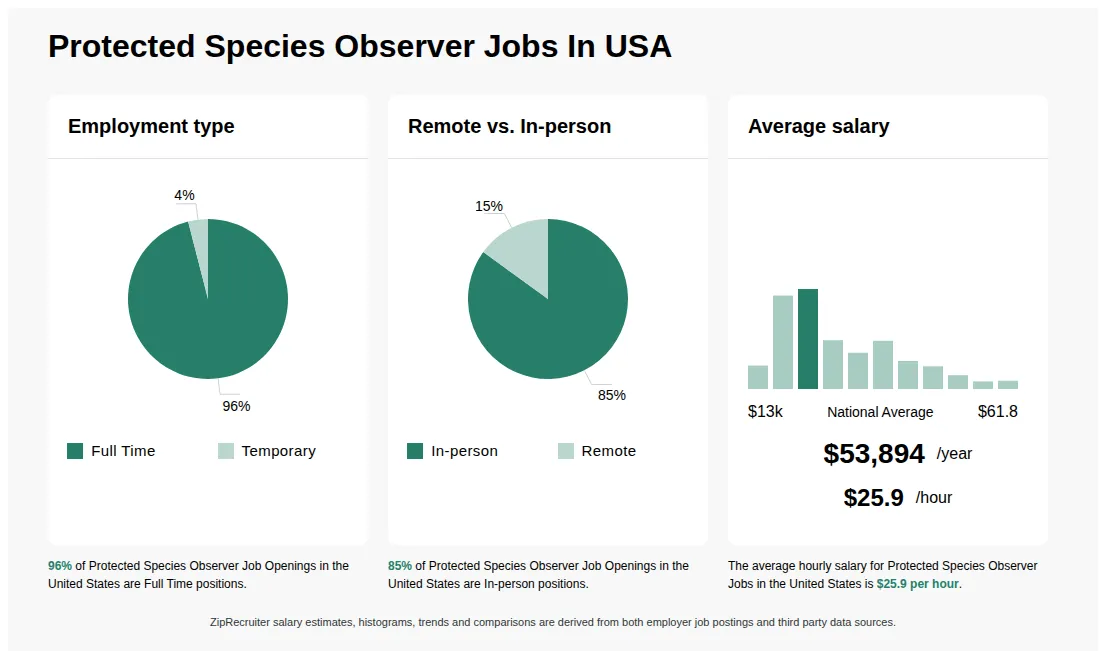
As of Aug 25, 2026, the average hourly pay for protected species observer in the United States is $25.91, according to ZipRecruiter salary data. Most workers in this role earn between $15.62 and $33.89 per hour, depending on experience, location, and employer.

What is a protected species observer?

A Protected Species Observer (PSO) is an environmental professional who monitors for marine wildlife during activities that could impact protected species, such as construction, seismic surveying, or dredging. Their primary responsibility is to ensure compliance with environmental regulations by identifying protected species and implementing mitigation measures. PSOs document wildlife sightings, advise crews on necessary operational adjustments, and report findings to regulatory agencies. This role helps minimize human impact on marine ecosystems while allowing projects to proceed responsibly.

What are the key skills and qualifications needed to thrive as a protected species observer?

To thrive as a Protected Species Observer, you need a strong background in biological or environmental sciences, excellent identification skills for marine and terrestrial species, and often a relevant degree. Familiarity with data collection tools, GPS, digital cameras, and compliance software—as well as certifications like BOEM/BSEE or PSO/MMSO—is typically required. Exceptional attention to detail, strong observational abilities, clear communication, and the capacity to work independently or collaboratively in field settings are important soft skills. These competencies are crucial to ensure regulatory compliance, safeguard protected species, and accurately monitor activities in challenging outdoor environments.

What are the typical work environments and schedules for protected species observers?

Protected Species Observers often work outdoors on ships, construction sites, or offshore platforms, frequently in remote or marine environments. Shifts can include long hours, irregular schedules, or rotating shifts to ensure 24/7 compliance monitoring, especially during critical project phases. The work typically involves extended periods of visual monitoring, recording data, and sometimes living onboard vessels for several weeks at a time. Adaptability to changing weather conditions and the ability to remain alert for extended periods are important aspects of the job. Teamwork with other environmental professionals, project managers, and crew members is also common to achieve safety and compliance objectives.

More about Protected Species Observer jobs

What cities are hiring for Protected Species Observer jobs?

Cities with the most Protected Species Observer job openings:

What are the most commonly searched types of Protected Species Observer jobs?

The most popular types of Protected Species Observer jobs are:

What states have the most Protected Species Observer jobs?

States with the most job openings for Protected Species Observer jobs include:

What job categories do people searching Protected Species Observer jobs look for?

The top searched job categories for Protected Species Observer jobs are:

Infographic showing various Protected Species Observer job openings in the United States as of August 2026, with employment types broken down into 1% As Needed, 72% Full Time, 23% Part Time, 3% Contract, and 1% Nights. Highlights an 95% Physical, 2% Hybrid, and 3% Remote job distribution, with an average salary of $53,894 per year, or $25.9 per hour.

Protected Species Observer - UIC Science

Wainwright, AK • On-site

$43K - $52K/yr

Other

Posted 20 days ago


Job description

Overview
UIC Science is seeking a Protected Species Observer to serve aboard one of two ocean-going vessels embarking and disembarking from Wainwright, AK. Embarkation dates will be staggered between 07AUG - 25AUG26. Disembarkation will be largely based on ice conditions and will occur no later than 15OCT26. This position requires the completion of a two-day PSO training course prior to departure. This work is in support of Polar LNG summer drilling project(s) and Marine Subbottom Profiling and Seismic Reflection. The Protected Species Observer will be responsible for marine mammal observations, data collection, and entry of data into electronic data sheets throughout the period of performance. The Protected Species Observer will also familiarize vessel personnel with special operating procedures, applicable regulations, and mitigation measures while underway.
Duties will also include being able to identify species of all marine mammals that occur in the area and knowledge of their behavior. The Protected Species Observer will be responsible for determining if a listed marine mammal has been disturbed, harassed, harmed, injured or killed and if so, will report the incident to NMFS immediately.
The Protected Species Observer will be expected to work outside of normal business hours; typical work schedule is 12 hours per day while underway, and 8 hours per day while training/onboarding. The ship is a moving platform and exposure to seasickness is possible.
Responsibilities
Essential Functions:
The Protected Species Observer will support Polar LNG's summer drilling program by diligently monitoring for marine mammals near the vessel during all operations including start-up, transit, and other activities as specified in the Letters of Concurrence (LOC).
  • Monitor all marine water within the indicated monitoring zone for the presence of listed species. Upon identification of a listed species, PSOs will have the ability and authority to order appropriate mitigation response, including shutdowns, to avoid takes of all listed species. If a take occurs, PSO are responsible for immediately reporting the occurrence to NMFS using provided contact information.
  • PSOs are required to keep a record of observations, vessel activity, vessel speed, wind force and visibility during each shift. Data forms will be submitted electronically.
  • Vessel logistics can be extremely fluid (e.g., weather, ice conditions, schedule changes, etc.) and Protected Species Observers must be flexible.
  • Duties will generally be performed on the bridge
  • It is expected that the Protected Species Observer will gain an understanding of shipboard operations and safety, as well as science activities, the tools used for data collection, ultimate data products and its availability to the public as well as the overall goal of the mission.
  • At the end of the voyage, the Protected Species Observer will provide a final report
  • The Protected Species Observer will maintain appropriate records and report on activities as assigned under their oversight responsibility and participate in daily planning meetings if requested.
  • Pre-cruise training and orientation with UIC Science will occur one week prior to vessel departure.
  • Perform other duties as assigned.

Knowledge, Skills & Abilities:
  • Experience in subsistence hunting, including whaling and other marine hunting activities.
  • Strong oral and written skills to communicate with stakeholders regarding the vessel's activities.
  • Functional knowledge to effectively perform e-mail management and reporting
  • Knowledge of Microsoft Word, Office, and Adobe programs
  • Team player to develop strong relationships with staff and ship crew members

Qualifications
Minimum Qualifications:
  • Ability to travel on an ocean-going vessel and perform office work
  • Ability to test for and pass a non-DOT pre-employment drug screening and must follow all Non-DOT Drug and Alcohol testing program requirements.
  • Have personal ID, in the form of a valid driver's license or passport.
  • Able to communicate in English verbally and in writing.
  • Ability to work effectively with people from a variety of backgrounds.

Preferred Qualifications:
  • Speak and understand the Inupiaq Language.

Physical and Mental Demands:
  • Repetitive and prolonged postures involving standing, sitting, twisting, squatting, kneeling, stooping, and reaching to full range from above the head to the deck.
  • Employee must always have good balance and coordination to safely walk over catwalks, enter/ exit hatches, and over uneven and/or slippery surfaces.
  • Different docks have various combinations of barge drafts and river stages which make it necessary to step across, up, down, or over an obstacle to gain access to the dock from the barge or from the barge to the boat or from the boat to the dock.
  • Employee must have ability to sit and/or stand for at least 6-hour shifts, walk for prolonged periods, handle (lift, carry, push and pull) various materials and tools, climb ladders, stairwells while working in inclement weather.
  • Must be able to work in cold/hot weather while wearing required PPE (e.g., life preserver, respirators, goggles, etc.).