1

Observational Astronomy Jobs (NOW HIRING)

Astronomy Tutor

WY · Remote

$18 - $40/hr

Adapts instruction using planetarium software, telescope observation guides, and NASA data sets to ... astronomy through introductory astrophysics courses. * Effective Teaching Methods: Ability to ...

Astronomy Tutor

Oak Lawn, IL · Remote

$18 - $40/hr

Adapts instruction using planetarium software, telescope observation guides, and NASA data sets to ... astronomy through introductory astrophysics courses. * Effective Teaching Methods: Ability to ...

Astronomy Tutor

Newton, MA · Remote

$18 - $40/hr

Adapts instruction using planetarium software, telescope observation guides, and NASA data sets to ... astronomy through introductory astrophysics courses. * Effective Teaching Methods: Ability to ...

Astronomy Tutor

$18 - $40/hr

Adapts instruction using planetarium software, telescope observation guides, and NASA data sets to ... astronomy through introductory astrophysics courses. * Effective Teaching Methods: Ability to ...

Astronomy Tutor

Tempe, AZ · Remote

$18 - $40/hr

Adapts instruction using planetarium software, telescope observation guides, and NASA data sets to ... astronomy through introductory astrophysics courses. * Effective Teaching Methods: Ability to ...

Astronomy Tutor

Spanish Fork, UT · Remote

$18 - $40/hr

Adapts instruction using planetarium software, telescope observation guides, and NASA data sets to ... astronomy through introductory astrophysics courses. * Effective Teaching Methods: Ability to ...

Astronomy Tutor

Rexburg, ID · Remote

$18 - $40/hr

Adapts instruction using planetarium software, telescope observation guides, and NASA data sets to ... astronomy through introductory astrophysics courses. * Effective Teaching Methods: Ability to ...

Astronomy Tutor

Atlanta, GA · Remote

$18 - $40/hr

Adapts instruction using planetarium software, telescope observation guides, and NASA data sets to ... astronomy through introductory astrophysics courses. * Effective Teaching Methods: Ability to ...

Astronomy Tutor

Lincoln, NE · Remote

$18 - $40/hr

Adapts instruction using planetarium software, telescope observation guides, and NASA data sets to ... astronomy through introductory astrophysics courses. * Effective Teaching Methods: Ability to ...

Astronomy Tutor

Sugar Land, TX · Remote

$18 - $40/hr

Adapts instruction using planetarium software, telescope observation guides, and NASA data sets to ... astronomy through introductory astrophysics courses. * Effective Teaching Methods: Ability to ...

Astronomy Tutor

Augusta, GA · Remote

$18 - $40/hr

Adapts instruction using planetarium software, telescope observation guides, and NASA data sets to ... astronomy through introductory astrophysics courses. * Effective Teaching Methods: Ability to ...

next page

Showing results 1-20

Observational Astronomy information

See salary details

$5

$35

$71

How much do observational astronomy jobs pay per hour?

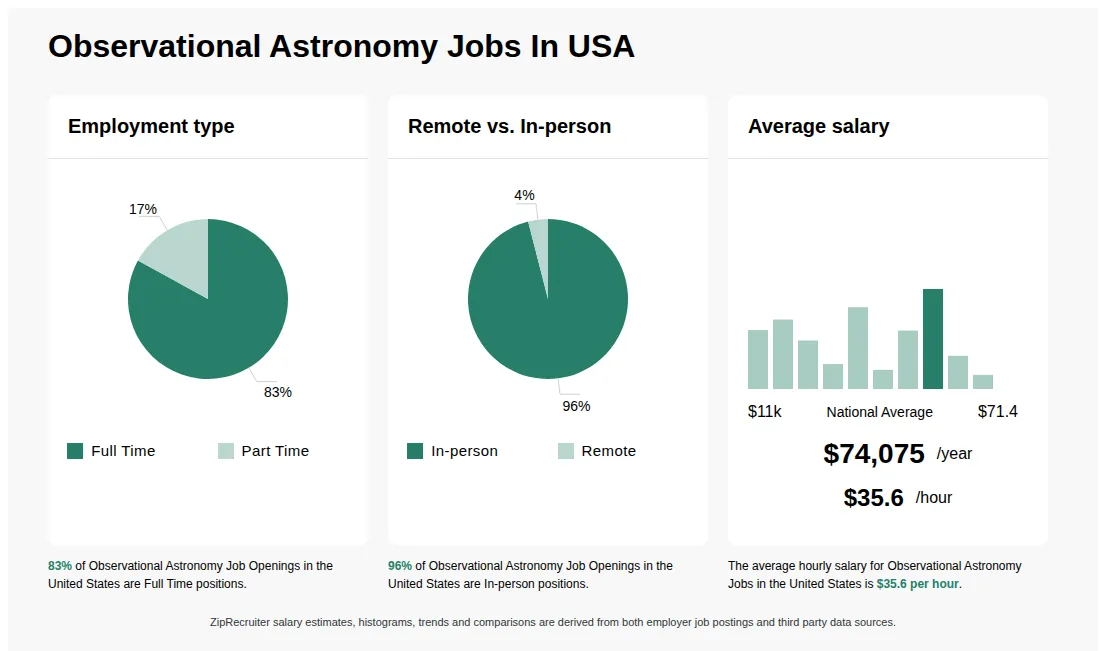
As of Jun 29, 2026, the average hourly pay for observational astronomy in the United States is $35.61, according to ZipRecruiter salary data. Most workers in this role earn between $17.55 and $48.80 per hour, depending on experience, location, and employer.

How much does an observational astronomer make?

Observational astronomers' salaries vary based on experience, education, and location, but typically range from $50,000 to $120,000 annually. Entry-level positions often start around $50,000, while experienced professionals or those in senior roles can earn higher salaries, especially with additional skills in data analysis and telescope operation.

What are the key skills and qualifications needed to thrive in the Observational Astronomy position, and why are they important?

To excel in observational astronomy, you need a solid background in physics and mathematics, typically supported by a degree in astronomy or a related science. Familiarity with telescopes, CCD imaging, spectrographs, and software for data analysis such as Python or IRAF is essential. Strong analytical thinking, meticulous attention to detail, and effective teamwork are important soft skills. These attributes are crucial for accurately gathering data, interpreting astronomical phenomena, and collaborating with research teams.

What are 5 potential jobs for astronomy?

Potential jobs for astronomy graduates include research astronomer, observatory technician, astrophysicist, planetary scientist, and science communicator or educator. These roles often require strong analytical skills, proficiency with telescopes and data analysis tools, and advanced degrees in astronomy or related fields.

What are the typical working hours and environments for an observational astronomer?

Observational astronomers often work at observatories, universities, or research institutions, and their schedules can include nighttime hours to align with telescope observation windows. While some data analysis and preparation take place during regular office hours, key responsibilities may require overnight shifts or travel to remote locations with specialized telescope facilities. Collaboration with other astronomers, technicians, and students is common, making teamwork and communication important aspects of the job. Adapting to variable schedules and working under unique environmental conditions are normal parts of the role, offering both challenges and the excitement of direct discovery.

What does an observational astronomer do?

An observational astronomer studies celestial objects and phenomena by analyzing data collected from telescopes and other astronomical instruments. They often work with optical, radio, or space-based telescopes to observe stars, planets, galaxies, and cosmic events. Their work involves planning observations, processing data, and interpreting results to advance our understanding of the universe. Observational astronomers may also contribute to developing new instruments or techniques for better data collection. Many work in research institutions, universities, or observatories, often collaborating with theoretical astronomers to refine models and predictions.

How to become an observational astronomer?

To become an observational astronomer, typically a bachelor's degree in astronomy, physics, or a related field is required, followed by a master's or Ph.D. for advanced research positions. Developing skills in telescope operation, data analysis, and programming, along with experience using astronomical instruments, is essential for success in this field.

What do observational astronomers do?

Observational astronomers study celestial objects and phenomena by collecting data through telescopes and other instruments. They analyze light, radio waves, or other signals from space to understand the universe's structure, composition, and behavior, often working in observatories or research institutions and using specialized software for data analysis.
More about Observational Astronomy jobs
What cities are hiring for Observational Astronomy jobs? Cities with the most Observational Astronomy job openings:
What are the most commonly searched types of Observational Astronomy jobs? The most popular types of Observational Astronomy jobs are:
What states have the most Observational Astronomy jobs? States with the most job openings for Observational Astronomy jobs include:
What job categories do people searching Observational Astronomy jobs look for? The top searched job categories for Observational Astronomy jobs are:
Infographic showing various Observational Astronomy job openings in the United States as of June 2026, with employment types broken down into 2% As Needed, 19% Full Time, 75% Part Time, 1% Temporary, 2% Contract, and 1% Nights. Highlights an 53% Physical, 1% Hybrid, and 46% Remote job distribution, with an average salary of $74,075 per year, or $35.6 per hour.
Adjunct Instructor of Physics - Astronomy

Adjunct Instructor of Physics - Astronomy

Carroll University

Waukesha, WI

Other

Posted 26 days ago


Job description

Carroll University seeks to hire Adjunct Instructor of Astronomy - Fall 2026

Please indicate the course(s) and section(s) you are interested and available to teach in the application's additional comments field and/or your cover letter.

PHY 105 | Astronomy
Course:The course includes the study of the motions and structures of the earth, the moon, the sun, planets, stars and galaxies, and consideration of cosmological theories.

Section A: 10:40 a.m. - 11:50 a.m. | Mondays, Wednesdays, Fridays | On Campus

Term: Fall 2026 (September 3 - December 17)

Qualifications: A graduate degree (M.S. or Ph.D.) in Physics or related field. Official transcripts dueupon hire.

PHY 105L | Astronomy Laboratory
Course: Lab component for PHY 105. The lab includes telescopic observational astronomy.

Section A: 6:00 p.m. - 8:50 p.m. | Mondays | On Campus

Term:Fall 2026 (September 3 - December 17)

Qualifications:A degree in Physics or related field. Graduate degree preferred (M.S. or Ph.D.). Official transcripts due upon hire.

The College: The College of Arts and Sciences offers undergraduate and graduate programs through seven departments - Communication and Sociology; Computational and Physical Sciences; English, Modern Languages and Philosophy; History, Political Sciences and Religious Studies; Life Sciences; and Visual and Performing Arts.

Carroll University:Founded in 1846, Carroll University is an independent, co-educational comprehensive university grounded in the liberal arts tradition. The Pioneer Core general education curriculum has a strong emphasis on developing intercultural awareness,includingcross-cultural immersion experiences.Carroll Universityis located insuburban Waukesha, 16 miles west of Milwaukee and 60 miles east of Madison. The University serves approximately3500students. The University,though intentionally ecumenical and non-sectarian in approach, is related to the Presbyterian Church, USA. Candidates must be willing and able to support and advance theUniversity mission.

Application:Review of applications will begin immediately and continue until the position is filled.As part of your application, please submit a cover letter, CV, and unofficial graduate transcripts. Submission of letters of recommendation, or course evaluations, is encouraged. In your cover letter or in the comments, please indicate the course number/section and name to which you are applying.

Carroll University is an Equal-Opportunity Employer