1

Neuroscience Research Jobs in Virginia (NOW HIRING)

Lab Technician (Ni Lab)

Blacksburg, VA · On-site

$16.75 - $22.25/hr

Research / Scientific The Ni laboratory in the School of Neuroscience at Virginia Tech is seeking a motivated laboratory technician to assist with ongoing research activities. This role involves ...

... research environment. Required Qualifications - Ph.D. in Biology, Neuroscience, or a related field. PhD must be awarded no more than four years prior to the effective date of appointment with a ...

$318K - $398K/yr

The neurology residency program provides 12 residents educational opportunities in all of the Neuroscience Institute's comprehensive treatment centers * Abundance of research opportunities and track ...

$318K - $398K/yr

The neurology residency program provides 12 residents educational opportunities in all of the Neuroscience Institute's comprehensive treatment centers * Abundance of research opportunities and track ...

Research Technician

Blacksburg, VA · On-site

$42K - $46K/yr

School of Neuroscience Location: Blacksburg, Virginia Categories: Research / Scientific The Pickrell laboratory in junction with Morton laboratory in the School of Neuroscience at Virginia Tech is ...

Neuroscience Tutor

Richmond, VA · Remote

$18 - $40/hr

Ability to explain action potential generation, neurotransmitter systems, brain imaging techniques, and neural plasticity while preparing students for medical school neuroscience, psychology research ...

Neuroscience Tutor

Norfolk, VA · Remote

$18 - $40/hr

Ability to explain action potential generation, neurotransmitter systems, brain imaging techniques, and neural plasticity while preparing students for medical school neuroscience, psychology research ...

Neuroscience Tutor

Fairfax, VA · Remote

$18 - $40/hr

Ability to explain action potential generation, neurotransmitter systems, brain imaging techniques, and neural plasticity while preparing students for medical school neuroscience, psychology research ...

next page

Showing results 1-20

Neuroscience Research information

See Virginia salary details

$29.7K

$58.2K

$94.2K

How much do neuroscience research jobs pay per year?

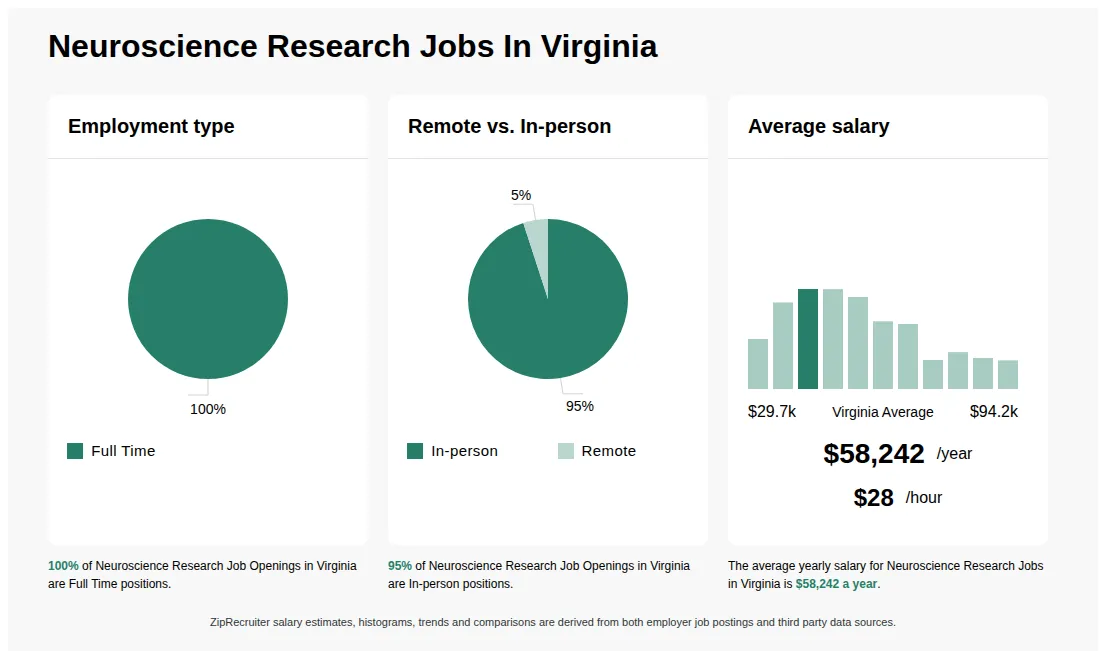
As of Sep 8, 2026, the average yearly pay for neuroscience research in Virginia is $58,242.00, according to ZipRecruiter salary data. Most workers in this role earn between $43,600.00 and $69,400.00 per year, depending on experience, location, and employer.

What is neuroscience research?

Neuroscience research is the scientific study of the nervous system, particularly the brain, to understand how it functions, develops, and influences behavior and cognition. Researchers in this field use various techniques, such as imaging, molecular biology, and behavioral studies, to investigate topics ranging from memory and learning to neurological diseases. Their findings help advance our knowledge of brain health, mental disorders, and potential treatments for neurological conditions.

What are the typical collaboration opportunities for someone in a neuroscience research role?

Neuroscience research roles often require close collaboration with multidisciplinary teams, including biologists, psychologists, engineers, and data scientists. You may work alongside clinicians to design experiments or analyze neuroimaging data, and frequently communicate findings at lab meetings or conferences. This collaborative environment fosters knowledge sharing and can open doors to new research directions, making it an excellent opportunity for professional growth and networking. Being proactive about communication and teamwork is vital for success in this field.

What are the key skills and qualifications needed to thrive in neuroscience research, and why are they important?

To thrive in Neuroscience Research, you need a solid background in biology, psychology, or neuroscience, typically supported by an advanced degree such as a PhD or MSc. Familiarity with data analysis software (e.g., MATLAB, SPSS), neuroimaging techniques, and laboratory protocols is essential. Critical thinking, attention to detail, and strong communication skills help researchers interpret complex data and collaborate effectively. These competencies ensure rigorous experimentation, reliable results, and meaningful contributions to scientific understanding and innovation.

What is the difference between Neuroscience Research vs Neuroscience Technician?

AspectNeuroscience ResearchNeuroscience Technician
Required CredentialsTypically requires a Master's or Ph.D. in Neuroscience or related fieldUsually requires an associate degree or relevant certification
Work EnvironmentResearch labs, universities, pharmaceutical companiesLaboratories, hospitals, research institutions
Job FocusDesigning experiments, analyzing data, publishing findingsAssisting with experiments, data collection, equipment maintenance
Common UsageAcademic and industry research rolesSupport roles within neuroscience research teams

Neuroscience Research involves designing and conducting experiments to advance understanding of the nervous system, often requiring advanced degrees. Neuroscience Technicians support these efforts by assisting with experiments and maintaining equipment, typically with less formal education. Both roles are essential in research settings but differ in responsibilities and qualifications.

How do I become a neuroscience researcher?

To become a neuroscience researcher, typically a bachelor's degree in neuroscience, biology, psychology, or a related field is required, followed by a master's or Ph.D. in neuroscience or a specialized area. Gaining research experience through internships, lab work, or assistant positions, along with developing skills in data analysis and laboratory techniques, is essential for advancing in this field.

What does a neuroscience researcher do?

A neuroscience researcher studies the structure and function of the nervous system, including the brain and spinal cord, to understand how they influence behavior and health. They design experiments, analyze data, and often use tools like imaging technology and laboratory techniques to investigate neural processes. Their work supports advancements in treating neurological disorders and improving cognitive health.

What jobs can I get if I study neuroscience?

Neuroscience graduates can pursue careers such as research scientist, clinical neuropsychologist, or neuroimaging technician, often working in laboratories, hospitals, or academic settings. These roles typically require strong analytical skills, knowledge of neuroanatomy, and proficiency with tools like MRI or EEG equipment.

What are the most commonly searched types of Neuroscience Research jobs in Virginia?

The most popular types of Neuroscience Research jobs in Virginia are:

What are popular job titles related to Neuroscience Research jobs in Virginia?

For Neuroscience Research jobs in Virginia, the most frequently searched job titles are:

What job categories do people searching Neuroscience Research jobs in Virginia look for?

The top searched job categories for Neuroscience Research jobs in Virginia are:

What cities in Virginia are hiring for Neuroscience Research jobs?

Cities in Virginia with the most Neuroscience Research job openings:

Infographic showing various Neuroscience Research job openings in Virginia as of August 2026, with employment types broken down into 67% Full Time, and 33% Part Time. Highlights an 83% In-person, and 17% Remote job distribution, with an average salary of $58,242 per year, or $28 per hour.

$80 - $100/hr

Other

Posted 20 days ago


Job description

About This Program

A ten‑week summer research internship at the Howard Hughes Medical Institute's Janelia Research Campus in Ashburn, Virginia. The program is open to well‑prepared undergraduate and master’s students with prior independent research experience who have not yet committed to a PhD program. Scholars conduct research in intentionally small labs (2–6 people) with direct interaction with lab heads, focusing on neuroscience, bioimaging, and related life‑science fields. The program is open to students from around the world.

Program Details
  • Duration: Ten weeks (summer)
  • Location: Janelia Research Campus, Ashburn, Virginia, USA
  • Eligibility: Undergraduate or master’s students with prior independent research experience, not yet committed to a PhD program
  • Fields: Neuroscience, bioimaging, related life‑science fields
  • Program type: Research internship (women encouraged)
Apply

Visit the official program page for current requirements, deadlines, and application details.

#J-18808-Ljbffr