1

Navigation Engineer Jobs (NOW HIRING)

S. in Aerospace, Electrical, Mechanical Engineering, Applied Math, Physics, or related. M.S. or Ph.D. preferred. * 7+ years of navigation or estimation work, with responsibility for one production ...

As part of a hardworking team of spacecraft development engineers, you will directly contribute to the development and assembly of the Navigation system on multiple lunar missions. You ...

GN&C Navigation Engineer III

Reston, VA · On-site

$164K - $230K/yr

As part of a hardworking team of spacecraft development engineers, you will directly contribute to the development and assembly of the Navigation system on multiple lunar missions. You ...

GN&C Navigation Engineer III

Denver, CO · On-site

$164K - $230K/yr

As part of a hardworking team of spacecraft development engineers, you will directly contribute to the development and assembly of the Navigation system on multiple lunar missions. You ...

GN&C Navigation Engineer III

Los Angeles, CA · On-site

$164K - $230K/yr

As part of a hardworking team of spacecraft development engineers, you will directly contribute to the development and assembly of the Navigation system on multiple lunar missions. You ...

Showing results 41-60

Navigation Engineer information

See salary details

$36.5K

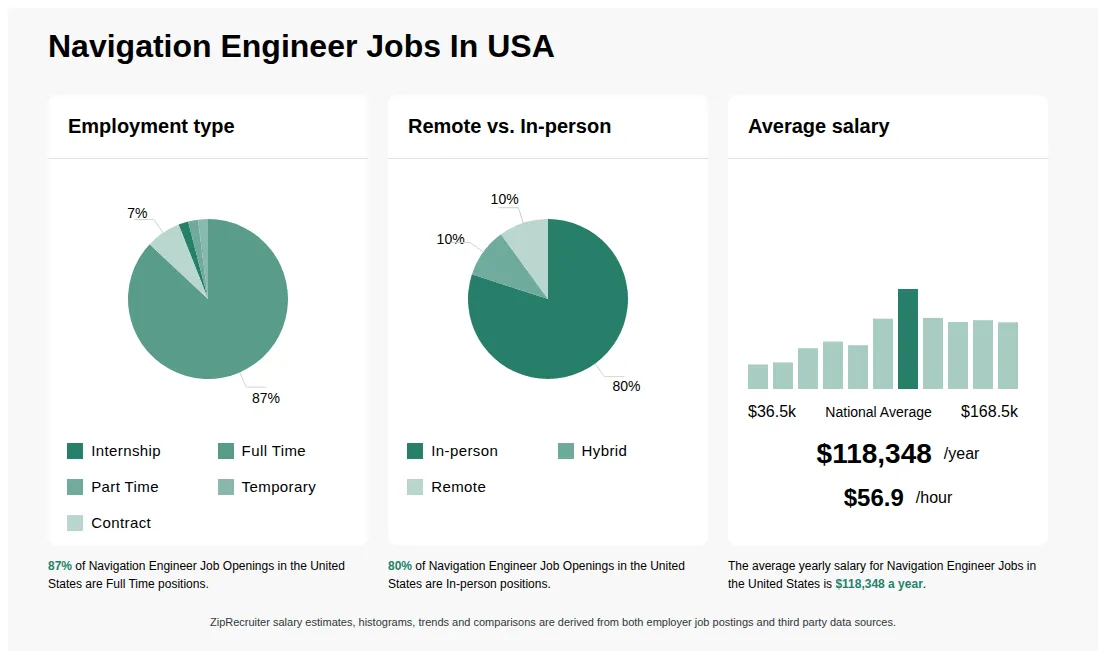
$118.3K

$168.5K

How much do navigation engineer jobs pay per year?

As of Aug 5, 2026, the average yearly pay for navigation engineer in the United States is $118,348.00, according to ZipRecruiter salary data. Most workers in this role earn between $92,000.00 and $149,000.00 per year, depending on experience, location, and employer.

What are the key skills and qualifications needed to thrive as a navigation engineer?

To excel as a Navigation Engineer, you need strong analytical skills, a background in engineering or computer science, and expertise in navigation algorithms and sensor integration. Experience with tools such as MATLAB, GNSS software suites, inertial navigation systems, and certifications like Professional Engineer (PE) or relevant industry credentials are valuable. Attention to detail, problem-solving ability, and effective teamwork and communication are important soft skills in this field. These qualifications are crucial for developing accurate, reliable navigation solutions and collaborating efficiently on multidisciplinary projects.

What are common challenges faced by navigation engineers in their daily work?

Navigation Engineers often face the challenge of ensuring precise positioning and navigation under varying environmental conditions, such as urban canyons or signal interference areas. They must troubleshoot and optimize complex sensor fusion algorithms to maintain system accuracy and reliability. This role typically requires close collaboration with software developers, hardware engineers, and project managers to implement robust solutions and quickly address technical issues as they arise. Staying up-to-date with the latest advancements in navigation technology is also key to meeting the evolving needs of clients or industries.

What is a navigation engineer?

A Navigation Engineer designs, develops, and maintains navigation systems for aerospace, marine, automotive, or robotic applications. They work with technologies like GPS, inertial navigation, and sensor fusion to ensure precise positioning and movement. Their role involves software development, algorithm design, and troubleshooting to improve navigation accuracy and reliability. These engineers often collaborate with other specialists in aerospace, robotics, or transportation industries.

More about Navigation Engineer jobs
What cities are hiring for Navigation Engineer jobs? Cities with the most Navigation Engineer job openings:
What are the most commonly searched types of Navigation Engineer jobs? The most popular types of Navigation Engineer jobs are:
Who are the top companies hiring for Navigation Engineer jobs? The top employers for Navigation Engineer jobs are:
What states have the most Navigation Engineer jobs? States with the most job openings for Navigation Engineer jobs include:
Infographic showing various Navigation Engineer job openings in the United States as of July 2026, with employment types broken down into 96% Full Time, 1% Part Time, and 3% Contract. Highlights an 87% Physical, 5% Hybrid, and 8% Remote job distribution, with an average salary of $118,348 per year, or $56.9 per hour.

Navigation Engineer, GNC

Furientis

Los Angeles, CA

Full-time

Re-posted 23 days ago


Job description

America is critically deficient in production of defensive munitions- we currently produce shipborne interceptors in the few hundreds per year while our adversaries are producing offensive threats in the tens of thousands per year. Furientis was started to help solve this problem- introducing a new class of cost-effective, high production rate, interceptor missiles. We're seeking motivated individuals who internalize this problem and are eager to apply their past experience in similar industries (aerospace, defense, automotive/racing, robotics) and out of the box thinking to solve this problem for the US and its allies.
About the Team

The GNC team writes the guidance algorithms, navigation solution, and autopilot that take a launched interceptor from rail to intercept under realistic noise, disturbances, and adversary behavior. On a modern missile, GNC decides whether the rest of the system's investment converts into a hit. We treat the navigation solution as the load-bearing wall every guidance and control decision rests on.

What You'll Do
  • Design, tune, and harden an error-state EKF for tight INS/GNSS coupling, with graceful degradation under GNSS denial, jamming, and spoofing.
  • Characterize inertial sensors: bias, scale factor, misalignment, g-sensitivity, random walks, Allan variance, and temperature behavior across the envelope.
  • Own the navigation error budget across sensor noise, calibration residuals, lever arms, time sync, vibration rectification, and high-g transients. Flow requirements down to suppliers and up to miss-distance.
  • Develop pre-launch alignment and in-flight alignment procedures (gyrocompass, transfer alignment, motion-based observability injection) suitable for tactical timelines.
  • Integrate aiding sensors as needed (GNSS, magnetometer, baro, vision, terrain-referenced, star tracker) and write the observability and fault-detection logic that decides when to trust them.
  • Build the full nav simulation stack: truth models, sensor error models, Earth and gravity models, Monte Carlo harness, and HWIL bench with real IMUs and GNSS receivers under motion.
  • Implement the navigation filter in flight-grade C/C++, with deterministic timing, fixed-step execution, and numerical conditioning suitable for a flight processor.
  • Plan and execute environmental qualification of the inertial assembly per MIL-STD-810 and program environments, with attention to vibration rectification and coning/sculling error.
  • Stand up the navigation HWIL from zero: rate table, three-axis motion simulator, GNSS RF simulator, and a bench that exercises the IMU filter against injected faults.
Skills We're Hiring For
  • B.S. in Aerospace, Electrical, Mechanical Engineering, Applied Math, Physics, or related. M.S. or Ph.D. preferred.
  • 7+ years of navigation or estimation work, with responsibility for one production navigation filter from architecture through flight test.
  • Designed and tuned an EKF (error-state or full-state) from first principles, not just consumed a vendor's nav solution. You can defend your state vector, process noise, measurement model, and observability at the whiteboard.
  • Deep fluency with strapdown inertial navigation: quaternion and DCM mechanizations, coning and sculling, Earth and gravity models (WGS-84, J2+), and frame conventions (ECEF, ECI, NED, body).
  • Hands-on inertial sensor characterization: Allan variance, temperature calibration, g-sensitivity, scale factor and misalignment estimation, vibration rectification.
  • GNSS at receiver-output and signal-processing level: tight vs. loose coupling, RAIM, anti-jam and anti-spoof considerations, and realistic expectations under denial.
  • Flight-grade C/C++ (or Rust) for embedded targets. Comfortable with fixed-step real-time execution, numerical conditioning of covariance matrices, and the difference between a prototype and a flight build.
  • Python (NumPy/SciPy) for modeling and Monte Carlo. Able to stand up a harness with noise-source ablation and defend the results.
  • Bias for low-cost navigation: track record of meeting miss-distance requirements with MEMS IMUs where the legacy approach reached for a tactical-grade FOG or RLG. Filter sophistication can buy back sensor grade.
  • AI-native working style: daily use of agentic coding tools (Claude Code, Codex, or similar) for filter scaffolding, Monte Carlo analysis, and report generation.
Bonus Points For
  • Direct flight experience on a tactical missile, munition, or interceptor navigation system.
  • High-g navigation experience (sustained launch loads, gun-launched munitions, or hard-impact events).
  • Transfer alignment from a moving host platform (air-launched or ship-launched).
  • GNSS-denied navigation: vision-aided, terrain-referenced, celestial, signals-of-opportunity, or magnetic-anomaly.
  • Production transition: moved a nav solution from prototype to volume manufacturing, including factory calibration flow.
  • Technical vendor relationships across the inertial and GNSS supply chain (tactical-grade IMUs, MEMS arrays, GNSS receivers, antennas).
  • Hobbyist drone or rocketry build and flight experience that translates to sensor packaging, vibration, and field-handling intuition.

Eligibility & Logistics Location: On-site at our Los Angeles, CA HQ; remote work is not available. Monthly weekend travel for test events and supplier engagements. Clearance: A clearance is not required for this position. Must be a U.S. Person.

Equal Opportunity & Export Compliance Furientis is an equal-opportunity employer. To comply with U.S. export control laws, employment is contingent on eligibility to access export-controlled information.

AI assists in reviewing applications. Humans make final hiring decisions. Contact us with questions.