Head of Medicinal Chemistry
Natick, MA · On-site
Lead Allorion medicinal chemistry team across multiple programs * Overview all programs up to IND-enabling studies, including structure-based drug design * Provide scientific direction, leadership ...
Natick, MA · On-site
Lead Allorion medicinal chemistry team across multiple programs * Overview all programs up to IND-enabling studies, including structure-based drug design * Provide scientific direction, leadership ...
Natick, MA · On-site
Lead Allorion medicinal chemistry team across multiple programs * Overview all programs up to IND-enabling studies, including structure-based drug design * Provide scientific direction, leadership ...
We are seeking a first-rate medicinal chemist to help us pioneer this uncharted frontier of drug discovery. Our Story A long-standing challenge in drug discovery is the development of molecules ...
We are seeking a first-rate medicinal chemist to help us pioneer this uncharted frontier of drug discovery. Our Story A long-standing challenge in drug discovery is the development of molecules ...
We are seeking a first-rate medicinal chemist to help us pioneer this uncharted frontier of drug discovery. Our Story A long-standing challenge in drug discovery is the development of molecules ...
We are seeking a first-rate medicinal chemist to help us pioneer this uncharted frontier of drug discovery. Our Story A long-standing challenge in drug discovery is the development of molecules ...
Louisville, CO · On-site
$163K - $257K/yr
We are seeking a hands-on medicinal chemistry leader with direct experience advancing molecular glue programs, from hit finding through candidate selection. * The role requires close collaboration ...
Louisville, CO · On-site
$163K - $257K/yr
We are seeking a hands-on medicinal chemistry leader with direct experience advancing molecular glue programs, from hit finding through candidate selection. * The role requires close collaboration ...
San Diego, CA · On-site
$150K - $200K/yr
Director, Medicinal Chemistry, Oligonucleotide Synthesis expert , San Diego, CA , $150,000-$200,000 per year Are you ready to lead cutting-edge oligonucleotide discovery to the clinic? Our client, an ...
San Diego, CA · On-site
$150K - $200K/yr
Director, Medicinal Chemistry, Oligonucleotide Synthesis expert , San Diego, CA , $150,000-$200,000 per year Are you ready to lead cutting-edge oligonucleotide discovery to the clinic? Our client, an ...
Louisville, CO · On-site
$200 - $250/hr
We are seeking a hands-on medicinal chemistry leader with direct experience advancing molecular glue programs, from hit finding through candidateselection. * The role requires close collaboration ...
Louisville, CO · On-site
$200 - $250/hr
We are seeking a hands-on medicinal chemistry leader with direct experience advancing molecular glue programs, from hit finding through candidateselection. * The role requires close collaboration ...
Louisville, CO · On-site
$163K - $257K/yr
We are seeking a hands-on medicinal chemistry leader with direct experience advancing molecular glue programs, from hit finding through candidateselection. * The role requires close collaboration ...
Louisville, CO · On-site
$163K - $257K/yr
We are seeking a hands-on medicinal chemistry leader with direct experience advancing molecular glue programs, from hit finding through candidateselection. * The role requires close collaboration ...
Medicinal Chemistry Reports To: Senior Director, Discovery Sciences Location: South San Francisco, CA - On-site 4 days per week (Mon to Thurs) Job Overview The Director, Medicinal Chemistry will ...
Medicinal Chemistry Reports To: Senior Director, Discovery Sciences Location: South San Francisco, CA - On-site 4 days per week (Mon to Thurs) Job Overview The Director, Medicinal Chemistry will ...
Natick, MA · On-site
Key responsibilities will include executing medicinal chemistry strategy and SAR studies along with management of external and internal resources. Experience with computational design and analysis ...
Natick, MA · On-site
Key responsibilities will include executing medicinal chemistry strategy and SAR studies along with management of external and internal resources. Experience with computational design and analysis ...
South San Francisco, CA · On-site
$207K - $250K/yr
Medicinal Chemistry Reports To: Senior Director, Discovery Sciences Location: South San Francisco, CA - On-site 4 days per week (Mon to Thurs) Job Overview The Director, Medicinal Chemistry will ...
South San Francisco, CA · On-site
$207K - $250K/yr
Medicinal Chemistry Reports To: Senior Director, Discovery Sciences Location: South San Francisco, CA - On-site 4 days per week (Mon to Thurs) Job Overview The Director, Medicinal Chemistry will ...
Natick, MA · On-site
Key responsibilities will include executing medicinal chemistry strategy and SAR studies and managing external and internal resources. Experience in computational design is highly desirable.
Natick, MA · On-site
Key responsibilities will include executing medicinal chemistry strategy and SAR studies and managing external and internal resources. Experience in computational design is highly desirable.
New York, NY · On-site
$210K - $250K/yr
Inductive Bio is an AI medicinal chemistry partner .We build virtual labs that help drug discovery teams make better decisions, faster, across the full DMTA cycle. Our platform includes Beacon-1 ...
New York, NY · On-site
$210K - $250K/yr
Inductive Bio is an AI medicinal chemistry partner .We build virtual labs that help drug discovery teams make better decisions, faster, across the full DMTA cycle. Our platform includes Beacon-1 ...
Responsible for devising the medicinal chemistry strategy on projects. Leads or co-leads multidisciplinary project teams to advance discovery programs to key milestones. Provides expertise in ...
Responsible for devising the medicinal chemistry strategy on projects. Leads or co-leads multidisciplinary project teams to advance discovery programs to key milestones. Provides expertise in ...
$197K - $296K/yr
Vertex is seeking a Director, Medicinal Chemistry to provide people management and strategic leadership for small-molecule discovery programs and to help advance compounds from early discovery ...
$197K - $296K/yr
Vertex is seeking a Director, Medicinal Chemistry to provide people management and strategic leadership for small-molecule discovery programs and to help advance compounds from early discovery ...
Responsible for devising the medicinal chemistry strategy on projects. Leads or co-leads multidisciplinary project teams to advance discovery programs to key milestones. Provides expertise in ...
Responsible for devising the medicinal chemistry strategy on projects. Leads or co-leads multidisciplinary project teams to advance discovery programs to key milestones. Provides expertise in ...
San Diego, CA · On-site
$150 - $200/hr
Provides expertise in medicinal chemistry principles, complex small molecule synthesis, purification, and data analysis across multiple projects and outside of direct team. Supervises and mentors ...
San Diego, CA · On-site
$150 - $200/hr
Provides expertise in medicinal chemistry principles, complex small molecule synthesis, purification, and data analysis across multiple projects and outside of direct team. Supervises and mentors ...
Boston, MA · On-site
$250/hr
We are seeking a seasoned and visionary Senior Director of Medicinal Chemistry to join our leadership team. This individual will play a pivotal role in shaping the future direction of our company by ...
Boston, MA · On-site
$250/hr
We are seeking a seasoned and visionary Senior Director of Medicinal Chemistry to join our leadership team. This individual will play a pivotal role in shaping the future direction of our company by ...
Watertown, MA · On-site
$150 - $200/hr
PsiThera is seeking a talented and creative medicinal chemist with a strong track record of advancing peptide therapeutics and small molecule drug discovery projects from initial hits through to ...
Watertown, MA · On-site
$150 - $200/hr
PsiThera is seeking a talented and creative medicinal chemist with a strong track record of advancing peptide therapeutics and small molecule drug discovery projects from initial hits through to ...
Watertown, MA · On-site
$170K - $200K/yr
PsiThera is seeking a talented and creative medicinal chemist with strong hands-on experience advancing discovery programs from hit identification through development candidate nomination. This ...
Watertown, MA · On-site
$170K - $200K/yr
PsiThera is seeking a talented and creative medicinal chemist with strong hands-on experience advancing discovery programs from hit identification through development candidate nomination. This ...
San Diego, CA · On-site
$197K - $296K/yr
Vertex is seeking a Director, Medicinal Chemistry to provide people management and strategic leadership for small-molecule discovery programs and to help advance compounds from early discovery ...
San Diego, CA · On-site
$197K - $296K/yr
Vertex is seeking a Director, Medicinal Chemistry to provide people management and strategic leadership for small-molecule discovery programs and to help advance compounds from early discovery ...
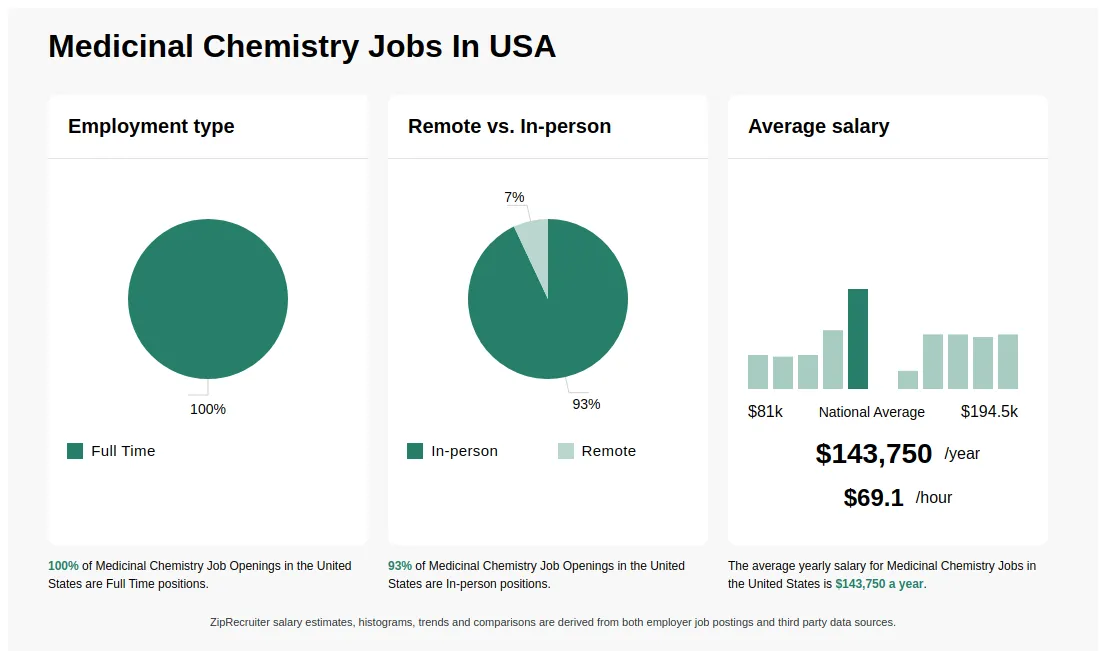
$81K - $91.3K
6% of jobs
$91.3K - $101.6K
6% of jobs
$101.6K - $112K
6% of jobs
$117.3K is the 25th percentile. Wages below this are outliers.
$112K - $122.3K
12% of jobs
The median wage is $131.8K / yr.
$122.3K - $132.6K
21% of jobs
$132.6K - $142.9K
0% of jobs
$142.9K - $153.2K
3% of jobs
$153.2K - $163.5K
12% of jobs
$171.3K is the 75th percentile. Wages above this are outliers.
$163.5K - $173.9K
12% of jobs
$173.9K - $184.2K
11% of jobs
$184.2K - $194.5K
12% of jobs
$81K
$143.8K
$194.5K
Medicinal chemistry is a branch of chemistry that focuses on developing pharmaceutical drugs. Professionals in this field often research chemicals, apply the principles of biology and biochemistry when synthesizing new chemicals, explore treatment options, analyze disease samples, and otherwise work to support the health of the general public. Most medicinal chemistry takes place in research labs, but drug candidates that get far enough in the development process may go through testing outside the development lab. Medicinal chemists often participate in these trials to monitor effects and provide care as needed. You can find most medicinal chemistry jobs with pharmaceutical companies, but a few jobs exist with government regulatory agencies.
| Aspect | Medicinal Chemistry | Organic Chemistry |
|---|---|---|
| Required Credentials | Bachelor's or Master's in Chemistry, PhD often preferred | Bachelor's or Master's in Chemistry, PhD often preferred |
| Work Environment | Pharmaceutical labs, research institutions | Academic labs, research institutions, industry |
| Industry Usage | Drug development, pharmaceutical research | Materials, polymers, natural products, academic research |
| Common Search/Comparison | Medicinal Chemistry vs Organic Chemistry |
Medicinal Chemistry focuses on designing and developing new drugs, often working closely with pharmacology and biology. Organic Chemistry involves studying the structure, properties, and reactions of organic compounds, with broader applications in materials and academia. While both fields require strong chemistry backgrounds, Medicinal Chemistry is more specialized towards pharmaceuticals, whereas Organic Chemistry covers a wider range of chemical research areas.
Cities with the most Medicinal Chemistry job openings:
The most popular types of Medicinal Chemistry jobs are:
States with the most job openings for Medicinal Chemistry jobs include:
The top searched job categories for Medicinal Chemistry jobs are:

Natick, MA • On-site
Full-time
Re-posted 27 days ago

Sourced by ZipRecruiter
Pharmaceutical and medicine manufacturing
11 - 50 Employees
Natick, MA, US
2020


