The Medical Biller collaborates with providers, coding staff, insurance companies, and patients to maximize reimbursement while delivering excellent customer service. Essential Duties and ...
The Medical Biller collaborates with providers, coding staff, insurance companies, and patients to maximize reimbursement while delivering excellent customer service. Essential Duties and ...

Medical Billing - Data Entry - Payment Posting
Savannah, GA · On-site
$15 - $22/hr
Previous experience with medical coding or billing desired * Strong organization skills * Excellent attention to detail
Quick apply
Medical Billing - Data Entry - Payment Posting
Savannah, GA · On-site
$15 - $22/hr
Previous experience with medical coding or billing desired * Strong organization skills * Excellent attention to detail
Billing Specialist II
Peachtree City, GA · On-site
$18 - $24.25/hr
Medical Coding and Billing: Knowledge and correct application of CPT, ICD-10, HCPCS codes, modifiers, and current coding guidelines. * Payer Regulations: Understanding of payer billing requirements ...
Billing Specialist II
Peachtree City, GA · On-site
$18 - $24.25/hr
Medical Coding and Billing: Knowledge and correct application of CPT, ICD-10, HCPCS codes, modifiers, and current coding guidelines. * Payer Regulations: Understanding of payer billing requirements ...
Medical Billing - Data Entry - Payment Posting
Savannah, GA · On-site
$15 - $22/hr
Previous experience with medical coding or billing desired * Strong organization skills * Excellent attention to detail
Quick apply
Medical Billing - Data Entry - Payment Posting
Savannah, GA · On-site
$15 - $22/hr
Previous experience with medical coding or billing desired * Strong organization skills * Excellent attention to detail
Medical Billing - Data Entry - Payment Posting
Savannah, GA · On-site
$15 - $22/hr
Previous experience with medical coding or billing desired * Strong organization skills * Excellent attention to detail
Quick apply
Medical Billing - Data Entry - Payment Posting
Savannah, GA · On-site
$15 - $22/hr
Previous experience with medical coding or billing desired * Strong organization skills * Excellent attention to detail

Medical Billing Specialist
Stockbridge, GA · On-site
$17 - $19/hr
Coding medical services, diagnoses, and procedures according to industry standards. Company Description Erogen Enterprises, LLC., your trusted partner in medical billing and consulting. Our mission ...
Quick apply
Medical Billing Specialist
Stockbridge, GA · On-site
$17 - $19/hr
Coding medical services, diagnoses, and procedures according to industry standards. Company Description Erogen Enterprises, LLC., your trusted partner in medical billing and consulting. Our mission ...
Medical Billing Specialist
Stockbridge, GA · On-site
$17 - $19/hr
Coding medical services, diagnoses, and procedures according to industry standards. Company Description Erogen Enterprises, LLC., your trusted partner in medical billing and consulting. Our mission ...
Quick apply
Medical Billing Specialist
Stockbridge, GA · On-site
$17 - $19/hr
Coding medical services, diagnoses, and procedures according to industry standards. Company Description Erogen Enterprises, LLC., your trusted partner in medical billing and consulting. Our mission ...
Medical Billing Specialist
Thomasville, GA · On-site
$14.75 - $19/hr
Knowledge of medical coding systems (ICD-10, CPT) * Familiarity with billing software such as Athena * Strong attention to detail and accuracy * Excellent communication and time management skills
Quick apply
Medical Billing Specialist
Thomasville, GA · On-site
$14.75 - $19/hr
Knowledge of medical coding systems (ICD-10, CPT) * Familiarity with billing software such as Athena * Strong attention to detail and accuracy * Excellent communication and time management skills

MEDICAL BILLING
Sandy Springs, GA · On-site
$17.50 - $22.50/hr
This position encompasses all areas of medical Billing ... It includes, but is not limited to, coding patients' encounters, posting Explanations of Benefits ...
MEDICAL BILLING
Sandy Springs, GA · On-site
$17.50 - $22.50/hr
This position encompasses all areas of medical Billing ... It includes, but is not limited to, coding patients' encounters, posting Explanations of Benefits ...

MD - Medical Billing & Coding Candidates shall work to support requirements as a Lead Medical Coder and Auditor and review health record documentation for assignment of proper diagnosis and procedure ...
MD - Medical Billing & Coding Candidates shall work to support requirements as a Lead Medical Coder and Auditor and review health record documentation for assignment of proper diagnosis and procedure ...
MEDICAL BILLING
Sandy Springs, GA · On-site
$17.50 - $22.50/hr
This position encompasses all areas of medical Billing ... It includes, but is not limited to, coding patients' encounters, posting Explanations of Benefits ...
MEDICAL BILLING
Sandy Springs, GA · On-site
$17.50 - $22.50/hr
This position encompasses all areas of medical Billing ... It includes, but is not limited to, coding patients' encounters, posting Explanations of Benefits ...

Medical Billing Claims Team LeadCompany Overview Summit Spine and Joint Centers (SSJC) is a rapidly ... Demonstrate knowledge of CPT, ICD-10, HCPCS coding, and modifiers. * Demonstrate knowledge of third ...
Medical Billing Claims Team LeadCompany Overview Summit Spine and Joint Centers (SSJC) is a rapidly ... Demonstrate knowledge of CPT, ICD-10, HCPCS coding, and modifiers. * Demonstrate knowledge of third ...
Medical Billing Claims Specialist - Lead
Atlanta, GA · On-site
$18 - $23/hr
Medical Billing Claims Team Lead Company Overview Summit Spine and Joint Centers (SSJC) is a ... Demonstrate knowledge of CPT, ICD-10, HCPCS coding, and modifiers. * Demonstrate knowledge of third ...
Medical Billing Claims Specialist - Lead
Atlanta, GA · On-site
$18 - $23/hr
Medical Billing Claims Team Lead Company Overview Summit Spine and Joint Centers (SSJC) is a ... Demonstrate knowledge of CPT, ICD-10, HCPCS coding, and modifiers. * Demonstrate knowledge of third ...

Medical Billing Manager
Atlanta, GA · On-site
$51K - $67K/yr
Mid-size Medical practice looking for a Billing Administrator. The candidate will be responsible ... codes performed PQRS and Meaningful Use tracking and reporting ICD-10 preparation and training ...
Medical Billing Manager
Atlanta, GA · On-site
$51K - $67K/yr
Mid-size Medical practice looking for a Billing Administrator. The candidate will be responsible ... codes performed PQRS and Meaningful Use tracking and reporting ICD-10 preparation and training ...
Medical Billing Manager
Atlanta, GA · On-site
$51K - $67K/yr
Company Description Mid-size Medical practice looking for a Billing Administrator. The candidate ... procedures/codes performed • PQRS and Meaningful Use tracking and reporting • ICD-10 ...
Medical Billing Manager
Atlanta, GA · On-site
$51K - $67K/yr
Company Description Mid-size Medical practice looking for a Billing Administrator. The candidate ... procedures/codes performed • PQRS and Meaningful Use tracking and reporting • ICD-10 ...
MD - Medical Billing & Coding Candidates shall work to support requirements as a Medical Coding Administrative Apprentice-Journeyman (Level I, Certified, Onsite) and will work directly with medical ...
MD - Medical Billing & Coding Candidates shall work to support requirements as a Medical Coding Administrative Apprentice-Journeyman (Level I, Certified, Onsite) and will work directly with medical ...

Medical Billing Specialist
Atlanta, GA · On-site
$17.50 - $22.50/hr
Medical Billing Specialist Location: Atlanta, GA 30327 | Full-Time | In-Person Join Our Team at ... coding information are present to support billing. · Communicate with insurance companies ...
New
Quick apply
Medical Billing Specialist
Atlanta, GA · On-site
$17.50 - $22.50/hr
Medical Billing Specialist Location: Atlanta, GA 30327 | Full-Time | In-Person Join Our Team at ... coding information are present to support billing. · Communicate with insurance companies ...
New
Medical Billing Specialist
Atlanta, GA · On-site
$17.50 - $22.50/hr
Description Medical Billing Specialist Location: Atlanta, GA 30327 | Full-Time | In-Person Join Our ... coding information are present to support billing. • Communicate with insurance companies ...
Medical Billing Specialist
Atlanta, GA · On-site
$17.50 - $22.50/hr
Description Medical Billing Specialist Location: Atlanta, GA 30327 | Full-Time | In-Person Join Our ... coding information are present to support billing. • Communicate with insurance companies ...

Medical Coder and Abstractor
Hinesville, GA · On-site
$55 - $75/hr
MD - Medical Billing & Coding Candidates shall work to support requirements as a Medical Coder and Abstractor and review health record documentation for assignment of proper diagnosis and procedure ...
Medical Coder and Abstractor
Hinesville, GA · On-site
$55 - $75/hr
MD - Medical Billing & Coding Candidates shall work to support requirements as a Medical Coder and Abstractor and review health record documentation for assignment of proper diagnosis and procedure ...

Medical Billing and Insurance Coding Instructor (64193)
Stone Mountain, GA · On-site
$21 - $26/hr
Someone with tenacity, passion, discipline and grit to join our team as a Medical Billing and Insurance Coding Instructor at our Stone Mountain Campus . To Do What: In this position, you will be ...
Medical Billing and Insurance Coding Instructor (64193)
Stone Mountain, GA · On-site
$21 - $26/hr
Someone with tenacity, passion, discipline and grit to join our team as a Medical Billing and Insurance Coding Instructor at our Stone Mountain Campus . To Do What: In this position, you will be ...
Medical Billing And Coding information
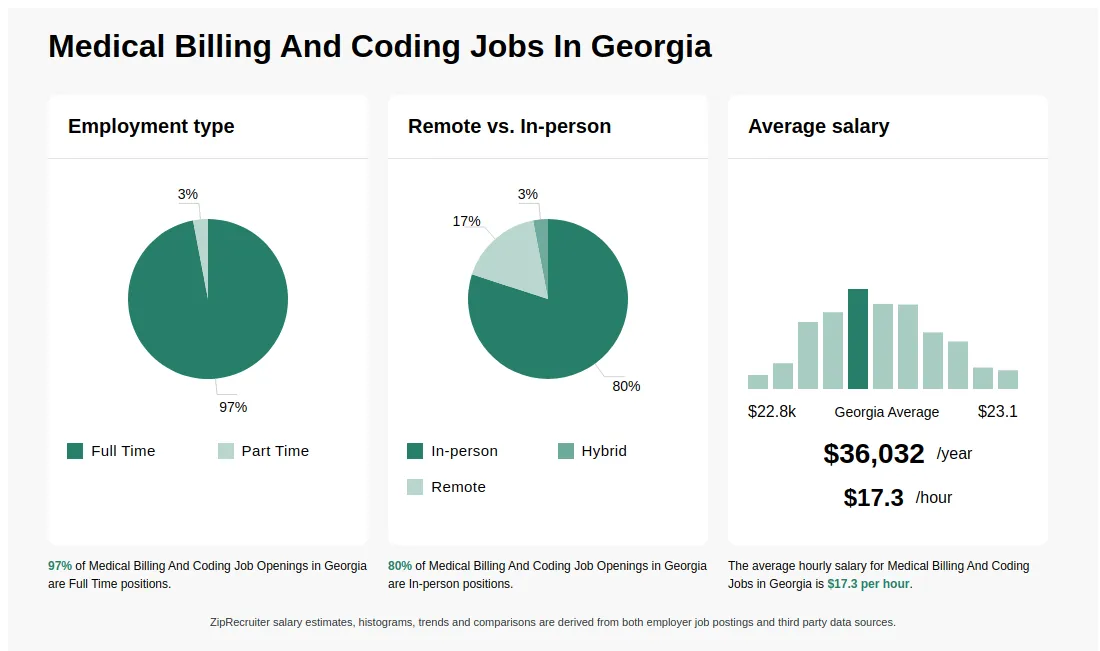
See Georgia salary details
$10.96 - $12.07
2% of jobs
$12.07 - $13.17
4% of jobs
$13.17 - $14.28
12% of jobs
$14.90 is the 25th percentile. Wages below this are outliers.
$14.28 - $15.39
13% of jobs
$15.39 - $16.50
17% of jobs
The median wage is $16.69 / hr.
$16.50 - $17.60
15% of jobs
$18.57 is the 75th percentile. Wages above this are outliers.
$17.60 - $18.71
15% of jobs
$18.71 - $19.82
9% of jobs
$19.82 - $20.93
7% of jobs
$20.93 - $22.03
3% of jobs
$22.03 - $23.14
3% of jobs
$10
$17
$23
How much do medical billing and coding jobs pay per hour?
As of Sep 5, 2026, the average hourly pay for medical billing and coding in Georgia is $17.32, according to ZipRecruiter salary data. Most workers in this role earn between $14.81 and $19.09 per hour, depending on experience, location, and employer.
What is medical billing and coding?
Medical billing and coding is the process of translating healthcare services into standardized codes and submitting claims to insurance companies for reimbursement. Medical coders review patient records and assign the appropriate codes for diagnoses and procedures, while medical billers use those codes to create and process insurance claims. Together, these professionals ensure healthcare providers are paid accurately and promptly. This role requires attention to detail, knowledge of medical terminology, and understanding of healthcare regulations.
What are the key skills and qualifications needed to thrive as a medical billing and coding specialist?
To thrive as a Medical Billing and Coding Specialist, you need a strong understanding of medical terminology, coding systems (such as ICD-10, CPT, and HCPCS), and healthcare regulations, usually supported by certification like CPC or CCS. Familiarity with medical billing software, electronic health record (EHR) systems, and insurance claim processes is essential. Attention to detail, organizational skills, and effective communication are standout soft skills in this role. These abilities ensure accurate billing, reduce claim denials, and facilitate timely reimbursement, which are crucial for healthcare facility operations.
What are some common challenges faced by medical billing and coding professionals, and how can they be managed?
Medical Billing and Coding professionals often encounter challenges such as keeping up with frequent changes in coding guidelines (ICD-10, CPT, HCPCS), managing claim denials, and ensuring accuracy under tight deadlines. Staying current through continuing education and certification updates is essential to handle code changes effectively. Building strong communication with healthcare providers and insurance companies can also minimize errors and expedite claim resolutions. Many professionals find that developing strong organizational and problem-solving skills helps them thrive in this fast-paced environment.
What is the difference between Medical Billing And Coding vs Medical Office Assistant?
| Aspect | Medical Billing And Coding | Medical Office Assistant |
|---|---|---|
| Credentials | Certification in coding and billing (e.g., CPC, CBCS) | High school diploma or equivalent; administrative training |
| Work Environment | Healthcare offices, hospitals, billing companies | Medical offices, clinics, hospitals |
| Primary Responsibilities | Processing insurance claims, coding diagnoses and procedures | Scheduling appointments, patient intake, administrative tasks |
Medical Billing And Coding focuses on insurance claims and coding, while Medical Office Assistants handle administrative duties. Both roles are essential in healthcare settings but differ in daily tasks and required certifications.
Is a career in medical billing and coding worth it?
A career in medical billing and coding offers stable employment opportunities, as it is essential for healthcare administration. It typically requires certification, attention to detail, and proficiency with coding software, with job growth driven by the expanding healthcare industry.
Is a career in medical coding and billing worth it?
Medical coding and billing is a stable healthcare career that involves translating medical records into standardized codes for billing and insurance purposes. It typically requires certification, attention to detail, and knowledge of coding systems like ICD-10 and CPT, with job opportunities available in hospitals, clinics, and insurance companies. The field offers flexible schedules and the potential for remote work, making it a practical choice for many healthcare administrative professionals.
Is it hard to get a job in medical coding and billing?
Medical coding and billing jobs generally require certification and knowledge of coding systems like ICD-10 and CPT. While some entry-level positions are available, competition can vary based on location and experience, and having strong attention to detail and computer skills improves job prospects.
Is it hard to get hired as a medical billing and coding specialist?
Getting hired as a medical billing and coding specialist can be competitive, but having relevant certifications such as CPC or CCS and proficiency with coding software can improve job prospects. Entry-level positions are often available, but experience and accuracy are valued by employers.
Is medical billing and coding still in demand?
Medical billing and coding remains a high-demand field due to ongoing healthcare industry growth and the need for accurate medical records. Certified professionals with knowledge of coding systems like ICD-10 and CPT are especially sought after, and employment opportunities are expected to continue increasing as healthcare services expand.
Is medical coding and billing still in demand?
Medical coding and billing remain in high demand due to ongoing healthcare industry growth and the need for accurate medical record management. Professionals with certification and familiarity with coding systems like ICD-10 and CPT are especially sought after in hospitals, clinics, and insurance companies.
Which medical coding and billing jobs pay the most?
Senior medical coders, especially those with certifications like CPC or CCS, tend to earn the highest salaries in medical coding and billing. Specialized roles such as coding managers or compliance officers also offer higher pay, often due to increased experience, expertise, and leadership responsibilities.
What are the most commonly searched types of Medical Billing And Coding jobs in Georgia?
The most popular types of Medical Billing And Coding jobs in Georgia are:
What are popular job titles related to Medical Billing And Coding jobs in Georgia?
For Medical Billing And Coding jobs in Georgia, the most frequently searched job titles are:
- Laboratory Billing
- Medical Coding Using Ai
- Part Time Remote Medical Coder
- Medical Billing Coding Paid Training
- Freelance Medical Billing Coding Willing To Train
- Work From Home Medical Biller
- Remote Certified Billing Coding Specialist Cbcs
- Internship Remote Medical Biller
- No Experience Medical Billing Coding Willing To Train
- Work From Home Billing Specialist
What job categories do people searching Medical Billing And Coding jobs in Georgia look for?
The top searched job categories for Medical Billing And Coding jobs in Georgia are:
- Trainee Remote Medical Billing & Coding
- Rcm Certified Ambulance Coder
- Remote Medical Billing Coding Night Shift
- Medical Billing Coding Externship
- Billing And Coding Specialist
- Commission Remote Medical Billing
- Internship No Experience Medical Billing & Coding
- Paid Training Medical Coding
- Independent Contractor Medical Billing & Coding
- Weekend Pay Per Chart Medical Coder
What cities in Georgia are hiring for Medical Billing And Coding jobs?
Cities in Georgia with the most Medical Billing And Coding job openings:

Full-time
Medical, Dental, Vision, Life, Retirement, PTO
Re-posted 23 days ago
Job description
Medical Billing Associate
Status: Non-Exempt / Full Time / On Site
Medical Specialty: Women's Health - OB/GYN
Job Summary
The Medical Biller is responsible for preparing, submitting, and monitoring medical claims to ensure timely and accurate reimbursement from insurance companies, government payers, and patients. This position plays a critical role in the revenue cycle by reviewing documentation for billing accuracy, resolving claim denials, posting payments, and maintaining compliance with payer guidelines and healthcare regulations. The Medical Biller collaborates with providers, coding staff, insurance companies, and patients to maximize reimbursement while delivering excellent customer service.
Essential Duties and Responsibilities
- Review patient accounts, clinical documentation, and charge information for completeness and billing accuracy.
- Prepare and submit electronic and paper claims to commercial insurance carriers, Medicare, Medicaid, Workers' Compensation, and other third-party payers.
- Verify insurance eligibility, benefits, coverage, and patient demographic information prior to claim submission.
- Review medical records to ensure appropriate documentation supports billed services.
- Work collaboratively with third party billing partner and providers to ensure accurate assignment of CPT, HCPCS, and ICD-10-CM codes.
- Monitor claim status and follow up on unpaid, delayed, or rejected claims.
- Investigate and resolve claim rejections, denials, and payment discrepancies by correcting claims and submitting timely appeals when appropriate.
- Prepare and submit corrected claims, reconsiderations, and payer appeals with supporting documentation.
- Post insurance and patient payments accurately into the practice management system.
- Reconcile daily payment batches, deposits, and explanation of benefits (EOBs) or electronic remittance advice (ERA).
- Calculate and apply patient deductibles, copayments, coinsurance, and contractual adjustments.
- Generate and distribute patient statements and assist patients with billing questions and payment arrangements.
- Maintain accurate billing documentation and account notes within the Electronic Health Record (EHR) and practice management system.
- Communicate with insurance companies to resolve claim issues and obtain claim status updates.
- Maintain current knowledge of payer policies, reimbursement guidelines, and regulatory requirements.
- Generate billing, accounts receivable, aging, denial, and reimbursement reports for leadership.
- Participate in revenue cycle improvement initiatives to reduce denials and improve reimbursement.
- Maintain compliance with HIPAA, CMS regulations, payer requirements, and organizational policies.
- Protect the confidentiality and security of patient financial and health information.
- Perform other duties as assigned.
Education and Experience
Required
- High school diploma or GED.
- Minimum of one (1) year of medical billing, insurance claims processing, or revenue cycle experience in a healthcare setting.
Preferred
- Associate degree in Medical Billing and Coding, Health Information Management, Healthcare Administration, or a related field.
- Certified Professional Biller (CPB), Certified Professional Coder (CPC), Certified Coding Associate (CCA), or other industry-recognized certification preferred.
- Experience billing multiple specialties and working with commercial insurance, Medicare, Medicaid, and managed care organizations.
Knowledge, Skills, and Abilities
- Strong knowledge of medical billing processes and revenue cycle management.
- Working knowledge of CPT, ICD-10-CM diagnosis coding, and medical terminology.
- Understanding of insurance verification, claim submission, payment posting, denial management, and appeals.
- Knowledge of payer policies, Medicare, Medicaid, commercial insurance, and managed care reimbursement guidelines.
- Proficiency with Electronic Health Record (EHR) and practice management systems, ie AdvancedMD, eClinicalWorks, Athenahealth, Oracle Health (Cerner), Epic, or similar platforms.
- Experience with electronic claims submission, clearinghouses, ERA, and EOB processing.
- Strong analytical and problem-solving skills with attention to detail.
- Excellent mathematical skills for balancing accounts, reconciling payments, and calculating patient financial responsibility.
- Strong organizational and time management skills with the ability to prioritize multiple deadlines.
- Excellent written and verbal communication skills.
- Strong customer service skills when assisting patients with billing inquiries.
- Ability to work independently and collaboratively within a healthcare revenue cycle team.
- Ability to maintain confidentiality and comply with HIPAA and other healthcare privacy regulations.
Physical Requirements
- Ability to sit for extended periods while using a computer.
- Ability to operate a computer, keyboard, calculator, telephone, and other standard office equipment.
- Ability to occasionally lift, carry, push, or pull up to 25 pounds.
- Ability to communicate effectively in person, electronically, and by telephone.
Work Environment
- Work is performed in a medical office or centralized billing office.
- Frequent interaction with providers, coding staff, insurance representatives, patients, and revenue cycle personnel.
- Fast-paced environment requiring accuracy, attention to detail, and adherence to billing deadlines and regulatory requirements.
Core Competencies
- Revenue Cycle Management
- Medical Billing and Claims Processing
- Insurance and Payer Knowledge
- Attention to Detail
- Analytical Thinking
- Problem Solving
- Organization and Time Management
- Customer Service
- Communication
- Regulatory Compliance
- Confidentiality and Ethics
- Accountability
- Teamwork
- Continuous Process Improvement
Other:
Pay: Commensurate with Experience
Expected hours: 40 per week
Benefits: (Waiting period may apply)
- Dental insurance
- Disability insurance
- Health insurance
- Life insurance
- Paid time off
- Vision insurance
- 401(k) / Profit Sharing

About Sullivan Group HR
Sourced by ZipRecruiter
Industry
Human resources consulting services
Company size
11 - 50 Employees
Headquarters location
Savannah, GA, US
Year founded
1986