1

Linux Kernel Developer Jobs in New York (NOW HIRING)

Sr Linux Engineer Job Location: Connecticut Job Type: Permenant Specifically, you will: * Work as ... Excellent knowledge of tuning Linux for low latency, high throughput, and kernel bypass (e.g ...

As a Linux Engineering intern, you'll work side by side with full-timers to learn how we build and ... fixing a kernel bug, responding to an overheating datacenter in real time, analyzing data to ...

Email Reliability Engineer

New York, NY · On-site

$62.25 - $82.75/hr

Senior Systems Engineer - Email Reliability (Hybrid SRE) New York, NY (Hybrid, 3 days in office ... Deep comfort with the Linux kernel, TCP stack tuning, and Postfix/MTA configuration management.

Senior Linux Engineer Job Location: Greenwich Connecticut , Onsite Job Type: Permenant * Work as ... Excellent knowledge of tuning Linux for low latency, high throughput, and kernel bypass (e.g ...

As a Linux Engineering intern, you'll work side by side with full-timers to learn how we build and ... fixing a kernel bug, responding to an overheating datacenter in real time, analyzing data to ...

Group Details The Linux engineering team are responsible for Tradeweb's Linux runtime environment ... Very strong knowledge of the Linux platform, including regular system administration, kernel ...

Showing results 41-60

Linux Kernel Developer information

See New York salary details

$110.5K

$163.1K

$192.6K

How much do linux kernel developer jobs pay per year?

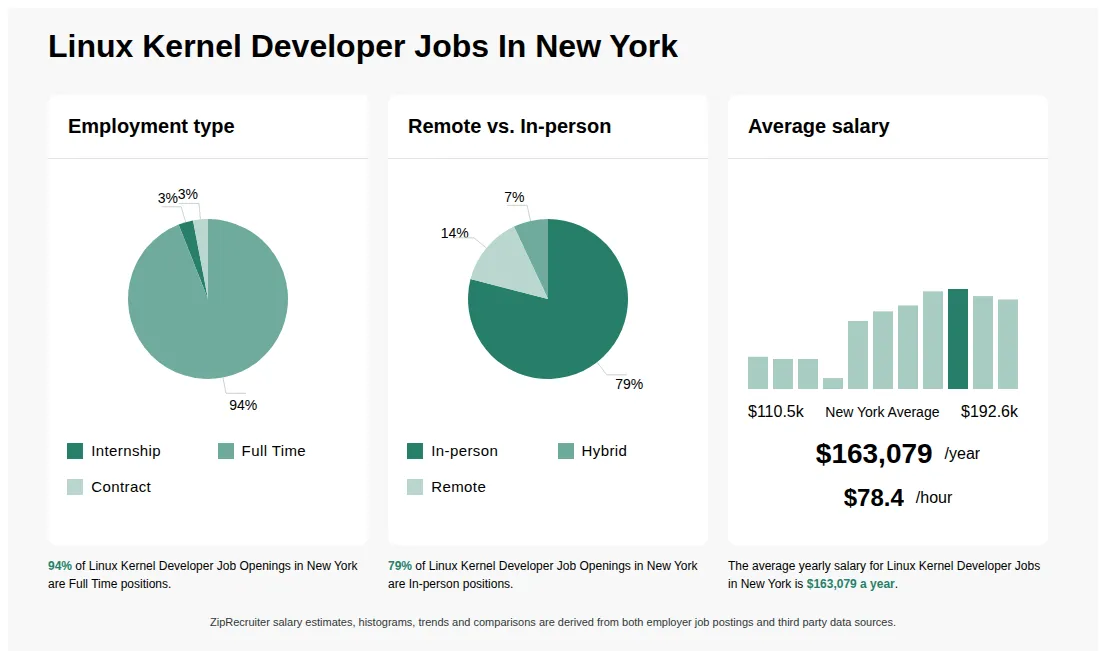
As of Sep 4, 2026, the average yearly pay for linux kernel developer in New York is $163,079.00, according to ZipRecruiter salary data. Most workers in this role earn between $149,300.00 and $180,500.00 per year, depending on experience, location, and employer.

What does a Linux kernel developer do?

A Linux kernel developer uses computer code to create a program that functions as the core of a computer operating system. Your duties can include creating kernels for open-source operating systems for desktop computers, laptops, phones, and tablets. You can also develop programs for embedded systems for routers, smart devices, or automated machinery. Linux uses C programming languages, so you often write code in C and C++. In addition to your coding responsibilities, you also test and debug your programs. Your employer may ask you to develop applications, drivers, and other tools to use with your kernel.

What does a Linux kernel developer do?

A Linux Kernel Developer is responsible for designing, developing, and maintaining the core part of the Linux operating system known as the kernel. Their work involves writing and reviewing code, debugging issues, implementing new features, and ensuring the kernel remains efficient and secure. They also collaborate with the open-source community to contribute patches and updates. Linux Kernel Developers play a crucial role in supporting hardware compatibility and system performance across various devices.

What are the key skills and qualifications needed to thrive as a Linux kernel developer?

To thrive as a Linux Kernel Developer, you need deep knowledge of C programming, operating system concepts, and experience with kernel development, often supported by a degree in computer science or related fields. Familiarity with tools such as Git, GDB, build systems, and patch submission processes, as well as experience contributing to open-source projects, is typically required. Strong problem-solving, attention to detail, and effective communication are critical soft skills for collaborating within the open-source community. These skills ensure high-quality code contributions, efficient troubleshooting, and successful integration with the broader Linux ecosystem.

What are some common challenges Linux kernel developers face when integrating new features or patches?

Linux Kernel Developers often encounter challenges such as ensuring compatibility with a wide range of hardware architectures and maintaining stability across diverse distributions. Integrating new features or patches requires rigorous code review, thorough testing, and clear communication with the broader open-source community. Developers must also keep up with the kernel's fast-paced development cycles and adhere to strict coding standards, which can be demanding but offers significant opportunities for learning and professional growth.

What is the difference between Linux Kernel Developer vs Linux Device Driver Developer?

AspectLinux Kernel DeveloperLinux Device Driver Developer
Required CredentialsProficiency in C, Linux kernel development experience, often a degree in Computer Science or related fieldSimilar credentials, with focus on device-specific programming and hardware knowledge
Work EnvironmentDeveloping and maintaining core kernel components, often in a Linux environmentWriting and debugging drivers for specific hardware devices within Linux
Employer & Industry UsageTech companies, open-source projects, hardware manufacturersHardware manufacturers, embedded systems, specialized device companies

While both roles require strong C programming skills and Linux knowledge, Linux Kernel Developers focus on core kernel development, whereas Linux Device Driver Developers specialize in creating drivers for hardware components. The roles often overlap but differ in scope and focus within the Linux ecosystem.

What are the most commonly searched types of Linux Kernel Developer jobs in New York?

The most popular types of Linux Kernel Developer jobs in New York are:

What job categories do people searching Linux Kernel Developer jobs in New York look for?

The top searched job categories for Linux Kernel Developer jobs in New York are:

What cities in New York are hiring for Linux Kernel Developer jobs?

Cities in New York with the most Linux Kernel Developer job openings:

What are popular job titles related to Linux Kernel Developer jobs in NY?

For Linux Kernel Developer jobs in NY, the most frequently searched job titles are:

Infographic showing various Linux Kernel Developer job openings in New York as of August 2026, with employment types broken down into 88% Full Time, 2% Part Time, and 10% Contract. Highlights an 80% Physical, 5% Hybrid, and 15% Remote job distribution, with an average salary of $163,079 per year, or $78.4 per hour.

Senior Lead Software Engineer- Platform / Linux Engineering

JPMorgan Chase & Co.

Manhattan, NY • On-site

$175K - $260K/yr

Full-time

Medical, Retirement

Re-posted 6 days ago


JPMorgan Chase & Co. rating

7.9

Company rating: 7.9 out of 10

Based on 500 frontline employees who took The Breakroom Quiz

77th of 174 rated banks


Job description


Be an integral part of an agile team that's constantly pushing the envelope to enhance, build, and deliver top-notch technology products.
As a Senior Lead Software Engineer- Platform / Linux Engineering at JPMorganChase within the Corporate Sector- Infrastructure Platforms, you are an integral part of an agile team that works to enhance, build, and deliver trusted market-leading technology products in a secure, stable, and scalable way. Drive significant business impact through your capabilities and contributions, and apply deep technical expertise and problem-solving methodologies to tackle a diverse array of challenges that span multiple technologies and applications.
As a Senior Platform Engineer within Electronic Trading Services Platforms, you will be a hands-on technical leader responsible for designing, building, and tuning the Linux-based compute and infrastructure platforms that power our low-latency electronic trading businesses. This is a deeply technical, engineering-first role: you will write code and automation, design new systems, architect novel deployment models, and drive latency out of the stack at the hardware, kernel, and network layers. You will also harness modern Agentic AI tooling to accelerate delivery and multiply your impact.
You will work directly with the Electronic Trading Lines of Business to align technical strategy with business goals, solve complex compute and performance-engineering challenges, and mentor partner technical teams. You will serve as an expert, hands-on advisor to peers, leadership, and stakeholders.
Job responsibilities
  • Design, build, and operate high-performance Linux platforms for low-latency electronic trading, engineering from the hardware and kernel level up
  • Architect new system designs and next-generation deployment models - including immutable infrastructure, containerization, and automated provisioning pipelines
  • Perform deep performance engineering and latency optimization: kernel tuning, CPU isolation/pinning, NUMA awareness, IRQ affinity, kernel-bypass networking, and precision time synchronization
  • Write production-quality code and automation to build tooling, eliminate manual toil, and improve platform reliability and speed
  • Leverage Agentic AI tools and workflows to accelerate engineering tasks, automate research and remediation, and deliver against goals faster
  • Drive adoption and governance of approved AI-assisted engineering practices across teams to improve code quality, delivery speed, and operational outcomes (e.g., AI-assisted code review/refactoring, test acceleration, release readiness, incident/root-cause analysis), while establishing measurable validation standards (secure coding, peer review, automated testing) and promoting reuse of proven patterns and automation within the SDLC/TLM toolchain
  • Apply knowledge of tools within the Software Development Life Cycle toolchain, including approved AI-assisted development and automation capabilities, to improve the value realized by automation at scale.
  • Interface with hardware and software vendors on product roadmaps and to define the next generation of Electronic Trading Platform infrastructure
  • Make decisions that influence teams' resources, budget, tactical operations, and the execution of processes and procedures
  • Carry governance accountability for engineering decisions, control obligations, and measures of success such as cost of ownership, maintainability, and portfolio operations
  • Deliver reusable technical solutions that can be leveraged across multiple businesses and domains and mentor and influence SRE, peer engineers, and senior stakeholders across business, product, and technology teams

Required qualifications, capabilities, and skills
  • Formal training or certification on software engineering concepts and 5+ years applied experience
  • Strong programming skills with the ability to build production-grade tooling and automation (e.g., Python, Go, Bash)
  • Deep, hands-on Linux engineering expertise - administration, internals, performance tuning, and benchmarking, in areas such as Red Hat Enterprise Linux and proven experience engineering for low-latency, high-throughput environments (kernel tuning, CPU/NUMA optimization, precision timing)
  • Hands-on experience with kernel-bypass networking, specifically Solarflare Onload and extensive experience with configuration management, in areas such as Chef or Ansible
  • Hands-on experience applying Agentic AI tools (e.g., AI coding assistants and agent-based workflows) to accelerate engineering and operational tasks
  • Demonstrated experience leading effective use of enterprise-authorized AI-assisted software development tools within the work environment (e.g., for coding, code review, test acceleration, troubleshooting) with the ability to set team expectations for validating AI outputs for correctness, performance, and security
  • Strong understanding of responsible AI use in engineering workflows, including data sensitivity considerations, secure handling of inputs/outputs, and adherence to resiliency and security expectations; experience coaching senior engineers/leads on compliant usage patterns and controls
  • Solid understanding of IPv4 networking, including the OSI model, unicast/broadcast/multicast, routing, and network segregation mechanisms
  • Experience designing CI/CD pipelines and infrastructure-as-code (e.g., Terraform)
  • Practical cloud-native and container/orchestration experience (e.g., Docker, Kubernetes)
  • Experience leading cross-functional teams of technologists, and hiring, developing, and recognizing talent

Preferred qualifications, capabilities, and skills
  • Experience with server hardware selection, BIOS/firmware tuning, and bare-metal provisioning for performance-sensitive workloads
  • Familiarity with observability and telemetry stacks (e.g., Prometheus, Grafana, ELK) and understanding of standard cryptography (certificates, key pairs, secure communication, etc.)
  • Experience with market-data and messaging technologies common to electronic trading (e.g., multicast market data, low-latency messaging buses)
  • Experience with database management systems, preferably PostgreSQL

About Us
JPMorganChase, one of the oldest financial institutions, offers innovative financial solutions to millions of consumers, small businesses and many of the world's most prominent corporate, institutional and government clients under the J.P. Morgan and Chase brands. Our history spans over 200 years and today we are a leader in investment banking, consumer and small business banking, commercial banking, financial transaction processing and asset management.
We offer a competitive total rewards package including base salary determined based on the role, experience, skill set and location. Those in eligible roles may receive commission-based pay and/or discretionary incentive compensation, paid in the form of cash and/or forfeitable equity, awarded in recognition of individual achievements and contributions. We also offer a range of benefits and programs to meet employee needs, based on eligibility. These benefits include comprehensive health care coverage, on-site health and wellness centers, a retirement savings plan, backup childcare, tuition reimbursement, mental health support, financial coaching and more. Additional details about total compensation and benefits will be provided during the hiring process.
We recognize that our people are our strength and the diverse talents they bring to our global workforce are directly linked to our success. We are an equal opportunity employer and place a high value on diversity and inclusion at our company. We do not discriminate on the basis of any protected attribute, including race, religion, color, national origin, gender, sexual orientation, gender identity, gender expression, age, marital or veteran status, pregnancy or disability, or any other basis protected under applicable law. We also make reasonable accommodations for applicants' and employees' religious practices and beliefs, as well as mental health or physical disability needs. Visit our FAQs for more information about requesting an accommodation.
JPMorgan Chase & Co. is an Equal Opportunity Employer, including Disability/Veterans
About the Team
Our Global Technology Infrastructure group is a team of innovators who love technology as much as you do. Together, you'll use a disciplined, innovative and a business focused approach to develop a wide variety of high-quality products and solutions. You'll work in a stable, resilient and secure operating environment where you-and the products you deliver-will thrive.
High Risk Roles (HRR) are sensitive roles within the technology organization that require high assurance of the integrity of staff by virtue of 1) sensitive cybersecurity and technology functions they perform within systems or 2) information they receive regarding sensitive cybersecurity or technology matters. Users in these roles are subject to enhanced pre-hire screening which includes both criminal and credit background checks (as allowed by law). The enhanced screening will need to be successfully completed prior to commencing employment or assignment.

What JPMorgan Chase & Co. employees say

Pay

Benefits

Hours and flexibility

Workplace

Get the full story on Breakroom