1

Large Animal Veterinary Jobs (NOW HIRING)

... Large Animal Attendant Anticipated Hiring Range $39,000 Work Schedule Sunday-Thursday 6pm-3am ... Delivering expert clinical instruction to fourth-year veterinary students from the College of ...

Posted Job Title Veterinary Technician, Large Animal Job Profile Title Veterinary Technician B Summary New Bolton Center has an ongoing need for Veterinary Technicians. This posting describes the ...

Posted Job Title Veterinary Technician, Large Animal Job Profile Title Veterinary Technician B Summary New Bolton Center has an ongoing need for Veterinary Technicians. This posting describes the ...

$7.25 - $17/hr

... animal veterinary hospital. Our large animal attendants play a vital role in the hospital ... performing a variety of duties including cleaning patient stalls, daily feeding, and general upkeep ...

$7.25 - $17/hr

... animal veterinary hospital. Our large animal attendants play a vital role in the hospital ... performing a variety of duties including cleaning patient stalls, daily feeding, and general upkeep ...

next page

Showing results 1-20

Large Animal Veterinary information

See salary details

$12

$21

$31

How much do large animal veterinary jobs pay per hour?

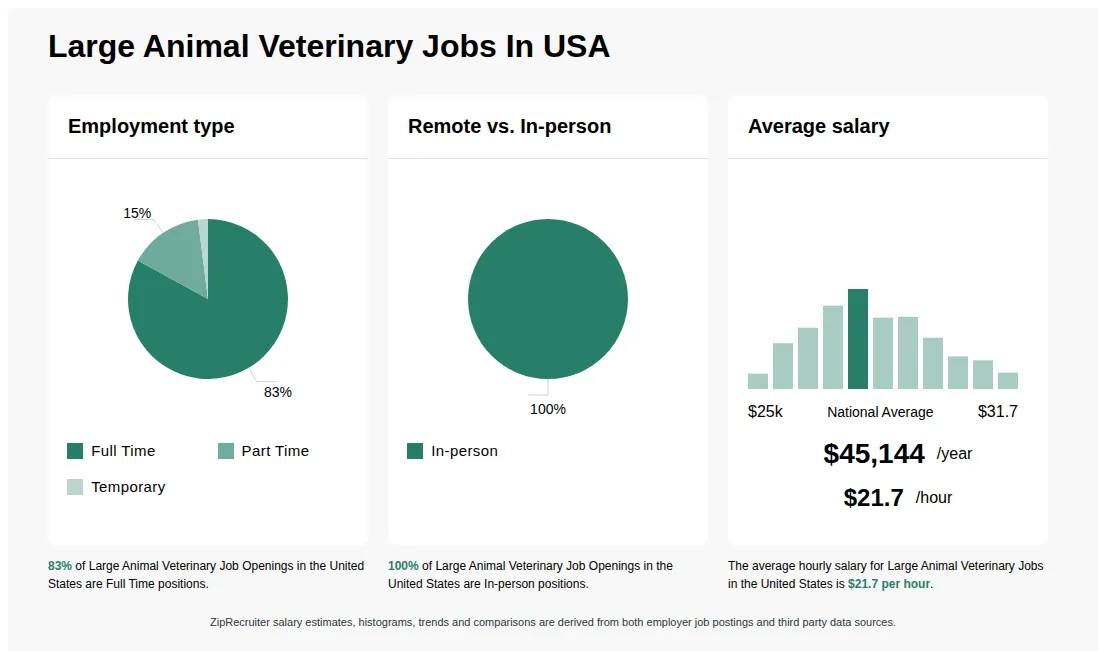
As of Jul 15, 2026, the average hourly pay for large animal veterinary in the United States is $21.70, according to ZipRecruiter salary data. Most workers in this role earn between $17.79 and $24.76 per hour, depending on experience, location, and employer.

What are large animal veterinarians?

Large animal veterinarians are medical professionals who specialize in the care and treatment of animals such as horses, cattle, sheep, goats, pigs, and other livestock. They diagnose illnesses, perform surgeries, provide preventive care, and advise owners on best practices for animal health and welfare. These veterinarians often work on farms, ranches, or in rural settings, and may also respond to emergency situations involving large animals. Their work is essential for maintaining animal health, ensuring food safety, and supporting agricultural communities.

What are some common challenges large animal veterinarians face when working on farms or ranches?

Large animal veterinarians often work in unpredictable outdoor environments, which can present logistical challenges such as inclement weather, difficult terrain, and limited access to equipment. Additionally, handling large and sometimes uncooperative animals requires strong safety awareness and physical stamina. Effective communication with farmers and ranchers is essential to ensure animal health and compliance with treatment plans. Collaboration with other veterinary professionals and agricultural workers is also a regular part of the job, fostering a team-based approach to animal care.

What is the difference between Large Animal Veterinary vs Equine Veterinarian?

AspectLarge Animal VeterinaryEquine Veterinarian
CredentialsDVM or VMD, state licensure, often additional certifications in large animal careDVM or VMD, state licensure, often specialized in equine medicine
Work EnvironmentFarms, ranches, large animal clinics, rural areasEquine clinics, stables, racetracks, rural and suburban settings
Employer & IndustryVeterinary practices, farms, livestock industriesEquine hospitals, racing industry, private horse owners

Large Animal Veterinarians and Equine Veterinarians both focus on large animals, but the former covers a broad range including cattle, pigs, and sheep, while the latter specializes specifically in horses. The credentials, work environments, and industry usage overlap significantly, but their specific focus areas differ, guiding career choices based on animal type specialization.

What are the key skills and qualifications needed to thrive as a Large Animal Veterinarian, and why are they important?

To thrive as a Large Animal Veterinarian, you need a Doctor of Veterinary Medicine (DVM) degree, state licensure, and strong diagnostic and surgical skills specific to livestock and equine species. Familiarity with laboratory diagnostics, portable imaging equipment, and herd management software is typically required. Excellent communication, physical stamina, and problem-solving abilities help build trust with clients and manage the demands of fieldwork. These skills are vital for ensuring animal health, supporting agricultural operations, and delivering effective veterinary care in diverse environments.
More about Large Animal Veterinary jobs
What cities are hiring for Large Animal Veterinary jobs? Cities with the most Large Animal Veterinary job openings:
What are the most commonly searched types of Large Animal Veterinary jobs? The most popular types of Large Animal Veterinary jobs are:
What states have the most Large Animal Veterinary jobs? States with the most job openings for Large Animal Veterinary jobs include:
Infographic showing various Large Animal Veterinary job openings in the United States as of July 2026, with employment types broken down into 76% Full Time, 22% Part Time, 1% Temporary, and 1% Contract. Highlights an 96% Physical, and 4% Remote job distribution, with an average salary of $45,144 per year, or $21.7 per hour.
Large Animal Veterinary Technician I - Livestock

Large Animal Veterinary Technician I - Livestock

Tufts University

Woodstock, CT • On-site

$23 - $31.70/hr

Full-time

Posted 20 days ago


Tufts University rating

8.4

Company rating: 8.4 out of 10

Based on 25 frontline employees who took The Breakroom Quiz

81st of 555 rated colleges and universities


Job description

Overview
The Department of Ambulatory Medicine and Theriogenology is home to Tufts Veterinary Field Service (TVFS), the largest mobile large animal practice in the Northeast providing primary care and emergency/after hours services. The 11 veterinarians in the section make approximately 4,600 farm calls per year, and tend to over 30,000 cows, 2,500 horses, and 2500 sheep/goats/alpacas/llamas.
What You'll Do
Under limited supervision, the veterinary technician provides skilled administrative and technical support for the busy large animal and multi-disciplinary ambulatory practice of eleven veterinarians. The veterinary technician is a crucial team member that supports other technicians and veterinarians in the office and on-farm as required, providing quality veterinary care to a demanding clientele and providing optimum learning experience for professional veterinary students enrolled in a demanding curriculum.
  • Technical:
    • Provide in-house technical support including equipment maintenance, preparation of surgery packs, laundry, and haul-in area maintenance.
    • Complete diagnostic testing as ordered by clinicians including bench-top lab tests (CBC, chemistry, McMasters fecal), plate and interpret milk cultures.
    • Prepare samples and complete paperwork for shipment of biological samples as ordered by clinicians.
    • Train as back-up veterinary support for selective assisted reproductive procedures such as cattle embryo transfers and laparoscopic artificial insemination of sheep and goats.
  • Maintenance:
    • Assist with inventory of medical supplies and pharmaceuticals on veterinary trucks.
    • Clean and maintain clinical areas, with primary oversight of haul-in procedure space.
    • Facilitate the maintenance of clinical equipment by identifying malfunctioning equipment and assist in scheduling/packing up for service.
    • Process laundry and prepare surgical packs.
  • Communication and Document Management:
    • Collaborate with administrative and clinical care team members throughout the hospital to coordinate and prioritize patient care.
    • Provide secondary support to Client Relations staff for taking inbound phone calls/assist with triaging. Cross-train with other office and technical staff to cover busy times of the day, and during scheduled or unscheduled absences.
    • Schedule and complete follow-up calls to clients as directed by clinicians. Schedule return visits when needed/requested.
    • Under direction of clinicians, effectively communicate with clients to explain treatment plans and review discharge instructions including medication administration.
    • Enter medical records and billing for appointments supported, as directed by clinician.
    • Become familiar with USDA regulations for animal transport, including required testing and official identification and provide guidance to clients requesting certificates of veterinary inspection. Collect and enter all details from clients as required for each transport, translate into paper forms or into Global Vet Link online database, check for accuracy, and process certificates (paper or digital) for signing by veterinarians.
  • Other:
    • Cross train with other clinic support staff to fill in as needed for staff shortages.
    • Perform other duties as assigned by Practice Administrator and senior technicians.
  • Typical 8-hour shift between 8a-5p. Some overtime may apply with advanced notice.

What We're Looking For
Basic Requirements:
Knowledge and experience typically acquired by:
  • High School Diploma
  • 2 years of experience as a veterinary assistant or technician, or similar technician experience.
  • Familiarity with veterinary and medical terminology, pharmacology and animal behavior
  • Demonstrated experience handling horses and livestock
  • Excellent written and verbal communication skills

Preferred Qualifications:
  • Familiarity with geography of TVFS service area (CT, MA, RI)
  • Customer service experience
  • Experience using/navigating veterinary practice management software, Microsoft Office suite, and medical diagnostic equipment (radiograph, ultrasound, gastroscope systems).

Pay Range
Minimum $23.00, Midpoint $27.35, Maximum $31.70
Salary is based on related experience, expertise, and internal equity; generally, new hires can expect pay between the minimum and midpoint of the range.

What Tufts University employees say

Pay

Benefits

Hours and flexibility

Workplace

Get the full story on Breakroom