1

Hmi Engineer Jobs (NOW HIRING)

PLC programming, HMI programming, and/or Drive Application programming experience highly preferred Physical Demands While performing the duties of this Job, the employee is regularly required to sit ...

Controls Engineer

Roscoe, IL ยท On-site

$75K - $120K/yr

In addition to engineering system designs, we oversee mechanical and electrical installation, write and implement PLC/HMI programming, and commission the computerized controls that set our systems ...

Electrical Controls Engineer

Chicago, IL ยท Hybrid

$82K - $110K/yr

Your expertise in electrical schematic design, PLC/HMI/VFD programming, and troubleshooting will be essential in ensuring the success of our projects. Key Responsibilities: - Supervise the drafting ...

We are seeking an experienced Automation Engineer to support process automation and control systems ... Develop, modify, troubleshoot, and maintain PLC and HMI programs. * Configure automation hardware ...

Controls Engineer

Troy, MI ยท On-site

$76K - $98K/yr

Responsible for PLC/HMI code development, code installation, debug on job site, and commissioning of the complete system. * Conducting the peripheral device programming, machine PLC programming ...

Controls Engineer- PLC/ HMI Programmer Responsibilities include the design and overseeing the assembly and installation of robotic systems * Associates or Bachelors Degree in Engineering * Possess a ...

next page

Showing results 1-20

Hmi Engineer information

See salary details

$39K

$101.8K

$137.5K

How much do hmi engineer jobs pay per year?

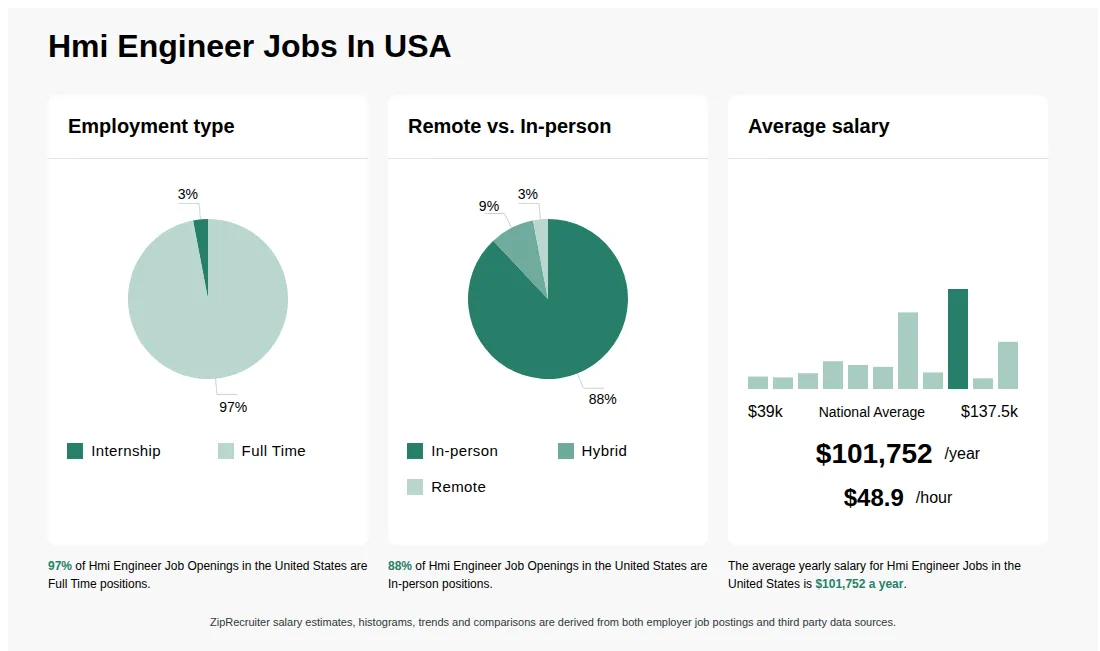
As of Jul 1, 2026, the average yearly pay for hmi engineer in the United States is $101,752.00, according to ZipRecruiter salary data. Most workers in this role earn between $84,000.00 and $116,500.00 per year, depending on experience, location, and employer.

What is the difference between Hmi Engineer vs Automation Engineer?

AspectHmi EngineerAutomation Engineer
CredentialsTypically requires a degree in electrical, computer, or control engineering; certifications in HMI software are commonRequires a degree in electrical, mechanical, or control engineering; certifications in automation systems are often preferred
Work EnvironmentDesigning and programming HMI interfaces for industrial control systems in manufacturing plantsDeveloping and maintaining automation processes and control systems in industrial settings
Industry UsageUsed across manufacturing, process control, and industrial automation sectorsApplied in manufacturing, robotics, and process industries for system automation

Both roles involve working with industrial control systems, but Hmi Engineers focus on creating user interfaces for operators, while Automation Engineers develop the control logic behind these systems. Understanding both roles helps in choosing the right career path or job focus within industrial automation.

What are HMI Engineers?

HMI Engineers, or Human-Machine Interface Engineers, specialize in designing and developing user interfaces that allow humans to interact effectively with machines, systems, or software. They focus on creating intuitive, efficient, and safe interfaces by understanding both the technical and user experience aspects. HMI Engineers work in various industries, including automotive, manufacturing, and automation, ensuring that control panels, dashboards, and software interfaces are user-friendly and meet industry standards. Their role often involves collaborating with software developers, hardware engineers, and end-users to optimize system usability.

What are the key skills and qualifications needed to thrive as an HMI Engineer, and why are they important?

To thrive as an HMI Engineer, you need a strong background in electrical engineering, computer science, or a related field, along with experience in designing and developing human-machine interfaces. Proficiency with HMI/SCADA software (such as Wonderware, Siemens WinCC, or Rockwell FactoryTalk) and familiarity with PLC programming and industrial protocols are typically required. Excellent problem-solving, attention to detail, and effective communication skills set standout professionals apart in this role. These abilities are crucial for creating intuitive, reliable interfaces that enhance operator efficiency and ensure safe, smooth industrial operations.

What are some common challenges HMI Engineers face when integrating new interfaces into existing industrial systems?

HMI Engineers often encounter challenges when integrating new interfaces with legacy systems, such as compatibility issues, data synchronization, and ensuring minimal downtime during deployment. They must carefully balance user experience improvements with the technical constraints of older hardware and software. Effective collaboration with controls engineers, IT teams, and operators is crucial to address these challenges and achieve seamless integration while maintaining system reliability and safety.
More about Hmi Engineer jobs
What cities are hiring for Hmi Engineer jobs? Cities with the most Hmi Engineer job openings:
What states have the most Hmi Engineer jobs? States with the most job openings for Hmi Engineer jobs include:
What job categories do people searching Hmi Engineer jobs look for? The top searched job categories for Hmi Engineer jobs are:
Infographic showing various Hmi Engineer job openings in the United States as of June 2026, with employment types broken down into 96% Full Time, 1% Part Time, and 3% Contract. Highlights an 95% Physical, 2% Hybrid, and 3% Remote job distribution, with an average salary of $101,752 per year, or $48.9 per hour.

Vehicle Support Engineer - HMI Systems

Wealth Recruitment, LLC

San Mateo, CA โ€ข On-site

$75/hr

Full-time

Posted 21 days ago


Job description

As a Fleet Support Engineer focused on Human Machine Interface (HMI) and passenger experience systems, youโ€™ll play a critical role in keeping our autonomous fleet operational, reliable, and customer-ready. Youโ€™ll be the technical authority for diagnosing, resolving, and preventing issues that impact in-vehicle displays, audio/visual systems, cameras, and cabin interaction modules.

This role is ideal for a hands-on engineer who thrives in real-time operational environments, enjoys deep technical problem-solving, and collaborates seamlessly across Hardware, Software, and Operations teams.

What Youโ€™ll DoTechnical Escalation & Fleet Support
  • Serve as the primary technical escalation point for HMI-related issues, including passenger displays, audio/visual alerts, interior cameras, and cabin interaction modules.
  • Provide real-time troubleshooting support to maintain fleet uptime, including on-call coverage during nights and weekends as needed.
Root Cause Analysis & Sustaining Engineering
  • Conduct deep root-cause analysis using Linux/Android system logs and electrical diagnostics to resolve complex hardware and software failures.
  • Lead sustaining engineering efforts by reviewing historical fleet data to identify failure trends such as ghost touch events, display blackouts, and audio latency, and drive permanent corrective actions.
Validation, Bring-Up & Tooling
  • Execute hardware bring-up, functional validation, and verification for new HMI components, firmware, and software releases.
  • Partner closely with HMI and Software Engineering teams to improve diagnostic tooling and increase failure-mode visibility in the field.
Documentation & Knowledge Sharing
  • Develop, maintain, and continuously improve troubleshooting guides and workflows to enable faster, more independent issue resolution by field technicians.
  • Define and capture critical data points to validate fixes and measure the effectiveness of corrective actions.
Travel
  • Occasionally travel within the U.S. to support fleet operations at various locations.

Requirements

Required Qualifications

Experience & Education

  • Minimum 4 years of relevant experience in automotive, consumer electronics, or autonomous vehicle systems, with a focus on infotainment, display technologies, or cockpit electronics.
  • Bachelorโ€™s degree in Electrical Engineering, Computer Engineering, or a related field.

Technical Skills

  • Hands-on experience troubleshooting LVDS, Ethernet, CAN, and LIN communication protocols.
  • Familiarity with LCD/OLED displays, touch controllers, and audio amplifiers.
  • Ability to read and interpret schematics, electrical diagrams, connector pinouts, and end views to distinguish wiring issues from component failures.
  • Strong understanding of hardware/software interaction, including how operating systems drive displays and peripheral devices.

Problem Solving & Collaboration

  • Demonstrated ability to take a holistic approach to diagnosing system-level issues and driving resolution down to individual components.
  • Self-starter with strong communication skills and the ability to build productive relationships across Engineering and Operations teams.
Preferred Qualifications
  • Experience with Android Automotive or Linux-based infotainment systems.
  • Experience supporting remote vehicle troubleshooting.
  • Knowledge of vehicle systems and Unified Diagnostic Services (UDS).
  • Proficiency with Linux and Python for parsing and analyzing large log files.
  • Familiarity with networking concepts, including TCP and socket programming.
  • Experience with audio system tuning or debugging.

Benefits

Pay Rate = $75 per hour

Contract Assignment

Schedule - Monday - Friday - 8 - 5