1

Grain Operations Jobs (NOW HIRING)

Grain Operations Manager Position Objective: The Grain Operations Specialist takes Individuals who take pride and ownership in their work and are conscientious, enjoy physical work, driven to ...

The Grain Operations Worker role supports daily grain operations through hands-on involvement in receiving, inspection, storage, and loading of corn and wheat across a large agricultural facility.

The Grain Operations Worker role supports daily grain operations through handson involvement in receiving, inspection, storage, and loading of corn and wheat across a large agricultural facility.

Join CHS, Inc as a Grain Operations Manager in Pipestone, MN! Daily you will work alongside the team by providing strategic & operational oversight for all functions and production processes.

Large and long standing grain operation is looking for an expereinced grain operations employee ready for the next step or current grain manager or to manage a top production facility. Pay will be ...

next page

Showing results 1-20

People also search for

Grain Operations information

See salary details

$33K

$60.8K

$82K

How much do grain operations jobs pay per year?

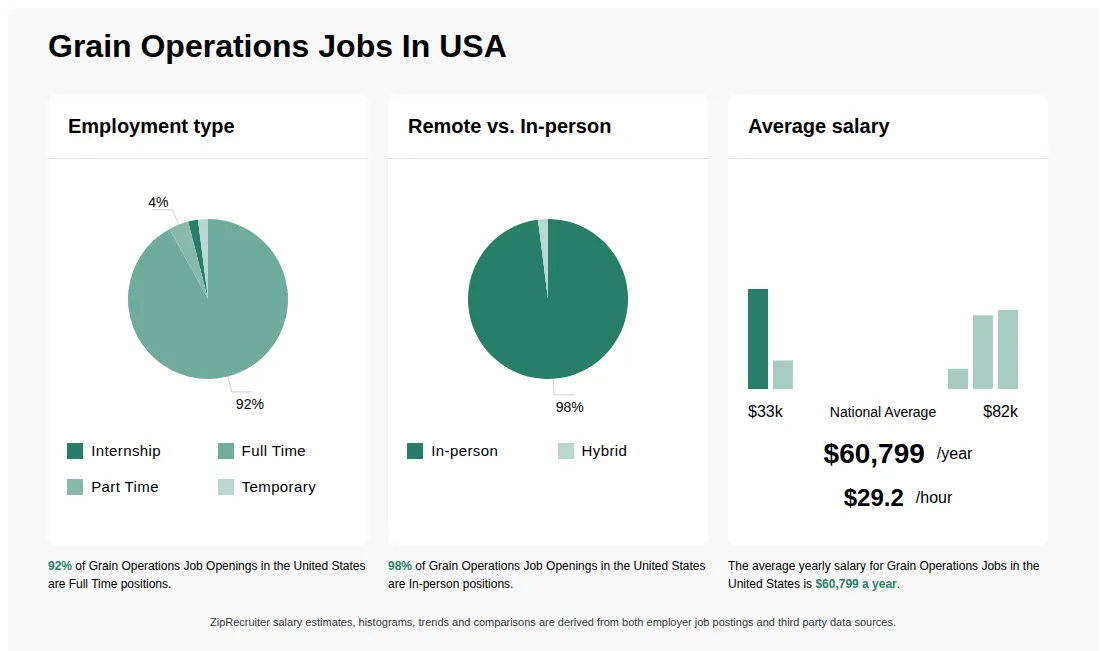
As of Jun 5, 2026, the average yearly pay for grain operations in the United States is $60,799.00, according to ZipRecruiter salary data. Most workers in this role earn between $36,500.00 and $78,000.00 per year, depending on experience, location, and employer.

What are the key skills and qualifications needed to thrive in Grain Operations, and why are they important?

To thrive in Grain Operations, you need a solid understanding of grain handling, inventory management, and basic mechanical skills, often supported by a high school diploma or relevant experience. Familiarity with grain elevators, conveyor systems, and safety protocols, as well as certifications such as OSHA training, are typically required. Attention to detail, problem-solving abilities, and strong teamwork are standout soft skills for this role. These competencies ensure safe, efficient grain handling and contribute to the smooth operation of agricultural supply chains.

What are some common challenges faced in a Grain Operations role, and how can they be effectively managed?

Grain Operations professionals often face challenges such as managing fluctuating inventory levels, maintaining equipment, and ensuring safety and quality standards are met, especially during peak harvest seasons. Effective time management, attention to detail, and proactive communication with team members are crucial for success. Regular equipment inspections and ongoing training help address operational issues, while collaboration with logistics and quality assurance teams ensures smooth workflow and compliance with industry regulations.

What are grain operations?

Grain operations refer to the processes involved in handling, storing, and transporting grain crops such as wheat, corn, soybeans, and barley. Professionals in this field work at grain elevators, processing plants, and storage facilities to ensure the safe and efficient movement and quality control of grain. Their responsibilities often include loading and unloading grain, monitoring storage conditions, maintaining equipment, and adhering to safety and quality standards. Grain operations are essential to the agricultural supply chain, ensuring that grain moves from farms to markets or processing centers reliably.

What is the difference between Grain Operations vs Grain Handling Worker?

AspectGrain OperationsGrain Handling Worker
CertificationsTypically requires safety and equipment operation certificationsOften requires basic safety training and possibly forklift certification
Work EnvironmentInvolves managing entire grain processes, including storage, quality control, and logisticsPrimarily involved in loading, unloading, and moving grain within facilities
Employer & Industry UsageUsed in grain storage facilities, processing plants, and distribution centersCommonly employed at grain elevators, farms, and processing sites

Grain Operations roles encompass overseeing the entire grain handling process, including quality control and logistics, while Grain Handling Workers focus on manual tasks like loading and unloading grain. Both roles are essential in the grain industry but differ in responsibilities and required certifications.

More about Grain Operations jobs
What are the most commonly searched types of Grain Operations jobs? The most popular types of Grain Operations jobs are:
What states have the most Grain Operations jobs? States with the most job openings for Grain Operations jobs include:
Infographic showing various Grain Operations job openings in the United States as of May 2026, with employment types broken down into 92% Part Time, and 8% Contract. Highlights an 94% Physical, 2% Hybrid, and 4% Remote job distribution, with an average salary of $60,799 per year, or $29.2 per hour.

Grain Operations Specialist

Centerra Co-op

Andover, OH โ€ข On-site

Full-time

Posted 9 days ago


Job description

Grain Operations Specialist
Reports to: Grain Operations Manager
Position Objective: The Grain Operations Specialist takes Individuals who take pride and ownership in their work and are conscientious, enjoy physical work, driven to interact with others, respond positive to pressure and have an internal drive to take care of our customers.
About us: Centerra Co-op is a challenging environment surrounded by teammates that want the best for our customers. Our work environment includes flexibility of daily tasks, locations and interaction with teammates. Employees are encouraged every day and ask questions to improve the workplace. Our customers drive our business, and we work shoulder to shoulder with them to improve their operation as they define success.
Occupation Specific Tasks:
  • Safety is the first priority
  • Ability to grading grain, sample grain and storage of grain delivered by customers after being properly trained
  • Maintain grain grading license
  • Work with team to ship and receive grain commodities
  • During peak business seasons or times of increased demand, this role may be assigned temporary duties in other departments. Such cross-department support is essential to maintaining service levels and ensuring smooth company operations

Physical Demands:
The physical demands described here are representative of those that must be met by an employee to successfully perform the essential functions of this job. Reasonable accommodation may be made to enable individuals with disabilities to perform the essential functions.
  • The employee is frequently required to stand, walk, sit, use hands to finger, handle, or feel; reach with hands and arms; climb and balance; stoop, kneel, crouch, or crawl; talk or hear; and taste or smell.
  • The employee is occasionally required to lift and/or move up to 50 pounds.
  • Specific vision abilities required by this job include close vision, distance vision, color vision, peripheral vision, depth perception, and ability to adjust focus.

Work Environment:
The work environment characteristics described here are representative of those an employee encounters while performing the essential functions of this job. The work environment is typically noisy and may be hot, cold, or dusty.
  • The employee is occasionally exposed to fumes or airborne particles.
  • The noise level in the work environment is usually moderate.

Education: High School Graduate or equivalent.
As an Equal Opportunity and Affirmative Action Employer, we are committed to creating an inclusive workplace. All qualified applicants will receive consideration for employment without regard to race, color, religion, sex, sexual orientation, gender identity, national origin, disability, veteran status, or other legally protected characteristics. All duties and responsibilities are essential functions and requirements and are subject to possible modification to reasonably accommodate individuals with disabilities. Centerra Co-op is a drug-free workplace.
Centerra supports teammates that are curious, humble and committed.