1

Flight Navigator Jobs (NOW HIRING)

Naval Flight Officers are the navigators, the lookouts and the weapon operators inside naval aviation. Whether you're hunting submarines from a P-8 Poseidon, navigating an E-2 Hawkeye through enemy ...

Engineer IV

Poway, CA · On-site

$98K - $171K/yr

Communicate clearly in writing and verbally during all phases of flight test programs to include ... Experience as a test conductor, test director, test pilot/navigator or participation in a Combined ...

NY · On-site

$90 - $130/hr

This does not include simulator, helicopter, flight engineer, bombardier, navigator, RIO, EWO, WSO, NFO, or Special Crew.* Ability to deploy for an extended amount of time to various OCONUS operating ...

Engineer III

Poway, CA · On-site

$81K - $141K/yr

We have an exciting opportunity for an experienced Flight Test Engineer / Systems Test Engineer as ... Experience as a test conductor, test director, test pilot/navigator or participation in a Combined ...

NAVAL FLIGHT OFFICER - In this role, you're the navigator, the lookout and the weapon operator inside naval aviation. Whether you're hunting submarines from a P-8 Poseidon, navigating an E-2 Hawkeye ...

NAVAL FLIGHT OFFICER - In this role, you're the navigator, the lookout and the weapon operator inside naval aviation. Whether you're hunting submarines from a P-8 Poseidon, navigating an E-2 Hawkeye ...

Showing results 41-60

Flight Navigator information

See salary details

$13

$22

$33

How much do flight navigator jobs pay per hour?

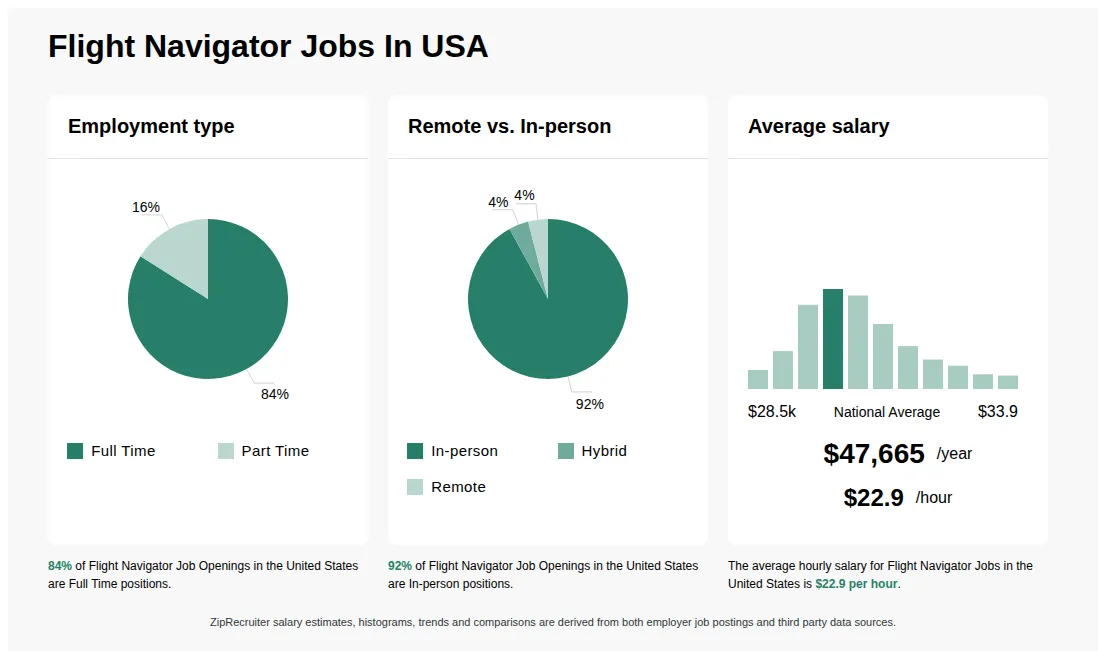
As of Aug 7, 2026, the average hourly pay for flight navigator in the United States is $22.92, according to ZipRecruiter salary data. Most workers in this role earn between $18.99 and $25.00 per hour, depending on experience, location, and employer.

What are the typical working conditions and challenges faced by flight navigators?

Flight Navigators often work in the confined space of an aircraft cockpit during flights, sometimes for extended periods and in varying weather conditions. The role involves staying focused and alert to monitor navigation systems, adjust flight paths, and provide real-time support to pilots based on changing circumstances. Navigators must be prepared to troubleshoot technical challenges, manage fatigue, and adapt quickly to unexpected situations such as reroutes due to weather or airspace restrictions. Collaboration with pilots and crew is constant, requiring strong communication skills and the ability to make swift decisions to ensure safe and efficient operations.

What are the key skills and qualifications needed to thrive in the flight navigator position, and why are they important?

To thrive as a Flight Navigator, you need strong expertise in navigation, meteorology, map reading, and calculations, typically supported by relevant training from military, government, or aviation organizations. Familiarity with navigational charts, flight computers, GPS, radar, and, when required, certifications from aviation authorities are essential. Attention to detail, composure under pressure, and effective teamwork are key soft skills in this position. Mastery of these competencies ensures accurate route planning, safe navigation, and efficient communication with pilots and crew, which are critical for flight safety and mission success.


How much do flight navigators make?

Flight navigators typically earn between $70,000 and $120,000 annually, depending on experience, employer, and location. They often require specialized training and certifications, and may work irregular hours or long shifts onboard aircraft or in control centers.

What is a flight navigator?

A Flight Navigator is responsible for determining an aircraft's position, planning its route, and ensuring it stays on course during flight. They use navigation instruments, maps, and sometimes celestial navigation to guide the aircraft safely to its destination. While modern aircraft rely on automated navigation systems, some military and specialized operations still use human navigators. Their role is crucial in long-haul or complex missions where GPS or automated systems may not be fully reliable.

What are the most commonly searched types of Flight Navigator jobs? The most popular types of Flight Navigator jobs are:
What states have the most Flight Navigator jobs? States with the most job openings for Flight Navigator jobs include:
Infographic showing various Flight Navigator job openings in the United States as of August 2026, with employment types broken down into 93% Full Time, 5% Part Time, and 2% Contract. Highlights an 97% Physical, 1% Hybrid, and 2% Remote job distribution, with an average salary of $47,665 per year, or $22.9 per hour.

Naval Aviator (Pilot/NFO) - AL & GA

U.S. Navy

Mobile, AL

Part-time

Re-posted 17 days ago


United States Navy rating

6.4

Company rating: 6.4 out of 10

Based on 379 frontline employees who took The Breakroom Quiz

42nd of 49 rated military and defense


Job description

Pilots aren’t the only Officers behind our aircraft. Naval Flight Officers are the navigators, the lookouts and the weapon operators inside naval aviation. Whether you’re hunting submarines from a P-8 Poseidon, navigating an E-2 Hawkeye through enemy territory or dropping bombs from the backseat of an F-18 fighter jet—it’s your skills that make the mission possible.

Naval Flight Officers (NFOs) are an important component in an exclusive, world-class group of Officers. This job will require you to perform at the best of your ability in your aircraft at all times. Making use of your advanced training and unparalleled knowledge to provide the utmost safety and security in the world’s skies. As an NFO, your responsibilities include:

  • Studying aerodynamics, aircraft engine systems, meteorology, navigation, flight planning and flight safety
  • Training and specializing in EA-18G Growler electronic countermeasures aircraft, E-2C Hawkeye early warning and control aircraft or the new P-8A Poseidon antisubmarine aircraft
  • Electronically detecting and tracking ships, submarines, aircraft and missiles

As a Naval Flight Officer, missions and assignments can be anywhere around the globe. This includes working from carrier battle groups, or other sea-based platforms, and at Naval Air Stations or other locations on shore.

Those pursuing a Naval Flight Officer role must first attend Officer Candidate School (OCS) in Newport, RI, and then complete a six-week air indoctrination course at Naval Aviation Schools Command, in Pensacola, FL. From there, prospective NFOs attend primary flight training.

NFO candidates then request an aircraft pipeline and enter the intermediate phase of flight training, which builds upon basic flight and navigation training. The final phase is advanced naval flight training, focusing on mission specifics. After completion, candidates are awarded their “wings of gold” and report to their respective Fleet Replacement Squadrons (FRSs) for further training specific to their aircraft.

Promotion opportunities are regularly available but competitive and based on performance.

Post-Service Opportunities

Specialized training received and work experience gained in the course of service can lead to valuable credentialing and occupational opportunities in related fields in the civilian sector.

Following your initial flying tour as a Naval Flight Officer, you can attend the Naval Postgraduate School (NPS) in Monterey, CA, where you may be able to earn a master’s or doctoral degree while being paid full-time.

Opportunities for further education within this platform include:

  • Navy College Program
  • VOLED Assistance Center
  • VOLED Region Advisors
  • The Naval Postgraduate School (NPS)
  • Navy War College (NWC)
  • USAF Air University Air Command and Staff College

Currently, this position in the Navy Reserve is open only to prior or current military aviators.

Serving part-time as a Navy Reserve Sailor, your duties will be carried out during your scheduled drilling and training periods. During monthly drilling,Naval Flight Officers in the Navy Reserve typically work at a location close to their homes.

For annual training, Naval Flight Officers may serve anywhere in the world, whether on a ship at sea or at bases and installations on shore.

Take a moment to learn more about the general roles and responsibilities of Navy Reserve Sailors.

Most of what you do in the Navy Reserve is considered training. The basic Navy Reserve commitment involves training a minimum of one weekend a month (referred to as drilling) and two weeks a year (referred to as Annual Training) – or the equivalent of that.

NFOs in the Navy Reserve serve in an Officer role. Your prior experience as an Officer satisfies the initial leadership training requirement – so you will not need to go through Officer Training again.


What United States Navy employees say

Pay

Benefits

Hours and flexibility

Workplace

Get the full story on Breakroom


US Navy logo

About US Navy

Sourced by ZipRecruiter

Industry

National security, national security and international affairs, public safety statistics centers and offices, guided missile and space vehicle manufacturing and public administration

Company size

10,000+ Employees

Headquarters location

Washington, DC, US

Social media