Groundfish Observer Position: * Training running from October 6th through October 22nd, 2026 ... Fisheries Observer programs for the NMFS Groundfish and Atlantic Sea Scallop Programs * Marine ...
New
Groundfish Observer Position: * Training running from October 6th through October 22nd, 2026 ... Fisheries Observer programs for the NMFS Groundfish and Atlantic Sea Scallop Programs * Marine ...
New
Groundfish Observer Position: * Training running from October 6th through October 22nd, 2026 ... Fisheries Observer programs for the NMFS Groundfish and Atlantic Sea Scallop Programs * Marine ...
New
Mobile, AL · On-site
$35K - $55K/yr
Become a Fisheries Observer!! A.I.S., Inc. (AIS) is a national scientific services firm supporting maritime activities requiring certification of compliance with environmental regulations as well as ...
Quick apply
Mobile, AL · On-site
$35K - $55K/yr
Become a Fisheries Observer!! A.I.S., Inc. (AIS) is a national scientific services firm supporting maritime activities requiring certification of compliance with environmental regulations as well as ...
Panama City, FL · On-site
$35K - $55K/yr
Become a Fisheries Observer!! A.I.S., Inc. (AIS) is a national scientific services firm supporting maritime activities requiring certification of compliance with environmental regulations as well as ...
Quick apply
Panama City, FL · On-site
$35K - $55K/yr
Become a Fisheries Observer!! A.I.S., Inc. (AIS) is a national scientific services firm supporting maritime activities requiring certification of compliance with environmental regulations as well as ...
Panama City, FL · On-site
$35K - $55K/yr
Become a Fisheries Observer!! A.I.S., Inc. (AIS) is a national scientific services firm supporting maritime activities requiring certification of compliance with environmental regulations as well as ...
Panama City, FL · On-site
$35K - $55K/yr
Become a Fisheries Observer!! A.I.S., Inc. (AIS) is a national scientific services firm supporting maritime activities requiring certification of compliance with environmental regulations as well as ...
Mobile, AL · On-site
$35K - $55K/yr
Become a Fisheries Observer!! A.I.S., Inc. (AIS) is a national scientific services firm supporting maritime activities requiring certification of compliance with environmental regulations as well as ...
Mobile, AL · On-site
$35K - $55K/yr
Become a Fisheries Observer!! A.I.S., Inc. (AIS) is a national scientific services firm supporting maritime activities requiring certification of compliance with environmental regulations as well as ...
Mobile, AL · On-site
$19.33/hr
Become a Fisheries Observer!! A.I.S., Inc. (AIS) is a national scientific services firm supporting maritime activities requiring certification of compliance with environmental regulations as well as ...
Mobile, AL · On-site
$19.33/hr
Become a Fisheries Observer!! A.I.S., Inc. (AIS) is a national scientific services firm supporting maritime activities requiring certification of compliance with environmental regulations as well as ...
Panama City, FL · On-site
$19.33/hr
Become a Fisheries Observer!! A.I.S., Inc. (AIS) is a national scientific services firm supporting maritime activities requiring certification of compliance with environmental regulations as well as ...
Panama City, FL · On-site
$19.33/hr
Become a Fisheries Observer!! A.I.S., Inc. (AIS) is a national scientific services firm supporting maritime activities requiring certification of compliance with environmental regulations as well as ...
Galveston, TX · On-site
$19.33/hr
Become a Fisheries Observer!! A.I.S., Inc. (AIS) is a national scientific services firm supporting maritime activities requiring certification of compliance with environmental regulations as well as ...
Galveston, TX · On-site
$19.33/hr
Become a Fisheries Observer!! A.I.S., Inc. (AIS) is a national scientific services firm supporting maritime activities requiring certification of compliance with environmental regulations as well as ...
Galveston, TX · On-site
$35K - $55K/yr
Become a Fisheries Observer!! A.I.S., Inc. (AIS) is a national scientific services firm supporting maritime activities requiring certification of compliance with environmental regulations as well as ...
Quick apply
Galveston, TX · On-site
$35K - $55K/yr
Become a Fisheries Observer!! A.I.S., Inc. (AIS) is a national scientific services firm supporting maritime activities requiring certification of compliance with environmental regulations as well as ...
Galveston, TX · On-site
$35K - $55K/yr
Become a Fisheries Observer!! A.I.S., Inc. (AIS) is a national scientific services firm supporting maritime activities requiring certification of compliance with environmental regulations as well as ...
Galveston, TX · On-site
$35K - $55K/yr
Become a Fisheries Observer!! A.I.S., Inc. (AIS) is a national scientific services firm supporting maritime activities requiring certification of compliance with environmental regulations as well as ...
North Myrtle Beach, SC · On-site
$35K - $55K/yr
Become a Fisheries Observer!! A.I.S., Inc. (AIS) is a national scientific services firm supporting maritime activities requiring certification of compliance with environmental regulations as well as ...
Quick apply
North Myrtle Beach, SC · On-site
$35K - $55K/yr
Become a Fisheries Observer!! A.I.S., Inc. (AIS) is a national scientific services firm supporting maritime activities requiring certification of compliance with environmental regulations as well as ...
North Myrtle Beach, SC · On-site
$35K - $55K/yr
Become a Fisheries Observer!! A.I.S., Inc. (AIS) is a national scientific services firm supporting maritime activities requiring certification of compliance with environmental regulations as well as ...
North Myrtle Beach, SC · On-site
$35K - $55K/yr
Become a Fisheries Observer!! A.I.S., Inc. (AIS) is a national scientific services firm supporting maritime activities requiring certification of compliance with environmental regulations as well as ...
Become a Fisheries Observer!! A.I.S., Inc. (AIS) is a national scientific services firm supporting maritime activities requiring certification of compliance with environmental regulations as well as ...
Become a Fisheries Observer!! A.I.S., Inc. (AIS) is a national scientific services firm supporting maritime activities requiring certification of compliance with environmental regulations as well as ...
New Orleans, LA · On-site
$19.33/hr
Become a Fisheries Observer!! A.I.S., Inc. (AIS) is a national scientific services firm supporting maritime activities requiring certification of compliance with environmental regulations as well as ...
New Orleans, LA · On-site
$19.33/hr
Become a Fisheries Observer!! A.I.S., Inc. (AIS) is a national scientific services firm supporting maritime activities requiring certification of compliance with environmental regulations as well as ...
New Orleans, LA · On-site
$35K - $55K/yr
Become a Fisheries Observer!! A.I.S., Inc. (AIS) is a national scientific services firm supporting maritime activities requiring certification of compliance with environmental regulations as well as ...
Quick apply
New Orleans, LA · On-site
$35K - $55K/yr
Become a Fisheries Observer!! A.I.S., Inc. (AIS) is a national scientific services firm supporting maritime activities requiring certification of compliance with environmental regulations as well as ...
New Orleans, LA · On-site
$35K - $55K/yr
Become a Fisheries Observer!! A.I.S., Inc. (AIS) is a national scientific services firm supporting maritime activities requiring certification of compliance with environmental regulations as well as ...
New Orleans, LA · On-site
$35K - $55K/yr
Become a Fisheries Observer!! A.I.S., Inc. (AIS) is a national scientific services firm supporting maritime activities requiring certification of compliance with environmental regulations as well as ...
Miami, FL · On-site
The Fishery Observer III plays a critical role in the collection, quality assurance, and supervision of fisheries-dependent data that informs national fishery management, conservation policies, and ...
Quick apply
Miami, FL · On-site
The Fishery Observer III plays a critical role in the collection, quality assurance, and supervision of fisheries-dependent data that informs national fishery management, conservation policies, and ...
Key Biscayne, FL · On-site
The Fishery Observer III plays a critical role in the collection, quality assurance, and supervision of fisheries-dependent data that informs national fishery management, conservation policies, and ...
Key Biscayne, FL · On-site
The Fishery Observer III plays a critical role in the collection, quality assurance, and supervision of fisheries-dependent data that informs national fishery management, conservation policies, and ...
The Electronic Monitoring (EM) Fisheries Specialist provides technical support to NOAA Fisheries' Fisheries Observation Science (FOS) Program, supporting both the Electronic Monitoring (EM ...
The Electronic Monitoring (EM) Fisheries Specialist provides technical support to NOAA Fisheries' Fisheries Observation Science (FOS) Program, supporting both the Electronic Monitoring (EM ...
The Electronic Monitoring (EM) Fisheries Specialist provides technical support to NOAA Fisheries' Fisheries Observation Science (FOS) Program, supporting both the Electronic Monitoring (EM ...
Quick apply
The Electronic Monitoring (EM) Fisheries Specialist provides technical support to NOAA Fisheries' Fisheries Observation Science (FOS) Program, supporting both the Electronic Monitoring (EM ...
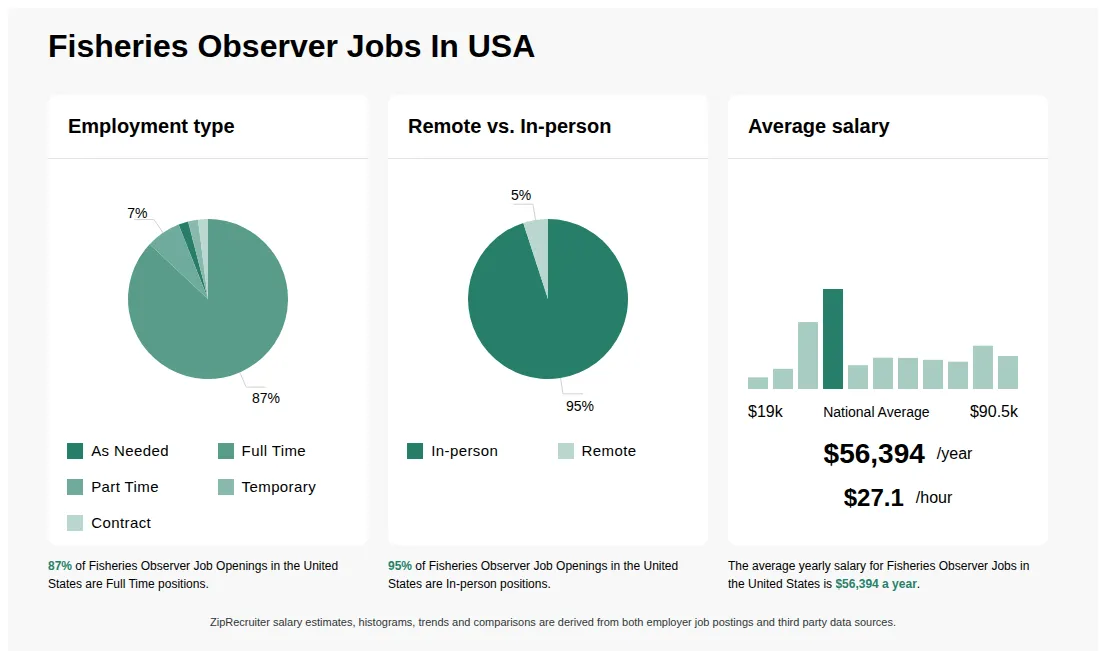
$19K - $25.5K
2% of jobs
$25.5K - $32K
4% of jobs
$32K - $38.5K
17% of jobs
$38.9K is the 25th percentile. Wages below this are outliers.
$38.5K - $45K
25% of jobs
The median wage is $47K / yr.
$45K - $51.5K
5% of jobs
$51.5K - $58K
8% of jobs
$58K - $64.5K
8% of jobs
$70.7K is the 75th percentile. Wages above this are outliers.
$64.5K - $71K
6% of jobs
$71K - $77.5K
6% of jobs
$77.5K - $84K
11% of jobs
$84K - $90.5K
8% of jobs
$19K
$56.4K
$90.5K
A Fisheries Observer is a trained professional who collects data on commercial fishing vessels to monitor catch composition, bycatch, and fishing practices. They document species caught, sizes, and any interactions with protected marine life to support fisheries management and conservation efforts. Observers work in various environments, often in remote offshore locations, and must ensure accurate, unbiased data collection. Their work helps enforce regulations, assess fishery sustainability, and inform policymaking. The role requires strong attention to detail, resilience, and the ability to work independently in challenging conditions.
Fisheries Observers typically work at sea on commercial fishing vessels, sometimes for several weeks at a time, where conditions can be physically demanding and weather unpredictable. You will be responsible for documenting catch data, monitoring bycatch, and ensuring regulatory compliance, often working independently in confined spaces alongside fishing crews. Common challenges include rough sea conditions, long hours, and adapting to a rotating schedule, but the work is rewarding for those who are adaptable and enjoy field-based scientific observation. Collaboration with vessel operators, regulators, and scientific agencies is a key part of the job, offering unique insight into marine conservation and the fishing industry. This role also provides valuable field experience and can lead to advanced opportunities in fisheries management, marine research, or environmental policy.
To thrive as a Fisheries Observer, you need strong knowledge of marine biology or fisheries science, field data collection skills, and keen attention to detail, often backed by a relevant bachelor's degree. Familiarity with GPS devices, electronic data entry systems, and safety certifications such as marine safety or first aid is typically required. Excellent observational skills, resilience, strong communication, and the ability to work independently or in remote, challenging environments help someone excel in this role. These competencies are crucial for accurately monitoring fishing activities and ensuring compliance with regulations while contributing valid scientific data under variable at-sea conditions.
Cities with the most Fisheries Observer job openings:
The most popular types of Fisheries Observer jobs are:
States with the most job openings for Fisheries Observer jobs include:
For Fisheries Observer jobs, the most frequently searched job titles are:

Middletown, RI • On-site
Other
Posted 2 days ago
New
NEED A CHALLENGING, BUT REWARDING CAREER?
Fathom Resources may just have the job for you
Fathoms Research Department Specializes in:Marine and fisheries Data collection services, for use by scientists and industry members for the management of commercial fisheries and marine environments. Department staff include fisheries biologists, marine mammal experts and professional observers. Fathom completes work in:
Fisheries Observers work as the only scientist on board a commercial fishing vessel. Vessels average 70 feet in length operating in ocean waters up to 200 miles offshore in all weather conditions. Trips lengths range from 7 to 15 days in length and are dependent on individual trips fishing effort. Trips require observers to live in cramped quarters in close proximity to vessel crew while at sea. Observers are responsible for the accurate recording and collection of:
Fathom is currently hiring Marine Fisheries Biologists for At-sea work in the Groundfish Observer Programs. Approved candidates will attend a 2.5 week paid National Marine Fisheries Services led training. Training is fully in-person taking place in Falmouth, MA. Training includes paid training wage, provided lodging at no cost to trainee and paid meal per diem for the duration of training. New hires are to have their own lodging set up within 50 miles or closer to their assigned port no later than by the end of training.
Open port assignments include New Bedford, MA, Boston, MA and Gloucester, MA.
Marine Fisheries Biologist Requirements specific to Observing:Candidates must possess

Sourced by ZipRecruiter
Environmental consulting services
11 - 50 Employees
New Bedford, MA, US
2002

