1

Fiber And Cable Pulling Jobs (NOW HIRING)

Be Seen First

4.2.1 The Cable Puller Technician (CPT) shall have capability to provide Layer 1 infrastructure ... Layer 1 includes Inside Plant (ISP), which includes fiber and copper network drops, wireless APs ...

Network Installation Technician

Philadelphia, PA ยท On-site

$23.75 - $30.50/hr

Install Inner Duct for fiber optic cable * Install cable supports systems under the floor * Install firestop and/or smoke barrier system * Perform cable pulling setup * Install pull string or rope in ...

Network Installation Technician

Philadelphia, PA ยท On-site

$23.75 - $30.50/hr

Install Inner Duct for fiber optic cable * Install cable supports systems under the floor * Install firestop and/or smoke barrier system * Perform cable pulling setup * Install pull string or rope in ...

Network Installation Technician

Philadelphia, PA ยท On-site

$23.75 - $30.50/hr

Install Inner Duct for fiber optic cable * Install cable supports systems under the floor * Install firestop and/or smoke barrier system * Perform cable pulling setup * Install pull string or rope in ...

Fiber Technician

Lake Buena Vista, FL ยท On-site

$18 - $25/hr

We currently work in fiber optics, Cat6, and Coax. We do specialize in fiber optic work. We do new ... We do cable pulling, terminating, and testing. Just to be clear this is not an IT job. This is ...

next page

Showing results 1-20

Fiber And Cable Pulling information

See salary details

$16

$26

$36

How much do fiber and cable pulling jobs pay per hour?

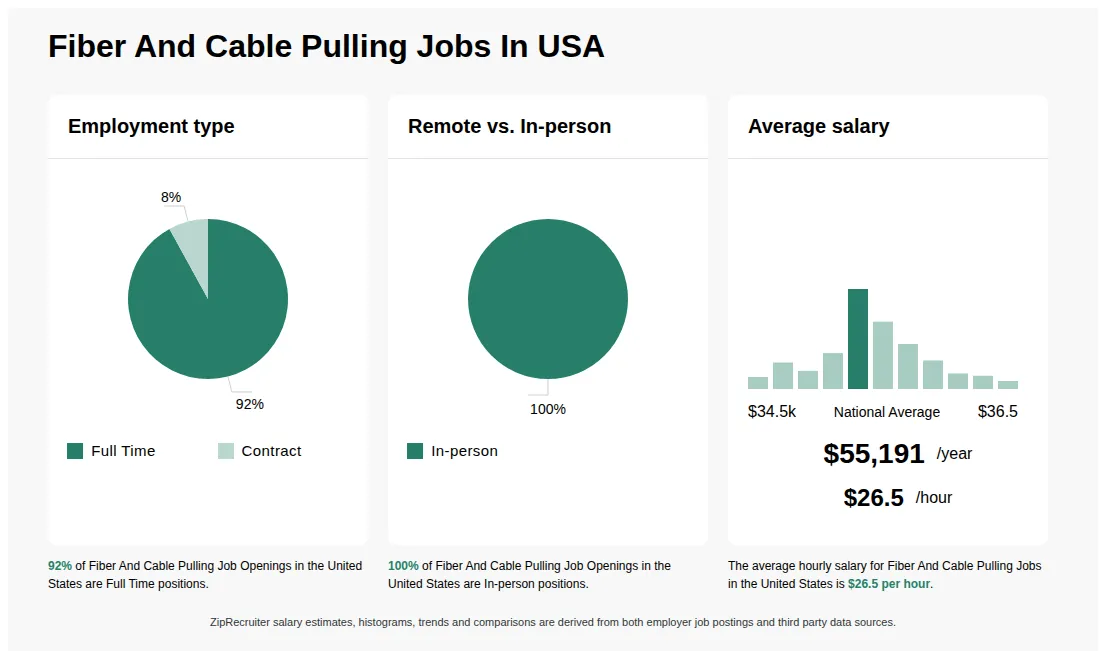
As of Jun 15, 2026, the average hourly pay for fiber and cable pulling in the United States is $26.53, according to ZipRecruiter salary data. Most workers in this role earn between $24.04 and $28.61 per hour, depending on experience, location, and employer.

What are the key skills and qualifications needed to thrive as a Fiber and Cable Puller, and why are they important?

To thrive as a Fiber and Cable Puller, you need a solid understanding of cable installation techniques, basic electrical knowledge, and often a high school diploma or equivalent. Familiarity with tools like cable pullers, fish tapes, and safety equipment, as well as certifications such as OSHA or fiber optic technician credentials, are commonly required. Attention to detail, physical stamina, teamwork, and effective communication are crucial soft skills in this field. These skills ensure safe, efficient, and high-quality installations that meet industry standards and client expectations.

How much does a cable puller make?

A cable puller, also known as a fiber and cable pulling technician, typically earns between $15 and $25 per hour, depending on experience, location, and certifications. Experienced workers or those in high-demand areas can earn higher wages, and the job often involves physical labor and the use of specialized tools.

What jobs pay 2000 a day?

In fiber and cable pulling, high-paying jobs such as experienced project managers or specialized technicians can earn around $2,000 per day, especially with overtime, certifications, and in high-demand environments. These roles often require technical skills, safety training, and experience working in construction or telecommunications settings.

What is fiber and cable pulling?

Fiber and cable pulling is the process of installing fiber optic or electrical cables through conduits, ducts, or other pathways in buildings or underground. This work is essential for establishing communication networks, such as internet, phone, and television services. Technicians use specialized equipment to carefully route cables without causing damage, ensuring efficient and reliable connectivity. The job requires attention to detail, adherence to safety standards, and sometimes working in challenging environments.

What are some common challenges faced during fiber and cable pulling, and how can they be addressed on the job?

Fiber and cable pulling professionals often encounter obstacles such as tight conduit spaces, existing infrastructure congestion, and minimizing cable damage during installation. These challenges can be addressed by carefully planning cable routes, using the appropriate pulling equipment, and employing proper techniques like using cable lubricants and maintaining suitable tension. Collaborating closely with project managers, electricians, and other trades on-site ensures smooth coordination and helps anticipate potential issues before installation begins.

What job makes $10,000 a month without a degree?

Fiber and cable pulling technicians can earn around $10,000 per month with experience, especially in high-demand areas or overtime. These roles typically require physical skill, knowledge of tools, and safety certifications but do not usually require a college degree.

How much does pulling fiber pay?

Fiber and cable pulling technicians typically earn between $15 and $25 per hour, depending on experience, location, and job complexity. Overtime, certifications, and working in challenging environments can increase pay rates.

What is the difference between Fiber And Cable Pulling vs Cable Installer?

AspectFiber And Cable PullingCable Installer
CredentialsBasic electrical or technical certifications, safety trainingElectrical or technical certifications, safety training
Work EnvironmentConstruction sites, telecommunications facilities, outdoor and indoor environmentsResidential, commercial buildings, outdoor and indoor settings
Industry UsageTelecommunications, internet service providers, data centersTelecommunications, cable TV, internet providers

Fiber And Cable Pulling and Cable Installers often share similar certifications and work environments, but Fiber And Cable Pulling focuses more on installing fiber optic cables in telecommunications infrastructure, while Cable Installers typically handle coaxial and electrical cables in residential and commercial settings. Both roles are essential in the telecommunications industry, but their specific tasks and environments differ slightly.

Infographic showing various Fiber And Cable Pulling job openings in the United States as of June 2026, with employment types broken down into 33% Full Time, and 67% Contract. Highlights an 100% In-person job distribution, with an average salary of $55,191 per year, or $26.5 per hour.
Network Cable Technician with Security Clearance

Network Cable Technician with Security Clearance

Information Management Group

Pittsburgh, PA โ€ข On-site

$21.75 - $28/hr

Other

This job post hasย expired today.ย Applications are no longer accepted.


Job description

Opportunity
As a trusted federal contractor, IMG delivers mission-focused solutions that support government customers and the people who serve them. We are currently hiring a Network Cable Technician who will support our team at Bettis Atomic Power Laboratory with installing, maintaining, and troubleshooting network cabling infrastructure, including both copper and fiber optic systems. They may also support cable pulling, terminations, testing, and documenting cable runs for the Naval Nuclear Laboratory mission. Key Responsibilities Install equipment enclosures, patch panels, and equipment (network - LAN/SAN, server, storage, UPS, etc.) as directed
Install grounding cables for equipment enclosures, equipment, and cable tray
Install cable tray/raised floor cable tray and cable tray accessories
Install intra-building backbone cabling
Install cable trays, J Hooks, and cable tray accessories
Install horizontal cable
Install work area outlets, faceplates, jacks, and patch cables
Remove kick-plates and pedestals on cubicles to install network cabling
Terminate Category 3, 5e, 6, and 6a UTP cable on patch panels and modular plugs Terminate 62.5-micron multimode fiber, 50-micron multimode fiber, and single mode fiber using ST, SC, and LC connectors using the anaerobic adhesive system and Corning UniCam system
Diagnose and correct copper cable and fiber optic cable problems
Replace failed equipment and install new equipment as directed
Complete network trouble tickets as directed, document test results as needed
Key Responsibilities
Installation Install equipment enclosures, patch panels, and equipment (e.g., LAN/SAN, servers, storage, UPS) as directed Install grounding cables for equipment enclosures, equipment, and cable trays Install cable trays, J-hooks, raised floor cable trays, and related accessories Install intra-building backbone cabling Install horizontal cabling Install work area outlets, faceplates, jacks, and patch cables Remove kick-plates and pedestals on cubicles to install network cabling Organize, form, and dress cables Termination Terminate Category 3, 5e, 6, and 6a UTP cables on patch panels and modular plugs Terminate 62.5-micron multimode, 50-micron multimode, and single-mode fiber using ST, SC, and LC connectors (anaerobic adhesive system or Corning UniCam system) Troubleshooting & Maintenance Diagnose and correct copper and fiber optic cable issues Replace failed equipment and install new equipment as directed Complete work orders and network trouble tickets Groom network enclosures and equipment as directed Inventory material as directed Documentation & Testing Perform certification testing of UTP cables (Category 3, 5e, 6, and 6a), fiber (multimode and single-mode), and coaxial cables Document test results as required Label and document network equipment, cable paths, rooms, and cabinets Maintain configuration/control records for copper and fiber patch panels and cable locations
Qualifications
โ€‹โ€‹5+ yearsโ€™ experience in cabling or network technician work โ€‹Qualified to install, terminate, and conduct certification testing of Category 3, 5e, 6, and 6a unshielded twisted pair (UTP) cable, multimode and single-mode fiber cable โ€‹Knowledge in the application of the following structured cable standards and codes: โ€‹ANSI/TIA/EIA 568-B โ€‹ANSI/TIA/EIA 569 โ€‹ANSI/TIA/EIA 606 โ€‹ANSI/TIA/EIA 607 โ€‹NFPA 70 โ€‹Proficient with Fluke DSX-8000 copper/fiber tester โ€‹Proficient with Fluke OFP-100-QI OptiFiber Pro Optical Time Domain Reflectometer โ€‹Writing and speaking clearly and concisely about technical topicsโ€‹
โ€‹Active Secret or L security clearance Preferred Qualifications Active Top Secret or Q security clearance