1

Fiber And Cable Pulling Jobs (NOW HIRING)

CABLE TECHNICIAN

Columbus, OH · On-site

$19.25 - $24.75/hr

Pull, route, and install various types of cables, including fiber optic, coaxial, and Ethernet, through walls, ceilings, and conduit pathways in accordance with project specifications and industry ...

CABLE TECHNICIAN

VA · On-site

Pull, route, and install various types of cables, including fiber optic, coaxial, and Ethernet, through walls, ceilings, and conduit pathways in accordance with project specifications and industry ...

CABLE TECHNICIAN

Columbus, OH · On-site

$19.25 - $24.75/hr

Pull, route, and install various types of cables, including fiber optic, coaxial, and Ethernet, through walls, ceilings, and conduit pathways in accordance with project specifications and industry ...

Cable Puller

Salt Lake City, UT · On-site

$17.25 - $19.75/hr

This role is responsible for pulling, routing, and staging low-voltage cabling (fiber and copper) throughout large-scale data center facilities under the direction of Leads and Foremen. Ideal ...

Cable Puller

Atlanta, GA · On-site

$17 - $19.75/hr

This role is responsible for pulling, routing, and staging low-voltage cabling (fiber and copper) throughout large-scale data center facilities under the direction of Leads and Foremen. Ideal ...

Cable Puller

Muskogee, OK · On-site

$17 - $19.75/hr

This role is responsible for pulling, routing, and staging low-voltage cabling (fiber and copper) throughout large-scale data center facilities under the direction of Leads and Foremen. Ideal ...

Cable Puller

Tulsa, OK · On-site

$14.75 - $17/hr

This role is responsible for pulling, routing, and staging low-voltage cabling (fiber and copper) throughout large-scale data center facilities under the direction of Leads and Foremen. Ideal ...

Network Installation Technician

Philadelphia, PA · On-site

$23.75 - $30.50/hr

Install Inner Duct for fiber optic cable * Install cable supports systems under the floor * Install firestop and/or smoke barrier system * Perform cable pulling setup * Install pull string or rope in ...

next page

Showing results 1-20

Fiber And Cable Pulling information

See salary details

$16

$26

$36

How much do fiber and cable pulling jobs pay per hour?

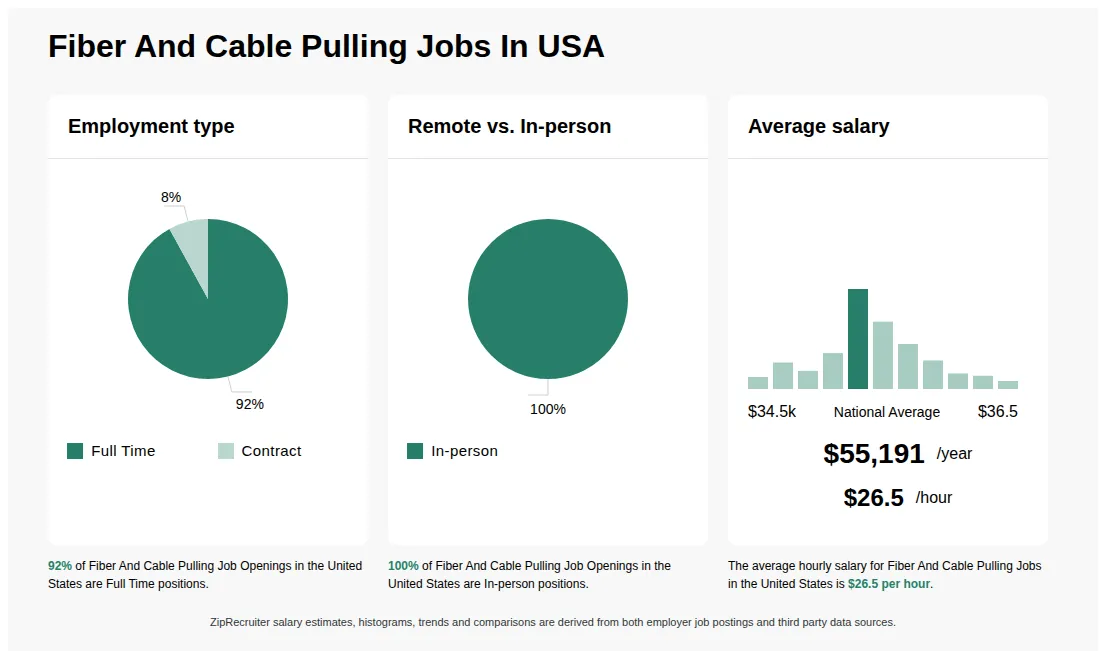
As of Jun 16, 2026, the average hourly pay for fiber and cable pulling in the United States is $26.53, according to ZipRecruiter salary data. Most workers in this role earn between $24.04 and $28.61 per hour, depending on experience, location, and employer.

What are the key skills and qualifications needed to thrive as a Fiber and Cable Puller, and why are they important?

To thrive as a Fiber and Cable Puller, you need a solid understanding of cable installation techniques, basic electrical knowledge, and often a high school diploma or equivalent. Familiarity with tools like cable pullers, fish tapes, and safety equipment, as well as certifications such as OSHA or fiber optic technician credentials, are commonly required. Attention to detail, physical stamina, teamwork, and effective communication are crucial soft skills in this field. These skills ensure safe, efficient, and high-quality installations that meet industry standards and client expectations.

How much does a cable puller make?

A cable puller, also known as a fiber and cable pulling technician, typically earns between $15 and $25 per hour, depending on experience, location, and certifications. Experienced workers or those in high-demand areas can earn higher wages, and the job often involves physical labor and the use of specialized tools.

What jobs pay 2000 a day?

In fiber and cable pulling, high-paying jobs such as experienced project managers or specialized technicians can earn around $2,000 per day, especially with overtime, certifications, and in high-demand environments. These roles often require technical skills, safety training, and experience working in construction or telecommunications settings.

What is fiber and cable pulling?

Fiber and cable pulling is the process of installing fiber optic or electrical cables through conduits, ducts, or other pathways in buildings or underground. This work is essential for establishing communication networks, such as internet, phone, and television services. Technicians use specialized equipment to carefully route cables without causing damage, ensuring efficient and reliable connectivity. The job requires attention to detail, adherence to safety standards, and sometimes working in challenging environments.

What are some common challenges faced during fiber and cable pulling, and how can they be addressed on the job?

Fiber and cable pulling professionals often encounter obstacles such as tight conduit spaces, existing infrastructure congestion, and minimizing cable damage during installation. These challenges can be addressed by carefully planning cable routes, using the appropriate pulling equipment, and employing proper techniques like using cable lubricants and maintaining suitable tension. Collaborating closely with project managers, electricians, and other trades on-site ensures smooth coordination and helps anticipate potential issues before installation begins.

What job makes $10,000 a month without a degree?

Fiber and cable pulling technicians can earn around $10,000 per month with experience, especially in high-demand areas or overtime. These roles typically require physical skill, knowledge of tools, and safety certifications but do not usually require a college degree.

How much does pulling fiber pay?

Fiber and cable pulling technicians typically earn between $15 and $25 per hour, depending on experience, location, and job complexity. Overtime, certifications, and working in challenging environments can increase pay rates.

What is the difference between Fiber And Cable Pulling vs Cable Installer?

AspectFiber And Cable PullingCable Installer
CredentialsBasic electrical or technical certifications, safety trainingElectrical or technical certifications, safety training
Work EnvironmentConstruction sites, telecommunications facilities, outdoor and indoor environmentsResidential, commercial buildings, outdoor and indoor settings
Industry UsageTelecommunications, internet service providers, data centersTelecommunications, cable TV, internet providers

Fiber And Cable Pulling and Cable Installers often share similar certifications and work environments, but Fiber And Cable Pulling focuses more on installing fiber optic cables in telecommunications infrastructure, while Cable Installers typically handle coaxial and electrical cables in residential and commercial settings. Both roles are essential in the telecommunications industry, but their specific tasks and environments differ slightly.

Infographic showing various Fiber And Cable Pulling job openings in the United States as of June 2026, with employment types broken down into 33% Full Time, and 67% Contract. Highlights an 100% In-person job distribution, with an average salary of $55,191 per year, or $26.5 per hour.

CABLE TECHNICIAN

EOA Technologies LLC

Columbus, OH • On-site

$19.25 - $24.75/hr

Other

Posted 4 days ago


Job description

Description

EOA Technologies is seeking a Cable Technician on one of our subcontracts. This is a full-time position offering the opportunity to support a U.S. Government customer. You will be responsible for the installation, routing, and termination of various types of cables, including fiber optic and data, in commercial and industrial settings. This role requires a detail-oriented individual capable of working in diverse environments, such as construction sites, commercial buildings, and outdoor spaces. The Cable Technician will work under the supervision of a Foreman or Project Manager and collaborate with other team members to ensure the successful completion of projects.


Key Responsibilities:

  • Cable Installation: Pull, route, and install various types of cables, including fiber optic, coaxial, and Ethernet, through walls, ceilings, and conduit pathways in accordance with project specifications and industry standards.
  • Cable Termination: Perform precise terminations of fiber optic and copper cables, including the installation of connectors, patch panels, and other termination hardware. Ensure that terminations meet industry standards for performance and reliability.
  • Preparation and Setup: Prepare work areas by identifying and marking locations for cable installation and termination, ensuring all tools and materials are ready for use.
  • Equipment Operation: Safely operate equipment such as fiber optic and copper testing equipment, fiber optic cleavers, crimping tools, and other specialized tools required for cable installation and termination.
  • Safety Compliance: Adhere to all safety protocols and procedures to ensure a safe working environment. Use personal protective equipment (PPE) as required.
  • Quality Assurance: Inspect and test installed and terminated cables to ensure proper connections, performance, and adherence to specifications. Use testing equipment such as OTDRs, cable testers, and certifiers.
  • Documentation: Maintain accurate records of work performed, including cable routes, lengths, termination points, and test results.
  • Team Collaboration: Work effectively as part of a team, communicating with supervisors and colleagues to coordinate efforts and resolve any installation or termination issues.
  • Problem-Solving: Identify and troubleshoot issues related to cable installation and termination, including obstructions, cable integrity problems, and signal loss.

Requirements

To be considered for this position you must have the following:

  • Possess an active Top Secret security clearance.
  • Education: High school diploma or equivalent.
  • Experience: Previous experience in cable pulling, termination, or a related field is preferred. On-the-job training will be provided for those with less experience.
  • Physical Requirements: Ability to lift at least 44 lbs., stand for extended periods, and work in confined spaces. Must be able to work at heights above 20', which includes climbing a ladder, and in various weather conditions.
  • Technical Skills: Proficient in cable pulling techniques, and cable termination, including fiber optic splicing and copper crimping. Familiarity with testing equipment and tools used in the industry.
  • Licenses/Certifications: Valid driver's license. Certifications in Single Man Lift, fiber optic and copper cabling (e.g., BICSI, FOA) and OSHA 10 or 30 certification are a plus.
  • Soft Skills: Strong attention to detail, good communication skills, and the ability to work independently or as part of a team.

Employment decisions are based solely on qualifications, merit, and business needs - not on any protected characteristic. EOA Technologies, LLC provides equal employment opportunities to all employees and applicants for employment and prohibits discrimination and harassment of any type without regard to race, color, religion, age, sex, national origin, disability status, genetics, protected veteran status, sexual orientation, gender identity or expression, ancestry, marital status, religious affiliation, hairstyle, or any other characteristic protected by federal, state or local laws. EOA is committed to providing reasonable accommodations when feasible to individuals with disabilities.