2

Entry Level Script Writing Jobs in Michigan (NOW HIRING)

This entry-level position will perform Finite Element Analysis (FEA) to solve CAE NVH / Durability ... Develop Python scripts for workflow automation. * Learn new CAE tools quickly. * Manage analysis ...

This entry-level position will perform Finite Element Analysis (FEA) to solve CAE NVH / Durability ... Develop Python scripts for workflow automation. * Learn new CAE tools quickly. * Manage analysis ...

Utilize established scripts and system workflows to accurately transcribe commercial or personal ... Exceptional written and verbal communication skills Why Join Us?: * Balance your week with standard ...

This entry-level position will perform Finite Element Analysis (FEA) to solve CAE NVH / Durability ... Develop Python scripts for workflow automation. * Learn new CAE tools quickly. * Manage analysis ...

Entry Level Script Writing information

See Michigan salary details

$17.6K

$50.6K

$138.3K

How much do entry level script writing jobs pay per year?

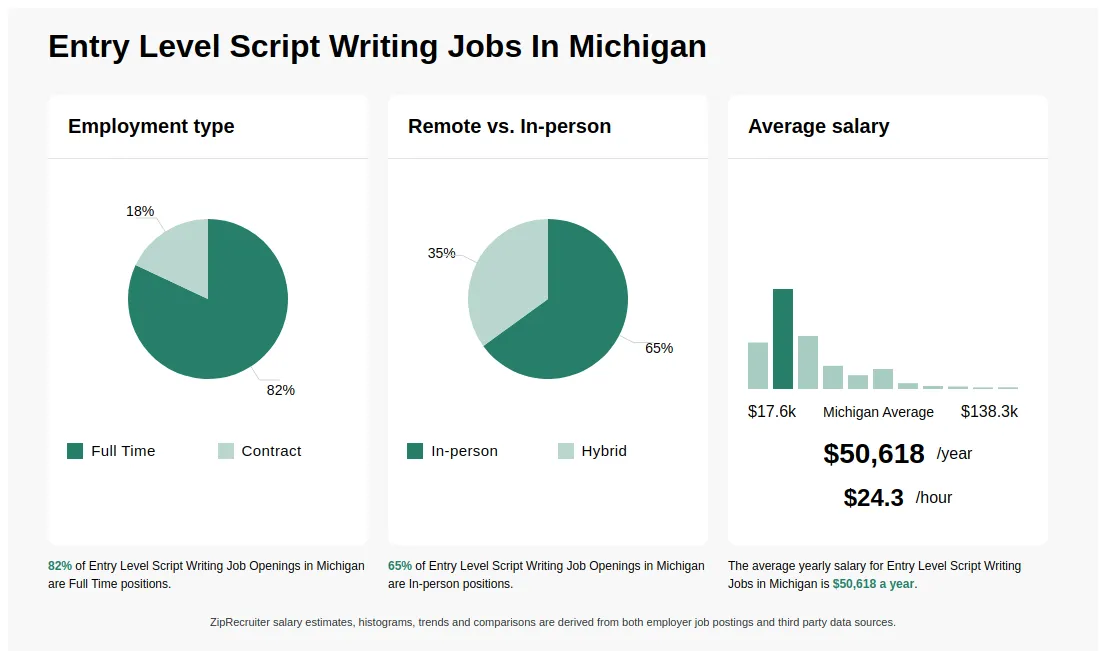
As of Jun 20, 2026, the average yearly pay for entry level script writing in Michigan is $50,618.00, according to ZipRecruiter salary data. Most workers in this role earn between $31,175.00 and $59,715.00 per year, depending on experience, location, and employer.

What are the key skills and qualifications needed to thrive in the Entry Level Script Writing position, and why are they important?

To thrive as an Entry Level Script Writer, you need strong writing skills, creativity, and a clear understanding of storytelling fundamentals, often demonstrated by relevant coursework or portfolio samples. Familiarity with script formatting software such as Final Draft or Celtx and basic knowledge of industry-standard style guides are beneficial. Excellent communication, adaptability, and openness to feedback help individuals collaborate effectively and grow in fast-paced production settings. These abilities are essential for producing compelling scripts that meet project goals and for building a successful foundation in the field.

What is an Entry Level Script Writing job?

An Entry Level Script Writing job involves creating scripts for various media, such as film, television, online content, or advertisements. Writers may assist in brainstorming ideas, drafting scripts, and revising content based on feedback. These roles often require strong storytelling skills, creativity, and an understanding of formatting conventions. Entry-level scriptwriters may work under experienced writers or producers to develop their craft. It's a great opportunity to gain experience, build a portfolio, and network within the industry.


What are the typical daily responsibilities of an Entry Level Script Writer?

Entry Level Script Writers often spend their days drafting, revising, and formatting scripts under the guidance of senior writers or producers. They may participate in brainstorming sessions, conduct research on topics relevant to the script, and incorporate feedback from team members to improve their work. Collaboration with editors, directors, and other members of the creative team is common, ensuring the final script aligns with the project’s vision. Daily responsibilities can also include proofreading, attending team meetings, and learning from feedback to enhance writing skills and industry knowledge.

What are the most commonly searched types of Script Writing jobs in Michigan? The most popular types of Script Writing jobs in Michigan are:
What are popular job titles related to Entry Level Script Writing jobs in Michigan? For Entry Level Script Writing jobs in Michigan, the most frequently searched job titles are:
What job categories do people searching Entry Level Script Writing jobs in Michigan look for? The top searched job categories for Entry Level Script Writing jobs in Michigan are:
Infographic showing various Entry Level Script Writing job openings in Michigan as of June 2026, with employment types broken down into 93% Full Time, 3% Part Time, and 4% Contract. Highlights an 97% Physical, 1% Hybrid, and 2% Remote job distribution, with an average salary of $50,618 per year, or $24.3 per hour.
Instructional Systems Designer

Full-time

Posted 8 days ago


Job description

Design Learning. Simplify Complexity. Enable Technical Performance.

The Instructional Systems Designer (ISD) is responsible for developing engaging, performance-driven training solutions focused on automotive manufacturing equipment and technical processes. This role partners closely with engineering, plant operations, and subject matter experts to translate complex information into clear, effective learning experiences.

What You'll Do

  • Design and develop ILT and web-based training (WBT) for automotive manufacturing equipment and technical topics
  • Create end-to-end learning deliverables including objectives, scripts, storyboards, instructor guides, participant materials, presentations, and assessments
  • Partner with SMEs, manufacturing engineering, and plant teams to identify skill gaps and define training requirements
  • Translate technical processes and equipment knowledge into clear, practical learning experiences
  • Develop curriculum aligned to specific equipment, systems, and operational needs
  • Use multimedia tools and authoring platforms to build engaging, modern learning solutions
  • Conduct research to support both entry-level and advanced course development
  • Manage content development timelines and ensure high-quality, accurate deliverables

What Makes You a Great Fit

  • Experience designing and developing ILT and eLearning content in technical or manufacturing environments
  • Strong instructional design and technical writing skills
  • Ability to translate complex engineering or operational concepts into clear learning content
  • Comfortable working with SMEs, engineers, and plant personnel
  • Proficiency with multimedia and course development tools (Articulate, Captivate, etc.)
  • Strong organization and time management skills
  • Able to work independently while managing multiple deliverables

Why This Role Matters

Your work directly supports the performance of technicians and manufacturing teams on the floor. By creating clear, effective training, you help ensure equipment is used correctly, processes are followed, and operations run efficiently.