Heavy Equipment Operator
Ocala, FL · On-site
Are you looking for stable work as a Heavy Equipment Operator with benefits that provide financial security for you and your family? Aspiring to advance in your heavy equipment career at a site that ...
Ocala, FL · On-site
Are you looking for stable work as a Heavy Equipment Operator with benefits that provide financial security for you and your family? Aspiring to advance in your heavy equipment career at a site that ...
Ocala, FL · On-site
Are you looking for stable work as a Heavy Equipment Operator with benefits that provide financial security for you and your family? Aspiring to advance in your heavy equipment career at a site that ...
Springdale, AR · On-site
Are you looking for stable work as a Heavy Equipment Operator I with benefits that provide financial security for you and your family? Aspiring to advance in your heavy equipment career at a site ...
Springdale, AR · On-site
Are you looking for stable work as a Heavy Equipment Operator I with benefits that provide financial security for you and your family? Aspiring to advance in your heavy equipment career at a site ...
$22 - $24/hr
Are you looking for stable work as a Heavy Equipment Operator I with benefits that provide financial security for you and your family? Aspiring to advance in your heavy equipment career at a site ...
$22 - $24/hr
Are you looking for stable work as a Heavy Equipment Operator I with benefits that provide financial security for you and your family? Aspiring to advance in your heavy equipment career at a site ...
Dayton, TN · On-site
The Heavy Equipment Operator is responsible for the safe operation of heavy equipment at a recycling center, landfill or transfer station for the purpose of transferring, spreading, covering, loading ...
Dayton, TN · On-site
The Heavy Equipment Operator is responsible for the safe operation of heavy equipment at a recycling center, landfill or transfer station for the purpose of transferring, spreading, covering, loading ...
Kershaw, SC · On-site
Heavy Equipment Operator Company: Turner Staffing Group Location: Kershaw, South Carolina, USA Position Type: Full-Time About Us: Turner Staffing Group, in collaboration with our esteemed mining ...
Quick apply
Kershaw, SC · On-site
Heavy Equipment Operator Company: Turner Staffing Group Location: Kershaw, South Carolina, USA Position Type: Full-Time About Us: Turner Staffing Group, in collaboration with our esteemed mining ...
Be Seen First
Ladson, SC · On-site
$21 - $24/hr
We are seeking a skilled Heavy Equipment Operator for one of our trusted clients in the Ladson, SC area. This is a great opportunity for an experienced professional looking to stay busy on long-term ...
Quick apply
Be Seen First
Ladson, SC · On-site
$21 - $24/hr
We are seeking a skilled Heavy Equipment Operator for one of our trusted clients in the Ladson, SC area. This is a great opportunity for an experienced professional looking to stay busy on long-term ...
$22 - $24/hr
Are you looking for stable work as a Heavy Equipment Operator I with benefits that provide financial security for you and your family? Aspiring to advance in your heavy equipment career at a site ...
$22 - $24/hr
Are you looking for stable work as a Heavy Equipment Operator I with benefits that provide financial security for you and your family? Aspiring to advance in your heavy equipment career at a site ...
$22 - $24/hr
Are you looking for stable work as a Heavy Equipment Operator I with benefits that provide financial security for you and your family? Aspiring to advance in your heavy equipment career at a site ...
$22 - $24/hr
Are you looking for stable work as a Heavy Equipment Operator I with benefits that provide financial security for you and your family? Aspiring to advance in your heavy equipment career at a site ...
Springdale, AR · On-site
Are you looking for stable work as a Heavy Equipment Operator I with benefits that provide financial security for you and your family? Aspiring to advance in your heavy equipment career at a site ...
Springdale, AR · On-site
Are you looking for stable work as a Heavy Equipment Operator I with benefits that provide financial security for you and your family? Aspiring to advance in your heavy equipment career at a site ...
Kershaw, SC · On-site
Heavy Equipment Operator Company: Turner Staffing Group Location: Kershaw, South Carolina, USA Position Type: Full-Time About Us: Turner Staffing Group, in collaboration with our esteemed mining ...
Kershaw, SC · On-site
Heavy Equipment Operator Company: Turner Staffing Group Location: Kershaw, South Carolina, USA Position Type: Full-Time About Us: Turner Staffing Group, in collaboration with our esteemed mining ...
Morrisville, NC · On-site
Are you looking for stable work as a Heavy Equipment Operator with benefits that provide financial security for you and your family? Aspiring to advance in your heavy equipment career at a site that ...
Morrisville, NC · On-site
Are you looking for stable work as a Heavy Equipment Operator with benefits that provide financial security for you and your family? Aspiring to advance in your heavy equipment career at a site that ...
Are you looking for stable work as a Heavy Equipment Operator with benefits that provide financial security for you and your family? Aspiring to advance in your heavy equipment career at a site that ...
Are you looking for stable work as a Heavy Equipment Operator with benefits that provide financial security for you and your family? Aspiring to advance in your heavy equipment career at a site that ...
Heavy Equipment Operators Siteworks LLC is currently looking for Heavy Equipment Operators to work on crews specializing in grading and site utilities. We are always looking for dependable ...
Heavy Equipment Operators Siteworks LLC is currently looking for Heavy Equipment Operators to work on crews specializing in grading and site utilities. We are always looking for dependable ...
Williston, ND · On-site
$25 - $35/hr
We are currently seeking a Heavy Equipment Operator to join our growing organization. In this position, you will be responsible for operating equipment to help build roads, oil field locations ...
Quick apply
Williston, ND · On-site
$25 - $35/hr
We are currently seeking a Heavy Equipment Operator to join our growing organization. In this position, you will be responsible for operating equipment to help build roads, oil field locations ...
As a heavy equipment operator with us the minimum responsibilities are: * Operating heavy equipment such as: bulldozers, wheel loaders, motor grader, scraper, and compactors. * Performing routine ...
As a heavy equipment operator with us the minimum responsibilities are: * Operating heavy equipment such as: bulldozers, wheel loaders, motor grader, scraper, and compactors. * Performing routine ...
Nashville, TN · On-site
As a heavy equipment operator with us the minimum responsibilities are: * Operating heavy equipment such as: bulldozers, wheel loaders, motor grader, scraper, and compactors. * Performing routine ...
Nashville, TN · On-site
As a heavy equipment operator with us the minimum responsibilities are: * Operating heavy equipment such as: bulldozers, wheel loaders, motor grader, scraper, and compactors. * Performing routine ...
Job Overview We are currently seeking an experienced and skilled Heavy Equipment Operator to join our team. The ideal candidate will be responsible for operating various types of heavy machinery and ...
Job Overview We are currently seeking an experienced and skilled Heavy Equipment Operator to join our team. The ideal candidate will be responsible for operating various types of heavy machinery and ...
Ocala, FL · On-site
Are you looking for stable work as a Heavy Equipment Operator with benefits that provide financial security for you and your family? Aspiring to advance in your heavy equipment career at a site that ...
Ocala, FL · On-site
Are you looking for stable work as a Heavy Equipment Operator with benefits that provide financial security for you and your family? Aspiring to advance in your heavy equipment career at a site that ...
Springdale, AR · On-site
Are you looking for stable work as a Heavy Equipment Operator I with benefits that provide financial security for you and your family? Aspiring to advance in your heavy equipment career at a site ...
Springdale, AR · On-site
Are you looking for stable work as a Heavy Equipment Operator I with benefits that provide financial security for you and your family? Aspiring to advance in your heavy equipment career at a site ...
Dayton, TN · On-site
The Heavy Equipment Operator is responsible for the safe operation of heavy equipment at a recycling center, landfill or transfer station for the purpose of transferring, spreading, covering, loading ...
New
Quick apply
Dayton, TN · On-site
The Heavy Equipment Operator is responsible for the safe operation of heavy equipment at a recycling center, landfill or transfer station for the purpose of transferring, spreading, covering, loading ...
New
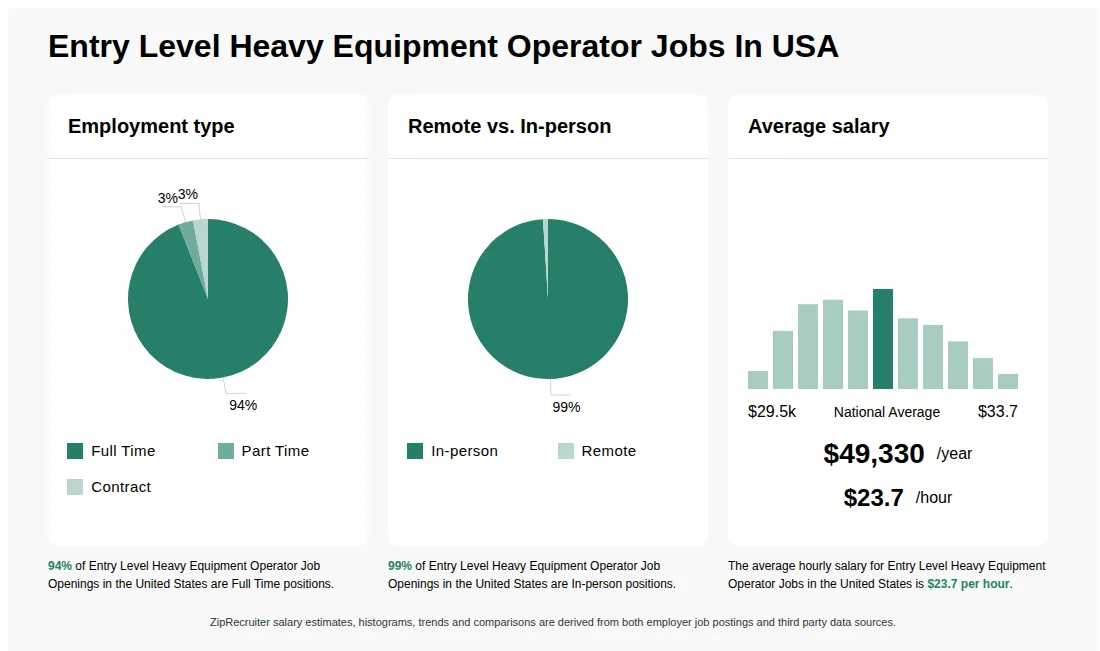
$14.18 - $15.95
2% of jobs
$15.95 - $17.72
9% of jobs
$17.72 - $19.49
13% of jobs
$19.66 is the 25th percentile. Wages below this are outliers.
$19.49 - $21.26
14% of jobs
$21.26 - $23.03
12% of jobs
The median wage is $23.09 / hr.
$23.03 - $24.80
16% of jobs
$26.35 is the 75th percentile. Wages above this are outliers.
$24.80 - $26.57
11% of jobs
$26.57 - $28.34
10% of jobs
$28.34 - $30.11
8% of jobs
$30.11 - $31.88
4% of jobs
$31.88 - $33.65
2% of jobs
$14
$23
$33
| Aspect | Entry Level Heavy Equipment Operator | Heavy Equipment Technician |
|---|---|---|
| Credentials | High school diploma, OSHA safety training | High school diploma, technical certification or diploma |
| Work Environment | Construction sites, mining, infrastructure projects | Repair shops, maintenance facilities, job sites |
| Job Focus | Operating machinery like excavators and bulldozers | Diagnosing and repairing heavy equipment |
While both roles involve heavy machinery, an Entry Level Heavy Equipment Operator primarily operates construction equipment on job sites, requiring safety training and basic certifications. In contrast, a Heavy Equipment Technician focuses on maintaining and repairing this machinery, often working in repair shops or maintenance facilities. The roles differ in skills, responsibilities, and work environments, but both are essential in the heavy equipment industry.
The job of an entry-level heavy equipment operator is to operate and perform maintenance on machinery used in building construction, like excavators, haul trucks, or snowcats. Someone in this role should follow all safety regulations on a construction site. An entry-level heavy equipment operator often works under direct supervision, although they may take on small building projects as they gain experience and demonstrate skills. Qualifications include a high school diploma and on-the-job training, although additional licensure or certification may be required for certain types of machinery.

Full-time
Medical, Dental, Vision, Retirement
Posted 14 days ago
7.6
Based on 635 frontline employees who took The Breakroom Quiz
18th of 77 rated recycling and waste
Are you looking for stable work as a Heavy Equipment Operator with benefits that provide financial security for you and your family? Aspiring to advance in your heavy equipment career at a site that prides itself on employee safety? Searching for a company that prioritizes its employees' well-being and understands the importance of family time? If this speaks to you, then WM might be the place for your next career move.
Stable work and benefits that support you and your loved ones, a schedule that respects work life balance with your safety at the heart of everything we do and support for your future with training and development based on your unique career goals. That's what you get as a Heavy Equipment Operator at WM - and more.
About us
WM is North America's leading provider of comprehensive waste management environmental services. We partner with our customers and the communities we serve to manage and reduce waste at each stage from collection to disposal, while recovering valuable resources and creating clean, renewable energy.
The pay and benefits you'll get as a Heavy Equipment Operator:
Depending on experience
Stable hours for your financial stability
Access to a stock purchase plan
Comprehensive healthcare coverage including dental, vision and prescription coverage.
We are Committed to Growth: Annual Education Assistance Benefit available for team members
Company-matched 401(k)
Adoption assistance and parent support
These are just a few of our comprehensive benefits for Heavy Equipment Operator. Whether you are planning on building or expanding your family or looking for the next step in your career - WM is there, helping build the best and total you.
The hours and location you'll work in as a Heavy Equipment Operator with WM:
Monday - Friday every week
6:45am to 4:15pm
No weekends
We're committed to offering you stable hours for the financial security and work life balance you need.
The normal setting for this job is our waste disposal site in Ocala, FL.
Those are the key details on pay and schedule - now here's more on what you'll be doing as a Heavy Equipment Operator at WM.
Each day you'll work at one of our recycling facilities that service over 20 million customers across the USA. As a Heavy Equipment Operator you'll be responsible for operating heavy equipment like bulldozers, scrapers & front-end loaders - this role is vital to the work we do, so your work will be recognized and valued for the impact it has on our operation. Our heavy equipment operators take their careers to the next level by working on equipment that requires a high level of skill - and determination. Our waste disposal sites have strict procedures in place to ensure the safety and wellbeing of all our employees.
Here's more of what you'll do:
Operates heavy equipment in compliance with the company operating safety policies and procedures.
Conducts routine equipment inspections and preventative maintenance on equipment; maintains accurate records.
Moves and positions raw materials and finished components with use of material moving equipment.
Follow appropriate standard operating procedures as per guidelines for operating and maintaining vehicle.
Performs other duties as assigned.
What do you need to be considered for the role of Heavy Equipment Operator?
1 year of experience operating heavy equipment.
Be over 18 years of age.
Legally eligible to work in the United States
Ability to perform physical requirements of the position with or without reasonable accommodations.
Successfully complete and pass pre-employment drug screen and physical.
The kind of people who thrive in our teams:
Thrive while working independently.
Take accountability for adhering to our safety guidelines.
Good communicators who are ready to support other colleagues
Able to problem solve while independently.
Work environment and physical demands:
Listed below are key points regarding physical demands, physical and occupational risks, and the work environment of the job. Reasonable accommodation may be made to enable individuals with disabilities to perform the essential functions of the job.
Required to use motor coordination with finger dexterity (such as keyboarding, machine operation, etc.) most of the workday.
Required to exert physical effort in handling objects less than 30 pounds occasionally.
Required to be exposed to physical occupational risks (such as cuts, burns, exposure to toxic chemicals, etc.) rarely.
Required to be exposed to physical environment which involves dirt, odors, noise, weather extremes or similar elements most of the workday.
Normal setting for this job is: shop or field.
ABOUT WMEqual Employment Opportunity
For United States: WM is an equal opportunity employer. All qualified applicants will receive consideration for employment without regard to race, color, creed, religion, sex, sexual orientation, gender identity, national origin, age, disability, status as a protected veteran or any other characteristic protected under applicable federal, state, or local law.
For Canada: WM is committed to the principle of equal employment for all applicants and employees, without discrimination on the basis of all grounds protected by applicable human rights legislation. Accommodations are available on request for candidates taking part in all aspects of the selection process. Please notify us if you require accommodation.
Real ID
In order to travel by air or access federal property, federal law requires individuals have a REAL ID or an acceptable alternative. This position may require the successful candidate to travel by air for business reasons, or service federal property. Accordingly, successful candidates must have, or be willing to obtain, a REAL ID, or TSA approved alternative.
Get the full story on Breakroom