Biology Research Assistants will help develop research, collect and analyze data, and communicate their research. Responsibilities * Biology Research Assistant Requirements include engaging in ...
Biology Research Assistants will help develop research, collect and analyze data, and communicate their research. Responsibilities * Biology Research Assistant Requirements include engaging in ...
... Biology Research Assistant 26-27 for the Department of Integrative Biology at Oregon State University (OSU). Applications submitted to this recruitment are reviewed on an as needed basis. Qualified ...
... Biology Research Assistant 26-27 for the Department of Integrative Biology at Oregon State University (OSU). Applications submitted to this recruitment are reviewed on an as needed basis. Qualified ...

Research Assistant, Lemaire Lab (Biology) JOB SUMMARY The Research Assistant supports investigators by performing moderately complex research and experimentation following established protocols. This ...
Research Assistant, Lemaire Lab (Biology) JOB SUMMARY The Research Assistant supports investigators by performing moderately complex research and experimentation following established protocols. This ...

Research Assistant Professor, Cardiology/ Interdisciplinary Stem Cell Institute We are seeking a ... D. equivalent in Molecular Biology, Biochemistry, Genetics or a related field. - Strong background ...
Research Assistant Professor, Cardiology/ Interdisciplinary Stem Cell Institute We are seeking a ... D. equivalent in Molecular Biology, Biochemistry, Genetics or a related field. - Strong background ...
Research Assistant Professor, Cardiology/ Interdisciplinary Stem Cell Institute We are seeking a ... D. equivalent in Molecular Biology, Biochemistry, Genetics or a related field. - Strong background ...
Research Assistant Professor, Cardiology/ Interdisciplinary Stem Cell Institute We are seeking a ... D. equivalent in Molecular Biology, Biochemistry, Genetics or a related field. - Strong background ...

RESEARCH ASSISTANT II- TB Biology
San Diego, CA · On-site
$70K/yr
Research Assistant II POSITION SUMMARY: The Research Associate will support the TB biology team with daily tasks, which may include conducting research, preparing reagents and managing data. Working ...
RESEARCH ASSISTANT II- TB Biology
San Diego, CA · On-site
$70K/yr
Research Assistant II POSITION SUMMARY: The Research Associate will support the TB biology team with daily tasks, which may include conducting research, preparing reagents and managing data. Working ...
RESEARCH ASSISTANT II- TB Biology
San Diego, CA · On-site
$70K/yr
Research Assistant II POSITION SUMMARY: The Research Associate will support the TB biology team with daily tasks, which may include conducting research, preparing reagents and managing data. Working ...
RESEARCH ASSISTANT II- TB Biology
San Diego, CA · On-site
$70K/yr
Research Assistant II POSITION SUMMARY: The Research Associate will support the TB biology team with daily tasks, which may include conducting research, preparing reagents and managing data. Working ...
Research Assistant
Orono, ME · On-site
$37K/yr
This is a research assistant position in the School of Biology and Ecology at the University of Maine with the Tan lab. Responsibilities focus primarily on activities of plant genetics laboratory at ...
Research Assistant
Orono, ME · On-site
$37K/yr
This is a research assistant position in the School of Biology and Ecology at the University of Maine with the Tan lab. Responsibilities focus primarily on activities of plant genetics laboratory at ...
Research Assistant
Orono, ME · On-site
$37K/yr
This is a research assistant position in the School of Biology and Ecology at the University of Maine with the Tan lab. Responsibilities focus primarily on activities of plant genetics laboratory at ...
Research Assistant
Orono, ME · On-site
$37K/yr
This is a research assistant position in the School of Biology and Ecology at the University of Maine with the Tan lab. Responsibilities focus primarily on activities of plant genetics laboratory at ...

Research Associate, Biology
Kokomo, IN · On-site
Position Details Title Research Associate, Biology Appointment Status Non-Tenure Track Department ... Responsibilities * Assist the PI and lab members with ongoing HIV-1 research projects. * Perform ...
Research Associate, Biology
Kokomo, IN · On-site
Position Details Title Research Associate, Biology Appointment Status Non-Tenure Track Department ... Responsibilities * Assist the PI and lab members with ongoing HIV-1 research projects. * Perform ...

Student Research Assistant LOCATION: St. Paul Campus PAY RATE: $16.50 HOURS: 10-15 hours per week Job Summary: The position involves working in a biology department lab with Dr. Amy Verhoeven on ...
Student Research Assistant LOCATION: St. Paul Campus PAY RATE: $16.50 HOURS: 10-15 hours per week Job Summary: The position involves working in a biology department lab with Dr. Amy Verhoeven on ...
Student Research Assistant LOCATION: St. Paul Campus PAY RATE: $16.50 HOURS: 10-15 hours per week Job Summary: The position involves working in a biology department lab with Dr. Amy Verhoeven on ...
Student Research Assistant LOCATION: St. Paul Campus PAY RATE: $16.50 HOURS: 10-15 hours per week Job Summary: The position involves working in a biology department lab with Dr. Amy Verhoeven on ...

Research Assistant - Metal Biology Lab (Student Position)
Big Rapids, MI · On-site
$14.99/hr
Research Assistant - Metal Biology Lab (Student Position) Job no: 498140 Work type: Student Employment - General Location: Big Rapids, MI 49307 Categories: Student Employment - General Position Title:
Research Assistant - Metal Biology Lab (Student Position)
Big Rapids, MI · On-site
$14.99/hr
Research Assistant - Metal Biology Lab (Student Position) Job no: 498140 Work type: Student Employment - General Location: Big Rapids, MI 49307 Categories: Student Employment - General Position Title:

DATA COLLECTION AND ANALYSIS: Assist with data collection during experimental procedures ... clinical trials research. Preferred Qualifications Strong biology background and hands-on ...
DATA COLLECTION AND ANALYSIS: Assist with data collection during experimental procedures ... clinical trials research. Preferred Qualifications Strong biology background and hands-on ...
Research Assistant - Metal Biology Lab (Student Position) Apply now Job no: 498140 Work type: Student Employment - General Location: Big Rapids, MI 49307 Categories: Student Employment - General ...
Research Assistant - Metal Biology Lab (Student Position) Apply now Job no: 498140 Work type: Student Employment - General Location: Big Rapids, MI 49307 Categories: Student Employment - General ...
The Vascular Biology Center at the Medical College of Georgia at Augusta University knows the ... the research protocols. DATA COLLECTION AND ANALYSIS: Assist with data collection during ...
The Vascular Biology Center at the Medical College of Georgia at Augusta University knows the ... the research protocols. DATA COLLECTION AND ANALYSIS: Assist with data collection during ...

Graduate Research Assistant (NSF- Bio&Chem)
Laredo, TX · On-site
$18.50/hr
The TAMIU Department of Biology & Chemistry is seeking a highly motivated research-oriented individual for NSF grant-funded Graduate Research Assistant (a part-time) position. We are seeking a ...
Graduate Research Assistant (NSF- Bio&Chem)
Laredo, TX · On-site
$18.50/hr
The TAMIU Department of Biology & Chemistry is seeking a highly motivated research-oriented individual for NSF grant-funded Graduate Research Assistant (a part-time) position. We are seeking a ...
Graduate Research Assistant (NSF- Bio&Chem)
Laredo, TX · On-site
$18.50/hr
The TAMIU Department of Biology & Chemistry is seeking a highly motivated research-oriented individual for NSF grant-funded Graduate Research Assistant (a part-time) position. We are seeking a ...
Graduate Research Assistant (NSF- Bio&Chem)
Laredo, TX · On-site
$18.50/hr
The TAMIU Department of Biology & Chemistry is seeking a highly motivated research-oriented individual for NSF grant-funded Graduate Research Assistant (a part-time) position. We are seeking a ...
Research Associate - Biology
Whitewater, WI · On-site
$45K - $50K/yr
Research Associate - Biology Job Category: Employees in Training Employment Type: Terminal (Fixed ... assistant, optometry, and veterinary medicine. Our department is particularly supportive of ...
Research Associate - Biology
Whitewater, WI · On-site
$45K - $50K/yr
Research Associate - Biology Job Category: Employees in Training Employment Type: Terminal (Fixed ... assistant, optometry, and veterinary medicine. Our department is particularly supportive of ...

Research Associate - Biology
Whitewater, WI · On-site
$45K - $50K/yr
Research Associate - Biology Job Category: Employees in Training Employment Type: Terminal (Fixed ... assistant, optometry, and veterinary medicine. Our department is particularly supportive of ...
Research Associate - Biology
Whitewater, WI · On-site
$45K - $50K/yr
Research Associate - Biology Job Category: Employees in Training Employment Type: Terminal (Fixed ... assistant, optometry, and veterinary medicine. Our department is particularly supportive of ...
Biology Research Assistant information
See salary details
$9.62 - $13.48
11% of jobs
$16.96 is the 25th percentile. Wages below this are outliers.
$13.48 - $17.35
16% of jobs
The median wage is $21.22 / hr.
$17.35 - $21.22
23% of jobs
$21.22 - $25.09
10% of jobs
$25.09 - $28.96
7% of jobs
$31.86 is the 75th percentile. Wages above this are outliers.
$28.96 - $32.82
11% of jobs
$32.82 - $36.69
0% of jobs
$36.69 - $40.56
18% of jobs
$40.56 - $44.43
1% of jobs
$44.43 - $48.30
1% of jobs
$48.30 - $52.16
2% of jobs
$9
$26
$52
How much do biology research assistant jobs pay per hour?
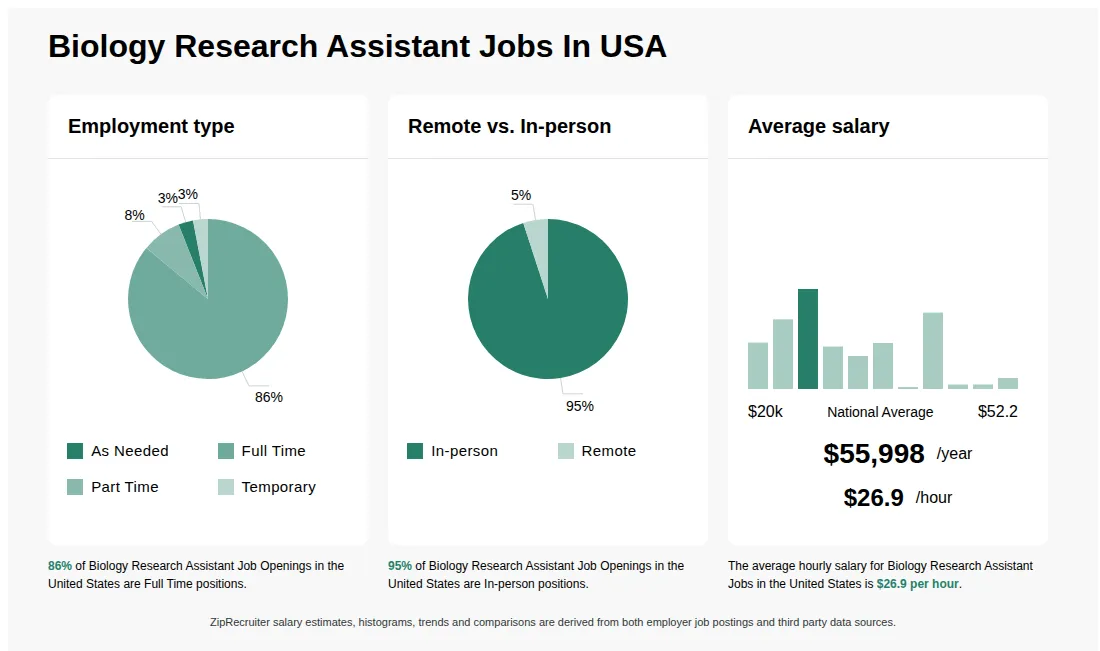
As of Sep 12, 2026, the average hourly pay for biology research assistant in the United States is $26.92, according to ZipRecruiter salary data. Most workers in this role earn between $18.03 and $39.66 per hour, depending on experience, location, and employer.
What does a biology research assistant do?
A biology research assistant helps researchers as they perform biological studies. Your job responsibilities in this career could take you to a lab setting or out in the field to collect samples. Your exact duties as a research assistant depend on the needs of your employer. You may test samples or collect and collate data from an experiment. You may also analyze the results of a study or test and then organize them into a report for the lead biologists.
What does a biology research assistant do?
A Biology Research Assistant helps scientists and researchers conduct experiments and collect data in biological studies. Their tasks often include setting up laboratory equipment, preparing samples, recording observations, and analyzing results. They may also assist with literature reviews, maintain lab records, and ensure compliance with safety protocols. This role is crucial for supporting research projects in areas such as genetics, ecology, or microbiology.
What are the key skills and qualifications needed to thrive as a biology research assistant, and why are they important?
To thrive as a Biology Research Assistant, you need a solid background in biological sciences, laboratory techniques, and data analysis, typically supported by a bachelor's degree in biology or a related field. Familiarity with laboratory equipment, statistical software (such as SPSS or R), and safety protocols is commonly required. Attention to detail, effective communication, and strong organizational skills help you excel in collaborative research environments. These skills are crucial for ensuring accurate data collection, maintaining lab integrity, and supporting successful scientific outcomes.
What are some common challenges faced by biology research assistants when working on laboratory experiments?
Biology Research Assistants often encounter challenges such as troubleshooting unexpected experimental results, maintaining meticulous records, and ensuring proper use and calibration of lab equipment. They must also adapt to evolving research protocols and occasionally manage multiple projects or deadlines simultaneously. Strong attention to detail and effective communication with principal investigators and team members can help address these challenges and contribute to successful research outcomes.
What is the difference between Biology Research Assistant vs Laboratory Technician?
| Aspect | Biology Research Assistant | Laboratory Technician |
|---|---|---|
| Required Credentials | Bachelor's degree in biology or related field; some roles may require research experience | Associate's degree or certification in laboratory techniques; relevant technical training |
| Work Environment | Research labs, academic institutions, biotech companies | Clinical, industrial, or research laboratories |
| Employer & Industry Usage | Universities, research institutes, biotech firms | Hospitals, diagnostic labs, manufacturing facilities |
| Common Search & Comparison Intent | Understanding roles in research projects, academic careers | Technical lab work, supporting laboratory operations |
In summary, Biology Research Assistants typically hold a bachelor's degree and focus on supporting research projects in academic or biotech settings. Laboratory Technicians often have technical certifications and perform routine lab procedures in clinical or industrial labs. Both roles are essential in scientific environments but differ mainly in educational requirements and job focus.
More about Biology Research Assistant jobs
What cities are hiring for Biology Research Assistant jobs?
Cities with the most Biology Research Assistant job openings:
What are the most commonly searched types of Biology Research jobs?
The most popular types of Biology Research jobs are:
Who are the top companies hiring for Biology Research Assistant jobs?
The top employers for Biology Research Assistant jobs are:
What states have the most Biology Research Assistant jobs?
States with the most job openings for Biology Research Assistant jobs include:
What are popular job titles related to Biology Research Assistant jobs?
For Biology Research Assistant jobs, the most frequently searched job titles are:

Biology Student Research Assistant - Federal Work Study
Dahlonega, GA • On-site
University of North Georgia
• Colleges, Universities, and Professional Schools • 1 - 5K employees1,001 - 5,000 employees
Part-time
Re-posted 9 days ago
University Of North Georgia rating

6.6
Based on 9 frontline employees who took The Breakroom Quiz
Job description
About Us
Located in the fastest-growing region of the state, the University of North Georgia is a multi-campus university with an enrollment of over 20,000 students, making it one of the largest institutions in the University System of Georgia. UNG is focused on a mission of educational excellence, leadership development and community engagement opportunities that develop students into leaders for a diverse and global society. Through a variety of educational pathways that provide access and range from certificates and associate degrees to a professional doctoral program, UNG is responsive to regional education and economic development needs. Federally designated as a senior military college, one of the university's signature leadership programs is its 800-member Corps of Cadets on UNG's Dahlonega Campus.
Job Summary
The University of North Georgia is currently accepting applications for a federal work study student in the Biology department on the Gainesville campus. Biology Research Assistants will help develop research, collect and analyze data, and communicate their research.
Responsibilities
Knowledge, Skills, & Abilities
Required Qualifications
Required Documents to Attach
USG Core Values
The University System of Georgia is comprised of our 25 institutions of higher education and learning as well as the System Office. Our USG Statement of Core Values are Integrity, Excellence, Accountability, and Respect. These values serve as the foundation for all that we do as an organization, and each USG community member is responsible for demonstrating and upholding these standards. More details on the USG Statement of Core Values and Code of Conduct are available in USG Board Policy 8.2.18.1.2 and can be found on-line at https://www.usg.edu/policymanual/section8/C224/#p8.2.18_personnel_conduct .
Additionally, USG supports Freedom of Expression as stated in Board Policy 6.5 Freedom of Expression and Academic Freedom found on-line at https://www.usg.edu/policymanual/section6/C2653 .
Institutional Values
The University of North Georgia, a regional multi-campus institution and premier senior military college, provides a culture of academic excellence in a student-focused environment that includes quality education, service, research, and creativity. This is accomplished through broad access to comprehensive academic and co-curricular programs that develop students into leaders for a diverse and global society. The University of North Georgia is a University System of Georgia leadership institution and is The Military College of Georgia. More details on the UNG Mission, Values, Vision, and Culture can be found at https://ung.edu/about/mission-vision-values.php
Conditions of Employment
Offers of employment are contingent upon completion of a background investigation including a criminal background check demonstrating your eligibility for employment with the University of North Georgia, as determined by University of North Georgia in its sole discretion, confirmation of the credentials and employment history reflected in your application materials and, if applicable, a satisfactory credit check. Applicants may be subject to a pre-employment drug test.
Equal Employment Opportunity
The University of North Georgia, a unit of the University System of Georgia, is an Affirmative Action/Equal Opportunity employer and does not discriminate on the basis of race, color, gender, sex or national origin, age, disability, religion, genetics or veteran status. Georgia is an open records state. Also, UNG is a federal contractor and desires priority referrals of protected veterans.
Other Information
Please note: the University of North Georgia career board updates daily, positions are subject to be removed without prior notice or before the posting expires.
Located in the fastest-growing region of the state, the University of North Georgia is a multi-campus university with an enrollment of over 20,000 students, making it one of the largest institutions in the University System of Georgia. UNG is focused on a mission of educational excellence, leadership development and community engagement opportunities that develop students into leaders for a diverse and global society. Through a variety of educational pathways that provide access and range from certificates and associate degrees to a professional doctoral program, UNG is responsive to regional education and economic development needs. Federally designated as a senior military college, one of the university's signature leadership programs is its 800-member Corps of Cadets on UNG's Dahlonega Campus.
Job Summary
The University of North Georgia is currently accepting applications for a federal work study student in the Biology department on the Gainesville campus. Biology Research Assistants will help develop research, collect and analyze data, and communicate their research.
Responsibilities
- Biology Research Assistant Requirements include engaging in regular meetings to discuss research ideas, concepts, and progression.
- Outside of the regular discussion meetings, Biology Research Assistants will schedule times to collect and analyze data.
- They will communicate their research using standard scientific methods (e.g., poster, oral presentation, and/or scientific article).
Knowledge, Skills, & Abilities
- Show a desire for continued learning and engaging in the scientific process.
- Committed to following through the research process from development to communication.
Required Qualifications
- Must be enrolled at the University of North Georgia in a minimum of six (6) credit hours to qualify as a student worker.
- Showing competency in BIOL 1107K and BIOL 1108K ("A" or "B" grade in the course)
Required Documents to Attach
- Resume
- Cover Letter
- Federal Work Study Award
USG Core Values
The University System of Georgia is comprised of our 25 institutions of higher education and learning as well as the System Office. Our USG Statement of Core Values are Integrity, Excellence, Accountability, and Respect. These values serve as the foundation for all that we do as an organization, and each USG community member is responsible for demonstrating and upholding these standards. More details on the USG Statement of Core Values and Code of Conduct are available in USG Board Policy 8.2.18.1.2 and can be found on-line at https://www.usg.edu/policymanual/section8/C224/#p8.2.18_personnel_conduct .
Additionally, USG supports Freedom of Expression as stated in Board Policy 6.5 Freedom of Expression and Academic Freedom found on-line at https://www.usg.edu/policymanual/section6/C2653 .
Institutional Values
The University of North Georgia, a regional multi-campus institution and premier senior military college, provides a culture of academic excellence in a student-focused environment that includes quality education, service, research, and creativity. This is accomplished through broad access to comprehensive academic and co-curricular programs that develop students into leaders for a diverse and global society. The University of North Georgia is a University System of Georgia leadership institution and is The Military College of Georgia. More details on the UNG Mission, Values, Vision, and Culture can be found at https://ung.edu/about/mission-vision-values.php
Conditions of Employment
Offers of employment are contingent upon completion of a background investigation including a criminal background check demonstrating your eligibility for employment with the University of North Georgia, as determined by University of North Georgia in its sole discretion, confirmation of the credentials and employment history reflected in your application materials and, if applicable, a satisfactory credit check. Applicants may be subject to a pre-employment drug test.
Equal Employment Opportunity
The University of North Georgia, a unit of the University System of Georgia, is an Affirmative Action/Equal Opportunity employer and does not discriminate on the basis of race, color, gender, sex or national origin, age, disability, religion, genetics or veteran status. Georgia is an open records state. Also, UNG is a federal contractor and desires priority referrals of protected veterans.
Other Information
- This is not a supervisory position.
- This position does not have any financial responsibilities.
- This position will not be required to drive.
- This role is not considered a position of trust.
- This position does not require a purchasing card (P-Card).
- This position will not travel
- This position does not require security clearance.
Please note: the University of North Georgia career board updates daily, positions are subject to be removed without prior notice or before the posting expires.
What University Of North Georgia employees say
Pay
Hours and flexibility
Workplace
Get the full story on Breakroom

About University of North Georgia
Sourced by ZipRecruiter
Industry
Colleges, universities, and professional schools
Company size
1,001 - 5,000 Employees
Headquarters location
Dahlonega, GA, US
Year founded
1873