1

Ballistics Expert Jobs (NOW HIRING)

Integration Systems Engineer

Littleton, CO · On-site

$170K/yr

For over 60 years, the Fleet Ballistic Missile (FBM) team has supported the Navy's mission to ... Organize/coordinate domain expert objective evidence creation and documentation. Organize ...

Aerospace Manufacturing SME

Mclean, VA · On-site

$139K - $251K/yr

Provide expert advice and support to government customers on materials, equipment, and infrastructure related to ballistic missile proliferation and production. * Deliver training and teach ...

Systems Engineer Senior

Littleton, CO

$106K - $145K/yr

For over 60 years, the Fleet Ballistic Missile (FBM) team has supported the Navy's mission to ... Organize/coordinate domain expert objective evidence creation and documentation. Organize ...

Aerospace Manufacturing SME

Mclean, VA · On-site

$139K - $251K/yr

Provide expert advice and support to government customers on materials, equipment, and infrastructure related to ballistic missile proliferation and production. * Deliver training and teach ...

next page

Showing results 1-20

Ballistics Expert information

See salary details

$9

$40

$72

How much do ballistics expert jobs pay per hour?

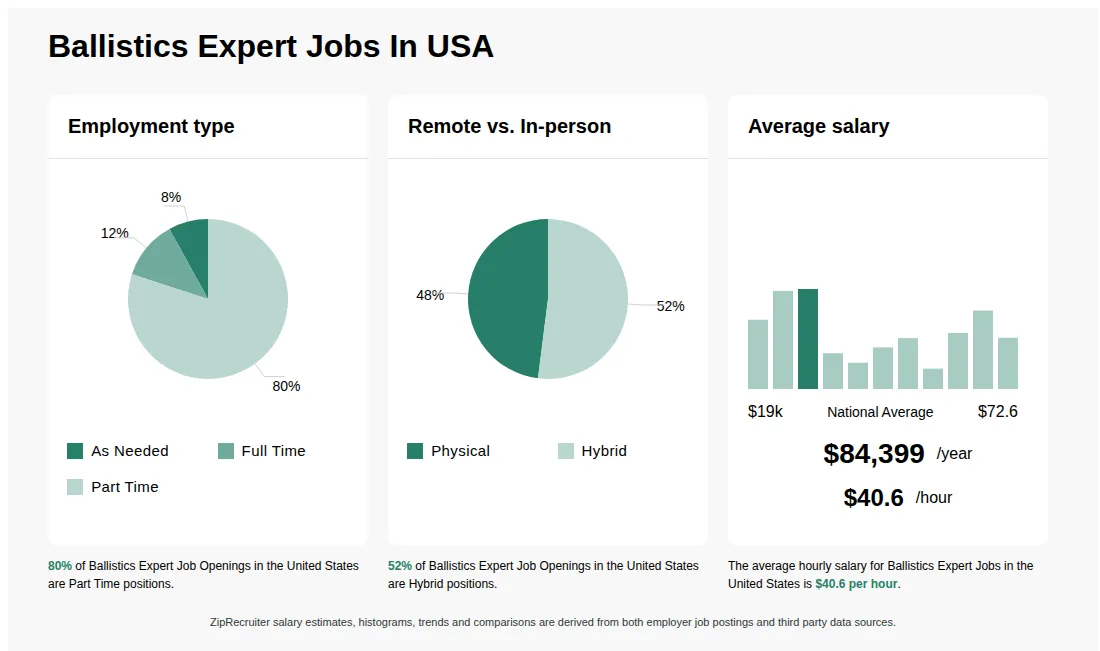
As of Jun 12, 2026, the average hourly pay for ballistics expert in the United States is $40.58, according to ZipRecruiter salary data. Most workers in this role earn between $20.19 and $60.82 per hour, depending on experience, location, and employer.

What are some typical daily responsibilities for a Ballistics Expert in a forensic laboratory setting?

Ballistics Experts in forensic laboratories are responsible for examining firearms, bullets, and cartridge cases to determine weapon type, origin, and whether a specific weapon was used in a crime. They use specialized microscopes and comparison technology to analyze markings and produce detailed, accurate reports on their findings. Collaboration with law enforcement officers, crime scene investigators, and sometimes legal professionals is common, and Ballistics Experts may also be required to testify in court as subject matter experts. Effective documentation, meticulous laboratory work, and staying current with advancements in forensic technology are key aspects of the daily routine.

What are the key skills and qualifications needed to thrive in the Ballistics Expert position, and why are they important?

To thrive as a Ballistics Expert, you must have a strong background in forensic science, physics, and firearms identification, typically supported by a degree in a related field and specialized training in ballistics analysis. Familiarity with laboratory equipment, forensic databases, and ballistics software is crucial, and certifications from organizations like the Association of Firearm and Tool Mark Examiners (AFTE) are often advantageous. Attention to detail, analytical thinking, and clear written and verbal communication enhance performance in this role. These competencies are vital for accurately analyzing evidence, preparing reports, and providing expert testimony in legal proceedings.

What is the highest paid forensic job?

The highest paid forensic jobs are often senior-level roles such as forensic laboratory directors or forensic science managers, who oversee investigations and laboratory operations. These positions typically require advanced degrees, certifications, and extensive experience, and they can earn six-figure salaries depending on the organization and location.

What is a Ballistics Expert job?

A Ballistics Expert is a forensic specialist who analyzes firearms, ammunition, and ballistic evidence in criminal investigations. They examine bullet trajectories, gunpowder residue, and firearm markings to determine weapon usage and potentially link suspects to crime scenes. Ballistics Experts often testify in court as expert witnesses and work closely with law enforcement agencies. Their expertise helps solve firearm-related crimes by providing crucial forensic evidence.

How do you become a ballistic expert?

To become a ballistic expert, typically one needs a bachelor's degree in forensic science, criminal justice, or a related field, along with specialized training in ballistics analysis. Gaining experience through internships or working in forensic laboratories is also important, and certifications such as those from the Association of Firearm and Tool Mark Examiners can enhance qualifications.

How much money does a ballistics expert make?

A ballistics expert's salary typically ranges from $50,000 to $100,000 annually, depending on experience, education, and location. Forensic ballistics specialists working in law enforcement or private labs may earn higher salaries, especially with advanced certifications and specialized skills in firearm analysis and crime scene investigation.

Can I be a CSI without being a cop?

A Crime Scene Investigator (CSI) is a forensic professional who collects and analyzes evidence from crime scenes. While some CSIs are law enforcement officers, many are civilian forensic specialists with backgrounds in science, such as biology or chemistry, and do not need to be police officers. Certification and training in forensic science are often required for civilian CSIs, but employment options exist outside of police departments.
More about Ballistics Expert jobs
What cities are hiring for Ballistics Expert jobs? Cities with the most Ballistics Expert job openings:
What are the most commonly searched types of Ballistics Expert jobs? The most popular types of Ballistics Expert jobs are:
Who are the top companies hiring for Ballistics Expert jobs? The top employers for Ballistics Expert jobs are:
What states have the most Ballistics Expert jobs? States with the most job openings for Ballistics Expert jobs include:

Senior Blast Analyst (Subject Matter Expert)

Goldbelt Apex

Fort Detrick, MD

$87K - $115K/yr

Full-time

Medical, Dental, Vision, Retirement, PTO

Posted 2 days ago


Job description

Overview

Please note that this position is contingent upon the successful award of a contract currently under bid.

Goldbelt Apex, a part of the Healthcare Technology Transformation Group, is a data-focused company dedicated to process and quality in every aspect. As healthcare IT experts, Apex is committed to building systems that enable healthcare organizations to communicate and exchange data seamlessly across disparate systems and devices. 

Summary:

The Senior Blast Analyst (SME) is a critical position responsible for providing expert-level analysis of blast effects, injury biomechanics, and data modeling to inform the development of injury prevention and mitigation strategies for the Department of Defense (DoD). This role directly supports the mission of the DoD Blast Injury Research Coordinating Office (BIRCO) and the Joint Trauma Analysis and Prevention of Injury in Combat (JTAPIC) Program by linking operational, materiel, and medical data to survivability and acquisition decisions.

Responsibilities

Essential Job Functions:

The duties of the Senior Blast Analyst (SME) are centered around the three core competencies required for the position:

I. Expertise in Blast Mechanics and Injury Analysis

  • Advanced Injury Analysis: Conduct in-depth analysis of combat and training events by integrating operational, intelligence, materiel, and medical data to determine the precise mechanism of blast-related injury (primary, secondary, tertiary, etc.)
  • Biomechanics Research: Apply expert knowledge of blast wave physics and human biomechanics to predict injury patterns and the physiological response to blast exposure, including assessment of traumatic brain injury (TBI) and organ damage
  • Computational Modeling: Develop, execute, and validate computational and experimental models of the human body's response to blast, ballistic, and impact events to advance injury prediction capabilities

II. Support to Creating Blast Injury Mitigation Strategy

  • Mitigation Strategy Development: Provide technical SME support to the development and refinement of DoD-wide blast injury prevention and mitigation standards, such as the Military Health System Blast Injury Prevention Standards Recommendation (MHS BIPSR) Process
  • Protective Systems Evaluation: Analyze blast phenomena and protective equipment (PPE, vehicular/structural systems) performance data to recommend improvements in materiel solutions and engineering controls (e.g., blast shields, standoff distances)
  • Exposure Tracking: Support the development and implementation of procedures for tracking and managing Blast Overpressure (BOP) exposures during training and operations to reduce long-term neurocognitive risk to Service Members

III. Data Modeling and Analysis for Technical Reporting and RDA Input

  • Data Aggregation and Integration: Lead the effort to integrate complex, disparate data sources (including medical records, operational reports, and forensic materiel analysis) to create cohesive and actionable datasets for injury analysis (JTAPIC mission)
  • Technical Reporting: Author and contribute high-quality technical reports, peer-reviewed publications, and detailed Casualty Operating and Injury Reports (COIRs) that synthesize findings and recommendations for military leadership and the acquisition community
  • Modeling and Simulation (M&S) and RDA Input: Design and maintain data models (conceptual, logical, physical) necessary to support M&S activities, and ensure robust Risk Data Aggregation (RDA) capabilities to inform survivability models, vehicle/equipment development, and acquisition milestone decisions
Qualifications

Necessary Skills and Knowledge:

  • Expertise in blast mechanics, wave dynamics, shock physics, and terminal ballistics
  • Demonstrated experience in injury biomechanics research with a focus on blunt force trauma, blast lung, and Traumatic Brain Injury (TBI)
  • Advanced proficiency in computational analysis, including Finite Element Analysis (FEA), computational fluid dynamics (CFD), and statistical modeling software (e.g., MATLAB, Python, R)
  • Experience with high-rate data acquisition systems, signal processing, and sensor systems used in blast and impact testing
  • Strong understanding of DoD RDT&E processes, the BIRCO/JTAPIC mission, and the challenges associated with military injury data collection and integration
  • Excellent written and verbal communication skills, specifically for communicating complex technical findings to multidisciplinary teams, military leaders, and non-technical stakeholders

Minimum Qualifications:

  • Master's degree in Biomedical Engineering, Mechanical Engineering, Physics, or a closely related technical field
  • Minimum 8 years of progressive experience in blast or impact injury research and analysis, with at least 3 years functioning in a Subject Matter Expert (SME) capacity
  • Proven experience in data modeling and technical reporting for a federal defense or research client
  • Ability to obtain and maintain a DoD security clearance

Preferred Qualifications:

  • Ph.D. in Engineering, Physics, or Biomechanics
  • Prior experience working directly with the BIRCO and/or JTAPIC organization or their data sets (e.g., JDE, JMEL, COIRs)
  • Demonstrated success in leading technical aspects of proposals related to blast injury mitigation
  • Ability to obtain U.S. Security Clearance (e.g., Secret or higher)

Pay and Benefits

The salary range for this position is $110,000.00 to $135,000.00 annually. 

At Goldbelt, we value and reward our team's dedication and hard work. We provide a competitive base salary commensurate with your qualifications and experience. As an employee, you'll enjoy a comprehensive benefits package, including medical, dental, and vision insurance, a 401(k) plan with company matching, tax-deferred savings options, supplementary benefits, paid time off, and professional development opportunities.

Employment Type: FULL_TIME