1

Automation Controls Engineer Jobs in Columbia, MO

This person will be an engineering professional with hands-on experience in Automation and Controls ... Understand and document current Automation and Controls Systems, identify areas for improvement ...

Sr Controls Engineer

California, MO · On-site

$140 - $180/hr

The Opportunity As a Controls Engineer at Astra, you'll design and implement the control systems ... Strong proficiency in Python for automation and control applications * Familiarity with industrial ...

Sr. Automation Engineer

California, MO · On-site

$118 - $162.26/hr

A brief overview The Sr. Automation Engineer manages automation systems and projects within a ... Collaborate with production and controls team to develop and streamline production process in ...

Experience * 5 years of experience in industrial automation, electrical maintenance, controls engineering, or a similar manufacturing environment. Technical Skills * Certification in electrical ...

New

Support identity and access management initiatives related to endpoint security controls ... in cybersecurity, endpoint engineering, systems administration, or security automation.

next page

Showing results 1-20

Automation Controls Engineer information

See Columbia, MO salary details

$43.8K

$93.4K

$133.7K

How much do automation controls engineer jobs pay per year?

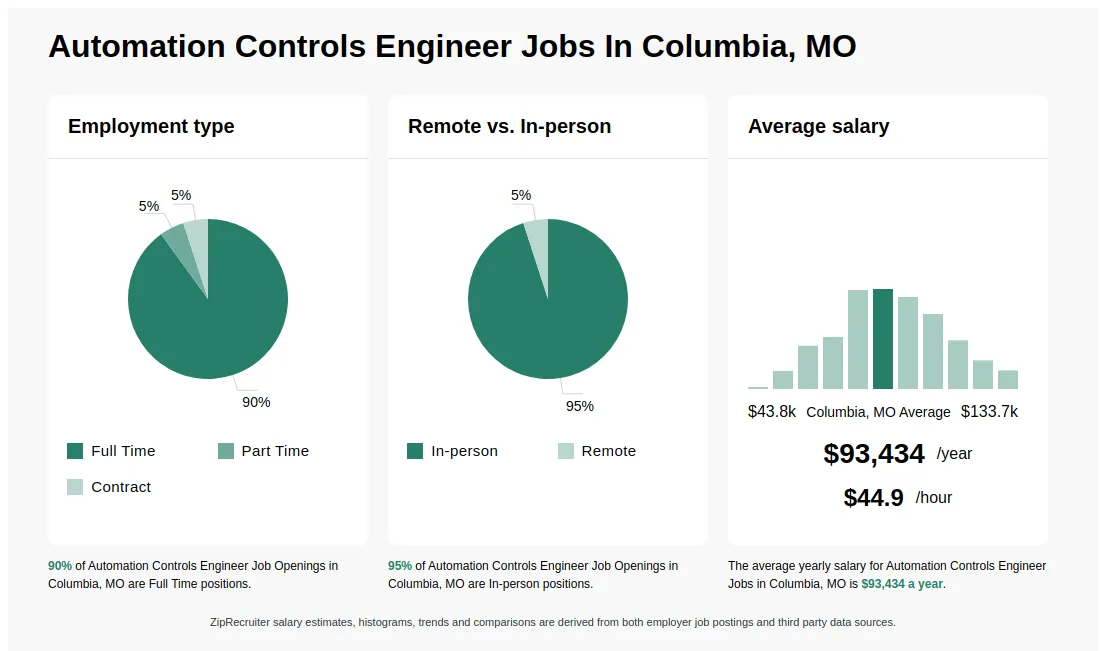
As of Aug 30, 2026, the average yearly pay for automation controls engineer in Columbia, MO is $93,434.00, according to ZipRecruiter salary data. Most workers in this role earn between $79,500.00 and $105,200.00 per year, depending on experience, location, and employer.

What is an automation controls engineer?

Automation Controls Engineers are professionals who design, develop, and maintain control systems that automate manufacturing and industrial processes. They typically work with hardware and software such as programmable logic controllers (PLCs), human-machine interfaces (HMIs), and robotic systems to ensure efficient and reliable operation of automated equipment. Their responsibilities include programming control systems, troubleshooting electrical and control issues, and collaborating with other engineers to optimize production processes. Automation Controls Engineers play a crucial role in improving productivity, safety, and quality in industries such as manufacturing, automotive, and energy.

What does an automation controls engineer do?

Automation controls engineers help create the layout of electrical and mechanical control systems. In this role, you may help program an automation process, modify existing programming when necessary, and help ensure the company is using the safest and most productive system possible for its needs. You may also be responsible for creating training documentation to show employees how to control and adjust their operations. Most automation control engineers work in manufacturing plants and similar companies where physical automation is used to speed up production tasks. This job should not be confused with automation programming outside of the manufacturing sector, such as software programming.

What are the key skills and qualifications needed to thrive as an automation controls engineer, and why are they important?

To thrive as an Automation Controls Engineer, you need a solid background in electrical engineering, control systems, and automation, often supported by a relevant engineering degree. Familiarity with PLC programming, SCADA systems, HMI software, and certifications like Certified Automation Professional (CAP) are typically required. Strong problem-solving skills, attention to detail, and effective communication set outstanding professionals apart in this field. These skills ensure reliable system integration, efficient troubleshooting, and successful collaboration in complex industrial environments.

What are some common challenges automation controls engineers face when working on new system integrations?

Automation Controls Engineers often encounter challenges such as compatibility issues between legacy equipment and new control systems, coordinating with multidisciplinary teams (mechanical, electrical, and software), and ensuring minimal downtime during system upgrades. Troubleshooting unforeseen problems during testing phases and maintaining clear documentation are also frequent hurdles. Proactive communication and thorough planning help mitigate these challenges and ensure smooth integration projects.

What is the difference between Automation Controls Engineer vs Electrical Engineer?

AspectAutomation Controls EngineerElectrical Engineer
CredentialsTypically requires a degree in electrical, mechanical, or automation engineering; certifications like Certified Automation Professional (CAP) are commonRequires a degree in electrical engineering; licensure as a Professional Engineer (PE) may be preferred
Work EnvironmentWorks primarily in manufacturing, automation, and control system settingsWorks in various sectors including power, construction, and manufacturing, often focusing on electrical systems
Industry UsageCommonly employed in automation, process control, and manufacturing industriesUsed across power generation, construction, and industrial sectors

Automation Controls Engineers focus on designing, programming, and maintaining control systems for automation processes, while Electrical Engineers have a broader scope involving electrical system design and analysis. Both roles require strong technical skills and often overlap in industrial settings, but their primary responsibilities and certifications differ.

What are popular job titles related to Automation Controls Engineer jobs in Columbia, MO?

For Automation Controls Engineer jobs in Columbia, MO, the most frequently searched job titles are:

What cities near Columbia, MO are hiring for Automation Controls Engineer jobs?

Cities near Columbia, MO with the most Automation Controls Engineer job openings:

Infographic showing various Automation Controls Engineer job openings in Columbia, MO as of August 2026, with employment types broken down into 85% Full Time, 12% Part Time, 2% Contract, and 1% Nights. Highlights an 92% Physical, 3% Hybrid, and 5% Remote job distribution, with an average salary of $93,434 per year, or $44.9 per hour.

Head of Manufacturing Engineering Automation & Controls

Booster

California, MO • On-site

$196 - $257/hr

Other

Medical, Retirement, PTO

Posted 4 days ago


Job description

Skydio is the leading US drone company and the world leader in autonomous flight, the key technology for the future of drones and aerial mobility. The Skydio team combines deep expertise in artificial intelligence, best-in-class hardware and software product development, operational excellence, and customer obsession to empower a broader, more diverse audience of drone users, from utility inspectors to first responders, soldiers in battlefield scenarios, and beyond.

About the Role:

We are seeking a Head of Manufacturing Engineering to lead the development and scale-up of our manufacturing systems for high-volume small unmanned aircraft production. This leader will own the manufacturing engineering organization responsible for translating product designs into robust, automated, production-ready manufacturing systems capable of operating reliably at scale.

A major focus of this role will be factory automation, controls engineering, equipment development, and manufacturing systems architecture. You will build and lead a multidisciplinary organization spanning manufacturing engineering, automation and controls, equipment engineering, process development, and production industrialization.

The ideal candidate has experience scaling complex electromechanical products from early production into high-rate manufacturing, with a strong understanding of how automation, controls, data, equipment design, and process engineering come together to create a world-class production system.

This is a hands-on leadership role for someone who can establish the long-term manufacturing strategy while also driving execution on the factory floor.

How You’ll Make an Impact:

  • Build, lead, and develop a high-performing Manufacturing Engineering organization supporting production from new product introduction through high-volume manufacturing.
  • Define the manufacturing engineering strategy, technical roadmap, organizational structure, and capabilities required to support significant production growth.
  • Partner closely with Design Engineering, Operations, Quality, Supply Chain, Test Engineering, and Product teams to ensure products are designed for manufacturability, automation, testability, and scale.
  • Establish manufacturing standards, design reviews, equipment specifications, process qualification methodologies, and production-readiness criteria.
  • Lead the architecture, development, deployment, and lifecycle management of automated manufacturing equipment and production systems.
  • Build strong internal capabilities in controls engineering, PLC programming, industrial robotics, motion control, machine vision, industrial networking, sensors, servo systems, safety systems, and automated material handling.
  • Establish controls and automation standards that enable equipment to be deployed, supported, replicated, and scaled rapidly across production.
  • Develop strategies for balancing manual, semi-automated, and fully automated manufacturing based on production rate, process capability, economics, and product maturity.
  • Establish disciplined equipment development processes including requirements definition, design reviews, FAT/SAT, commissioning, process validation, and production acceptance.
  • Partner with external automation integrators and equipment suppliers while developing critical automation and controls capabilities internally.
  • Build a highly instrumented manufacturing environment where equipment and processes generate actionable production data.
  • Partner with software and data teams to connect manufacturing equipment with MES, traceability, quality, and factory data systems.
  • Develop automated collection and analysis of process parameters, equipment states, cycle times, downtime, quality results, and genealogy.
  • Use manufacturing data to identify process drift, predict failures, improve yield, and accelerate root-cause analysis.

What Makes You a Good Fit:

  • 12+ years of experience in manufacturing engineering, automation engineering, controls engineering, equipment engineering, or related disciplines.
  • 5+ years of experience leading engineering organizations responsible for manufacturing systems or factory automation.
  • Demonstrated experience scaling complex electromechanical products into high-volume production.
  • Experience in aerospace, automotive, robotics, industrial automation, electronics, battery, semiconductor, or another highly engineered manufacturing environment; aerospace experience strongly preferred.
  • Deep understanding of manufacturing automation and controls, including several of the following:
  • PLC and industrial controls architectures
  • Robotics and robotic cells
  • Servo and motion-control systems
  • Machine vision
  • Industrial networking and communications
  • Sensors and instrumentation
  • Automated test and inspection
  • Machine safety systems
  • SCADA/HMI systems
  • Manufacturing equipment software
  • Experience developing custom production equipment from concept through production deployment.
  • Experience developing capital equipment strategies and managing significant CapEx programs.
  • Strong understanding of DFM/DFA and the ability to influence product architecture to enable manufacturing scale and automation.
  • Experience operating in environments requiring rigorous configuration management, traceability, process control, and quality systems.
  • Demonstrated ability to recruit, develop, and lead multidisciplinary technical organizations.
  • Strong analytical and problem-solving skills with the ability to move between factory-level strategy and detailed engineering problems.
  • Bachelor's degree in Mechanical Engineering, Electrical Engineering, Controls Engineering, Manufacturing Engineering, Mechatronics, Robotics, or a related technical field.
Preferred Qualifications
  • Experience scaling aerospace or similarly complex hardware from low-rate initial production to hundreds or thousands of units per month.
  • Experience building an automation and controls engineering function from the ground up.
  • Experience designing manufacturing systems for products combining mechanical assemblies, electronics, motors, sensors, batteries, composites, or other complex electromechanical technologies.
  • Familiarity with aerospace manufacturing and quality frameworks such as AS9100.
  • Experience with MES, equipment connectivity, manufacturing data infrastructure, and Industry 4.0 architectures.
  • Experience with automated inspection, machine vision, robotic assembly, dispensing, fastening, material handling, or automated test systems.
  • Experience developing standardized automation platforms that can be replicated across multiple production lines or factories.
  • Experience working in fast-growth hardware organizations where product design and manufacturing systems evolve simultaneously.
  • Master's degree in an engineering discipline or equivalent technical experience.
  • Obtaining FAA Part 107 certification within the first 60 days of employment is strongly encouraged for all Skydio employees and required for certain positions.

Compensation: At Skydio, our compensation packages for regular, full-time employees include competitive base salaries, equity in the form of stock options, and comprehensive benefits packages. Compensation will vary based on factors, including skill level, proficiencies, transferable knowledge, and experience. Relocation assistance may also be provided for eligible roles. The annual base salary range for this position is $196,000-$257,000*. Fundamentally, we believe that equity is the key to long-term financial growth, and we ensure all regular, full-time employees have the opportunity to significantly benefit from the company's success. Regular, full-time employees are eligible to enroll in the Company's group health insurance plans. Regular, full-time employees are eligible to receive the following benefits: Paid vacation time, sick leave, holiday pay and 401K savings plan. This position and all associated benefits are subject to applicable federal, state, and local laws, as well as the Company's policies and eligibility criteria.

*Compensation for certain positions may vary based on the position’s location.

#LI-BJ1

At Skydio we believe that diversity drives innovation. We have created a multidisciplinary environment that embraces the power of diverse perspectives to create elegant solutions for complex problems. We are committed to growing our network of people, programs, and resources to nurture an inclusive culture.

Qualified applicants will receive consideration for employment without regard to race, color, religion, sex, sexual orientation, gender identity, national origin, disability, protected veteran status, or other characteristics protected by federal, state or local anti-discrimination laws.

For positions located in the United States of America, Skydio, Inc. uses E-Verify to confirm employment eligibility. To learn more about E-Verify, including your rights and responsibilities, please visit https://www.e-verify.gov/

#J-18808-Ljbffr