Provide diagnostic services to evaluate hearing and auditory processing and identify the need for hearing assistance technology including candidacy for assistive listening devices to support students ...
Provide diagnostic services to evaluate hearing and auditory processing and identify the need for hearing assistance technology including candidacy for assistive listening devices to support students ...
Fit and dispense hearing aids and provide support for auditory training. At least 50% travel is required. Primary Duties and Responsibilities: * Administer and interpret developmentally appropriate ...
Fit and dispense hearing aids and provide support for auditory training. At least 50% travel is required. Primary Duties and Responsibilities: * Administer and interpret developmentally appropriate ...
The APD Specialist will focus their practice on supporting students with hearing difficulties in an educational setting by evaluating the student's hearing, and auditory processing deficits that can ...
The APD Specialist will focus their practice on supporting students with hearing difficulties in an educational setting by evaluating the student's hearing, and auditory processing deficits that can ...
Audiologist
Union City, CA · On-site
Responsibilities revolve around diagnostic evaluations, prevention, habilitation and rehabilitation services for auditory problems and research relating to hearing and attendant disorders.
Audiologist
Union City, CA · On-site
Responsibilities revolve around diagnostic evaluations, prevention, habilitation and rehabilitation services for auditory problems and research relating to hearing and attendant disorders.

Builds and establishes auditory phenotyping platforms (ABR, DPOAE, noise exposure systems) from the ground up. * Integrates auditory biology with immunological and single-cell approaches. * Mentors ...
Builds and establishes auditory phenotyping platforms (ABR, DPOAE, noise exposure systems) from the ground up. * Integrates auditory biology with immunological and single-cell approaches. * Mentors ...
Assesses need for and recommends appropriate auditory rehabilitation including but not limited to medical referrals, amplification needs, and educational needs and associated therapeutic intervention.
Assesses need for and recommends appropriate auditory rehabilitation including but not limited to medical referrals, amplification needs, and educational needs and associated therapeutic intervention.

Assesses need for and recommends appropriate auditory rehabilitation including but not limited to medical referrals, amplification needs, and educational needs and associated therapeutic intervention.
Assesses need for and recommends appropriate auditory rehabilitation including but not limited to medical referrals, amplification needs, and educational needs and associated therapeutic intervention.
Assesses need for and recommends appropriate auditory rehabilitation including but not limited to medical referrals, amplification needs, and educational needs and associated therapeutic intervention.
Assesses need for and recommends appropriate auditory rehabilitation including but not limited to medical referrals, amplification needs, and educational needs and associated therapeutic intervention.
Assesses need for and recommends appropriate auditory rehabilitation including but not limited to medical referrals, amplification needs, and educational needs and associated therapeutic intervention.
Assesses need for and recommends appropriate auditory rehabilitation including but not limited to medical referrals, amplification needs, and educational needs and associated therapeutic intervention.
Assesses need for and recommends appropriate auditory rehabilitation including but not limited to medical referrals, amplification needs, and educational needs and associated therapeutic intervention.
Quick apply
Assesses need for and recommends appropriate auditory rehabilitation including but not limited to medical referrals, amplification needs, and educational needs and associated therapeutic intervention.
Aud/Speech Pathologist 2
Clarkston, GA · On-site
Fit and dispense hearing aids and provide support for auditory training. At least 50% travel is required. Primary Duties and Responsibilities : * Administer and interpret developmentally appropriate ...
Aud/Speech Pathologist 2
Clarkston, GA · On-site
Fit and dispense hearing aids and provide support for auditory training. At least 50% travel is required. Primary Duties and Responsibilities : * Administer and interpret developmentally appropriate ...
Builds and establishes auditory phenotyping platforms (ABR, DPOAE, noise exposure systems) from the ground up. * Integrates auditory biology with immunological and single-cell approaches. * Mentors ...
Builds and establishes auditory phenotyping platforms (ABR, DPOAE, noise exposure systems) from the ground up. * Integrates auditory biology with immunological and single-cell approaches. * Mentors ...

Aud/Speech Pathologist 2
Clarkston, GA · On-site
Fit and dispense hearing aids and provide support for auditory training. At least 50% travel is required. Primary Duties and Responsibilities : * Administer and interpret developmentally appropriate ...
Aud/Speech Pathologist 2
Clarkston, GA · On-site
Fit and dispense hearing aids and provide support for auditory training. At least 50% travel is required. Primary Duties and Responsibilities : * Administer and interpret developmentally appropriate ...

Food Service Aide
$11 - $14.50/hr
Prolonged standing Manual dexterity Ability to lift twenty-five pounds Visual and auditory acuity
Food Service Aide
$11 - $14.50/hr
Prolonged standing Manual dexterity Ability to lift twenty-five pounds Visual and auditory acuity

Audiologist
Lawton, OK · On-site +1
$89K - $116K/yr
Responsible for identifying and evaluating individuals with auditory disorders that impact the reception and perception of speech, language and other acoustic signals. * Administers the full range of ...
Audiologist
Lawton, OK · On-site +1
$89K - $116K/yr
Responsible for identifying and evaluating individuals with auditory disorders that impact the reception and perception of speech, language and other acoustic signals. * Administers the full range of ...

The newly opened Central Auditory Neuroscience Lab at Creighton University invites applications for the role of Postdoctoral Fellow, starting in October 2025. The position will provide opportunities ...
The newly opened Central Auditory Neuroscience Lab at Creighton University invites applications for the role of Postdoctoral Fellow, starting in October 2025. The position will provide opportunities ...

Conducts auditory evoked potential assessments for patients. * Assesses hearing sensitivity and quality and provides patients with information regarding the results. * Dispenses assistive listening ...
Conducts auditory evoked potential assessments for patients. * Assesses hearing sensitivity and quality and provides patients with information regarding the results. * Dispenses assistive listening ...
Food Service Aide
$11 - $14.50/hr
Prolonged standing Manual dexterity Ability to lift twenty-five pounds Visual and auditory acuity
Food Service Aide
$11 - $14.50/hr
Prolonged standing Manual dexterity Ability to lift twenty-five pounds Visual and auditory acuity
Model clear speech, auditory cueing, and appropriate communication techniques to support comprehension and expressive language. * Facilitate student participation in classroom instruction ...
Quick apply
Model clear speech, auditory cueing, and appropriate communication techniques to support comprehension and expressive language. * Facilitate student participation in classroom instruction ...
Responsible for identifying and evaluating individuals with auditory disorders that impact the reception and perception of speech, language and other acoustic signals. * Administers the full range of ...
Responsible for identifying and evaluating individuals with auditory disorders that impact the reception and perception of speech, language and other acoustic signals. * Administers the full range of ...
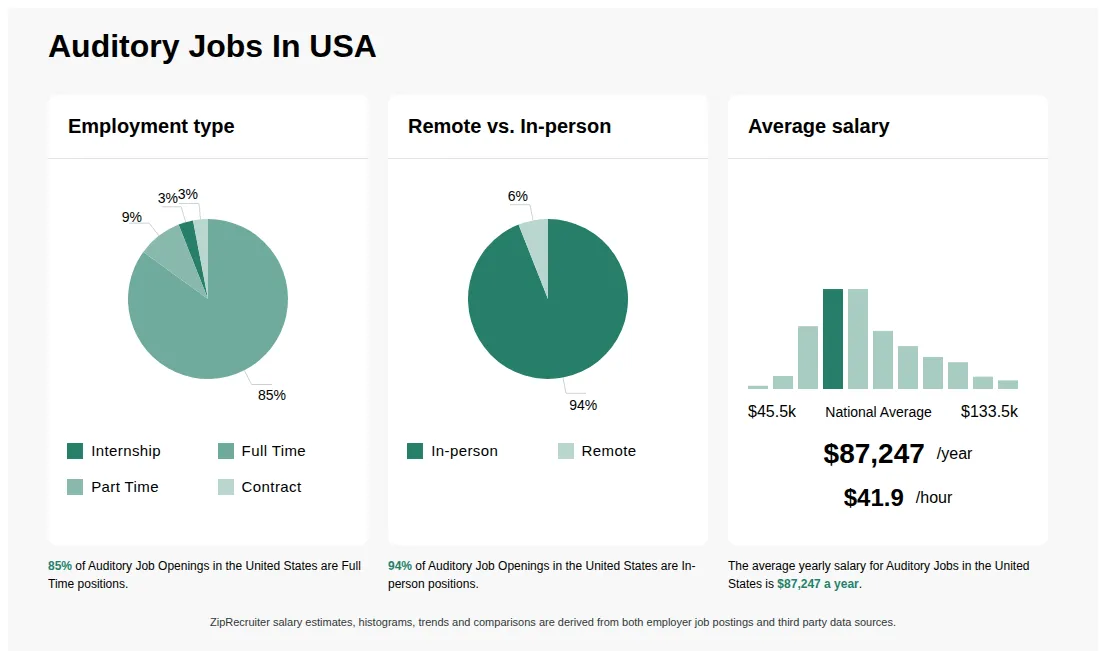
Auditory information
See salary details
$45.5K - $53.5K
0% of jobs
$53.5K - $61.5K
2% of jobs
$61.5K - $69.5K
14% of jobs
$72.5K is the 25th percentile. Wages below this are outliers.
$69.5K - $77.5K
23% of jobs
The median wage is $81.3K / yr.
$77.5K - $85.5K
23% of jobs
$93.5K is the 75th percentile. Wages above this are outliers.
$85.5K - $93.5K
13% of jobs
$93.5K - $101.5K
10% of jobs
$101.5K - $109.5K
7% of jobs
$109.5K - $117.5K
5% of jobs
$117.5K - $125.5K
2% of jobs
$125.5K - $133.5K
1% of jobs
$45.5K
$87.2K
$133.5K
How much do auditory jobs pay per year?
As of Jun 16, 2026, the average yearly pay for auditory in the United States is $87,247.00, according to ZipRecruiter salary data. Most workers in this role earn between $70,500.00 and $98,500.00 per year, depending on experience, location, and employer.
What are the different audiology jobs?
Audiology jobs include audiologists who diagnose and treat hearing and balance disorders, hearing aid specialists who fit and maintain hearing devices, and audiology assistants who support audiologists with testing and administrative tasks. These roles typically require specialized training, certification, and knowledge of audiometric equipment. The work environment often involves clinics, hospitals, or private practices.
What are the key skills and qualifications needed to thrive as an Audiologist, and why are they important?
To thrive as an Audiologist, you need a solid background in hearing science, diagnostic evaluation, and a Doctor of Audiology (Au.D.) degree with appropriate state licensure. Familiarity with audiometric testing equipment, hearing aid fitting software, and electronic health records is crucial. Excellent interpersonal skills, patience, and the ability to communicate complex information clearly help build trust with patients and their families. These skills and qualifications are vital for accurately diagnosing hearing disorders, recommending appropriate interventions, and ensuring positive patient outcomes.
What jobs are best for auditory learners?
Auditory learners often excel in jobs that involve listening and verbal communication, such as teaching, counseling, sales, or customer service. These roles typically require strong listening skills, verbal instruction, and the ability to process information through sound-based methods.
Is AI going to replace audiologists?
Audiologists are healthcare professionals who diagnose and treat hearing and balance disorders, and AI is currently used to assist with data analysis and hearing aid technology. However, AI is not expected to fully replace audiologists, as their expertise involves patient interaction, clinical judgment, and personalized care that AI cannot replicate. The role of audiologists will likely evolve to incorporate AI tools to enhance diagnostic accuracy and treatment options.
What are auditory jobs?
Auditory jobs are roles that primarily involve the use of hearing and listening skills. These positions can include careers such as audiologists, sound engineers, speech-language pathologists, and music therapists. Professionals in auditory jobs may assess, diagnose, and treat hearing or communication disorders, create or edit audio content, or help individuals improve their listening abilities. Such roles are vital in healthcare, media, entertainment, and education industries. People in these jobs usually have specialized training in sound, hearing science, or audio technology.
What are some common challenges faced by professionals working in auditory research or audiology, and how can they be addressed?
Professionals in auditory research or audiology often encounter challenges such as keeping up with rapidly evolving technology, effectively communicating complex findings to patients or interdisciplinary teams, and managing diverse caseloads. Staying updated through continuous education, collaborating closely with other healthcare providers, and utilizing advanced diagnostic tools can help address these challenges. Building strong patient relationships and honing counseling skills are also essential for delivering effective care and achieving positive outcomes.
What job makes $10,000 a month without a degree?
Auditory-related jobs such as voice-over artists, audio engineers, or sound designers can potentially earn $10,000 or more per month with experience and specialized skills. Success in these roles often depends on building a strong portfolio, networking, and sometimes freelance work or working with high-profile clients.
What is the difference between Auditory vs Audiologist?
| Aspect | Auditory | Audiologist |
|---|---|---|
| Required Credentials | Typically none or basic training | Doctoral degree (Au.D.) and licensing |
| Work Environment | Hearing aid stores, clinics, educational settings | Clinics, hospitals, private practices |
| Industry Usage | Describes hearing-related functions or processes | Professional healthcare role diagnosing and treating hearing issues |
| Common Search Intent | Understanding hearing functions or devices | Seeking hearing assessments or treatment options |
Auditory generally refers to hearing or sound-related functions, while Audiologist is a healthcare professional specializing in diagnosing and treating hearing and balance disorders. The main difference lies in credentials, work environment, and industry usage, with Auditory being a descriptive term and Audiologist a licensed profession.
More about Auditory jobs
What job categories do people searching Auditory jobs look for? The top searched job categories for Auditory jobs are:
Audiologist - APD Specialist (0.6 FTE)
Northwest Suburban Special Education OrganizationMount Prospect, IL
Other
Posted 25 days ago
Job description
GENERAL INFORMATION:
Title ................................................................. Audiologist - APD Specialist (0.6 FTE)
Licensure ....................................................... Valid Illinois License to practice Audiology
Endorsement ..................................................None
Classification ..................................................Certified/Licensed 10 month 195 days
FLSA Status ...................................................Exempt
Reports to ......................................................Program Administrator
Salary Classification ......................................NSSEA Salary Schedule starting at Lane V Step 0 Benefits......................................................... As per the NSSEA Collective Bargaining Agreement (For 1.0 FTE only)
Reviewed/Revised ........................................5/2026
PURPOSE:
The APD Specialist will focus their practice on supporting students with hearing difficulties in an educational setting by evaluating the student's hearing, and auditory processing deficits that can affect their academic success, communication abilities and psychosocial well-being. The APD Specialist participates in the evaluation of each child identified and referred by NSSEO member or local school districts. The APD Specialist serves as a contact person for all educational sites regarding day to day amplification/ALD needs and equipment maintenance. The ADP Specialist is guided by best practices and codes of ethics that are outlined by his or her professional organizations.
ESSENTIAL FUNCTIONS:
Participate as a member of the multidisciplinary professional team for the purpose of meeting the hearing needs of children and students ages 0-22.
Provide diagnostic services to evaluate hearing and auditory processing and identify the need for hearing assistance technology including candidacy for assistive listening devices to support students in their education environments.
Provides educationally relevant interpretation of auditory processing findings and make recommendations for educational teams.
Participates in the Individualized Education Plan to develop educational recommendations, including communication accommodations and assistance with interventions, as appropriate.
Provides counseling to parents and students regarding audiologic findings.
Collaborates multidisciplinary educational teams regarding audiologic rehabilitation.
Collaborates with colleagues and parents in order to share information and expertise to plan and implement effective student programs.
Collaborates and consults with local district personnel regarding students who demonstrate auditory- based communication difficulties.
Collaborates and consults with community audiologists and physicians regarding the audiologic and educational management of students with auditory processing disorder. Provide consultation in regard to the selection, purchase, installation, maintenance, calibration checking and utilization of audiologic equipment.
Provide training about hearing, hearing loss, and other auditory disorders for school personnel, students, and parents to facilitate a better understanding of the impact of auditory impairments on language, learning, literacy, and social development.
Troubleshoot assistive listening devices (ALDs), hearing aids and cochlear implants. Provide on-site service visitor equipment maintenance and repairs.
Select, fit, and maintain ALDs.
Assist school district in obtaining efficacy information during ALD trials and ensure deadlines for trial periods are met.
Maintain and manage the ALD database and the physical inventory for self-contained sites, central office and school districts as requested.
OTHER FUNCTIONS:
Assume appropriate roles as adult model, behavior manager and educator.
Continue professional growth.
Communicate effectively and respect human diversity.
Assume other duties and special projects as assigned.
Support NSSEO policy, NSSEO and governing board goals and objectives, and The School Code of Illinois.
WORKING ENVIRONMENT:
To perform the physically demanding job functions, strength and/or endurance for lifting, carrying, pushing and/or pulling are frequently required.
To perform the most physically demanding job functions, the physical capability of climbing is occasionally required and balancing is frequently required.
To perform the most physically demanding job functions, the physical body movement of stooping, kneeling, crouching and/or crawling is frequently required.
To perform the most physically demanding job functions, the upper extremity physical capabilities reaching, handling, and/or fine motor dexterity are frequently required.
Exposure to temperature extremes is seldom or not present.
Exposure to hazardous conditions (e.g. mechanical, cuts, burns, infectious disease, high decibel noise, etc.) is occasionally present.
Frequency of exposure to injury to self and/or others is occasionally present.
MINIMUM QUALIFICATIONS:
Master's or Doctoral degree in Audiology from an accredited University with knowledge of, and experience preferred, in evaluation and intervention for auditory processing disorder
Valid Illinois license to practice Audiology
Participate in twelve (12) hours of Nonviolent Crisis Intervention (NVCI) training and techniques.
Collaborate effectively with students, parents, and other professionals.
SPECIFIC REQUIREMENTS
Specific skills related to proficient use of technology systems, computers and electronic communication devices and the ability to develop, implement, modify and assess student academic progress. Continued need to attend training and participate in professional development in order to update knowledge and to implement the curriculum and positive behavioral interventions effectively to meet the changing needs of students.
Ability is required to independently problem-solve, schedule daily activities, model good communication and to communicate and work effectively with professional staff and parents. Ability is required to monitor student academic performance and behaviors across setting and to physically position and manipulate students as necessary.
Responsibilities include: completing IEP updates within specified timeframes, working collaboratively with team members, parents, and administration, managing time and schedule efficiently, using specialized equipment effectively, maintaining confidentiality, meeting
deadlines and schedules and making data-driven decisions for meaningful educational activities.